







Raider Recap: Scarsdale Sports Close Out January on a High Note
- Details
- Written by: Jack Capobianco
- Hits: 1399
 Scarsdale's winter sports teams ended January with much to cheer about. Now the Raiders will turn their focus to February where they look for a strong finish to the regular season.
Hockey:
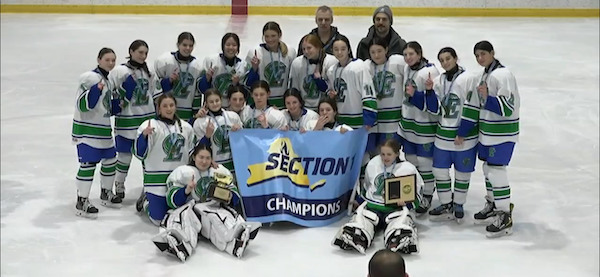
The East Green Wave, which is a girls varsity hockey team in Section One representing the Sound Shore region of Westchester, defeated the North Avalanche 1-0 on Friday January 30th to capture the Section One Girls Ice Hockey Championship! The game was played at Sport-O-Rama in Monsey, New York. They advanced to the semi final regional game on February 2 where they won 8-1. Next is the regional finals on Feb 12th vs ADK United of Section 2. Scarsdale’s sophomore Noa Avni and junior Ali Greco are members of the East Green Wave.
The Boy’s Hockey Team continues to get tough results despite playing in some really tight games. On Wednesday, the ‘Ders faced off against the reigning state champion Suffern Mounties. After falling behind 2-0 in the first period, the Raiders climbed back to tie the game at 2-2 with just over two minutes left in the third period but lost 3-2 in overtime. Despite the loss, the Raiders played very well and kept the game tight against a Suffern team who has a lot of championship pedigree. On Friday, the Raiders fell to North Rockland 2-1 in another close game. Senior netminder Buddy Meiselman played amazingly in net for the Raiders like he has all season. In hopes to get out of the skid, the Raiders traveled up to Newburgh, New York to take on Monroe-Woodbury on Monday and walked away with a big 10-1 win. The team then comes home to play Pelham on Wednesday and Pearl River on Friday.
Boys basketball:
The boys basketball continued their red hot playing with another great week finishing 2-0 and moving to .500 for the first time all season. On Wednesday January 28th, the boys beat Ossining 82-50 backed by a dominant 22 point performance by junior Hunter Ross. This win meant Scarsdale swept the season series against Ossining because they also beat them 44-40 in December. On Friday, during the Raiders Senior Night, they battled Spring Valley and the ‘Ders left with a 69-32 victory. Starting February 2nd the Raiders will play a 3-game week including a game against a determined North Rockland team on Monday in which Scarsdale lost in a close match 54-50 and then Ramapo on Wednesday. On Saturday, the Raiders will play Mount Vernon in a home matinee. This will certainly be a big week for the boys basketball team as they will take on some very competitive opponents.
Girls basketball:
Girls basketball won their only game of the week but it was a big win. They played John Jay-East Fishkill at home on Wednesday January, 28th and won 48-37. In this game, Scarsdale was behind 20-13 at the half and 28-22 at the end of the third quarter. Then, in the fourth quarter, Scarsdale's offense exploded as they dropped 26 points and pulled away with a huge victory. Next up, the girls beat Horace Greeley on Monday 53-21 and then play Harrison on Thursday. To close out the week, the Raiders will face Clarkstown South on Saturday. The Greeley game and the Clarkstown South matchup will be played at Scarsdale High School.
Boys swim:
The men's swim team had a stellar performance this past Saturday January 31st at the league championships. To start, they finished third overall as a team out of ten schools. Second, seniors Avi Stahl and Kieran Lee were Scarsdale's first place finishers in their respective events. Stahl finished first in the 200 meter free race and Lee got first place in the 200 meter individual medley and 100 meter backstroke. Junior Noam Tionkin finished second overall in the one meter dive. After a strong showing at leagues, the Raiders will look to have a repeat performance at the Section Championships this weekend at Felix Festa Middle School in West Nyack.
Skiing:
The ski team had a huge week on the slopes! On Tuesday January 27th, they headed up to Thunder Ridge where both the boys and girls finished in first place. Thomas Giuffra made his varsity debut for the boys team. Following their strong effort at Thunder Ridge on Thursday, the ski team raced at Mohawk Mountain where the girls earned a second place finish while the boys skied to a third place finish. In this race, Laura Chadie and Liam Mancini received career bests with their exceptional skiing.
Wrestling:
On Tuesday January 27th, both the girls and boys teams celebrated their senior nights before defeating New Rochelle 43-25 after a dominant second half of the meet. On Thursday, the boys squad traveled down to wrestle Mount Vernon where they won in a big way 61-17. The girls competed on Friday January 30th at Nyack High School, where Imaan Maroof finished first in the 120 pounds weight class and Margot Lombaerde and Celeste Minardi finished second in their respective weight classes. Next up, the boys have their sectional meet on Saturday 2/7 while the girls have theirs on Sunday 2/8, both at the County Center in White Plains.
Track and field:
Despite most of the team not being able to race at the League Championships on Saturday 1/31 at Rockland Community College, a few runners had strong races and really stepped up to represent their team. Alexander Andiopoulos and Myenta Van Den Broek raced really well in the boys 55 and 300 meter races. Henry Lorch earned a PR in the boys 1600 meters. Aartti Chandarana and Michelle Peng both reached a personal record in the girls 300 meter race. A select few athletes ran at the Classic Milrose Games which was on Sunday February 1st. The track team's next race will take place this Saturday 2/7 when the Raiders lace up the spikes at the Purple Championships which will be held at the Armory.
Squash:
The squash team had a tough match this weekend against Squash Haven (CT) at Yale University. Freshman Sam Yu who is Scarsdale's number one guy was the only player to win their match as Scarsdale lost 6-1. The team does not have a match this week but will work hard in preparation for their next game on Wednesday 2/11.
Cheerleading:
The cheerleading squad accompanied the wrestling team for a small portion at their Senior Night and now have their sights set for their next competition which will be in Orlando, Florida at the place none other than Disney World this weekend. This competition is the UCA National High School Cheerleading Championships which is an annual competition that Scarsdale competes in every year and this year, our cheerleaders will hope to leave with some hardware.
Bowling:
The bowling team picked up a 7-0 sweep against Port Chester for the second time this season. Senior Captain Aaron Gans had a huge game as he bowled to a 599 series and now looks to qualify for sectionals. Juniors Jacob Grossman and Tim Deschamps also had strong matches for the ‘Ders, each scoring very high in their respective matches.
Gymnastics:
Junior star gymnast Laila El Moselhy earned honors as the “Raider of the Week.” She will represent the gymnastics team and the Raiders at the gymnastics divisional tournament.
It was another big week for all of the Raiders sports teams. For teams whose regular seasons concluded in the last few weeks like the gymnastics, swim and wrestling teams, emphasis has been put on to dominate at sectionals and states. For teams that still need to finish out the regular season, they want to finish it off in a strong way! Scarsdale10583.com and the Raiders Recap, covers all Scarsdale athletics!
Why Gambling Is More Addictive for Teens Than Adults
- Details
- Written by: SAY Scarsdale
- Hits: 839
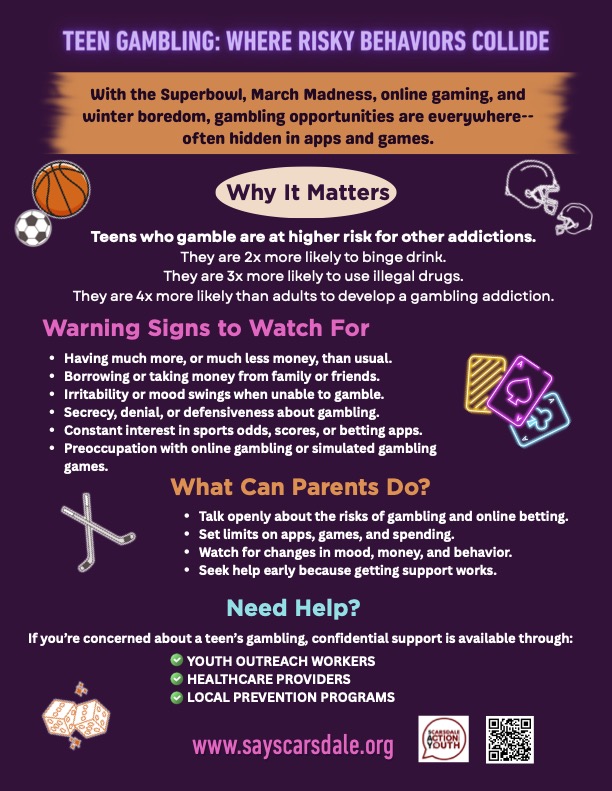
 Reclaim the Game: Gambling and alcohol use impact the adolescent brain in the same way. In fact, teens who gamble and drink alcohol are more likely to develop mental health and addiction issues.
Love the Game Not the Odds or the Beer
Gambling poses a much greater risk for children and teenagers than it does for adults, largely because of how the adolescent brain develops. During adolescence, the brain is still under construction, especially the prefrontal cortex, the area responsible for judgment, impulse control, decision-making, and assessing risk. This part of the brain does not fully mature until around age 25, and research shows that development typically occurs later in boys than in girls. As a result, teens are biologically less equipped to regulate risky behaviors, including gambling.
At the same time, teens are especially sensitive to dopamine, the neurotransmitter associated with pleasure, motivation, and reward. Gambling triggers dopamine release, creating feelings of excitement and thrill. Because adolescent brains respond more strongly to dopamine than adult brains, gambling can feel more intense and rewarding for teens. This heightened sensitivity, combined with a natural developmental tendency toward risk-taking, makes young people particularly vulnerable to addiction.
Gambling environments further amplify this risk. Many forms of gambling, especially online games and betting platforms, are fast-paced, visually stimulating, and designed to keep players engaged. Bright colors, quick feedback, and near-miss outcomes are especially appealing to young brains that are wired to seek novelty and excitement. Gambling also rewards rapid decision-making and encourages players to chase wins, but teen brains often lack the inhibitory control needed to stop once the thrill begins.
Early exposure to gambling can also shape long-term behavior. During adolescence, the brain is highly adaptable, meaning habits and coping mechanisms learned at this stage can become deeply ingrained. When teens experience gambling as a way to manage stress, boredom, or emotional discomfort, their brains may “learn” to rely on the thrill of gambling as a coping tool. Unfortunately, patterns established during adolescence are much harder to change later in life.
Gambling is also frequently linked to substance use among teens. Both gambling and substance use activate the same reward pathways in the brain and are connected to heightened risk-taking tendencies during development. This overlap increases the likelihood that teens who gamble may also experiment with drugs or alcohol, compounding the potential harm.
Understanding the unique vulnerabilities of the adolescent brain helps explain why gambling is not just a harmless pastime for young people. It is a high-risk activity that can interfere with healthy brain development and set the stage for long-term addictive behaviors.
For more information on teen gambling, please go to https://www.sayscarsdale.org/gambling
Treats from Trader Joe's: What Are Your Favorites?
- Details
- Written by: Joanne Wallenstein
- Hits: 1616
 With another foot of snow planned for this weekend, we’re soon to be snowbound and cocooned indoors. If you’re thinking of stocking up on food, there’s no better place to find snacks, treats and quick dinners, than Trader Joe’s.
But what to buy there? The choices are overwhelming and it’s hard to know what to try. We surveyed a few friends to find out what they buy and here are their recommendations. What do you buy at Trader Joe’s? Share your favorites in the comments section below:
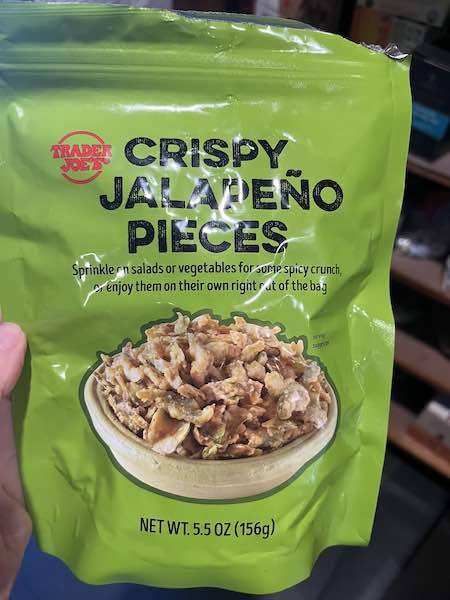
Crispy Jalapeño pieces are the perfect combination of savory flavor and a touch of crunchy texture. These are great to add to a casserole, salad topping, sandwiches, egg scrambles, and more.
The Fire Roasted Red Peppers in a jar have a delightfully robust roasted flavor along with a natural sweetness that makes them the perfect topping for pizzas, sandwiches or charcuterie boards.
Miso Crunch Chopped Salad kit has everything you need- right in one bag! Make meal prepping easy with this delicious, healthy meal.
Pineapple Teriyaki Chicken Meatballs may sound like a strange flavor combination, but there’s something about the combination that just clicks. This unlikely trio of sweet, savory, and succulent elements always has us reaching for more.
Steamed Chicken Soup Dumplings are a wonder to behold and a comforting, delicious meal for one.
 The Five Seed Almond Bars, packed with energy and nutrients, are a must-try at trader joes. They combine a traditional Italian biscotti and a modern take on granola bars and are the perfect treat for any time of day.
Mini Ice Cream Cones come in a variety of flavors, including strawberry, chocolate, chocolate chip, and vanilla. Who can resist these adorably miniature and satisfyingly indulgent mini cones? These make the most comforting sweet treat after a long day.
Mango Cream Bars are a popular frozen treat featuring a creamy vanilla ice cream center encased in a sweet and tangy mango sorbet shell, similar to a classic creamsicle but with tropical fruit flavor, made from Magdalena and Alphonso mango purees.
The famous Dark Chocolate Peanut Butter Cups are free from artificial flavors and  preservatives, but taste even better than the traditional peanut butter cup. The melt-in your mouth chocolate combined with the decadent peanut butter middle make these the perfect sweet treat after a meal.
Readers wanted to add these to the list: "I love the Frosted Gingerbread Cookies that appear in every year in November and December." Another said, "The Fromage Pave" a soft French cheese, is only sold during the holidays. Wish we could get it all year."
What are your favorites? Share them in the comments section below.

Other favorites:



School Board Expresses Unanimous Support for $98.5M Bond
- Details
- Written by: Wendy MacMillan
- Hits: 1645
 Hoping to ensure that the proposed capital bond reflects the right balance between educational needs and community affordability, the Scarsdale School District recently encouraged community members to provide feedback on the proposed $98.5 million capital bond by completing a comprehensive survey. At the Board of Education meeting on Monday, January 12th, Superintendent Dr. Drew Patrick shared the results of that survey and provided board members an opportunity to share their sentiments.
Framing the findings as a key checkpoint in a months-long public engagement process that began last fall, Patrick shared an overview of the results which demonstrate continued majority support for investing in school facilities, while also highlighting growing concerns about affordability, particularly among residents without school-aged children.
Before exploring the results, Patrick briefly reminded those in attendance that the bond proposal outlines a districtwide plan to address aging infrastructure, classroom capacity pressures, environmental conditions, and athletic facilities.
The proposed bond includes:
$25.2 million for vital infrastructure, such as electrical, mechanical, and code-compliance upgrades to address health, safety, reliability, and operational efficiency
$58.9 million for student learning spaces/spatial upgrades, including classroom additions at Fox Meadow and Edgewood to maintain class-size caps of 22–24 students, modernized libraries and dining spaces, and flexibility for future academic programs
$12 million for environmental improvements, primarily air conditioning and climate control in remaining unconditioned instructional and gathering spaces
$2.4 million for field upgrades, including major drainage improvements at Quaker Ridge and a dedicated softball facility at Greenacres
Patrick emphasized that classroom additions were proposed as an alternative to redistricting, preserving neighborhood stability while accommodating projected enrollment growth. To learn about the proposed bond in greater detail see here.
Diving into the results, Patrick explained that the most recent survey drew 834 responses, showing increased participation from October’s turnout but with a somewhat different demographic mix. Residents made up a larger share of respondents (745 compared with 641 in October) and participation from residents without school-aged children rose to 19%, up from just over 6% previously.
Patrick said the shift suggested broader community engagement, particularly among “empty nesters,” a group that consistently expressed greater sensitivity to cost.
Highlights from the survey results:
Survey results showed the strongest support for infrastructure projects, with 72% of respondents saying the scope is appropriate or should go further. Only 28% felt those projects exceed need or affordability.
Support for student learning spaces remained a majority but declined since October. About 58.5% said those projects strike the right balance or should be expanded, while 41.5% felt they were too extensive or costly. Empty nesters were far more likely to say the learning space investments were “too much,” while residents with children and district staff expressed stronger support.
Written comments from survey takers in this category raised concerns about enrollment projections, potential overbuilding, and whether alternatives such as redistricting, rezoning, or bussing had been sufficiently explored.
Air Conditioning
Air conditioning emerged as one of the most strongly supported components of the bond. Eighty-five percent of respondents supported some or all of the proposed cooling projects, citing student health, learning conditions, climate change, and staff working environments. Fifteen percent said air conditioning should not be a priority.
Board members repeatedly referenced the educational and regulatory importance of temperature control, noting state guidelines that require action when classroom temperatures exceed certain thresholds.
“Students don’t just learn in classrooms,” one board member said. “They learn in libraries, cafeterias, gyms, multipurpose rooms, and auditoriums. These spaces have to be usable and comfortable if we’re serious about learning.”
Multiple board members voiced support for adding air conditioning back into the Heathcote School multipurpose room, a roughly $106,000 item that had been removed earlier in the process.
“That’s not a high-ticket item in the context of a $98 million bond,” one member said. “Leaving a major shared space without climate control doesn’t make sense.”
Athletic Fields
Opinions on field projects were more divided. Respondents generally supported drainage and safety improvements, but expressed less consensus on the full scope of athletic upgrades. Some comments called for additional projects, such as turf fields, while others questioned the placement of a varsity softball field at Greenacres.
Patrick also explained why a proposed middle school turf field had been removed from the scope, citing both cost (approximately $3 million) and unresolved coordination issues with the village related to potential flood-mitigation infrastructure.
Overall Cost
When asked about the total bond amount, 56% of respondents said the cost was appropriate or should be expanded, while 44% said it was too high. Among empty nesters, opposition was more pronounced, with 69% saying the bond exceeds what they consider affordable.
Written comments reflected concerns about tax impacts, particularly for retirees, and skepticism about cost estimates. District leaders responded that all figures include required contingencies, escalation, and soft costs, and stressed that detailed line-item budgets have already been made public.
Board Member Statements
After considering all of the community feedback, each board member expressed their strong support for the bond, praising both the substance of the proposal and the transparency of the process.
In her statement, BOE Vice President Colleen Brown shared that participating in the bond’s development underscored Scarsdale’s long-standing commitment to its schools and students. Acknowledging the magnitude of asking residents, especially those without children in the district, to support a $98 million bond, she said the investment is essential to maintaining educational excellence and the community’s long-term vitality.
Citing conversations with local realtors, Brown noted that families overwhelmingly move to Scarsdale for its schools, making continued investment critical. She emphasized that many school buildings and systems are aging and no longer meet modern educational needs, pointing to outdated HVAC systems, overcrowded elementary schools, insufficient art spaces, and aging middle school and high school facilities.
She said classroom additions at Fox Meadow and Edgewood are necessary to preserve small class sizes and neighborhood stability, while upgrades across libraries, cafeterias, and multipurpose spaces, especially air conditioning, are essential for student health and learning.
Brown concluded that while the bond represents a significant cost, it is an investment not only in students but also in property values, community strength, and Scarsdale’s future, and said the proposal appropriately places student needs at the center of the district’s planning.
Other board members also took turns sharing their support for the bond:
“We’ve heard loud and clear that people want clarity, discipline, and good stewardship,” one board member related. “This bond reflects those values. We’ve made choices, we’ve deferred projects, and we’ve been responsive to feedback.”
Another board member emphasized the broader context of infrastructure investment in the community. “Scarsdale’s schools are not separate from the village, they’re central to it,” the member said. “This is about maintaining a vibrant, competitive community for the long term.”
Several members noted that while the bond is substantial, the district’s aging buildings and evolving educational needs make action unavoidable.
“These buildings were not designed for how we teach and learn today,” another board member made clear. “If we want to preserve small class sizes, modern instruction, and student well-being, we have to plan proactively.”
One of our new student board members, Anish Mehta, commented earlier in the evening and shared that the majority of the student body at SHS supports the bond proposal. “Due to expansion of creative learning spaces, the LRC wing reestablishment for the high school, the AC for large spaces…overall, I think that they're glad to see that the bond implications are very student focused, both educationally and socially.”
James Dugan, the board president, concluded by underscoring the bond’s focus on students. “This is about supporting our students’ growth, adaptability, and future,” he said. “That’s what has always set Scarsdale apart.”
Public Comment
During the Public Comment portion of the meeting, several residents and community representatives raised concerns and questions regarding the proposed capital bond, focusing on athletic facilities, enrollment assumptions, financial transparency, and equity in school building upgrades.
Ralph Gear, a Scarsdale resident speaking on behalf of the Scarsdale Youth Lacrosse Association, expressed disappointment over the removal of turf fields from the bond scope. He said the decision limits year-round athletic opportunities for students and forces local sports programs to rent facilities outside the district at significant cost. Gear noted that wet field conditions frequently disrupt spring sports and urged the board to prioritize turf fields in future capital planning.
Representing the League of Women Voters of Scarsdale, Dalya Khan asked a series of questions about the proposed Edgewood School construction project. She sought clarification on the rationale for the addition, the enrollment metrics used to justify it, and whether alternatives such as boundary adjustments, class size changes, or relocating programs had been considered. Khan also raised concerns about deferred oil tank replacements, asking about environmental risk, long-term costs, and how postponement would affect the district’s five-year capital plan.
Mayra Kirkendall Rodriguez, PTC Budget Study Co-Chair, thanked the district for extensive outreach related to the surveys but questioned whether the roughly 5% response rate was sufficient. She asked whether additional efforts would be made to engage more residents before a formal board vote and requested more detailed analysis comparing survey responses from residents with and without school-aged children.
Rachana Singh, PTC Budget Study Co-Chair, questioned the district’s claim that $40 million of the proposed $98 million bond would be “tax neutral,” arguing that the designation is based on assumptions about interest rates, repayment terms, and property values that cannot yet be known. She asked how the district supports the claim, whether alternative tax-impact scenarios have been modeled, and whether financial advisors have reviewed the use of the term. She also challenged the district’s enrollment projections, saying they rely too heavily on recent cohort survival data and do not fully account for long-term trends such as declining birth rates, limited housing growth, and projected enrollment declines at the high school level. She urged the district to acknowledge uncertainty, present multiple enrollment scenarios, and consider offering alternative bond options so residents can better assess financial risk.
Heathcote PTA president, formally requested that air conditioning for the Heathcote multipurpose room be reinstated in the bond. She argued the space meets the district’s own criteria for cooling, is used daily for instruction, meals, and after-school programs, and presents health, safety, and equity concerns without air conditioning. She emphasized that the estimated cost, approximately $156,000, would have minimal impact on the overall bond and should be considered a basic necessity rather than an enhancement.
In a short response, Dr. Patrick reiterated that cost and tax impact projections are estimates until bonds are issued and noted that updated financial analyses will be prepared once the bond scope and construction phasing are finalized.
What Comes Next
If the board finalizes the bond scope by mid-March, a public referendum could be scheduled alongside the May 19 school budget vote and board election. In the meantime, the district plans to expand its public information campaign, including community forums, school-based meetings, and detailed mailed and digital materials explaining the proposal and its tax impact.
“This process isn’t over,” Patrick stated, “Community feedback continues to shape where we land.”
How to Recycle Food Cartons
- Details
- Written by: Conservation Advisory Council
- Hits: 755
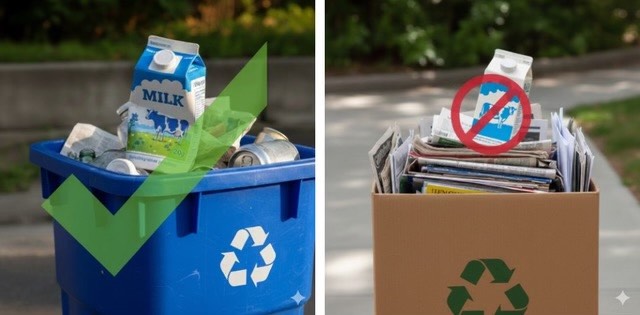 Artwork credit: David FenigsteinRecycling Tip of the Week: Cartons Go in COMMINGLED Recycling (NOT with paper)
Beverage and liquid food cartons like milk and soup cartons as well as juice boxes and ice cream containers should be placed in commingled recycling, NOT in paper recycling. In order to be leak-proof, these containers are lined with a plastic film. During the recycling process, the plastic lining is separated from the paper fiber which can then be recycled into new paper products, including tissues, paper towels and office paper. The plastic that is collected is also recycled into such products as pallets, tiles and crates. Another carton recycling option that is gaining momentum converts the whole carton into construction materials.