










Timely Talk on Constitutional Democracy as the Nation’s Founding Approaches 250 Years
- Category: On Our Radar
- Published: Tuesday, 19 May 2026 16:42
- Joanne Wallenstein
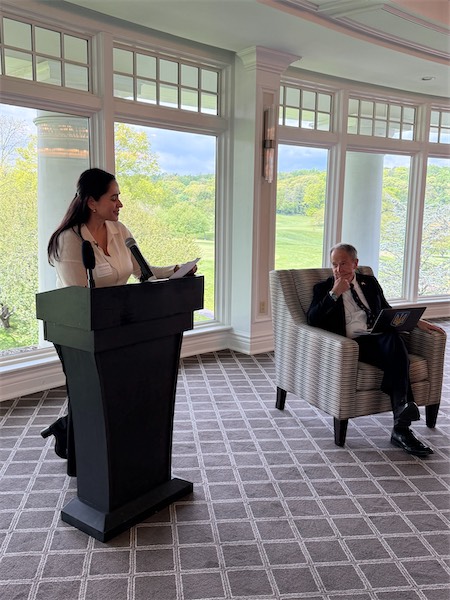 Diksha Mudbhary Sitaula and Martin S. Flaherty.With the nation’s 250th anniversary coming up this July 4th, it was an opportune time to have a lesson on the founding of the country. The League of Women Voters of Scarsdale invited Constitutional scholar Martin S. Flaherty to be the speaker at their annual luncheon on May 8, 2026 at Scarsdale Golf Club. Diksha Mudbhary Sitaula, League Board member and Events Chair, introduced Flaherty saying he is a leading scholar of international human rights, constitutional law, and foreign affairs. He is a graduate of Princeton, Yale and Columbia Law School, the Leitner Family Professor of International Human Rights Law at Fordham Law School and previously clerked for U.S. Supreme Court Justice Byron R. White.
Flaherty’s talk focused on the Declaration of Independence, explaining that the three main purposes of the Declaration were to act as a constitutional law brief, a legal assertion to the international world, and a general statement of human rights. He traced the origins of the American system of government back to England’s government structure of the monarchy, aristocracy, and democracy, a triangle cornered by the crown, the House of Lords, and a House of Commons that was the basis for the American executive, the judiciary and congressional branches of government that set a foundation for the balance of power and liberty Americans enjoy today.
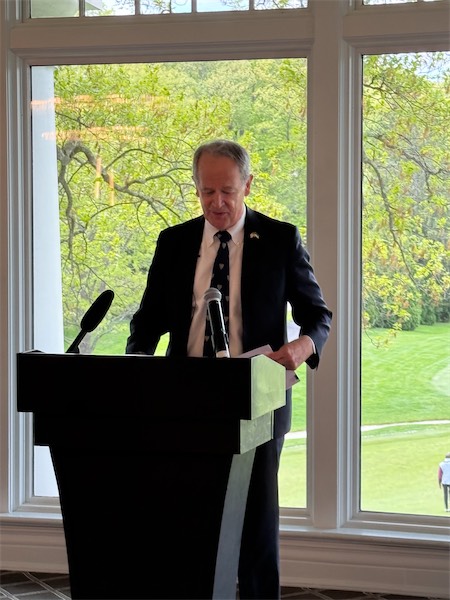 Martin S. Flaherty.Under the British Constitution, Parliament held power over the whole empire. Though the colonists proclaimed loyalty to the British monarch, they were also loyal to their own “mini-triangles” with local assemblies. They saw the British Royal Governor as the representative of the crown, to the point where Lord Cornbury, the Royal Governor of New York, would cross dress as the Queen. When Parliament started taxing the colonies, there was what Flaherty called a “clash of constitutions.”
Flaherty noted that the first two paragraphs of the Declaration of Independence are the most commonly read. In drafting this portion, Flaherty says, “Jefferson has done a fancy version of plagiarizing John Locke. He's a great writer. But, you know, he's not saying anything that Locke didn't say in the second treaty.” He continued, “What Jefferson says is not original, nor is his use of law original, but it's precisely because it's so eloquent and because it is said in a way that is timeless and universal, that it continues to have the impact it has today.”
Flaherty had three concluding thoughts about this section’s enduring legacy: equality, rights, and consent. He acknowledged that the Constitution was not written with minorities in mind, particularly women and racial minorities. Mentioning Frederick Douglass and Elizabeth Cady Stanton, he explained how each expanded on the equality claimed in the Constitution to broaden rights to minorities.
Bringing the conversation to the present day, an audience member asked, “Why do you think that our checks and balances are no longer effective?”
Flaherty raised a host of problems including “economic aristocrats,” “partisan and racial gerrymandering,” and the power of social media, as factors undermining the balance of power that were never envisioned by the founders. The unitary executive theory, making the President immune from prosecution for deeds executed in office, has further skewed the balance of power by making the executive the most powerful branch of government.
He said, “Well, I think one of the worst crafted [Supreme Court] opinions I've ever seen is Trump versus the United States where the Supreme Court, I think, invented out of whole cloth, this notion of the executive having immunity for official acts, could not be more antithetical to the intention of the founders.”
A member of the audience said, “Those of us who are concerned about the degradation of checks and balances, what can we do? What other messages of hope do you have for us?”
Flaherty said, “The fact that the country and even the world seems to be stumbling along as well as it is, is kind of a miracle, right?” … “It is very clear what needs to be reformed.”… “The nation has faced crises even worse and risen up and, you know, come out as a better nation and I think there is every reason to think that if everybody who is concerned about these things puts their shoulder to the grindstone, we will get out of this.”