






Understanding the Complexities of Scarsdale’s Special Education Program
- Tuesday, 03 March 2026 16:35
- Last Updated: Tuesday, 03 March 2026 16:52
- Published: Tuesday, 03 March 2026 16:35
- Joanne Wallenstein
- Hits: 28483
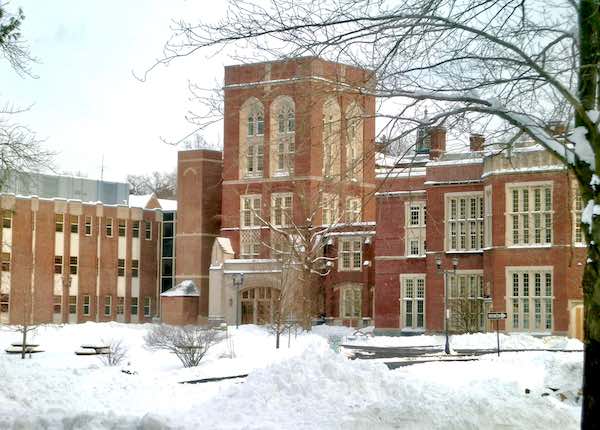 With a $2mm budget gap to fill to keep the 2026-27 Scarsdale School budget below the tax cap, and a $101.7mm school bond vote scheduled for May, the district, the Board of Education and the community are actively reviewing Scarsdale’s $199 mm budget for the next school year.
The numbers are hard to wrap your head around. In order to get a fix on just one component of the budget, Special Education, which at approximately $22 mm per year represents about 11% of the total budget, Assistant Superintendent Eric Rauschenbach invited us to pose some questions in an effort to understand this complex piece of the puzzle.
Number of Students Served
First, how many students are served? Data through 2024 shows that in Scarsdale, 14%, or 662 students have a CSE Classification Rate. This rate has almost doubled over the last twenty years, as only 6.8% or 371 students had this classification in 2010. Scarsdale’s classification rate is lower than the NYS Classification Rate which stands at 20% and Westchester County’s at around 17%. As of 2024, 617 students, or 13.2% of the student population had a 504 Identification.
What do these designations mean?
There are 2 laws that govern K-12 disabilities, the Individual with Disabilities Education Act (IDEA), and Section 504 (ADA). All students have one or the other; they cannot have both. Functionally, students with an IEP (through IDEA) are students who need specialized instruction from a special education teacher ie. LRC/ICT/Special Class. Students with a 504 only need accommodation or modification and/or some related services. 504s on the elementary level tend to have related services (OT/PT/Speech) which lessen and disappear (in large part) by middle school, the vast majority of secondary 504s are classroom modifications and testing accommodations.
What does the special education program offer? There are several programs offered and here are some definitions:
Inclusion Classes
The largest number of elementary special education students are in inclusion classes, which are classes that include a mixture of general education and special education students with two teachers, rather than one. There were just six inclusion classes in 2014 and the district is now up to 25 inclusion classes, or about 25% of elementary school classrooms.
Learning Resource Room
Another component of the program is extra help provided by the Learning Resources staff at all grade levels, elementary through high school. LRC is the largest program at the secondary level.
Special Education Classes
The district houses three four self contained special education classes, now with 3 at Edgewood Elementary School and one at SMS. These are referred to as 8:1:2 and 12:1:1 classes. The names of the programs denote the state staffing requirements for the programs (number of kids : number of teachers : number of aides) the 12:1:1 is one teacher and one assistant, the 8:1:2 is one teacher, one assistant, and one aide.
This year the program serves 21 Scarsdale students and 5 out of district students – 2 of the out of district students are in special classes and three are in other programs where there is space.
Rauschenbach has expanded Scarsdale’s in district program because he believes students and parents would prefer to have children educated in their own district – and it is more economical to do so.
Outside Placements
Still another group of students, 23 this year, are attending schools outside the district where Scarsdale pays the tuition. According to Rauschenbach, “Cost for students in outside placements averages $99,000 per student but can range from $75,000 to well over $200,000 per student dependent on needs.” The number of outplacements has decreased from 50 students in 2016 to 23 this year.
Rauschenbach explained, “8 of the students are of high school age and placed out because they need an alternate assessment program (our program has not expanded to SHS yet), 11 students district-wide are at social emotional programs (more intensive than our SSP program - some residential), 3 students are out in need of specialized academic programs, and 1 student is out of District (elementary) for alternate assessment but has very complex medical needs.”
Staffing
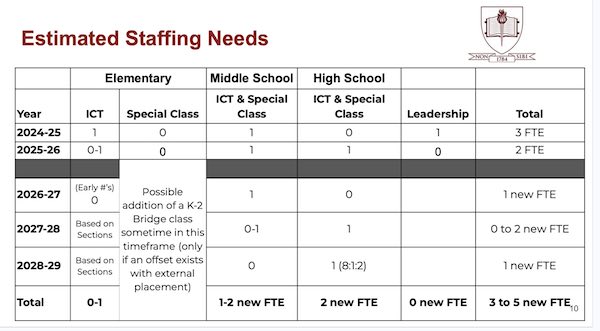
We asked Rauschenbach for the numbers surrounding staffing and here are two charts, that when added together, provide a picture of the growth since 2014.
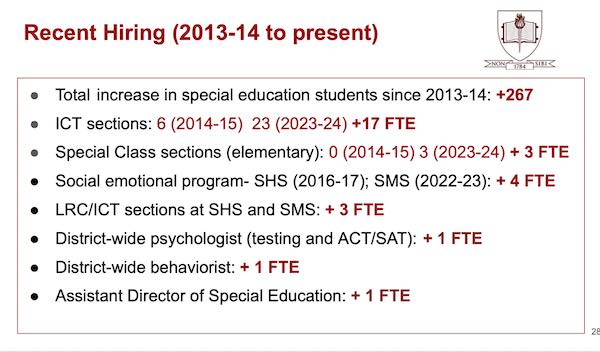
In the coming school year, in order to extend the inclusion class program in the middle school, one position will be added at SMS. For the 2027-28 year. Rauschenbach expects that in coming years, an additional teacher may be needed at SMS and another at the high school.
Budget for Therapy and Services
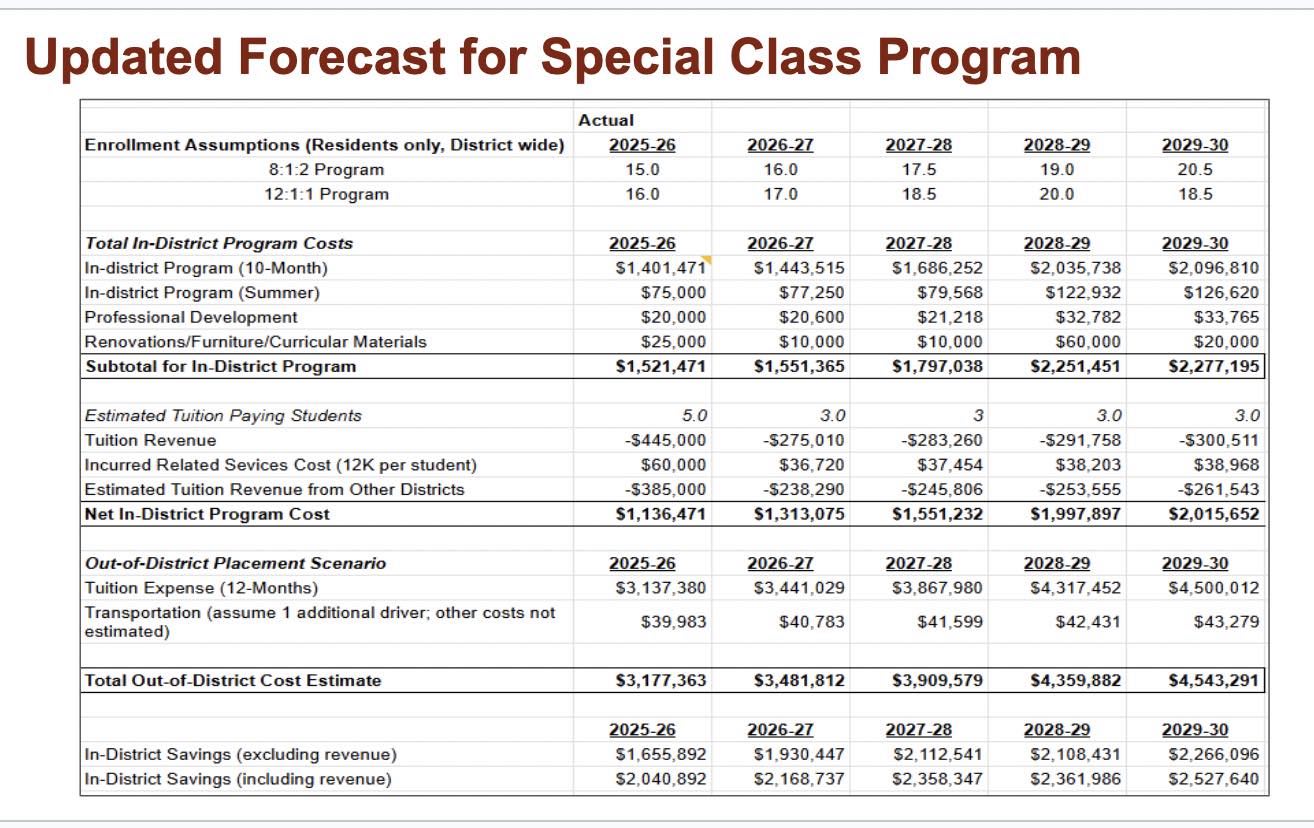
We asked Rauschenbach how much is budgeted for services like speech, OT etc. per student and he explained, “We don't budget per student as we use our current FTEs and a mix of contractors - there is a cost but it fluctuates widely by student/building. We did add an incurred cost for tuition students at 12K per student per year (purposely generous as most students would be below this and it assumes no tuition students would be served by FTEs). If we were to assume that for all in-district students (which would be too high) then it would be an additional $396,000 - $468,000 depending on the year and the number of students in the programs district-wide. Again, this is wildly high as many of these students are seen by our FTEs where there is no invoiced cost. As the chart shows, the in-district versus out of District savings (without tuition revenue) is between $1.6 and $2.2 million.”
Life Skills
In order to extend the life skills program to Scarsdale High School, the 2026-27 school budget includes $330,000 to construct a kitchen and laundry facilities at SHS. Rauschenbach thought the estimate was high but said the equipment is necessary.
2026-27 Special Education Budget
As we staff and build out our in district programs Rauschenbach expects the Special Education budget to level off in the next few years. Accepting out of district tuition students who pay tuition to Scarsdale will help to defray program costs. This year five out of district students are attending the special education classes. At $89,000 per student they have improved the economics of the program and projections show that with that revenue, there is a $2mm plus savings to hosting the SPED programs in-district rather than sending these students out of district.
Last we posed a more general question about the allocation of district resources, We asked “There are always choices to be made when allocating the school budget…. especially now as we are experiencing some challenges. As administrators, how do you evaluate the need for staff and facilities for a small group of Special Education students vs. requests for additional staff for the math/science curriculum or facilities costs for labs etc.?
He said, “First, special education students are due a free and appropriate education as a civil right. Secondly, the in-district program cost is below what the costs would be for out of district (OOD) placements (FYI, OOD placement costs are out-stripping our predictions so the projection is probably low for those). This bond discussion is an example of balancing the needs of many stakeholders and making sure the capitol improvements have benefits for all students. Scarsdale has both extremely successful programs for special ed but also general education students -- the measurable outcomes in achievement, scores, and college admissions are nation leading for the general education students attending Scarsdale Schools -- that doesn't happen without planning for everyone.”