








Town Hall Discussion Examines How AI is Affecting Education and Our Futures
- Thursday, 07 May 2026 11:36
- Last Updated: Monday, 11 May 2026 15:27
- Published: Thursday, 07 May 2026 11:36
- Stacey Liew
- Hits: 1973
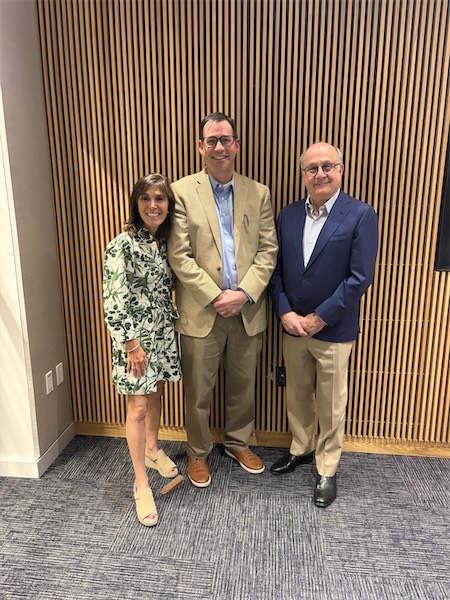 SAS Director Jill Serling, Superintendent Andrew Patrick, and David SiegelWhether Artificial Intelligence becomes a useful tool for students or a detriment to their learning in the long-run, there’s one factor that will remain critical to education and careers: human collaboration.
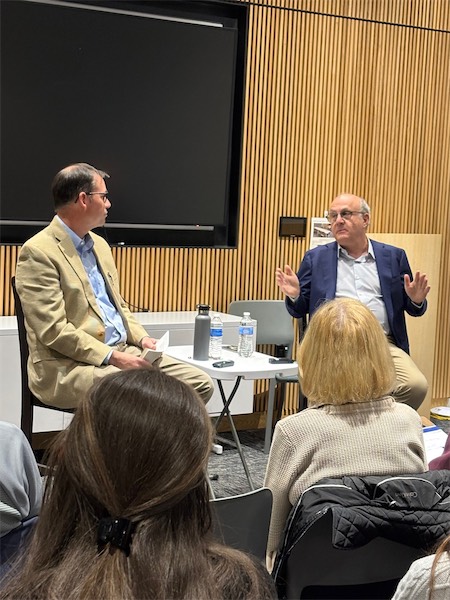
That was the takeaway from a Town Hall session featuring David Siegel and Drew Patrick, hosted by the Scarsdale Adult School on April 28, 2026 at Scarsdale Library called “AI and the Future of Education.”
David Siegel is a Princeton trained computer scientist and entrepreneur with a PhD from MIT where he did research at the university’s Artificial Intelligence Laboratory. He spent the early days in his career working on applying technology to financial services, and eventually created his own company, Two Sigma, in the early days of the internet. Two Sigma was made on the premise that innovative technology and data science can unlock meaningful insight on the world’s data. Siegel has also served on the board of Khan Academy and the Cornell Tech Council and co-founded the Scratch Foundation and the FIRST Robotics organization in New York City. He also happens to be the proud parent of two Scarsdale High School graduates.
He sat down with Scarsdale’s Superintendent of Schools Andrew Patrick to discuss AI in the schools, challenges for public schools in this new age, how AI has affected teachers, how to prepare children to “get ahead” of AI, career goals for students and prioritizing the process of obtaining an answer versus simply having the correct answer.
Current Practices With AI
Patrick explained that schools are currently working through the best ways to manage screen time, AI, and software, following a red-orange-green light model, where there’s certain actions students can take and can’t take, but also some gray areas.
Siegel added that best practices are widely debated, and that no one truly knows what the best practices are in the end. He said that the source of the issue comes from the timing of the outcome in education, which only occurs a decade or two after completing education. There are questions surrounding successful outcomes, including what parents want for their children: Ensuring they earn enough money? Emotional happiness? And how would these outcomes be measured? Siegel urged a return to basics, as trying to tackle these tough problems all at once may just result in blindly enacting plans without thoroughly considering them.
Challenges for Public Schools
Due to the widespread usage of technology today, Siegel suggests that the “social fabric” is unraveling. Rather than students working with each other, they treat Chat-GPT and other chatbots as their teammates. He calls it an “open issue” that has to be handled. Though, he notes that no one is certain of how to best handle it, even if the problem has been identified. Since technology tends to cause people to work in isolation, Siegel indicates that perhaps two decades from now, it will be discovered that something extremely concerning has happened to the next generation.
At Scarsdale High School, the Design Lab, the AT Entrepreneurship class, and the robotics team all share a common element, according to Siegel. In all these places, students build creations together, which ultimately teaches them to work with each other. He considers collaboration a critical focus and a philosophy to be followed.
SAS Director Jill Serling noted that this is one of the reasons why the Scarsdale Adult School exists: to strengthen a sense of community.
AI’s Effect on Teachers
Patrick calls the present moment a period of struggle where faculty are attempting to figure out what AI means for them. Some teachers are worried that any time a student uses AI, they are missing out on learning properly.. Others feel that there are thoughtful ways to utilize it, especially since it will be a factor in their lives after leaving Scarsdale. They consider it a tool that can enhance learning. Inquiry groups are actively working to answer questions about the uncertainty and the effects of AI.
The topic evidently impacts university faculty as well. Siegel mentions that the faculty don’t want to have to police students. After all, they’re there to teach and connect with students. He said that parents play an important role: children shouldn’t go to school with a mindset that it’s acceptable to engage in behaviors that will harm education. Instead, parents should encourage kids to learn, not just to obtain desired grades. Siegel implores parents to help children to understand that the most significant part of education is learning.
 Best and Worst Cases When AI is Involved
In Siegel’s opinion, the most likely case is that students will learn much less. The worst case begins when students continuously use AI to do thinking for them. At some point, they’ll no longer know what they’re even writing. He reiterated that the prompts students feed to AI don’t capture what they're actually thinking, and that chatbots won’t know what students are thinking. Rather, chatbots can only expand on student input.
The best case is if AI is utilized the same way any other tools are, he asserts. After all, it can be useful to help increase productivity. Siegel’s main point is that people have to do the work themselves, or else they won’t end up learning anything.
“Getting Ahead” of AI
“We’re not getting ahead of AI,” Patrick disclosed to the audience. He says institutions move much slower compared to the pace of AI’s development. However, he does think that elementary schoolers are in a bit of a different scenario. With a framework around digital competencies, media literacy, ethics, and the way to judge sources, the district aims to expose elementary schoolers to prerequisites before encountering AI.
Ideal Career Areas
When asked about what’s next for students after high school and college, Siegel revealed that he is not that worried about the loss of jobs. He argues that AI isn’t exactly doing anything in particular. That in the end, it’s just generating words, and that words alone can’t solve issues. He affirms that any work that will move society forward requires people and collaboration, and that the reason why AI companies say there won’t be any jobs left is to drive up their sales. Most work doesn’t involve writing a report, meaning that AI may speed up only around ten percent of a job.
Bringing up professional programmers as an example, Siegel explains that only twenty percent of their time is spent on coding. The majority of their time is spent working with sales teams and others, designing, planning, and figuring out solutions. Consequently, AI doesn’t speed up the entirety of a job, only a portion.
According to Siegel, even if the market years from now looks very different from today’s market, every year it only changes by a bit. He implied that currently people are struggling since they think their future will be worse than their parents’ experience. A factor that may have led to this view is the rapid rate that the market has evolved. People who expected to have the same career their whole lives are disappointed when it goes away. He highlights that for many jobs, you stagnate if you don’t evolve as an individual and “keep reinventing yourself.”
Siegel notes that many will find the process exhausting as education didn’t teach them the agility needed for reinvention. He also acknowledges that not everyone has enough time to invest in frequently developing new skills. In his view, a lot of people in the US are unable to do this, which results in them struggling the most as AI will take away their jobs. He expresses that there’s improvement needed to be made by society in this realm.
The Process Versus the Result
Siegel regards the process of determining an answer is to define what truly matters, not to find the “right” answer. He believes people can sometimes learn much more by working through something and getting an incorrect answer than just instantly getting the right answer. In the end, education is about the journey, not obtaining the correct answer.