








Gun Violence Hits Close to Home
- Details
- Written by: Joanne Wallenstein
- Hits: 2585
 Just days after National Gun Violence Day, the issue hit close to home when two incidents involving gun violence occurred in Scarsdale.
On Wednesday afternoon June 7 around 3 pm police received a call from The Ambassador of Scarsdale, an assisted living facility on Saxon Woods Road.
The caller said that an employee was threatening to kill another employee so police rushed to the scene. According to police, two kitchen employees got into an argument and one threatened to shoot the other with a gun.
Shortly afterwards, the employee fled on foot down Mamaroneck Road. A description of the suspect was issued and police were able to track him to the Saxon Woods Pool where he was arrested.
However, it turns out that though he threatened to shoot, he never displayed a gun and did not have one when he was arrested. Police also searched his route to see if a gun had been discarded but none was found.
Ultimately Timothy Shawn Crawford of New Rochelle was arrested for menacing in the third degree. He was released pending a 6-14 court date.
The second incident did involve a gun.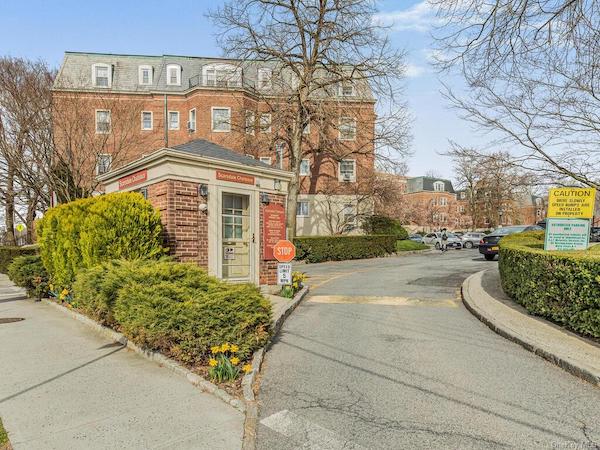
On the morning of June 10, residents of an apartment in Chateaux Circle awoke to find a shattered window and a bullet in the wall. They reported hearing a noise between 1 and 3 am the prior night but thought something hit the window. However, when they woke up the next morning they found the broken window and a bullet in the wall.
Police suspect that it came from a gun fired from the Bronx River Parkway and are trying to determine the type of bullet, as it is damaged.
Fortunately no one was in range of the window at the time of the incident.
Boys LAX Team Wins Third Consecutive Section Title, Tennis Team Triumphs in Binghamton
- Details
- Written by: Sajiv Mehta and Joanne Wallenstein
- Hits: 2472
 The Scarsdale Boys Varsity Lacrosse Team has done it again. For the third year in a row they clinched the Section 1 Class A championship, beating Mamaroneck 10-7 at Yorktown Heights on Wednesday May 31, 2023.
Kudos to Senior goalie Andrew Lehrman who made 13 saves in the game along with:
Jake Goldstein made two goals and three assists
Nate Seslowe scored two goals in just 46 seconds and had one assist.
Jared Hoffman scored two goals, and one assist.
Ryan Ornstein scored three times.
Jack Ramsey scored one goal.
The team, under the direction of Coach Synowiez will next play against Section 2 winner, Shenendehowa at Mahopac at 10 am on Saturday June 3, 2023. The winner of that match will advance to the state final four. For some seniors, the timing will mean that they will miss the weekend festivities for seniors following the prom on Thursday night June 1, 2022.
But that’s the price of success!






Boys Tennis Team
The Boys Varsity A Tennis team, meanwhile, are having themselves a run in the state tournament.
After a 6-1 performance in the sub-regional round, the team had another dominant showing at the regional round last Thursday, May 25th. They routed Ithaca, 6-1, at the Binghamton University Tennis Courts, with only number 1 player Sam Saeed dropping a match. He’ll look to get on track and lead the team to another dominant performance in the next round.
At 10 AM on Saturday, June 3rd, the team will play at Billie Jean King National Tennis Center in the state semifinal game. If if they win, they’ll play for a state title at 4pm and complete one of the best runs in Scarsdale Boys’ Tennis history.
Photos by Jonathan Thaler - See more here.
My Search for Dim Sum is Over
- Details
- Hits: 4895

A delicious aroma wafted through the lobby of the White Plains Marriot Hotel. The scent seemed to emanate from a gold-accented door adorned with the letters “Aberdeen Seafood & Dim Sum,” which contrasted sharply with the minimalist tones of the room. Filled with anticipation, I stepped through the door and was greeted with a view of the restaurant, where the waitstaff was delivering a steady stream of food from the kitchen to the tables. Although it was a lazy Monday afternoon, I was pleasantly surprised to see that the restaurant had drawn a respectable crowd—no doubt a testament to the quality of the food.
Aberdeen Seafood & Dim Sum Restaurant specializes in both traditional Cantonese cuisine and authentic Dim Sum. Cantonese cuisine refers to food from the Canton area of Southern China, which includes major cities such as Guangzhou and Hong Kong. This cuisine differs from others enjoyed throughout China in spice, the increased use of rice and rice flour rather than wheat, and steaming techniques. The restaurant is named after Aberdeen Harbor in Hong Kong, a fishing port that is renowned for having some of the finest quality and variety of seafood. The establishment strives to live up to its namesake by providing diners with one of the finest selections of fresh seafood and authentic Cantonese cuisine in Westchester.  Shrimp Dumplings (bottom left), Pork Shu Mai (bottom right), Vegetable Dumplings (top left), Steamed Roast Pork Buns (top right)
A waiter swiftly seated me, and as I perused the menu, I was immediately drawn to their Dim Sum dishes. I was quick to order their Shrimp Dumplings, Steamed Roast Pork Buns, and Turnip Cake. And after an intense debate with a friend, we decided to finish our order with Pork Shui Mai and Sesame Balls. After just a few short minutes of waiting, the food was whisked out in waves with steam still wafting from the dishes. Frankly, I was astounded. My years-long mission to find Dim Sum that I love was over. Each dish was fresh, flavorful, and high quality, but my personal favorite was the Turnip Cake. I can’t claim to be a Dim Sum connoisseur, but I was blown away by the aromatic, savory taste of this unassuming dish.
 Turnip CakeLocated on 3 Barker Avenue and adjacent to the White Plains Marriot lobby, Aberdeen Seafood & Dim Sum is truly a hidden gem of Westchester! The restaurant is open Wednesday-Monday from 12:00 PM to 3:00 PM for lunch and 5:00 PM to 9:00 PM for dinner. Check out their website here to see their menu and for more information on hours, location, and parking.
Speaker Outlines the Long Road to Recovery from Drug Addiction
- Details
- Written by: Wendy MacMillan
- Hits: 2611
 When you think of a teen who becomes a drug addict, what sort of person do you picture? Someone who lives in poverty or who is wealthy? Male or female? An athlete or musician? Someone who is outgoing and gregarious or someone who is shy? Presenter Stephen Hill spoke with an audience of parents and teens at the Scarsdale Library on Monday May 15th and made clear that addiction to drugs or alcohol can happen to ANYONE despite their background. Hill, an author, sought after speaker, advocate, and now an attorney, is also a recovering addict. The charismatic and engaging speaker related the story of how his drug addiction progressed from his first beer as a fourteen year old star athlete, to being arrested for drugs in front of his grandmother. He shared his personal struggles in hopes of educating and helping families prevent and protect their own children from stumbling down a similar path.
The program, sponsored by Scarsdale Advocates for Youth (SAY), began with an introduction from SAY co-chair Wendy Gendel. Before introducing Stephen Hill, Ms. Gendel started by reminding the packed room that, “Drug overdose is now the leading cause of accidental death in the United States. The CDC estimated over 108,000 drug overdose deaths in the United States during the 12 month period ending in November 2022—one of the highest numbers ever recorded. It is essential that we educate ourselves and learn from one another to fight the American drug epidemic from beginning to end. This includes substance use disorder prevention, early intervention, treatment and recovery, starting right here in our schools and community.”
In addition to providing a brief background of Mr. Hill and his family, Ms. Gendel also advised the audience, “As you hear Stephen’s story, there are a few key topics to keep in mind: middle school students playing high school sports, early warning signs of substance use, the growing fentanyl crisis, peer leadership and negative influence, protective factors, punitive measures such as out-of-school suspension, expulsions, removal from sports teams and school-related activities, the teenage brain, changing consequences for student misconduct, length of stay in treatment, and giving people a second chance.”
Before Hill took the stage, he shared a short video which featured commentary from his parents and each of his three brothers exemplifying the love and support that Mr. Hill is surrounded by. Knowing that he grew up with a stable and supportive family-life where three out of four children never struggled with addiction and instead went on to pursue business and law degrees, left some in the audience asking, “How did this happen to Stephen then?”.
Stephen Hill, founder of Speak Sobriety, used anecdotes from his personal struggle with substance abuse to highlight the factors that contributed to his progressive illness. He described how as a star lacrosse player in eighth grade, he was asked to play for the J.V. team and was bussed to the high school. While the family viewed it as an amazing opportunity for their athletically gifted child, Stephen found himself the lone youngster among much older students. These older students, whom Stephen looked up to, would occasionally smoke, drink alcohol, or use marijuana, thus normalizing recreational use in Stephen’s mind. As a freshman and on the varsity hockey team, Stephen was invited to a party where an older teammate offered him his first beer, which he readily accepted. He noted that because he tended to struggle academically, playing with older students was a source of confidence for him and he now recognizes that he wanted to feel accepted and was chasing validation.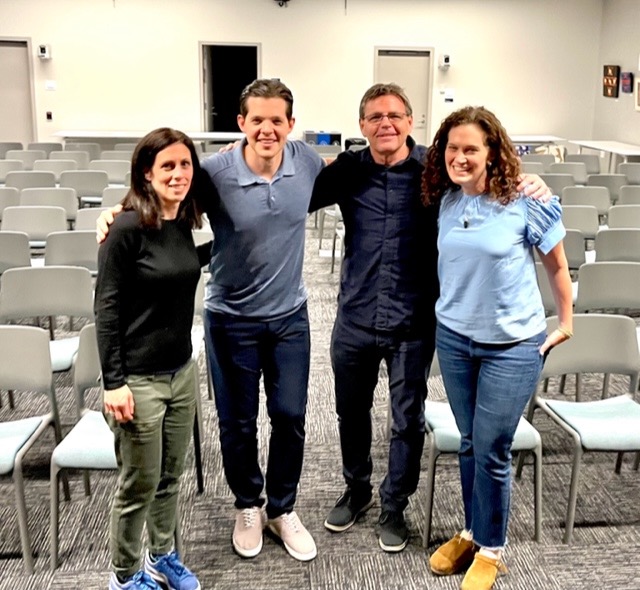 Amy Rompala, Stephen Hill, Kevin Hill, Say co-chair Wendy Gendel
Mr. Hill used this part of his story to remind his listeners that users of drugs and alcohol often believe that their choices don’t have an impact on anyone but themselves and aren’t aware of how their actions can hurt other people. Even the act of drinking, when you are an older role model, can influence others who may look up to you. He encourages everyone to consider how their use of drugs or alcohol may impact the world around them and to recognize that your actions really do matter.
He also used this narrative to illustrate the importance of protective factors such as teens having positive peer influences to ensure a sense of “safety in numbers” (it is easier to refuse alcohol or drugs if others are refusing it too), and owning key refusal techniques. He explained that being able to say no in a confident manner that is portrayed not only in your words and tone of voice, but also in your body language is instrumental in avoiding negative peer pressure.
Mr. Hill went on to describe how at first there seemed to be no real consequences of his recreational substance use. He was well-liked, kept his grades up, and continued to excel athletically. But as he continued to use more often and experiment with “harder drugs”, it started to affect his mood and attitude and he ended up getting suspended from his hockey team. This suspension turned into an expulsion for the entire season after Stephen had a heated confrontation with his coach. The confrontation also resulted in a ten day suspension from school which Stephen welcomed as an opportunity to avoid school and smoke pot all day.
It was around this time that Hill’s parents had him taken away to a “wilderness program” which was really more of a therapeutic bootcamp. Here, he took the summer to work hard towards his sobriety and came home a seemingly changed person ready for a second chance at school. Unfortunately, the school wanted to make an example out of Stephen yelling and cursing at his hockey coach and extended his athletic suspension into the Lacrosse season. As he related, this experience took away Stephen’s sense of identity and confidence and was incredibly demoralizing for him. Despite accepting the initial consequence and despite all of his hard work, he felt like he was never going to be able to shake the reputation of being a bad kid and started to believe he was the failure that everyone seemed to think he was.
Though he takes full responsibility for his choices and actions, Hill describes the pain and stigma of this experience as a contributing factor into a bigger downward spiral. No longer a member of his lacrosse team, Stephen had nothing to do after school and started spending time with older friends and getting high again. At first he thought he would be able to control his use, but he found himself progressively using more drugs to attain the pleasurable feeling until he no longer found pleasure in the world around him without getting high.
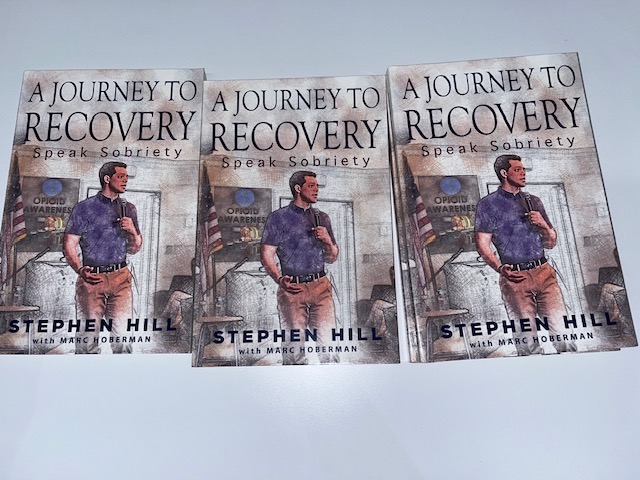
Stephen tried Oxycodone for the first time and though the friends he tried it with had very different reactions, Stephen loved the way it made him feel. He began taking oxycontin more regularly and quickly became addicted. To support his addiction, Stephen began selling drugs and continued to spiral more and more out of control. He was arrested and in and out of multiple rehab programs. It was during this time that Stephen felt like he repeatedly heard three common phrases: Why are you doing this? What were you thinking? And what is wrong with you? But very few people asked, “How can we help?”. The feelings of stigmatization and failure only intensified until Stephen seemed to just stop caring at all.
Thankfully this isn’t where Hill’s story ended. After a more tumultuous period and a more serious arrest, Stephen was able to find his way into a year-long rehabilitation program which he credits with turning his life around. He noted that it wasn’t until around five or six months into the program, that drugs weren’t the first thing he thought of when he woke up in the morning demonstrating one reason the shorter rehab programs were unsuccessful for him. The year-long program was also structured in phases that allowed Stephen to slowly add responsibilities and afforded him a sense of accomplishment and confidence. Of course Stephen recognizes that his family’s consistent love and support was, and continues to be vital to his recovery. As he declared, “Other people believed in me so I can believe in myself.”
While this is an condensed version of Hill’s powerful story, during his presentation he made several other noteworthy remarks:
-Everyone’s bodies and brains react differently to substance use. Some people can seemingly handle occasional drinking or recreational drug use, while others can be more vulnerable or predisposed to addiction.
-Alcohol and pot were absolutely gateway drugs for him. As he puts it, when he used “harder” drugs for the first time he was under the influence of pot and alcohol. When he was arrested for the first time, he was under the influence of pot and alcohol. His marijuana and alcohol use impaired his judgment, gave him a false sense of confidence, and encouraged him to make poor choices.
-Just because something is legal, doesn’t mean it is good for you. The brain isn’t finished developing until at least 25 years old and all drugs (including alcohol) negatively impact the developing brain.
-There is a strong correlation between mental health (depression/anxiety/neurodivergence like ADHD) and drug and alcohol addiction. People use drugs like pot to relieve stress and anxiety but the relief is only temporary. When you self-medicate you are also not giving yourself the chance to learn the strategies and techniques that will help you to work through tougher emotions.
-Drug addiction can happen to anyone. Drug addicts are not bad people…they might be our neighbor, a friend, a relative, or teammate…they don’t need condemnation, they need help.
At the conclusion of the presentation, Hill was joined by his father Kevin to answer questions from the audience.
For more information about Stephen Hill and Speak Sobriety, please see his website. And for local support and resources, please check out Scarsdale Advocates for Youth.
Scarsdale Police Alert Residents About An Increase in Burglaries
- Details
- Written by: Joanne Wallenstein
- Hits: 2719
 Scarsdale Police are seeing in uptick in burglaries this year. They report that year to date there have been 14 burglaries, as compared to four at this time last year.
They are offering residents the following tips to avoid becoming a victim:
Automobile Theft Prevention
1. Lock your vehicle doors and remove your keys and key fobs from inside your vehicle.
2. Secure your garage door opener in a locked glovebox, as thieves may use it to enter your home to retrieve your vehicle key or steal other valuables.
3. Never leave valuables inside your vehicle, particularly if visible.
Burglary Prevention
1. Keep all exterior doors at your residence locked, using deadbolt locks. Also, keep your garage door closed and locked, including your interior access door, and lock all widows, including second floor.
2. Always turn your alarm system on when you are away. It is also recommended to have your alarm system in the “stay” or “home” mode when you are home, especially while you are sleeping.
3. Use motion sensing exterior lighting and keep the perimeter of your home well lit.
4. Never leave your house key under doormats or in “hiding” places outside of your home.
5. Make your home appear occupied. Leave lights or televisions on timers when you are out for the evening.
6. Consider the use of a video surveillance system to protect your property.
7. If your residence will be vacant for an extended period, consider signing up for the Scarsdale Police Department’s “Dark House Program” by calling 914.722.1200. The program is free, and officers will make periodic checks of the house, depending on call volume and officer availability, until the homeowner returns.