








Sportswriter S.L. Price Discusses America's Oldest Game: Lacrosse - At Scarsdale Public Library
- Monday, 26 October 2026 17:43
- Last Updated: Monday, 26 October 2026 18:07
- Published: Monday, 26 October 2026 17:43
- Brian T. Brown
- Hits: 54
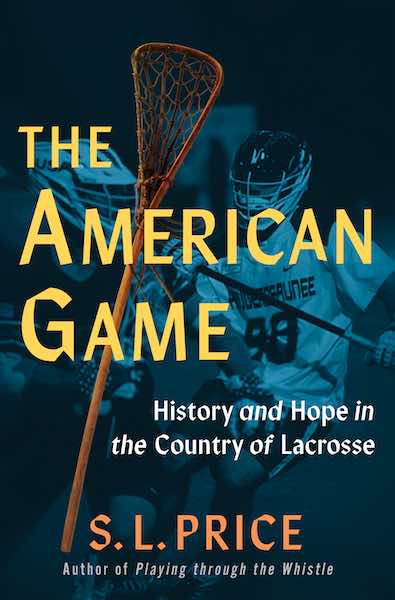 On Wednesday, November 4, at 6 p.m., S.L. Price will be appearing at Scarsdale Library to talk about his latest book, The American Game: History and Hope in the Country of Lacrosse.
One of America’s most acclaimed sportswriters, Price’s new book addresses the winding, epic story of our country’s oldest game – created a millennium ago by Indigenous people and perfected by the Haudenosaunee nation in upstate New York.
Many will know Price for his heralded and often gripping pieces at Sports Illustrated, where he authored 47 cover stories.
His award-winning books, classics of journalism and language, have dissected the culture of a Western Pennsylvania football stronghold, uncovered the roots of Cuba’s astonishing sports dynasty, and chronicled the often merciless world of minor league baseball.
The American Game – winner of the 2026 Jenkins Medal for Excellence in Sportswriting and based on seven years of research – is perhaps the most definitive work ever written about lacrosse culture, and explores how the game, perhaps more than any other, describes America’s long fitful attempt to bend the arc of the moral universe toward justice.
Price provided this exclusive interview to Scarsdale 10583 …
You were raised in Stamford, Connecticut. What elements of that upbringing played a role in becoming a writer?
My Dad was a real devotee of American history, and he and I used to quiz each other on American history. He was a member of your classic, reserved World War II, Korean War generation. Men who didn't speak a lot about their feelings. So the way we spoke to each other, the language we spoke to each other, a lot of it was based on our mutual love of American history. So there was that. And then my Mom was incredibly good at sitting down and talking to people. And I didn't realize it at the time, but she taught me curiosity and taking an interest in people and how to talk to them and interview them. And my best friend from high school, Bruce Schoenfeld, was a year ahead of me, and he went off to Harvard and was on the newspaper and he opened up to me this whole world of sports journalism, which I just really had no idea of.
What was your first experience writing sports journalism?
I joined the school newspaper at the University of North Carolina to get a lot of reps and become better as a writer because I knew I needed a lot of reps to get better, and there's no better place than a school newspaper, especially because sports are often the most important and the most interesting subject to students.
You worked for several newspapers and became a celebrated writer at Sports Illustrated. Is there a consistent theme in the stories you’ve written through the years? Author S.L. Price
I began my career at the Sacramento Bee, and I was the beat writer for the NBA’s Sacramento Kings when they moved from Kansas City to Sacramento. Very quickly, I understood the idea of sports as a mirror of a culture – and the enthusiasms of it beyond competition were fascinating to me. Sacramento thought, “If we get a Major League team, that makes us a Major League city.” And so that sort of planted a seed, which is like, “Wow, sports is not just bats and balls.” And, so, many of stories I've done that have resonated most with people are usually not just about sports, but in some way how sports sort of either mirrors or channels, the hopes, dreams, desires, passions, hatreds, prejudices of a school, town, city, country.
You have said that there is also something incredibly honest about sports. Can you elaborate?
When sports are part of the picture, people can't help but tell you who they are. Our games reveal us. You look at the field, and these athletes are playing at the height of their powers, under the most pressure, and they can't fake it. They can't fake who they are under that kind of pressure. You'll see them cry and laugh and scream and yell and swear, and you get a pretty good sense of who that person is. And, then, you turn around and look in the stands, you see people of all kinds of different backgrounds, races, income levels, all screaming or crying or laughing or whatever it is, seeing themselves in what they're watching on the field in a way that they don't really express any other way, and coming together as one and expressing together who they are. And those moments of deep passion happen because they love their team, they love their city, they love their region.
And because of that, you can write about any topic in sports. As long as there's somebody in that story bouncing a ball and shooting it or competing against somebody, people will pick up that story and read it. And you can sneak in all these other issues and talk about issues that are much larger and much broader. And you can maybe touch people in a place, in a way, that they didn't expect. And tell a story that they otherwise wouldn't be interested in, or a trend, or an issue that's important and bears scrutiny. I played one-on-one with Obama. I've met Clinton. I met George W. Bush when he was the owner of the Texas Rangers. So I was able to do all that all under the guise of being a sportswriter and to indulge my love of history, my love of the culture, my interest in the changing face of America. Sports has allowed me to do it, and it's given me a platform that otherwise I probably never would have had.
The American Game is your fifth book. What drew you to what is a sweeping story about lacrosse?
Lacrosse inspires a very cultish following and an intense devotion. And I can't tell you how many times I was told across the board – people old, young, black, white, Latino, male, female – how they were bitten by the stick, bitten by the game. They picked up the stick, they couldn't put it down. They were into other sports, more popular sports, but something about lacrosse got to them and, over and over, someone would say to me, “Well, I gotta confess something. I actually, for like two years, slept with my stick." So there are people who really think this game is great. And they don’t understand why this sport isn’t more popular. It's got everything. It's got hand-eye coordination, and a little bit of violence, and speed and dynamism and magical stick handling – behind-the-head shots, and so on and so forth. Lacrosse people believe the game is important and they don't understand why the world doesn't understand it. But I think it's more important than even the lacrosse people understand it to be.
Lacrosse is America’s oldest game. For those who may not know, how old is lacrosse, and who is credited with inventing the game?
So lacrosse was created about a thousand years ago, and no one knows exactly when or specifically where. The Indigenous people of this continent – from all over, North, South, and West – played a variation of the stick and ball game. But the field game – which has realized its highest expression at American Division I colleges – traces back to the Haudenosaunee Confederacy, previously known as the Iroquois Confederacy, which is basically located on either side of the St. Lawrence River, in northern New York and, on the other side, southern Ontario, Canada.
How many nations are part of the Confederacy?
The Haudenosaunee Confederacy is comprised of six nations. The most recognizable to a lay audience would be the Seneca and the Mohawk, but also the Onondaga, Tuscarora, Oneida and Cayuga. And the capital of the Haudenosaunee Confederacy is basically Onondaga, which is located near Syracuse, New York. The great faith keeper of the Onondaga, Oren Lyons, who is 96 and still living and one of the great Indigenous activists of the last fifty years, insists to me that Onondaga was where lacrosse was invented, but, essentially, no one knows for sure.
Did Oren Lyons play lacrosse?
Yes, Oren Lyons is also a notable figure because he was a teammate of Jim Brown. For most people, the most famous name that comes up whenever lacrosse is mentioned is still Jim Brown, perhaps the greatest running back in NFL history – and some people believe he's the greatest player overall. Many people in lacrosse feel that Jim Brown, who played at Syracuse, was the greatest lacrosse player of all time. There have been many great players since, and it's very hard to compare eras, but Jim Brown's All-American teammate and goalie at Syracuse was Oren Lyons. And Oren Lyons and two partners – Wes Patterson, a Tuscarora stick maker, being one of them – co-founded the Iroquois Nationals. Now they're called the Haudenosaunee Nationals. The team was founded in the 1980s as a vehicle for sovereignty for the Haudenosaunee, and they have an extremely small talent pool compared to the United States and Canada, and yet they're the third-best team in the world.
Many people grew up using Iroquois to describe this group. Why was it decided to change the name to Haudenosaunee?
Well, the Haudenosaunee have always called themselves Haudenosaunee, which translates as “People of the Longhouse.” Iroquois was a name dubbed by the French. But because of common usage, it’s obviously what everyone called them for 500 years. Oren Lyons is as fierce a nationalist as there is, but he didn't really take offense at the word “Iroquois.” It was simply the most recognizable name for the program to use at the time it was founded. As a wave of ethnic activism sort of swept the country in the early 2020s, I think the Haudenosaunee began rethinking how they were regarded and they felt, “You know what? We need to make sure people understand who we are.” And so no one really blinks if you call them Iroquois, but they appreciate if you actually follow what they've now decided, since 2021, officially calling themselves the Haudenosaunee Nationals – not to mention the Haudenosaunee Confederacy.
Isn’t lacrosse a French word?
Yes. French missionaries in the 17th century came across Native Americans in northern New York playing lacrosse as a medicine game for healing the community. It's a spiritual practice to this day. The suspicion is that it was called lacrosse because the stick resembled a bishop's crozier – the curved staff used in the Catholic religion.
Can you explain more about why the Haudenosaunee thought it necessary to form their own national team?
To start, keep in mind that when it comes to Native Americans, and certainly the Haudenosaunee specifically, the one phrase you're gonna hear over and over whenever speaking to anyone about Native American life is, “We are still here. People forget about us, but we need for them to understand that we're still here, we're still a vibrant part of this country. We're not a piece out of history or old cowboy movies with John Wayne.”
When the Haudenosaunee lacrosse team travels to international competitions, they use their own passports – not a U.S. passport. Isn’t this part of a long history of fighting for recognition as a sovereign state?
In 1794, the Treaty of Canandaigua was signed, stipulating that the United States would annually pay the Iroquois Confederacy $4,500 worth of implements and goods – such as farm implements. Over time, that morphed into muslin. And that treaty is still honored to this day by the United States government. The Obama White House actually had a ceremony where they officially refreshed the treaty. But every year, unceremoniously, a FedEx truck pulls up to the capitals of each nation and drops off a certain amount of muslin, to be divided up between all the people. And, depending on the market value, it could be a yard, two yards, a few inches. One of the general managers for the Haudenosaunee team got married in a shirt made out of the treaty muslin. There's a piece of artwork at the Smithsonian made out of the treaty cloth. The point is, the treaty is a living document. And back in the 1950s, the U.S. said, “Can we stop doing this? Give you a bulk of money, and stop doing this muslin thing?” And the Haudenosaunee said, "No, no, no, no, no. This is a treaty, which, by very definition, is between two nations. You recognize us as a nation. You're gonna keep paying us." They've insisted on that ever since.
But, as you write in The American Game, when the Haudanesaunne decide to form a national lacrosse team, they had a big problem. They didn’t really play the field game anymore.
Not institutionally, though their Medicine Games never ended. By the 1930s, lacrosse had become a white man's game in Canada and the owners of the NHL teams – the Toronto Maple Leafs and the Montreal Canadiens – thought, “We've got these empty arenas. Let's do something to fill them.” And they created indoor lacrosse – box lacrosse. Which became an instant sensation in Canada, and almost immediately rendered field lacrosse there irrelevant. The Native Americans were also allowed to play it and so that became, in many ways, the main Haudenosaunee game – box lacrosse.
Meanwhile, the Americans picked up field lacrosse, and over the next 50 years, raised it to a level at U.S. colleges that had never been seen before. The U.S. remains the number one team, and have won by far the most world championships. And though, over the decades, a trickle of great Haudenosaunee had played collegiate field, too, mostly at Syracuse – box reigned as the supreme Haudenosaunee variation, and there had been a disengagement from field developments and strategies.
However, as we learn from your book, winning world championships wasn’t the primary goal, anyway.
So when the Haudenosaunee Nationals, then-named Iroquois Nationals, were started in the 1980s, it was first of all seen as a reclamation of their original Creator's game. But, very quickly, within two or three cycles, the Haudenosaunee passed England and Australia and became one of the premier field powers. But the quest for sovereignty and the use of lacrosse as an expression of identity has always trumped what is, basically, the cardinal mission of all sports, which is. “We want to win.”
And, as you detail, the Haudenausonee won’t even step on the field if official recognition is denied.
In 2010, when their passports weren't gonna be recognized by England, the men's team pulled out of the championships. The U-19 women pulled out of another in 2015. And then in 2018, going to Israel, it came down to the last flight. The Haudenausonee were stuck at Toronto Airport, and there were all kinds of machinations because Israel is maybe supreme among nations in terms of border security, and were very wary of the Haudenosaunee coming, and there were all these negotiations going on, and the Haudenosaunee were willing, yet again, to not compete for the world championship if their passports were not recognized. But in 2018, their passports were recognized by Israel, and that is considered a great victory for the mission of the team.
Can you address the effort by the Haudenosaunee to participate in the 2028 Los Angeles Olympics as a separate nation?
The International Olympic Committee, the IOC, does not recognize the Haudenosaunee as a nation. If you're recognized by the United Nations, the IOC will recognize you as a nation. Also, you have to have a National Olympic Committee. The Haudenosaunee don't have that United Nations recognition, nor do they have a National Olympic Committee. For the latter, you need at least five sports recognized by the sporting federations. The Haudenosaunee have one – men's and women's lacrosse.
But they desperately want, as a form of recognition and of their sovereignty and identity, to play in the 2028 Olympic Games in Los Angeles, where lacrosse, for the first time in 80 years, will be contested. So they would like desperately to compete under their own flag and they’ve been campaigning for this. And the Biden Administration came out in support of the Haudenosaunee competing under their own flag in Los Angeles. But the IOC has repeatedly replied in the exact same way, which is that the Haudenosaunee are not recognized, and they're more than welcome to try out for the U.S. or Canadian teams.
In general, what has been lacrosse’s response to the IOC position?
The Haudenosaunee are still campaigning and World Lacrosse, who is in favor of the Haudenosaunee playing in the Olympics, has made it clear the Haudenosaunee are part of the qualifying process. And even though, right now, the Haudenosaunee are officially not allowed to play at the 2028 Los Angeles Olympics, they are involved in the qualifying process for the 2028 Games, which means that it's quite possible that a year from now, the Haudenosaunee, because they are the third-best team in the world, could qualify, and it's quite possible then that the IOC will continue its stance and suddenly you have not just an identity or sovereignty issue, but a competitive one, which is just that your basic sports fan is going to say, “Wait a minute, how is this competition in any way legitimate if the third-best team in the world is not allowed to play?” And in the meantime, you're gonna have people saying, “Wait a minute, the creators of the game, who are also great at the game, are not being allowed to play.” And it just so happens that these Olympics are being fielded and contested on what was once Native American land. And so you can see that the situation is rife for controversy, and it's a shame because the IOC doesn't seem to recognize that it's an absolute public relations boon if they allow the Haudenosaunee to play – and a disaster if they don't.
For readers in general – and specifically for Scarsdale lacrosse players, coaches, and parents – what might you hope they’d find of value in reading your book?
I’d hope they’d gain an appreciation for the depth of the game, and the spiritual depth of it, which is unlike any other game. And the historical depth of lacrosse, which in many ways serves as a metaphor for literally 500-plus years of the history and the collision of white and Indigenous cultures on this continent. And understand that this sport mirrors so much of American culture – from Wall Street finance, to the expanding and changing role of women, to racism and drug use, to this incredible bond with the military that's unlike any other sport. The layers of the game go so far beyond the caricature of the game. I think the sport has incredible layers, incredible dimensions, and it's worth everybody's time and everybody's passion … and it's a wonderful pastime. And, frankly, I think in many ways it’s the most American game there is.
Shop the Village. Read the World. The team at Scarsdale’s Bronx River Books – established by the truly engaging bibliophiles Jessica Kaplan and Mark Fowler – will be at S.L. Price’s November 4 Scarsdale event selling copies of The American Game. For more about Bronx River Books, check out their website: bronxriverbooks.com.