





A First Pass at the 2026-27 Scarsdale School Budget
- Thursday, 12 February 2026 12:39
- Last Updated: Thursday, 12 February 2026 12:49
- Published: Thursday, 12 February 2026 12:39
- Wendy MacMillan
- Hits: 82
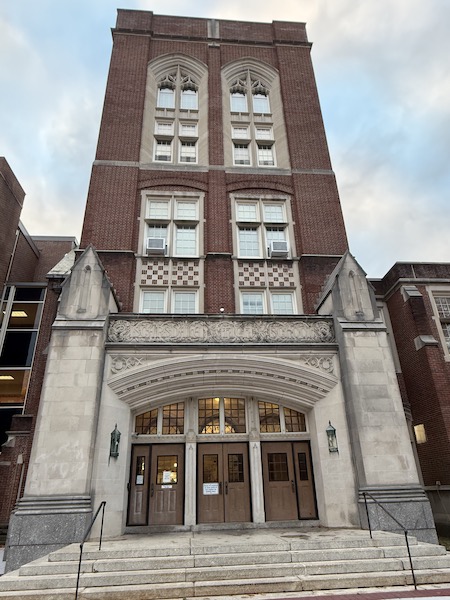 On Monday February 9th, the Board of Education held their first in a series of special Budget Study Sessions in which administrators “outlined the why, how, and what of the budget; presented the overall preliminary budget draft, discussed the key budget components and drivers; and discussed five key budget components: Curriculum, Instruction, & Assessment; Transportation; Facilities & Capital Projects; Debt Service & Lease Purchases; and Employee Benefits.”
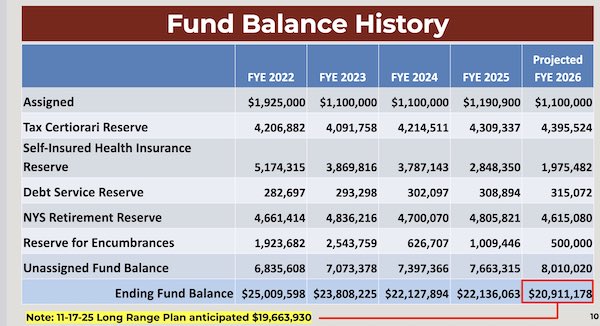
Andrew Lennon, Assistant Superintendent for Business, reviewed the district’s current position as it prepares for the 2026-27 budget cycle. The district began the 2025-26 school year with a fund balance of $22.1 million and now projects $190.7 million in revenues and $191.9 million in expenditures, resulting in an estimated year-end fund balance of approximately $20.9 million, an improvement over earlier projections. Administrators noted two key trends: a continued decline in the self-insured health reserve, which has helped absorb rising and unexpected health care costs, and growth in the unassigned fund balance, which remains capped at 4 percent of the subsequent year’s budget under state law and provides flexibility to address unforeseen expenses.
The district also outlined the state property tax cap calculation, which determines whether a simple majority or supermajority voter approval is required. Based on current factors, including a consumer price index cap of 2 percent, a tax base growth factor of 1.013 percent, and more than $9 million in capital exclusions, the district’s tax levy limit for a cap-compliant budget is $181.7 million, representing a 3.37 percent levy increase.
Revenue projections for the current year show an estimated $1.7 million above budget, driven by electric vehicle bus grants, higher-than-anticipated tuition revenue (particularly for special education programs), and additional state reimbursements. Looking ahead to 2026-27, the district anticipates a slight decline in state aid tied to lower expense-driven aid and a continued reduction in aid ratios for transportation and BOCES services. The proposed budget also reduces reliance on reserves, including a $250,000 decrease in the use of the health insurance reserve as part of a multi-year plan to gradually phase down its use in balancing the budget.
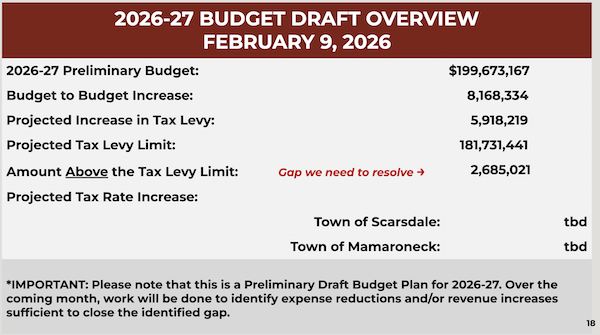
On the expenditure side, the draft budget reflects an $8.17 million, or 4.27 percent, increase over the current year. Major drivers include approximately $3.1 million in additional salary costs, $2.7 million in increased employee benefits, $1.1 million in contracted services, and higher utility and supply costs largely attributed to inflation. Debt service is also projected to rise, while transportation costs are expected to decline due to reduced bus purchases.
Overall, the proposed budget would require a tax levy increase of approximately $8.6 million, or 4.9 percent, about $2.7 million above the state tax cap. If proposed, the budget would need to be passed with a 60% majority. The administration acknowledged this gap and indicated that the next phase of budget work will focus on identifying expenditure reductions or additional revenues to bring the proposal within the tax cap ahead of final adoption.
Curriculum, Instruction, and Assessment
The presentation also highlighted curriculum, instruction and assessment initiatives supported by the budget. These include expanded performance-based learning, global education partnerships, arts enrichment, sustainability projects across all seven schools, and ongoing evaluation of district programs through surveys, consortium reviews and alumni feedback. Edgar McIntosh, Assistant Superintendent for Curriculum, emphasized that these investments are intended to ensure Scarsdale continues to innovate, respond to student needs and maintain its long-term financial and educational leadership.
At the instructional level, the proposed budget prioritizes learning by maintaining class size norms and expanding targeted staffing. Plans include the addition of a math position at Scarsdale High School, continued planning for elementary class sections, and further development of the special education continuum to ensure students receive appropriate services and meet graduation requirements. Investments are also directed toward sustained professional development, curriculum refinement and continuous improvement of instructional practice.
Student well-being and belonging remain a key focus, particularly at the elementary level. The budget includes a proposal to expand social work services through a partnership with Scarsdale-Edgemont Family Counseling Services, adding 1.5 full-time equivalent social workers to strengthen support for students and families. McIntosh framed this investment as part of a broader effort to create school environments that promote resilience, inclusion and emotional health.
Facilities
District officials spotlighted the work of the facilities department this week, emphasizing expanded in-house capacity, cost savings, and a proposed $1.815 million capital plan for 2026-27.
Assistant Superintendent for Business, Andrew Lennon explained that the department has made a concerted effort in recent years to reduce reliance on outside contractors by building internal expertise and promoting from within. With his promotion to Director of Facilities, Nick Ferraro and his team oversee custodial, grounds and maintenance teams responsible for approximately one million square feet of building space and 115 acres of property. Beyond daily cleaning and upkeep, staff have taken on larger-scale projects in-house, including office and classroom renovations, drainage improvements, field upgrades, playground repairs and capital-level work previously outsourced. Lennon said this shift has resulted in significant cost reductions while improving responsiveness.
Among recent efforts are field renovations at multiple schools, site beautification projects, playground repairs led by a certified in-house inspector, and a pilot initiative to create collaborative “nooks” in high school hallways. The department has also addressed priority building conditions and code-related items internally.
Despite these efficiencies, administrators noted ongoing challenges, including rising electrical costs, inflation affecting supplies and materials, increasing prices for contracted labor and the demands of aging facilities. The proposed operations budget reflects a $200,000 increase in utilities driven largely by electricity, an $85,000 equipment increase for maintenance vehicle replacements, including the district’s first EV maintenance vehicle, and higher BOCES costs tied to environmental testing such as asbestos, air quality and lead monitoring. Contractual spending is projected to decline as more work shifts in-house.
Officials also reported progress through a partnership with Synergistics, an energy management firm. Improved heating controls have reduced comfort complaints and are expected to yield energy savings, with a formal update anticipated this spring.
The proposed five-year capital plan, informed by facilities studies and bond discussions, aims to address building needs while stabilizing long-term tax impacts. Year-one projects total $1.815 million and include high school life skills classroom renovations, replacement of an aging oil tank and sewer line at Fox Meadow Elementary, a new playground structure at Heathcote, replacement of high school gym bleachers, a heat exchanger at the high school library, hot water heaters at two elementary schools and major paving work at the middle school.
Officials said the department will continue refining priorities for years two through five of the plan, which may include additional playground upgrades, classroom renovations, roofing, windows and other building systems.
Administrators described continued investment in facilities as essential to maintaining safe, functional schools while avoiding costlier repairs caused by project deferrals.
Transportation Upgrades and EV Bus Plan
Scarsdale school’s transportation department is undergoing major improvements under new Supervisor Nadia Pettignano, who has focused on stabilizing operations, strengthening safety and compliance systems, and modernizing communication and record-keeping.
Key initiatives include updated inspection procedures, standardized driver manuals, upgraded radio systems, and planning for GPS tracking and telematics. Pettignano emphasized that recruiting and retaining bus drivers remains the department’s top challenge amid a nationwide shortage.
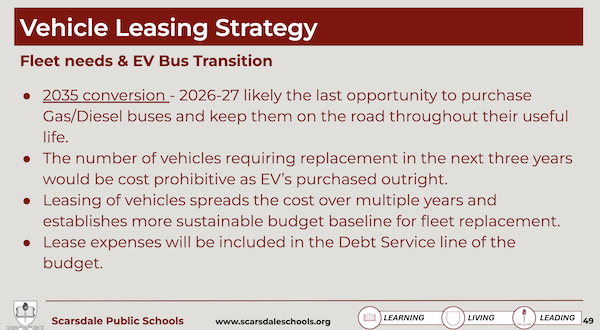
The district is also preparing for New York State’s zero-emissions mandate. Four electric buses have been procured, and charging infrastructure is being installed, with permanent stations expected in six to eight months. A fleet review identified 25 vehicles in urgent need of replacement. To bridge costs and meet operational needs, the district plans to lease 12 gas buses and two electric buses in the upcoming budget cycle.
Officials described the upgrades as a balanced approach to improving safety, efficiency, and environmental sustainability while navigating staffing and budget challenges.
Debt Service
Andrew Lennon also reported on key changes in debt service, salaries, and benefits. He explained that an increase of $246,000 is tied to the auditorium bond, while $408,000 reflects planned bus lease costs. Offsetting reductions come from prior grounds equipment purchases that have improved department operations, including performance during recent snowstorms.
Personnel costs remain a major focus, with the New York State Employees Retirement System contribution rising $482,000 due to higher rates for custodians, clerical staff, nurses, aides, and drivers. Meanwhile, the Teachers Retirement System contribution decreased, reducing the budget by $964,000. Social Security, Medicare, and health insurance costs are also projected to increase, with preliminary estimates suggesting 8-10% growth in claims.
Lennon emphasized the continued use of unassigned fund balance, historically around $1.1 million, to help mitigate tax levy increases. While long-term budget projections show potential deficits, administrators stressed that careful planning and monitoring of health reserves will prevent major impacts.
Next steps include refining revenue assumptions, reviewing expenses, and presenting updated projections at the second budget study session on March 2. The district reaffirmed its commitment to a balanced, thoughtful approach amid rising costs and inflationary pressures.
You can see the slides from Budget Study Session One here or watch a recording of the presentation here.
District Updates Bond Scope to Include Middle School Turf Field
During the Business portion of the marathon meeting on Monday evening, administrators presented an updated bond proposal ahead of the May 19th public vote. The overall bond scope increased from $98.69 million to $101.7 million to restore the middle school turf field, bringing the total field-related costs to $5.44 million.
Other aspects of the bond, including infrastructure, spatial renovations, and air conditioning, remain unchanged. The middle school turf field is now scheduled in Phase Five of the project. District officials emphasized coordination with village drainage projects to ensure smooth implementation and minimize conflicts with interior renovations.
The district continues toward referendum adoption on May 16th, with full details and phasing available on the district website.
SEQRA Review
Board members reviewed the State Environmental Quality Review Act (SEQRA) process for the proposed 2026 capital bond project and responded to questions from the public about potential impacts to the timeline.
Consultants determined the bond qualifies as a “Type I” action, requiring a more comprehensive environmental review. The designation is largely due to the historic status of three buildings included in the scope of work, which lowers the threshold for reviewing building additions. The high school does not carry the same historic designation.
As part of the process, the district must prepare and circulate a Full Environmental Assessment Form (FEAF) and allow a 30-day comment period for involved agencies. A resolution formally declaring the district’s intent to serve as lead agency and initiating the review process will return to the board for action.
During public comment, resident Christian Callaghan of Webster Road asked whether the 30-day review period would affect the district’s approval timeline and whether evaluating the bond as a single, comprehensive project means an issue at one site, such as the middle school turf fields, delay the entire proposal.
District officials said they do not anticipate the SEQRA process will disrupt the current schedule and expect to meet the March 16th deadline for board action. Based on consultations with environmental experts, legal counsel and project consultants, administrators said they do not foresee any significant environmental impacts that cannot be addressed through standard mitigation measures.
While the bond is being reviewed as a whole, meaning a major issue in one component could potentially delay the entire project, officials emphasized that no such obstacles are expected.
To watch all of the highlights from Monday’s meeting, see here.