







Scarsdale Schools Propose $197M Budget for 2026–27 Within State Tax Cap
- Wednesday, 18 March 2026 20:03
- Last Updated: Wednesday, 18 March 2026 20:20
- Published: Wednesday, 18 March 2026 20:03
- Wendy MacMillan
- Hits: 103
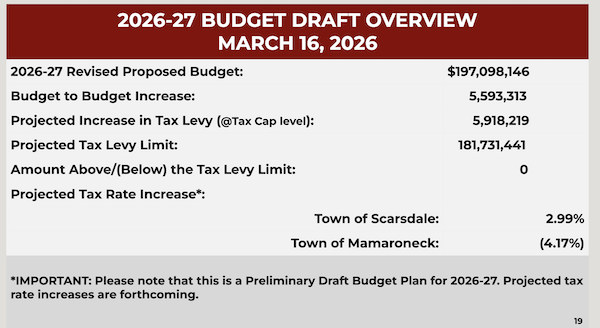 At the third Budget Study Session held Monday March, 16th the Board of Education presented a substantially revised proposed $197.1 million budget for the 2026-27 school year and outlined a plan that stays within New York State’s property tax cap but requires nearly $2 million in reductions, including several staffing adjustments.
Superintendent Dr. Andrew Patrick related that remaining within the cap was a deliberate decision this year, especially as the district plans to ask voters to consider a separate capital bond. “This year we’re asking the community not only to support a budget but also a $101 million bond referendum to make much needed capital improvements to aging buildings across our district. With all of this considered, I felt compelled to recommend a tax cap compliant budget.”
He went on to explain that the revised proposal aims to preserve core academic programs while limiting the financial impact on taxpayers stating, “We must be cognizant of the impact of school taxes on our community, and have to find a balance that maintains our exceptionally high quality of education and allows for Innovation and Improvement while minimizing the impact on our tax paying community, despite the fact that that balance is harder and harder to come by.”
Patrick details the rationale for this difficult, decision making process in a recent letter shared with the community:
Budget Details
Before highlighting the revised financial numbers, Patrick shared, “The school budget provides the necessary financial resources to operate the school district and to help achieve the goals and objectives of the school district, as set forth in our strategic plan.”
As he has done in past presentations, Patrick described the district as being organized with structures that “foster favorable student teacher ratios, create smaller learning communities within a larger school setting, and allow students to express agency over their course of study. The resources directed toward this fundamental organization of our schools, create the foundation that allows us to attend to the whole child while pursuing innovation and thoughtful adaptations to meet the needs of our learners. This is what we are desperately trying to preserve within the ever tightening financial realities that we are facing. I want to emphasize that we've been thoughtful, principled, transparent and responsible in our budget development process to date. Arriving at this budget has required difficult choices…This district has a long history of investing in education, which has enabled program innovation and expansion to take place while maintaining outstanding educational outcomes. This community has shown a level of financial support that reflects the real cost and value of an exemplary public education.”
The current proposed budget totals $197,098,146, an increase of about $5.6 million, or 2.92 percent, over the current school year.
To remain within the state tax cap, the district’s tax levy would rise by 3.37 percent, the maximum allowed under the formula for the coming year. Because the proposal stays within the cap, it would require a simple majority of voters to pass rather than the 60 percent supermajority needed for a tax cap override.
School officials estimate the increase would translate to roughly $715 more annually for the median homeowner in Scarsdale, based on current assessment data. Due to property assessment changes, homeowners in the Mamaroneck portion of the district could see a decrease.
Also highlighted during the presentation is the fact that in Scarsdale, property taxes account for about 92 percent of the district’s revenue, making the school system more reliant on local taxpayers than all neighboring districts because it receives the least amount of state aid.
Rising Costs Drive Budget Pressure
Patrick also made clear that the district began the budget process facing significant cost increases that outpaced the revenue allowed under the tax cap.
Major projected increases included:
- $2.8 million in health insurance costs
- $3 million in salary and wage increases
- $400,000 in Social Security and Medicare costs
- $1.1 million in contractual obligations, including student services and insurance
Even without new programs or staffing, those increases alone would have pushed the district over the cap.
Assistant Superintendent for Business Andrew Lennon said district leaders therefore needed to identify reductions across multiple areas.
Staffing and Spending Reductions
To close the remaining gap, administrators proposed about $1.99 million in reductions since the previous budget study session.
Assistant Superintendent for Human Resources, Meghan Troy outlined several staffing changes, including:
- Removing a proposed middle school special education teacher position
- Eliminating a planned high school math position
- Reducing two contingency positions to one
- Leaving some positions unfilled after retirements
- Reducing hours for teacher aides through attrition
- Eliminating a proposed elementary social worker (a contracted position)
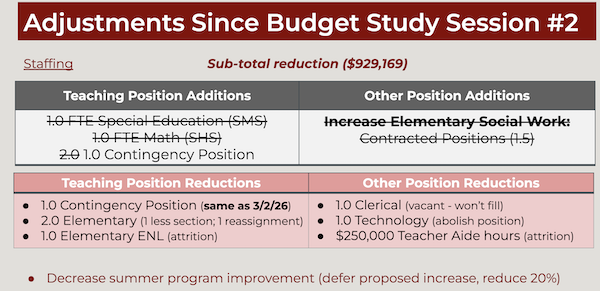
Overall staffing would decline slightly to about 661.7 full-time equivalent employees, five fewer than the current year’s staffing level.
The district also proposed smaller cuts in several operational areas, including technology leases, conference travel, supplies, and certain software services. One change would involve shifting most district meetings from Zoom to Google Meet to reduce costs.
Concerns Raised During Discussion
After the presentation, board members engaged in a thoughtful discussion, sharing concerns about the cuts made to the current proposed budget. Many acknowledged the difficulty of the decisions required to reach cap compliance, with several expressing concern about cumulative impacts on staffing, student-to-teacher ratios, and program quality over time.
To begin the conversation, BOE member Leah Dembitzer drew attention to the fact that reductions made in the proposed budget would not only affect future programming but the cuts would also mean that we cannot keep our current program as it is right now.
Dembitzer went on to express her concern that losing current positions through attrition for the second year in a row, could cause additional pressure to the remaining faculty.
Some noted the possible effect on class sizes in high school math courses, where enrollment demand has been growing. Anish Mehta, one of the BOE’s student representatives, echoed those concerns, saying large classes can make it harder for students to receive help during office hours.
Board members also raised questions about reductions in teacher aide hours and the decision not to expand elementary social work services.
Though he acknowledged the concerns, Patrick emphasized that the proposed budget preserves the district’s core instructional structure, including small elementary class sizes, the middle school team model, and the high school’s broad academic program.
Long-Term Financial Outlook
Board members acknowledged that the state’s property tax cap continues to put pressure on school district budgets, particularly in communities where property taxes make up the vast majority of revenue.
While districts can propose budgets that exceed the cap, those proposals require a 60 percent voter approval threshold, making them more difficult to pass.
Patrick said that dynamic has forced districts across New York to make difficult trade-offs in recent years.
“The evidence suggests the cap is a tool that has to be used carefully,” he said. “A failed budget vote can be devastating to a district’s educational program.”
Next Steps
The board will continue reviewing the proposal before adopting a final budget.
Key upcoming dates include:
- Budget Forum: March 23
- Board Adoption of Budget: April 13
- Annual Budget Vote: May 2026
School officials encouraged residents to stay engaged in the process and share feedback ahead of the final vote.
Watch a video of the meeting here.
To see the slides from the Budget Presentation see here.