







BOE Reviews Student Assessment and Discusses an AI Resilient Approach to Instruction
- Category: Schools
- Published: Thursday, 29 October 2026 12:14
- Shilpa Spencer
 Maroon and White Leaves: Jon MarkThe Scarsdale Board of Education met on October 26 for an evening of discussions covering the district's response to artificial intelligence, student academic performance, financial oversight and the future of the school lunch program. The meeting included the first education report of the school year, along with a separate audit committee meeting reviewing the district's finances for the 2025-26 fiscal year.
Board President Suzie Hahn began the business meeting by discussing the Board's recent conversations with Scarsdale High School students about artificial intelligence and a presentation by ConnectEd on civil discourse. She also highlighted a recent meeting with Village officials covering school safety, transportation and facilities.
Superintendent Drew Patrick provided an update on the district's partnership with Common Circles, an organization working with Scarsdale Middle School to develop an exhibit featuring the stories, artwork and perspectives of community members. Patrick encouraged residents to participate in the project, which is being developed with input from students, educators and families.
Board members also reported on recent school visits and committee meetings. At Edgewood Elementary School, members noted that an additional third-grade section has required Spanish instruction to take place in regular classrooms rather than a dedicated language room. At the middle school, members highlighted efforts to promote healthier technology habits, including a technology-free area in the library and an upcoming Digital Balance Week.
Student Board representatives Lucy Eisenberg and Nathan Goldfarb shared updates from Scarsdale High School, including a visit from Italian exchange students whose Scarsdale hosts will travel to Italy in February. They also discussed Global Citizenship Day, held on October 9, which included workshops on different cultures and an assembly focused on civil discourse and navigating difficult conversations.
Scarsdale Students Continue Strong Academic Performance
Before the AI presentation, the district reviewed student achievement data from the 2025-26 school year.
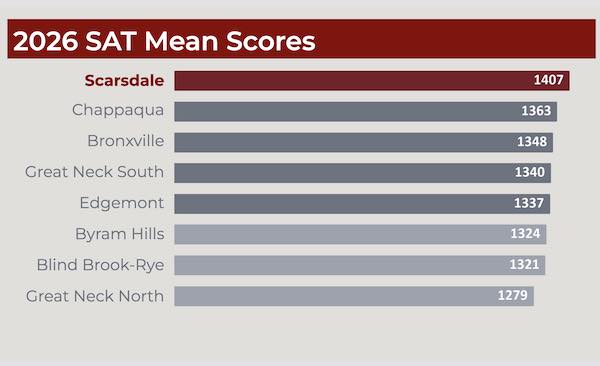
The Scarsdale High School Class of 2026 earned an average combined SAT score of 1407, including 719 in math and 688 in evidence-based reading and writing. The district reported that this placed Scarsdale first among its comparison group of high-performing districts in Westchester and Long Island.
The average ACT composite score rose to 31.1, compared with the New York State college-bound average of 28.9.
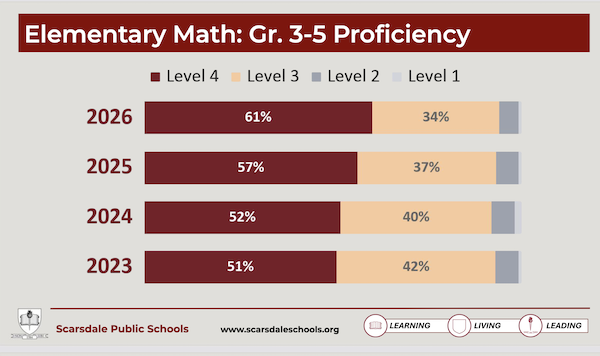
Elementary math proficiency reached 95 percent among students in grades three through five, with 61 percent scoring at Level 4, the state's highest performance category. District officials attributed the results in part to ongoing work on elementary math instruction and curriculum materials.
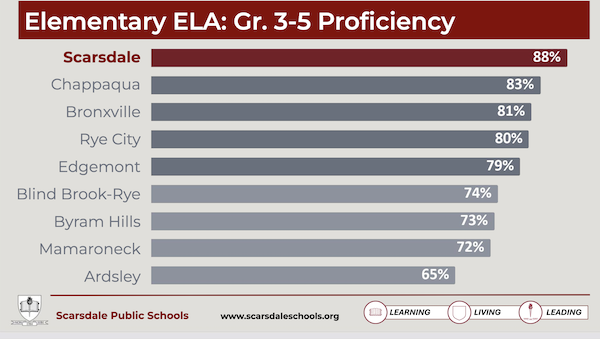
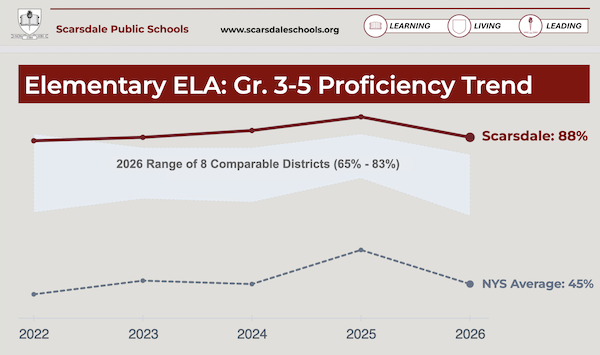
In English language arts, elementary proficiency stood at 88 percent, down from 94 percent the previous year. However, district officials noted that preliminary statewide elementary reading proficiency also declined sharply, from 55 percent to 45 percent.
The district plans to investigate whether changes in the state assessment or previous scoring issues contributed to the decline.
Middle school English language arts proficiency reached 90 percent. In science, fifth graders achieved 90 percent proficiency, while eighth graders reached 91 percent.
District officials emphasized that although standardized assessments provide useful comparisons, they are only one measure of student learning. See the full report here:
District Rethinks Writing and Research in the Age of AI
One of the evening's largest discussions focused on how Scarsdale schools are adapting to the widespread availability of generative artificial intelligence.
Scarsdale High School Principal Ken Bonamo, English Department Chair Karine Schaefer, and Social Studies Department Chair Jennifer Maxwell presented the challenges AI has created for traditional writing assignments, particularly those completed outside the classroom.
Maxwell explained that teachers began noticing changes in student writing shortly after generative AI tools became widely available. Essays and creative assignments sometimes appeared far more polished than students' previous work, while fewer students sought help from teachers during office hours.
Teachers initially responded by clarifying expectations for AI use and monitoring students' writing processes through tools such as Google Docs revision history. However, Maxwell said these measures have become increasingly difficult to enforce as AI tools have improved and students have found ways to disguise their use.
"We have learned the hard way that there is no assignment you can design that AI can't produce a reasonable answer to," Maxwell said.
Schaefer emphasized that the problem is not simply one of academic dishonesty. Students face significant pressure from grades, extracurricular activities and demanding schedules, making AI an appealing shortcut. She also noted that students who complete assignments without AI may feel disadvantaged when classmates submit more polished work with outside assistance.
Rather than relying primarily on AI detection tools, the English and Social Studies departments are pursuing what educators described as an "AI-resilient" approach to instruction.
This involves moving more writing and research into the classroom, where teachers can observe students developing their own ideas and provide guidance throughout the process.
Longer assignments are increasingly being divided into smaller exercises completed over several class periods. Teachers are also using shorter in-class essays and redesigning research projects to emphasize individual skills, including evaluating sources, developing arguments and selecting evidence.
The goal is to preserve what educators called "cognitive stamina," or students' ability to work through challenging intellectual tasks without immediately turning to technology for answers.
The district acknowledged that these changes involve tradeoffs. Spending more class time on writing leaves less time for other material, while students have fewer opportunities to work independently on lengthy assignments at home.
Scarsdale High School will also pilot a block schedule for five days after Thanksgiving. The trial will allow teachers to use longer class periods, potentially giving students 94 minutes instead of 47 minutes for sustained writing and other assignments.
During Board questions, members discussed whether schools should prohibit AI entirely or place greater emphasis on detecting unauthorized use. Educators said existing detection methods remain unreliable and could unfairly accuse students who completed their own work.
The discussion also raised questions about how to balance independent thinking with preparing students for a workforce where AI tools are becoming increasingly common.
For now, district educators emphasized that students must first develop strong writing, research and critical thinking skills before learning to rely extensively on AI.
AI Literacy Begins in Elementary and Middle Schools
The district is also expanding efforts to teach younger students how artificial intelligence works.
William Yang, Scarsdale's K-12 Coordinator for Digital Learning and Literacy, explained that the district is taking a cautious approach to introducing AI in classrooms. Rather than immediately adopting commercial AI tools, teachers are focusing on helping students understand algorithms, data, misinformation and the limitations of AI-generated content.
At Scarsdale Middle School, teachers are piloting AI literacy lessons that explore how AI models learn, why their responses can contain inaccuracies and how bias can emerge from training data. The lessons were initially developed for sixth and seventh graders, with eighth-grade teachers also choosing to participate.
At the elementary level, similar concepts are being incorporated into existing library, technology and research projects. Students are learning how algorithms work, why information generated by AI should be checked and how technology can affect their digital footprints.
Yang said the district's goal is to develop students who can evaluate technology critically while maintaining their own creativity and independent thinking.
"Our goal isn't to shield students from the modern world, but to equip them with the deep, critical, and creative thinking skills, strategies, and dispositions required to lead in it," Yang said.
Annual Audit Finds District Finances in Good Standing
Earlier in the evening, the Board convened as the district's audit committee to review the annual external audit for the fiscal year ending June 30, 2026.
Scott Oling of PKF O'Connor Davies presented the results, reporting that the district received a clean, or unmodified, audit opinion. The district collected approximately $190.7 million in general fund revenue, with spending coming in close to budget at approximately $190.5 million, plus outstanding commitments.
The district's general fund balance declined from $22.1 million to $20.6 million, a smaller decrease than the $4.2 million originally anticipated. Of the remaining balance, approximately $11.3 million is restricted for specific purposes, while $7.8 million is unassigned.
Oling cautioned that continued reductions in the fund balance could affect the district's credit rating as it prepares to borrow money for its $101 million capital improvement program.
The audit also identified eight student clubs with negative balances totaling approximately $16,000. Assistant Superintendent for Business Andrew Lennon explained that the deficits were related in part to transfers between student accounts and confirmed that all eight had since been brought back into balance.
The audit committee voted to recommend acceptance of the audit and the district's corrective action plan.
School Lunch Program Remains Under Review
The Board discussed the possibility of joining New York State's Universal Free Meals initiative. Assistant Superintendent for Business Andrew Lennon explained that the district decided to maintain its current lunch program for the 2026-27 school year due to financial concerns. The existing program lost money last year, and officials worry that switching to the state initiative could increase those losses. The district has extended its contract with Chartwells K-12 and will continue reviewing meal quality, affordability and future participation in the program.
School Safety, Technology and Community Initiatives
Board members provided updates on school safety, facilities and technology. Discussions included pedestrian safety, communication with families and possible additional supervision of athletic facilities. At the middle school, plans are underway for a Common Circles exhibit, an outdoor classroom and future renovations to dining and library spaces.
The technology committee also discussed concerns about classroom technology and AI, including the possibility of updating a 2023 district survey and holding additional educational events for families.
Policy Changes and Other Board Business
The Board postponed a proposed change to check-signing authority pending further discussion with district auditors but approved an increase in the district credit card limit from $2,500 to $10,000. Members also approved budget transfers, new high school English textbooks and several donations, including $12,000 for a Greenacres artist-in-residence program, $24,500 for Fox Meadow field trips, $8,100 for Edgewood teacher grants and $7,400 for new window shades at Quaker Ridge.
The Board's next business meeting is scheduled for November 16, following a joint meeting with Village trustees and a public forum on the 2027-28 school budget.