






Letter to the Editor In Support of Code Changes Regarding Wetlands, Watercourses and Buffers
- Monday, 03 August 2026 22:36
- Last Updated: Thursday, 06 August 2026 09:49
- Published: Monday, 03 August 2026 22:36
- Joanne Wallenstein
- Hits: 988
 The following letter was written by Yingying Na and Wei Zhou of Rock Creek Lane:
Dear Chair and Members of the Planning Board,
We write as residents of Scarsdale, and as neighbors who have spent the past several months following the application at 0 Spier Road (tax parcel 19.01.375), to express our strong support for the amendment to Chapter 171 of the Village Code now referred to your Board for review here. We respectfully urge the Planning Board to recommend adoption of the amendment as drafted, without weakening any of its protections for wetlands, watercourses, and their buffers.
The amendment finally puts into law what our community has understood for decades. The draft adds new findings to § 171-1 recognizing that wetlands and their buffers control flooding by slowing overland runoff and absorbing and storing sheet flow; that they trap sediment and filter stormwater-borne pollutants — fertilizers, pesticides, heavy metals, and septic leachate — before they reach a stream; and that undisturbed buffer areas are themselves critical, irreplaceable habitat, not just leftover space around a wetland. These are not abstract principles. They describe exactly what is at stake whenever a steep, wooded, stream-adjacent lot is cleared and excavated for construction.
The amendment closes a real loophole in how "wetland" is defined. Under the current code, wetland status turns heavily on the Village's Freshwater Wetlands Map, adopted in 2011. A lot can lose protection simply because it was never accurately reflected on that map, whatever its actual ecological condition. The proposed definition instead identifies a wetland by the presence of hydric soils and hydrophytic vegetation, using the federal delineation standards the Army Corps of Engineers applies nationwide. This change means the Village's protection follows the actual, on-the-ground condition of the land, not a fifteen-year-old drawing, and it removes the incentive for an applicant to argue a technicality rather than the facts.
The amendment closes a gap on tree removal near wetlands and watercourses. New § 171-6(B)(7) requires Village Engineer or Director of Planning review before any tree within 50 to 100 feet of a wetland or watercourse can be cut in a way that involves stump removal or the use of motorized equipment. Mature trees on steep, stream-adjacent slopes hold soil in place and slow runoff; removing them at scale, without any Village review, is precisely the kind of activity this chapter exists to prevent.
The amendment makes buffer protection and mitigation real, not just aspirational. It requires a mitigation plan whenever a controlled activity within a wetland buffer is approved, with genuine replacement of the disturbed area on at least a one-to-one basis, and it raises the maximum penalty for violations from as little as $250 to up to $1,500 a day. Protections that cannot be enforced are not protections; this amendment gives Chapter 171 actual teeth.
The amendment ensures that approved plans stay the approved plans. New § 171-8 provides that permits expire twenty-four months after approval and, importantly, that there shall be no changes, additions, modifications, or revisions to any plans, applications, or permits without approval. This provision addresses a pattern our neighborhood has watched closely: a project reviewed in one form, then revised afterward in ways that expand its footprint, its height, or its disturbance of protected areas. Under the amendment, those revisions come back for review rather than proceeding by default.
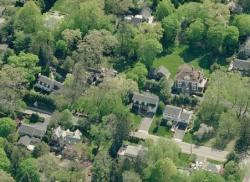
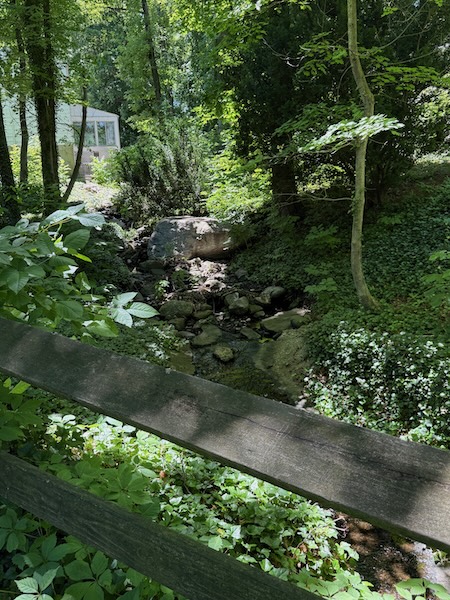
We ask the Board to consider why this matters using a case this Board knows well. The parcel at 0 Spier Road has been recognized by the Village as environmentally constrained wetland since its creation in 1968. It borders an active stream on one side and an open storm water drain on the other, sits on a slope with a 20-foot elevation drop, and the proposal calls for removing 13 mature trees plus substantial excavation and grading to fit a new house onto an irregularly shaped 7,538-square-foot lot. This is, almost precisely, the profile of site the amendment's new findings describe: a wetland-adjacent, steep, buffer-dependent parcel where flood control, sediment trapping, and habitat connectivity are not incidental benefits but the reason the land was recognized as wetland in the first place.
We recognize that this Board approved that application with conditions on May 27, and we are not asking the Board to revisit that decision in this proceeding. We do ask the Board to note what has happened since. The application was referred to the Board of Architectural Review, and the BAR has now denied it twice — in June and again in July — finding that the lot is small and irregular and that a structure of this height on a footprint this small is incompatible with the character of the neighborhood. The applicant may well return to the BAR with a revised design.
The community response has been substantial and sustained. The petition opposing the 0 Spier Road development has now gathered 410 signatures (stopzerospier.org), and it continues to grow. Residents have appeared before this Board and before the BAR repeatedly over the past several months. We raise this not as a headcount but as evidence of something relevant to your recommendation: the concern here is not confined to the handful of households that border this particular lot. Village-wide, residents are telling their boards that land the Village has recognized as wetland should not lose that protection at the moment it becomes profitable to build on. The amendment before you is the Village's opportunity to write that expectation into enforceable law.
That sequence is the strongest argument for adopting this amendment now. The May 27 wetlands review was conducted under Chapter 171 as it currently reads: a map-dependent definition of wetland, no review requirement for tree cutting near a watercourse, and mitigation standards that the amendment now makes specific and enforceable. Had the proposed provisions been in effect, this Board would have had materially better tools — a definition grounded in actual site conditions, explicit findings on flooding and erosion to weigh, a required mitigation plan with real replacement ratios, and clear authority over any later revisions to approved plans. On a lot where any redesign necessarily means further excavation, grading, and disturbance near the stream, those tools matter for what comes next, and they matter for every similarly constrained parcel in the Village.
One clarification we respectfully suggest. Proposed § 171-15 provides that "any existing encroachment into a freshwater wetland controlled area as of the effective date of this amendment shall not be subject to the requirements of this article." We support grandfathering genuinely pre-existing physical conditions. We would ask the Board to consider recommending language confirming that this provision reaches encroachments that physically exist as of the effective date, and is not read to exempt approved-but-unbuilt projects or future revisions to them. Without that clarity, the provision could be invoked to place precisely the projects this amendment targets outside its reach.
Our request. We respectfully ask the Planning Board to review and recommend the proposed Chapter 171 amendment to the Board of Trustees for adoption without narrowing its definitions, weakening its buffer and mitigation requirements, or diluting its tree-removal, permit-revision, and enforcement provisions. Considerable acreage of Scarsdale's wetlands and watercourses has already been lost or impaired by draining, filling, excavating, and construction disturbing natural buffer areas; without stronger protection, what remains stays at risk. This amendment is a meaningful step toward ensuring that Scarsdale's remaining wetlands, watercourses, and the neighborhoods that depend on them are protected not just on paper, but in practice.
Thank you for your time and consideration, and for your service to our community. Please include this letter in the public record for the proposed Chapter 171 amendment.
Respectfully,
Yingying Na and Wei Zhou
230 Rock Creek Lane
Note: Scarsdale10583.com reached out to Village Manager Alex Marshall to find out if the proposed code would affect plans to build a home at 0 Spier Road. Here is her reply:
0 Spier received a Wetland Permit from the Planning Board for proposed activities within the Wetland Controlled Area and Wetland Buffer. This information along with the Wetland Report that was provided by the Wetland Scientist is available in the Drop Box for the May 2026 Planning Board Meeting, the link to which can be found here.
The BAR does not have site plan or wetland permit approval authority so if the applicant deviates from the approved plans, they may be sent back to the Planning Board to amend their proposal and existing wetland permit. The plans will be checked by staff when the applicant submits for a building permit to ensure consistency.