








Neighbors Ask Trustees to Address Neglect of Historic Woods Lane Home
- Wednesday, 09 September 2026 21:28
- Last Updated: Thursday, 10 September 2026 12:42
- Published: Wednesday, 09 September 2026 21:28
- Joanne Wallenstein
- Hits: 1614
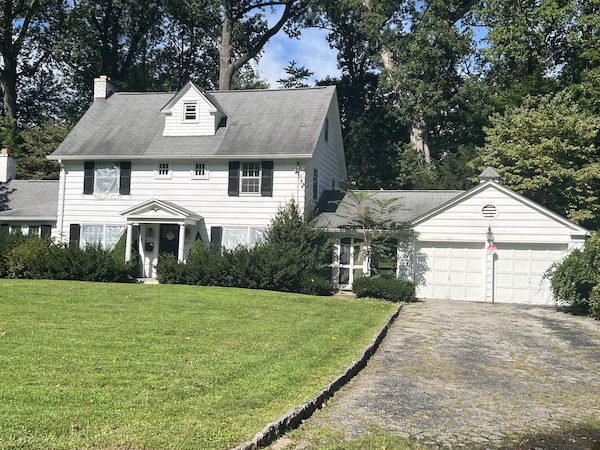 Broken windows at 27 Woods LaneResidents of the Woods, in Edgewood, returned to Village Hall on September 8, 2026 to ask the Village to prevent the neglect of a historic and unoccupied house at 27 Woods Lane. These same neighbors led a successful campaign to save the house after a realtor purchased it and applied to knock it down and subdivide the lot. Since it sits on a prominent lot on a well-preserved street in a historic portion of Edgewood, they were passionate about saving it.
Now, years after the Village designated the home as historic, the owner has left it empty and uncared for, and teens have broken in on several occasions to party on the premises. Neighbors are concerned about the deterioration of the home.
Maura Lee, who lives next door to 27 Woods Lane came to the meeting to “request that the village take meaningful action regarding this property.”
She said, “27 Woods Lane is a historic home and has been allowed to fall into a serious state of disrepair. The broken door and windows, repeated trespassing, indoor and outdoor parties by intruders, and the ongoing neglect of the property all demonstrate deterioration that is affecting not only the structure itself but our surrounding neighborhood. Section 182.12V of the Village Code states: No owner or person with an interest in a building that has been identified by the committee to be an historic building shall allow the property to fall into a serious state of disrepair, so as result in deterioration of any part of the building or significant architectural feature. Based on what has happened at 27 Woods Lane, I do not believe there's any real question that this standard has been met:
“After contacting the police multiple times to report intruders, I also reached out directly to the owner of 27 Woods Lane. Since she is both a Scarsdale Realtor and a current resident, I asked her to secure and care for the property in the way any of us would expect from a next-door neighbor. When I asked that a security camera be installed, she declined, stating that the property does not have Wi-Fi.”
“To me, that response reflects a lack of basic investment in securing the home, especially after repeated break-ins and damage to both the interior and the exterior. As we enter storm season and colder temperatures, I'm also concerned that continuing neglect could lead to additional damage, including frozen pipes, packed pipes, and water damage. These are foreseeable risks when a house is left unsecured and unattended.”
“This is no longer just a private property issue. The owner's neglect has allowed 27 Woods Lane to become a public safety concern and a public nuisance, affecting the health, safety, and welfare of our neighborhood. I understand that the Village has tried to give the owner time to comply, but from the perspective of neighbors who live with the consequences every day, that time has passed. The burden should not continue to fall on Woods Lane residents to monitor the property, call the police when something happens, and live with the risk created by another owner's inaction.”
There's been a great deal of emphasis on the owner's rights, but the neighbors are also being harmed. We are less safe. The house has become an eyesore, and continued deterioration threatens the character and property values of the surrounding neighborhood. It is deeply frustrating to watch a historic property that we fought so hard for be neglected to this extent, while the surrounding community continues to invest in and care for this neighborhood.”
“I grew up on Hampton Road in Scarsdale. My sister recently visited and saw the condition of 27 Woods Lane. She was shocked that this level of neglect is being permitted in Scarsdale. Broken windows and unsecured openings are not minor cosmetic issues. They invite trespassers and allow weather and water to further damage the home. Section 18210 gives the board enforcement authority, including civil penalties up to $50,000 and the ability to seek a court order requiring compliance. I respectfully ask the board to treat this matter with urgency and to use the enforcement tools available under the village code to require the owner to secure, weatherproof, and properly maintain 27 Woods Lane before the historic property deteriorates further and before the neighborhood is asked to bear even more of the consequences. If the owner does not comply immediately, any necessary repairs should be completed at the owner's expense.”
Jared DePalma of 10 South Woods Lane. I wanted to also address 27 Woods Lane specifically in relation to Section 180 2b of Historic Preservation Code. We believe the facts at this point are fairly straightforward. The property has been formally identified as a historic building under Chapter 182. The village has acknowledged that the current condition of the property requires remediation, and the village has received multiple documented complaints regarding the condition of the property. Despite this, the property continues to deteriorate, and as far as we are aware, there has been no meaningful enforcement action on the owner.”
“Our concern is no longer simply the condition of the particular property. The larger question is whether the village intends to enforce a provision of its code after it has determined that a violation exists. We completely understand that the village should give a property owner reasonable opportunity to correct a violation, but at some point, if there is no remediation, there needs to be a consequence or a next step. Otherwise, Section 188212B has little practical meaning. This also affects the surrounding neighborhood. Residents maintain their properties, comply with village requirements, and reasonably expect the village to enforce its code consistently, practically, and when the purpose of this provision is to prevent the deterioration of a historic property, so we would respectfully ask the village to answer three questions this evening.
One: Does the village consider this property to be a violation of Section 182 12 B?
If the answer is yes, what is the next formal enforcement step available to the village?
And third, what is the timetable for taking the steps if the owner does not bring the property into compliance?
We are not asking the village to prejudge the owner or take unreasonable actions. We are asking for a clear enforcement process and a reasonable timeline.
Jim Detmer said, “I live next to 27 Woods Lane, and in its current condition, it suggests abandonment and purposeful neglect. We are convinced the owner developer is dead set on demolition by neglect, as indicated by their inaction over the past three years, and specifically their inaction over the past three months. We ask the village investigates developing more robust building and enforcement code to mitigate purposeful neglects.
Ideas may include the denial of any demolition or infill permit for the neglected property, no building permit, unless the alterations, additions, and renovations enhance the existing structure, and align with the historical footprint of the house and align with the historical fabric of the neighborhood. We need to get tough here. We need to come down harder.
If you have a two and a half million dollar investment and you have that sitting around three years doing nothing, a $50,000 fine is not going to move the needle. We need to be more impactful with the consequences for failure to comply. My genuine fear is that we're sitting here a year or two from that, talking about purposeful neglect”
“We must act now and head off this potential disaster for the community and neighborhood. So the question is, what can we do to enhance penalties for purposeful neglect, we must get ahead of this. We can't be sitting here, like I said, a year or two from now, playing around with the same issue. Three years ago, almost to the day, it was deemed that this was a historical property, and it just been spin on for three years.
Linda Killian said, “I live down the street from 27 Woods Lane, and I see this house every single day. Over the past three years, I think the village has received ample documentation in this room through meetings with mayor and through complaints to the police department about activity at the house.”
“I'd like to bring up just a couple of additional points that my neighbors didn't bring up, and one is that it is one house, but it is a house that is historic and it's very important for Scarsdale to maintain the integrity of our community. And part of our heritage is the beautiful older homes that were built during the 1920s and early 1930s. This is one of those homes in a planned, in an era of planned suburbanization.
The second point that I'd like to make up that wasn't touched upon is that by allowing this to persist and by not enforcing village code, you are encouraging other developers to employ the very same strategy of intentional neglect to obtain permission to tear down an historic designated home or an older home, it will simply encourage more of this unless it stopped.
Finally, what I'd like to bring up is something that I've done some research on, but I'm not certainly not an expert on, and that is the issue of liability. Who is going to be liable if there is another party, and someone gets hurt? Some teenager drinks too much, gets hurt, gets raped, lies out in the snow after having consumed a lot of alcohol or drugs, who gets sued? Does the homeowner the does the owner of 27 Woods have liability insurance?
If an incident happens and it's not insured I sincerely believe the village, meaning all of us, are at risk of a lawsuit brought by the parents of one of these teenagers, and I just want you to think about that from a risk and legal standpoint.
Jordan Copeland, also a neighbor said, “One of the harder things the Village and staff have to balance is flexibility. Being overly rigid with a property owner who is genuinely trying to comply can feel punitive, so I’d think that any municipality would be justified in assuming good faith and giving an owner a fair chance to fix problems. But good faith is not a permanent, unearned status. At some point, good faith has to be demonstrated in results, and in this case, it has actually been refuted.
27 Woods Lane has been vacant for years, now with damaged windows, unauthorized entry, debris, and ongoing exposure to the elements. If the owner were genuinely acting in good faith, we would be able to see it already: the house secured, openings repaired or weatherproofed, and clear Village deadlines being met. But at some point, continued delay merits strict, formal enforcement.
The code itself gives the Village a reasonable framework. Under Chapter 132, once the Building Inspector issues an unsafe-building order, remedial work generally must begin within 10 days, and be completed within 30 days, unless the Inspector grants more time. That is not an aggressive standard. If someone were actually living in this house, we know these issues would have been fixed long ago. If the property owner was genuinely interested in protecting their property, these issues would have been fixed. Windows or wifi are a pretty small cost to protect a multi million dollar property, if you’re actually concerned with protecting it.
I am not asking for a harsh response. I am asking that when a property is demonstrably not being maintained or protected, informal assurances by the owner need to give way to formal requirements and consequences from the village.
That matters especially here because 27 Woods Lane is not just any vacant house. The Village has already determined that it is worth preserving. That designation only means something if the house survives long enough to be preserved. Otherwise, neglect quietly does what demolition review was designed to prevent.
So my ask is that the village set specific, measurable requirements; set a deadline; schedule a follow-up inspection; and escalate enforcement if the owner does not comply. Giving an owner a fair chance is reasonable, but letting a protected property deteriorate indefinitely without measurable proof of progress is not.
The Mayor responded to the speakers, saying,, “… I really appreciate the concern and the passion and the involvement and the willingness to keep coming and speaking with us. Of course, we understand how important of an issue this is for many. I think I can say that this board, particularly over the last few years, has a very proud and strong record on historic preservation and on building code enforcement. Something I certainly stand by, and I'm happy to debate.”
“You know, in any regard, I believe some of the challenges here, and I really do not like talking about any specific situations, applications, homes from up here. But what I would say briefly is, the Building Department and Police Department have been involved in this matter. We will be getting another update, but to my knowledge, the Building Department has not determined that it is in a serious state of disrepair at this point.”
“…If we believe that there is an infraction of our code, we will enforce it. Period. Full stop. And that is not going to change. And we will stay involved in in any matter that there's concern, and we will try to be objective, and we will make sure that our codes are enforced.”
“I want to mention that some of the possible suggestions for code changes -- which we always appreciate and welcome -- can be a slippery slope. I don't think we can require someone to live in a house. And what happens if someone goes to Florida for six months? What happens if somebody gets relocated for work and leaves for two years? I'm not saying that's what's happening here, and I'm not trying to belittle or minimize the concerns of any residents. But we just have to be careful that as we change our code, there could be unintended consequences, and we always have to be aware of that.”
Comments