






Comments From Mayra Kirkendall Rodriguez and Bob Harrison
- Details
- Written by: Joanne Wallenstein
- Hits: 3750
 Here are comments From Mayra Kirkendall-Rodriguez delivered during public comment at the Board of Education, June 1, 2020
Multiculturalism, Diversity and Inclusion Initiatives of the Scarsdale School District Are Important
In the first couple of Zoom Board meetings, I shared you with my analysis and forecast for the national and NY State economy. Unfortunately, I still not even the beginning of a recovery next year. I also stated that I was and am very concerned about Scarsdale residents’ ability to absorb tax increases. I very much appreciate Messrs. Mattey’s and Martin’s analysis of key stress factors such as very low interest rates, declining sales tax revenue, and the low probability of more state aid. In my professional experience, your stress analysis was sound and detailed. Your process helped me come to support this budget and to vote yes on it. I encourage my fellow residents to please review the incredible amount of material on the website, and if nothing else, please look at the very good tables and graphs in the District’s publication Insight.
For the next budget process, I would encourage the administration and board to detail to the community what the learning objectives are for your established multicultural, diversity, and inclusion initiatives which you have from K-12 and what funding is being allocated to meet those objectives.
Today the Dean of the Wharton School wrote an email to alumni stating “Words cannot express how profoundly saddened I am that African-Americans, and people from other racial, ethnic, and religious groups, are systematically marginalized and routinely subjected to racism, all the more so when this threatens their lives and their livelihoods.”
And you Dr Hagerman, in your holiday greeting letter wrote “We recognize that embracing inclusivity and the diversity within Scarsdale takes a concerted effort. It requires awareness of our similarities and differences, specific and accurate knowledge of others’ values and beliefs, along with the skills to individually negotiate various types of multicultural relationships. There are certainly structural changes that can support that work, and we are committed to doing that. It is important as an institution that we consistently state and model our beliefs.”
I encourage you to let us know what guidance and curricular development you will have for our students to understand, what is a riot? What are the historical, economic, psychological, racial, climate change, or religious causes of riots? How have riots unfolded in Russia and South Africa, as opposed to here in the US? Are the people who participate in riots thugs? Or are the ‘riots the language of the unheard’ as Dr. Martin Luther King Jr said in 1968? What should be Scarsdale school’s role in producing future leaders who will be looking for solutions to racism and marginalization, long after we are gone? Good night and be well.
Letter from Bob Harrison
To the Editor: Mr. Klein is "not" one of the two best candidates for the Scarsdale School Board. Bob, where have you been for 36 years in Scarsdale? We have never seen you at a public Board of Education meeting or a Village Board meeting. Have you ever volunteered and served on any Scarsdale Forum Education Committee or any other Forum Committees? To our knowledge the answer is NO.
Have you ever studied the Scarsdale School Budget as we have over 25 years? Have you ever participated in any School Budget Study Sessions? We think the answer is NO. Do you know what the size of the School District's unassigned Fund Balance is and that it can be used to lower any tax rate increases - a very important decision for the BOE. Bob you say you represent the empty nesters but based on your property taxes you have no skin in the game. You have lived in Scarsdale with a very little contribution to the community for years. There is an indication that have property in the mountains.
With regard to your nomination for the School Board by the secret SBNC nominating committee we do not know how many candidates were considered. There are comments in the community that there was only one other candidate considered for the second open Board position which is not very representative for over 12,000 registered voters. For voters you should know that the SBNC has not always been good in their nominations. Recently the SBNC FAILED to re-nominate Pam Fuehrer to a second three-year term for no good reason.
There was a political group within the SBNC who wanted a new school at Greenacres. Who says the secret SBNC is a great system? Pam ran independently like Mayra Kirkendall-Rodriguez is doing now and won the election. Pam is now President of the School Board and doing a great job as Mayra will do,
We strongly recommend that Scarsdale Taxpayer Voters vote for the two best candidates with the best resumes and volunteerism and children in Scarsdale Schools who are:
Mayra Kirkendall-Rodriguez who is a significant volunteer in the schools and community including the Co-chair of the Fox Meadow School Multicultural Committee, and the Young Writers' Workshop, Co-chair of the Scarsdale Forum's Education Committee with understanding of the school budget and educational needs of the District.
Mayra's professional and educational background are extensive as a bank and capital markets risk consultant and trainer with international clients as the owner of MRV Associates and she has holds degrees from Harvard/Radcliffe, the Lauder Institute and the Wharton School MBA at Penn and has studied at Hebrew University in Israel. Her analytical abilities would be helpful and important to the Board with the economy in a depression.
Amber Yusuf who is a proven volunteer for Scarsdale as a PTA leader and seasoned professional to serve on the School Board. Her education training as an electrical engineer from Washington U in St. Louis and MBA from California Berkeley make her an analytical thinker to problem solve on the Board.
Amber has served within the schools as Heathcote PTA president and PT Council president. She served as After-School Clubs Chair and serves as a hockey mom with her family.
Please put your X on the ballot for Mayra Kirkendall-Rodriguez and if you chose a second candidate make it Amber Yusuf and mail it in the pre stamped envelope immediately to be received by the School District by 5 PM on Tuesday, June 9th.
If you have any questions, please contact us at 914 646-4054 (cell) or by email at [email protected].
Bob Harrison
Fox Meadow Road
Scarsdale Taxpayer Alert
Letters in Support of Bob Klein and Amber Yusuf for Scarsdale School Board
- Details
- Written by: Joanne Wallenstein
- Hits: 3695
 Here are letters in support of Bob Klein and Amber Yusuf for Scarsdale School Board:
To the Editor: Bob Klein and Amber Yusuf are two outstanding school board candidates who have been vetted and nominated by the nonpartisan School Board Nominating Committee. They have demonstrated intelligence, integrity, independence, and a steady temperament. As a slate they will bring both experience and a fresh perspective to Scarsdale’s Board of Education.
The SBNC represents you. Look at the member list at scarsdalesbnc.com to judge for yourself. You will find a diverse cross-section of your friends and neighbors reflecting today’s Scarsdale. There are empty nesters and parents of children at every level of the school system, working professionals and full-time caregivers, life-long residents and recent arrivals to Scarsdale and the United States.
As the current Joint Committee and former SBNC chair, I am proud of the SBNC’s diversity of age, race, gender, ethnicity, religion, and life experience. The SBNC is not some “establishment” seeking to maintain the status quo, but rather a dynamic, independent collection of residents with a variety of perspectives and a shared desire for the highest-functioning school board. After months of fact finding and discussion, they have nominated two excellent community volunteers.
Bob Klein is a creative, analytical former architect, an "empty-nester" with extensive professional experience in long-term, complex planning and problem solving. He is empathetic and action-oriented, having helped found an organization which welcomes, protects, and advocates for refugees. Bob has a demonstrated ability and willingness to think outside the box and ask the questions that lead to better solutions.
Amber Yusuf is a standout Scarsdale volunteer with comprehensive, high-level experience on both the school and village sides, from PT Council to the League of Women Voters to The Acceleration Project. She has professional strategic, financial, and global expertise and is a respected and approachable straight-shooter. Amber possesses the passion and comprehensive knowledge to hit the ground running as a new school board member.
I enthusiastically endorse the SBNC’s composition, process, and nomination of Bob Klein and Amber Yusuf for the Scarsdale School Board.
Jordan Copeland
Woods Lane
Having lived in Scarsdale for more than 40 years, I have appreciated the careful study that the two nominating committees that select candidates for the Village Board and School Board commit to. The committees study the candidates’ skills, experience, history of working constructively with others and so much more. The recent work of the School Board Nominating Committee is no exception. With a number of people applying to be candidates for the School Board, the Committee was able to select Amber Yusuf and Robert Klein to serve us. Being able to choose from multiple applicants based on their characteristics, knowledge and all the other aspects that a group of 30 people have studied and pick the candidates that will serve us best has served us well for years. That’s what makes the work of the Board of Education top notch and that is why I support the SBNC’s candidates.
Dan Hochvert
62 Woods Lane
To the Editor:
It is with great enthusiasm that I endorse Amber Yusuf for Trustee of the Scarsdale Board of Education. I am making this endorsement in my individual capacity and not in my position on the SHS PTA Executive Committee.
I have known Amber and her family for ten years, as my neighbor in the Heathcote School District. In addition, I had the pleasure of working with Amber on the PT Council Executive Committee when she was the President of the Heathcote PTA. Amber has all the qualities one would want in a school board member. Amber is intelligent, thoughtful and deliberative. She is open-minded, a careful listener and a consensus builder. Amber brought a unique perspective of multicultural awareness to our PTC meetings and decision-making process. She has the distinctive ability to view problems through the lens of many stakeholders, a skill that will serve her well on the Board of Education.
Amber is a dedicated volunteer. Her extensive experience within the community, both for the Village and for the schools, allows her the perspective necessary to understand and address the concerns of a broad constituency. Her professional experience in engineering and technology, which includes an MBA, will ensure that she is ready to meet the financial and educational challenges of the Board of Education.
Our School Board Nominating Committee has always selected smart, capable and conscientious Trustees and this year is no exception. Amber is highly qualified to serve our community in this role. I strongly support Amber Yusuf for School Board, without reservation.
Sincerely,
Leanne M. Freda
Palmer Avenue
To the Editor,
I have been a resident of Scarsdale for over 13 years, and I am proud to write in support of Amber Yusuf for election to the Scarsdale School Board. I have known Amber for almost 10 years as my two daughters and her two sons have gone through The Little School, Heathcote School and Scarsdale Middle School, and with Scarsdale High School on the horizon for our eldest children.
I served as the Heathcote PTA President under Amber’s leadership during her term as the 2018-19 PT Council President. Amber had two major district initiatives taking place during her tenure -- the decision for the district to take over the school lunch program for all 7 schools, and the security and safety issue which became very contentious among different factions in the community.
As with any change, the takeover of the school lunch program came with an onslaught of issues from disparity between the schools, to food allergies, to the loss of revenue to the individual PTAs. Amber handled each problem calmly, rationally, politely, and, most important, effectively.
When different community groups were aggressively arguing safety and security issues at the schools, Amber was there to guide all of us as PTA Presidents. The questions of whether security guards and teachers should have guns were at the forefront. In typical Amber style, she had done all the research, understood all sides of the debate, and intelligently helped navigate the issue on behalf of the PTA’s.
Amber is one of the most dedicated volunteers to our schools’ programs I have met in my time here in Scarsdale. She has held the most important parent volunteer positions, as the PT Council President and an elementary school PTA President (Heathcote). These positions come with major responsibilities at the district level with constant interaction with the Superintendent and his cabinet, as well as the school board. Amber fulfilled these responsibilities in a most exemplary manner.
Amber is analytical and intelligent, while also being well liked and respected by all who have worked with her. In addition, she is a good listener and always respectful of others. I can’t think of a better candidate for the Scarsdale School Board. We’ll be lucky to have her!
I support the SBNC slate of Amber Yusuf and Robert Klein.
Kate Eichel
Heathcote Road
To the Editor:
I am writing this letter to show my support for Amber Yusuf’s candidacy for a seat on the Scarsdale School Board of Education.
I had the pleasure of working with Amber Yusuf during the time I was after school clubs co-chair and co-president elect for Edgewood PTA (2017-18) and as PTA co-president for Edgewood (2018-19). Over the course of those years, I attended numerous meetings where I witnessed Amber’s openness and willingness to listen to all thoughts and ideas on various topics. Her willingness to truly do what is best for our Scarsdale schools coupled with her business acumen will allow her to be a major asset on the board.
Amber has been a leader within the Scarsdale Schools PTA ever since she moved here. From class parent, to after school clubs chair, to PTA president, to last year as Parent Teacher Council president (and many roles in between), Amber proves to be passionate in all she does. On top of being a wife, mom to two Scarsdale school children, businesswomen, school leader, she also manages to have time for involvement in community organizations. She has been a member of the Scarsdale Youth Hockey Team and the Citizens Nominating Committee of Scarsdale among other organizations.
Amber embodies all of the qualities to make to an excellent candidate. She has my full confidence in her abilities to continue the extraordinary work of the board. I hope you join me and vote for Amber Yusuf for school board; mail-in ballots are due by 5pm on June 9th.
Sincerely,
Susie Smith
Boulevard
To the Editor:
In March, Amber Yusuf was honored to be nominated for the Scarsdale School Board of Education by the School Board Nominating Committee (SBNC), a group of 30 elected individuals from all 5 neighborhoods in Scarsdale. She, along with Bob Klein, hopes to serve the Scarsdale community by maintaining excellence in our schools while balancing our fiscal responsibilities.
They need your support and they certainly have mine!
I have worked closely with Amber for a number of years through PTA efforts in various capacities. I cannot think of anybody more qualified to fill this role for our community.
I am a Fox Meadow resident and have been very active in our FMPTA for 6 consecutive years, serving in a range of volunteer positions from class parent through to one of the VP board positions. In theory, I would not know Amber very well yet through PTC I have worked very closely with Amber and can state emphatically that she is exactly what our BOE needs. I have found her support of all the schools to be exemplary and she brings best practices to us all as well as being open to those we have found successful in our specific elementary school.
Amber is the quintessential person for this type if role: intelligent, thoughtful, fair, able to see situations from multiple perspectives, and most importantly capable of making decisions when there is no "right" answer thus solving challenging situations to further the overall objectives of the school district, students and our community. She is informative, collaborative, and a pleasure to work with to create amazing opportunities and programs for our children.
Jennifer Zola
Carstensen Rd
Scarsdale Kids Take Initiative During Trying Times
- Details
- Written by: Joanne Wallenstein
- Hits: 3915
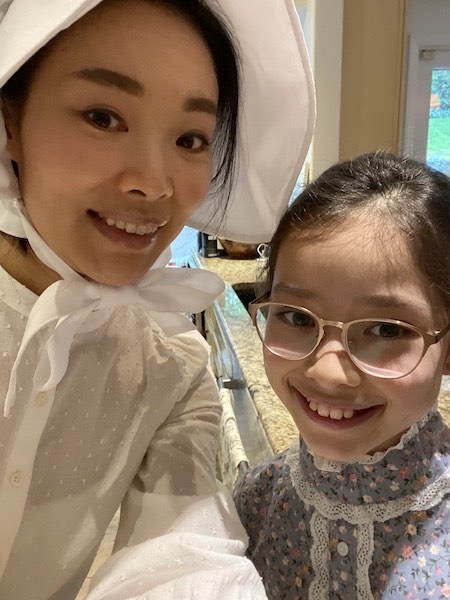 Motoko and Ayaka Gueler dressed for Colonial Day - at homeThough the streets of Scarsdale are quiet, don’t be fooled. There’s lots going on inside. Scarsdale kids are busy learning for themselves and creating great resources to teach one another.
A fourth grader at Edgewood was disappointed about the cancellation of the annual colonial fair and encouraged parents and teachers to design a virtual fair on Zoom. The children made whirly gigs (a Colonial toy), played colonial Bingo and each shared information from his/her colonial research project. Many children wore their colonial costumes for the one-hour Zoom session for Mr. DeStefano’s and Mrs. Aberman’s 4th grade classes.
Gold Award Girl Scouts who are high school students in 11th and 12th grades are busy helping to keep younger troops engaged. Annabelle Donnelly is running a wonderful “Save the Bees” workshop which culminates in girls planting pots of flowers to attract bees and building a bee hotel for mason bees. Gillian Zitrin is running a “Destress through Art and Mindfulness.” workshop which includes yoga, making a “Stress-less box “and a homemade stress ball. Other workshops girls are running include: anti-bullying and a peek into the fashion industry. All of these are executed via Zoom.
And Rebecca Friedland, a fourth grader at Quaker Ridge School created a website called quarantine 4 kids filled with things to keep kids busy during these hard times.
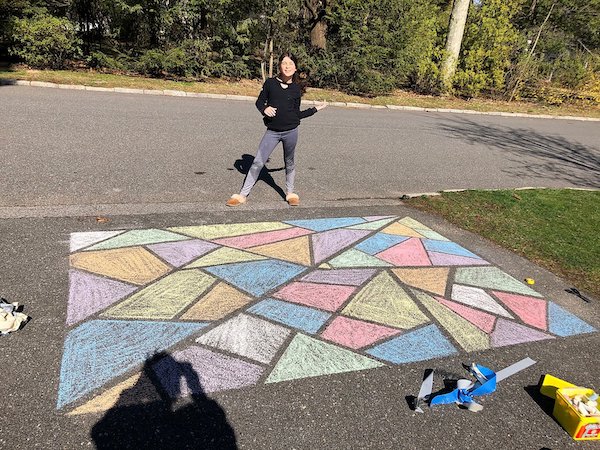 Rebecca Friedland has designed a website filled with fun activities to do during the quarantine.
Find her recipes to cook and projects and to make at www.quarantine4kids.com. She invites you to visit her website to get some great ideas about how to have fun during the quarantine.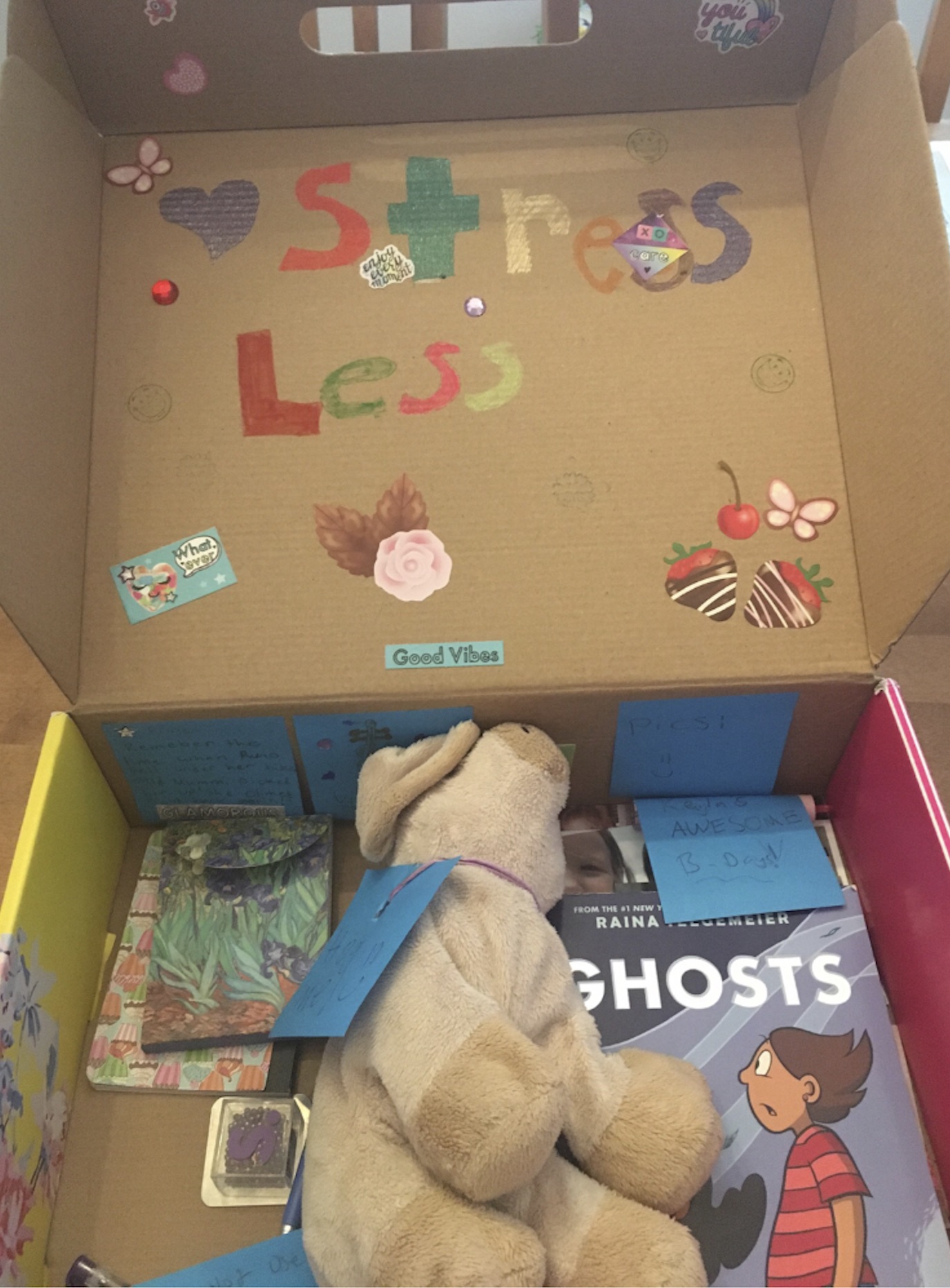 A stressless box designed by 4th grade Junior Girl Scout Sofia Clark during a workshop.
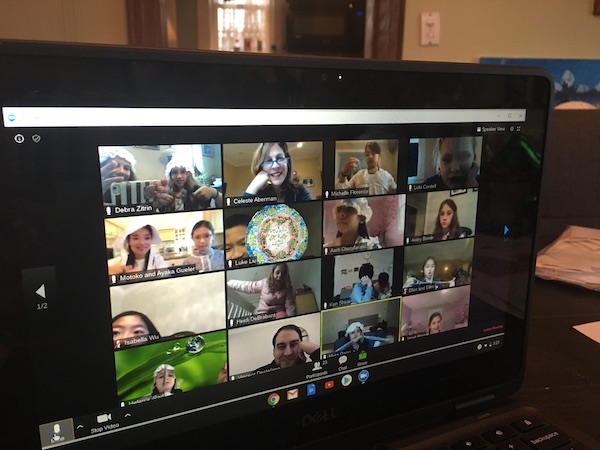 Colonial Day celebration via Zoom
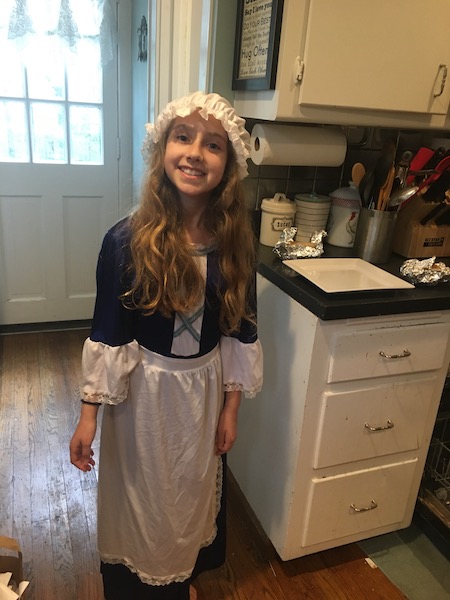 Adina Zitrin - a happy Colonial Day participant.
30 Granted Tenure, School Vets Alternative Ways to Celebrate the Class of 2020
- Details
- Written by: Joanne Wallenstein
- Hits: 3302
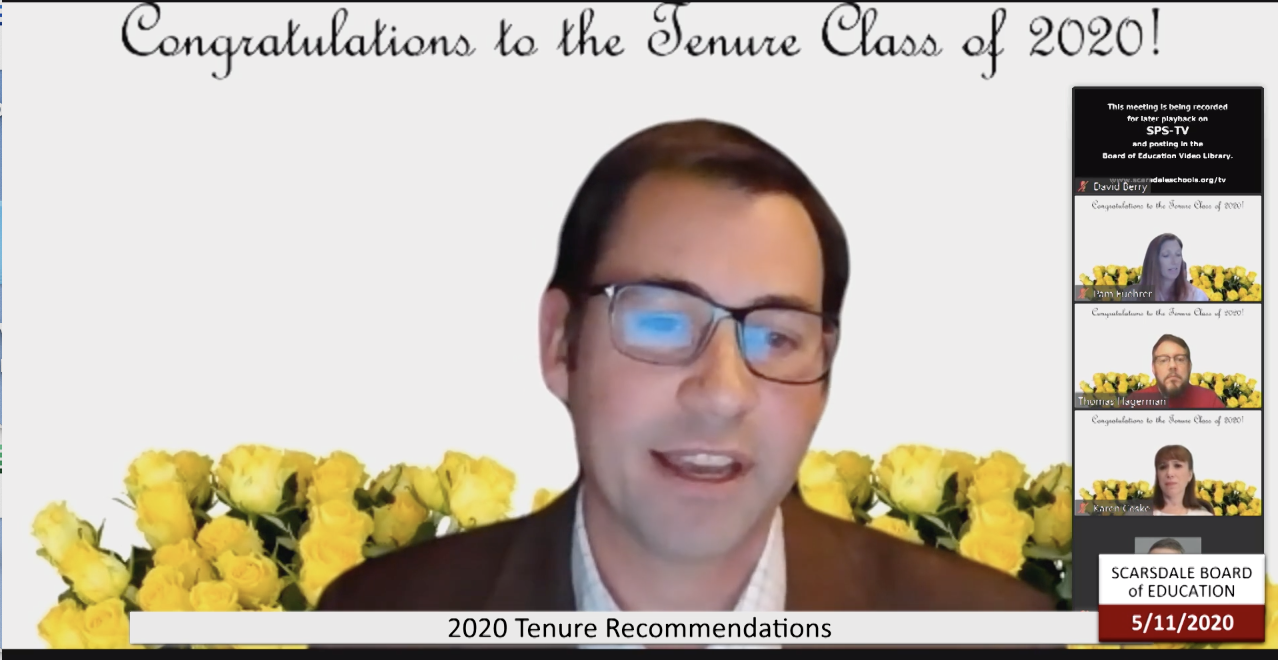 Assistant Superintendent Andrew Patrick with a Zoom background of yellow rosesThe Scarsdale School administration sought to add an air of celebration to the Zoom announcement of tenure for 28 faculty members and two school administrators by appearing before a background of yellow roses at their May 11 meeting.
Traditionally, tenure is granted at a May meeting attended by colleagues and families and each awardee is given a rose. As this year’s ceremony was held online, the administration sought to personalize it with a photo gallery of the faculty and administrators, in the absence of kisses and hugs.
Before the ceremony began, Dr. Thomas Hagerman called for a moment of silence to commemorate the loss of Karen Marcus, a beloved aid at Quaker Ridge, and others who have passed away during this crisis.
He recognized district faculty during Teacher Appreciation Week and gave a formal thank you on behalf of the community, saying that during this pandemic, “Scarsdale teachers have risen to every challenge, just as they always do.”
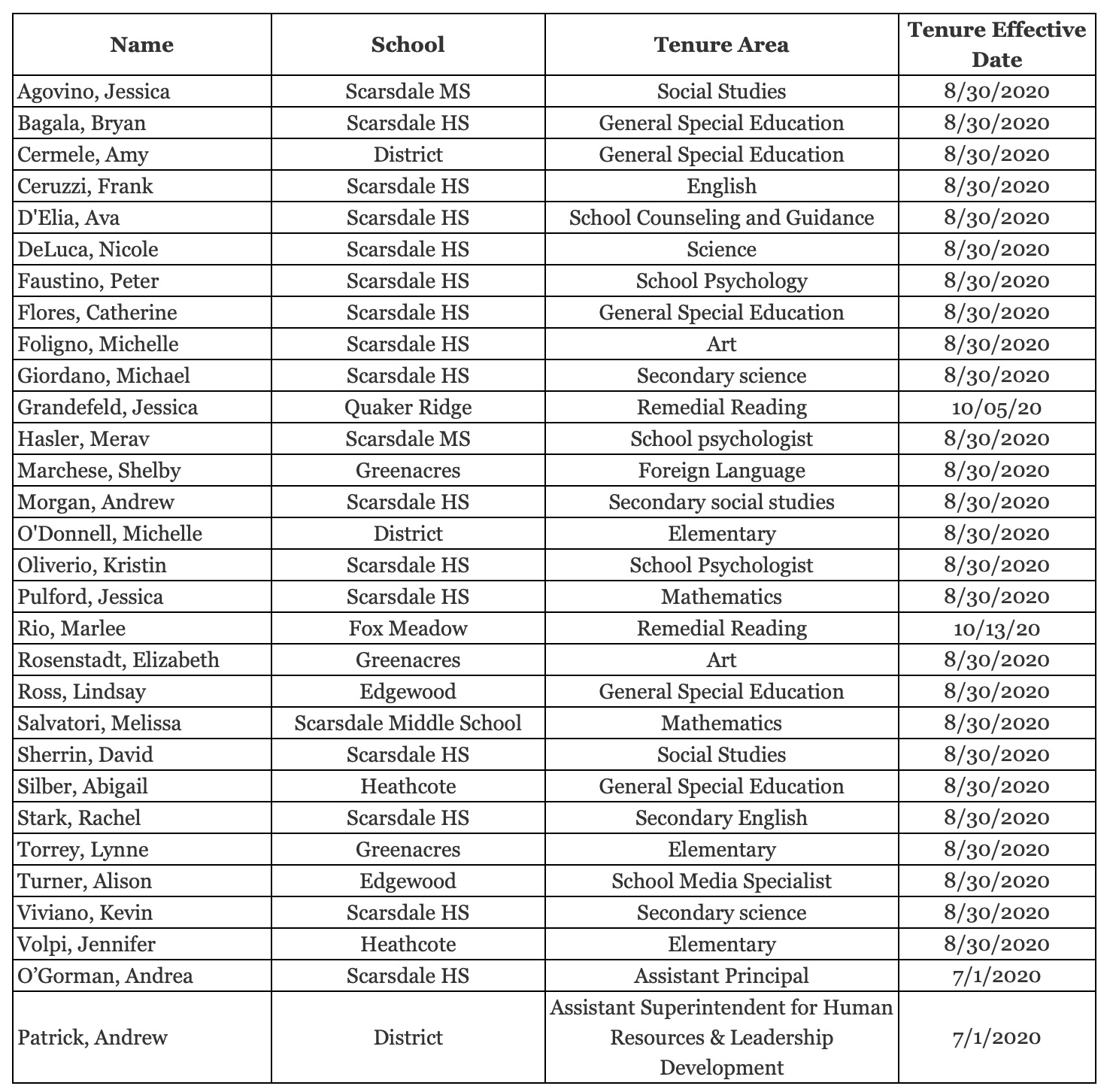
A total of 30 district employees, including 28 teachers and 2 administrators were celebrated on the attainment of tenure. Dr. Hagerman said, “We wholeheartedly believe in you and celebrate your attainment of tenure”
Assistant Superintendent Andrew Patrick, who himself was granted tenure, commented, “Achieving tenure is a significant accomplishment in the career of an educator ….. this cannot happen before a teacher or an administrator successfully completes a probationary period of performance…. Our appraisal system relies on a wide variety of inputs to inform a decision regarding tenure including observations, written reports, ratings, all conducted by supervisors. …. Formal and informal mentoring, a year-end conference, written appraisals, assessment of progress and rating annually, a portfolio of artifacts documenting professional accomplishments, feedback from parents and an administrative review panel attended by district administrators, building administrators, supervisors, and board of education members annually. We believe that the rigors of the tenure process are commensurate with the importance of the achievement.”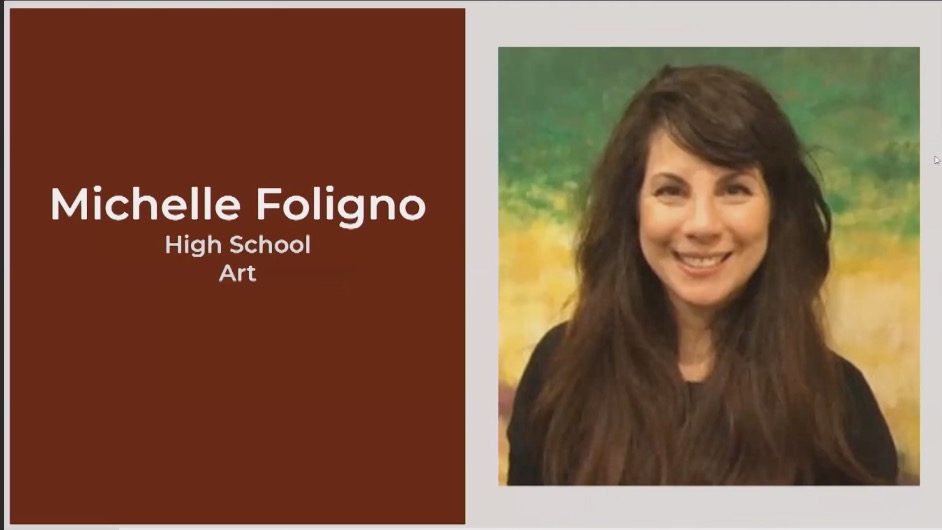
Patrick read a few reflections from portfolios of the tenure candidates.
Here are a few responses to the questions, “Why Do I Teach?”
“I teach because of my students. The students that I have the pleasure of sharing a year full of laughs, friendships, invigorating discussions, acceptances and rejections from college, hardships and accomplishments. I am reminded at the end of each year that their persistent dedication and willingness to put themselves out there in a subject so many express a dislike for, is the reason that I went into teaching in the first place.”
Another said, inspiration without implementation is a waste. This quote is now posted in my lesson planning binder that I look at all the time. I feel inspired by my colleagues, my students, teachers from all over the world and posts I see on Pinterest and Twitter. Being inspired is wonderful. But the difference is taking that inspiration and bringing it into the classroom and doing something with it before the feeling dissipates. I teach because I have a passion not just for my content area but for my profession.”
Dr. Patrick then displayed a photo gallery of the newly tenured faculty members and administrators:
Here they are:
Following the announcement the board gave the group a virtual clap and Board Vice President Alison Singer thanked them for “enriching the lives of their students.”
Celebrating the Class of 2020
Board President Pam Fuehrer outlined some work on behalf of the high school administration, teachers, parents and the PTA to identify ways to celebrate the senior class, who will miss important milestone events such as the prom and their graduation. SHS Principal Kenneth Bonamo has assembled a Senior Events Committee to vet alternate ideas to traditional end of year events.
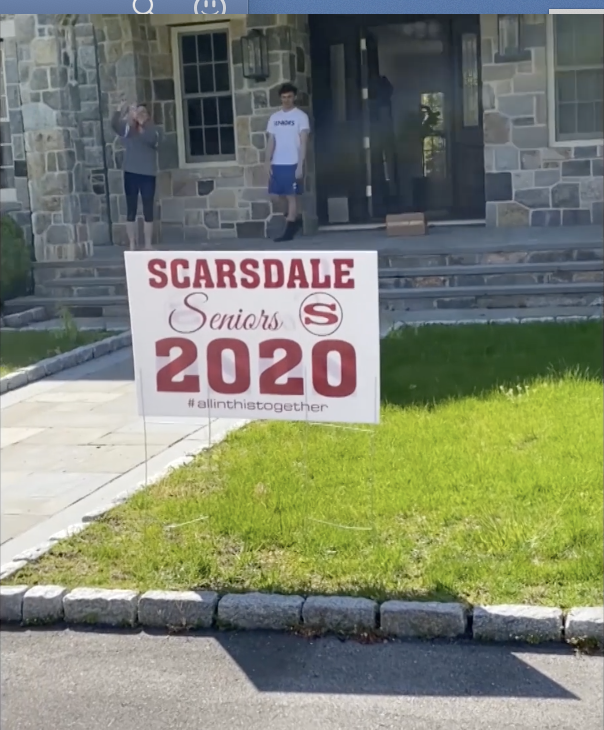 Students have been asked to reach out to their senior class advisors with ideas and parents can share their suggestions with SHS PTA President Deb Morel. These events can include social media connections and virtual events. Spring coaches are planning activities to recognize spring athletes. This past Thursday caravans of masked teachers drove through town and distributed Class of 2020 signs to the entire graduating class of 2020.
From the Board of Ed: School Election Via Mail, Concerns About Elementary School eLearning and Installment Billing for Taxes?
- Details
- Written by: Joanne Wallenstein
- Hits: 4454
 After technical glitches prevented some of the participants from accessing the Zoom meeting, the Scarsdale Board of Education got off to a late start for their May 4, 2020 meeting online.
On the agenda was the proposed 2020-21 school budget, new mandates from the state to hold the school board and budget election online, e- Learning and a discussion about allowing installment payments for school taxes.
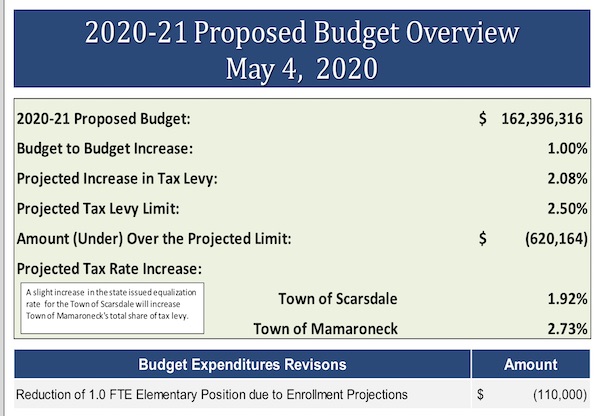
The proposed budget was reduced slightly from the April 20 meeting, due to the elimination of one full time teacher in response to decreased enrollment projections and savings from the extension of the school closing to the end of June.
The $162,396,316 proposed budget represents a 1% increase over 2019-20 which means a 1.92% increase in taxes for Scarsdale residents and 2.73% for those in the Mamaroneck strip.
The board plans to adopt the budget on May 11 and hold a hearing on June 1. What’s changed is that the election will be held by mail rather than in person and the state is requiring that the district mail absentee ballots to all eligible voters. A property tax report card must be delivered to the NYS Education Department by 5-18. Completed ballots will need to be received by the district by June 9 and the district is required to pay for this return postage as well. Assistant Superintendent Stuart Mattey commented on the difficulty of complying with the new law, and printing and mailing the ballots while the administrative staff is not working onsite due to the COVID crisis. There will also be additional expenses to conduct the election by mail.
District Clerk Honore Adams said that eligible voters can be defined as follows:
A United States citizen
· at least 18 years of age (as of the date of the election)
· a resident of the school district for at least 30 days before the election
· who is otherwise not ineligible to vote under Section 5-106 of the NY Election Law.
Budget Discussion
In a discussion about the budget, Board Member Chris Morin asked if expenses in the 2020-21 could be further reduced by delaying the hiring of staff for the fall. Given the uncertainty about re-opening in September he asked if the district could defer hiring even if it meant that that a class might not have an aide, a class might be a little larger or that every elective would not be available.
Assistant Superintendent Andrew Patrick responded, saying “When we talk about class sizes – or not offering electives – that is something we can do. But we’re not going to recommend that without having some dialogue…. we do have flexibility with attrition…. We could delay or not hire…. If we don’t have lunch supervision in the fall, we could not hire lunch aides.” He continued, “We are faced with tremendous uncertainty. My instinct is based on knowing that we are typically not nearly as successful in hiring in September, October or November as we are now.”
About school opening in the fall, Dr. Thomas Hagerman appeared more optimistic, saying, “NYC will be the last to decide about the fall. I don’t think we’re in the same boat as NYC schools. I don’t think we’re going to be on the same schedule.”
Scott Silberfein raised the question of using more of the district’s fund balance to reduce the tax levy. The board had already decided to increase the fund balance contribution to the proposed budget from $1.1 million to $1.45 million. He said, “I would still be in favor of using additional funds as assigned fund balance for 2020-21. I would be in favor of reducing the tax increase.”
Mattey said, “It’s ultimately the board’s decision and it’s my job to give you the warning signals”
Alison Singer said, “I feel comfortable where the budget is now. We have made appropriate cuts … significant cuts – but also maintain the high quality of a Scarsdale education. I think that our taxpayers would not want us to put the future into jeopardy by using more fund balance now.”
Karen Ceske said, “I am also hesitant not to make changes to that line.”
Board President Pam Fuehrer concurred, saying, “I think the $350,000 that we already put in is enough to have to make up. I think we have gone as far as we can go.” Carl Finger agreed, saying “I don’t like to evaluate our entire philosophy when we’re under the gun. In terms of fund balance, a modest amount is not going to have a significant impact on this year – so I am fine with keeping it as is.”
Scott Silberfien replied, “We owe our fellow taxpayers as much as we feel comfortable doing. I am concerned what our budget vote might be in this new environment. It is possible that we as a board will be under a different type of scrutiny this year because of the environment and because of who is eligible to vote…. I think ever $100,000 or $200,000 might make a difference to them…. If this budget was to fail we would be under a contingency budget.”
Carl Finger said, “We don’t have any information about the consequences of the vote at this point”
Responding to Finger’s question about how much an $200,000 from the fund balance would lower taxes, Stuart Mattey said, “A $200,000 increase in the fund balance contribution would drop the levy increase to 1.94% and mean an extra $30 for the average homeowner.”
Chris Morin commented, “We should be taking a tougher line now, especially on hiring. We do need a tight story now for taxpayers. This environment is not what taxpayers had expected. I think it would be good if we could demonstrate that this budget reflects the change in teaching as well as economic conditions.”
Pam Fuehrer reported on Scarsdale’s proposed budget in comparison to peer districts. She said, “Our budget to budget (increase) of 1% compares to our local peer group of eight school districts which are at 2.57% in Westchester-Putnam. Our tax levy increase is at 2.08% compares to our peer districts at 2.50%. We are in a very good position.”
Chris Morin said, “The ten-year graph is a very good long-term story for taxpayers… School districts are pretty inflexible… I think we need the tightest story we can have this year in anticipation of next year.”
The Board agreed to stick with the proposed budget as presented by Stuart Mattey. However at the end of the meeting, Scott Silberfein suggested using $730,000 that is currently in reserve to begin work on the high school auditorium next year. The Board agreed that they would like Stuart Mattey to provide information on phased work in the auditorium and determine if any work could be done in 2020-21. Mattey explained that this would increase the budget, but not the tax levy, as these funds would be taken out of reserves.
Public Comments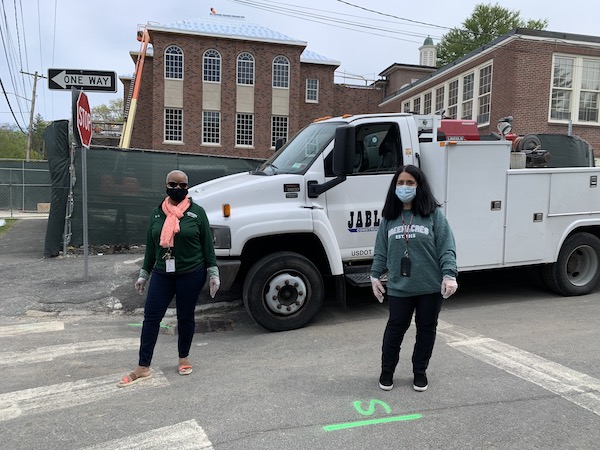 Greenacres PrincipalSharon Hill and Assistant Principal Sharon DeLorenzo were onsite Tuesday so that parents could pick up children's belongings from the school to facilitate the construction.
During public comments, Leah Dembitzer spoke on behalf of the Board of Directors of the League of Women Voters and Deb Morel spoke on behalf of the Scarsdale High School PTA Executive Board.
You can see their full comments here:
Former member of the Board of Education Art Rublin said, “One thing that is keeping Stuart (Mattey) up at night is concern about what will be required when students return to school in the fall. We could need more custodians or nurses. If money is not in the budget it will not be available for whatever might come up. If we need to make many upgrades to open school, we will need to have the funds in the budget to pay for it.”
Mayra Kirkendall-Rodriguez questioned comments about “peer districts” made by Board President Pam Fuehrer. She said, “When conducting a peer analysis in finance, assembling a good, relevant peer group is very challenging, and sometimes impossible….it would be good to know more about the school districts in Westchester and Putnam that you mention? Is this a reasonable group of towns to compare Scarsdale and its budget?” She raised concerns about the increase in the village and school budgets saying, “At each board meeting from both sides, I keep hearing from some board members and residents, loosely paraphrasing, the rise is only $30, $60, $90 ….. While these two budgets are separate, for us residents, expenses come from one household budget.”
She raised concerns about equity saying, “the tax level depends on your property assessments, whether you are fairly assessed or not. Last couple of years, as the effects of changes to federal tax regime, that is SALT, some of the very large owners have been able to grieve, while smaller ones may not have as much. Hence for some who were already impacted by vertical inequity, that will continue to be exacerbated.”
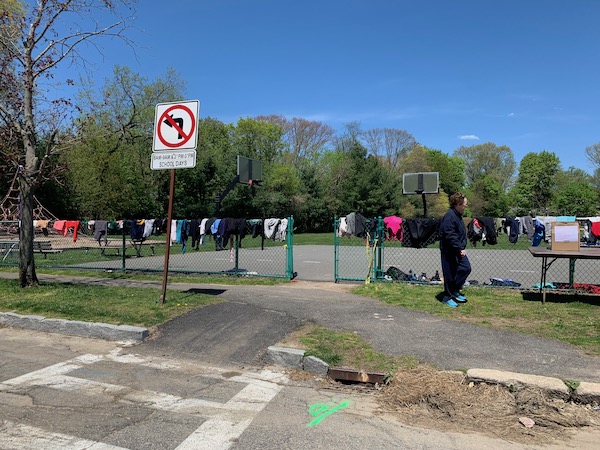 Greenacres Lost and FoundAbout e-Learning she said, the teachers, “were not trained for e-Learning. A good part of my profession is conducting workshops and training. And I know that there is a big difference between my live delivery and those conducted via Zoom and Adobe Connect.” Last, she asked what the district would do if there were a power outage, saying, “As hurricane season approaches, what will you do if power outages hit our very stressed grid. Just a couple of years ago, my household was without power for two weeks.”
Bob Harrison again stressed the economic impact of the crisis on residents and seniors. He asked for district administrators and teachers to freeze their salaries, calling for shared sacrifices. He reminded the Board and administration that in 2009 Superintendent Michael McGill and five top administrators took a pay freeze. Teachers offered to forgo 1% of their 2.5% pay increases in 2010-11. He advocated for more use of the fund balance to reduce taxes and called the 2% proposed budget increase “shameful.”
e-Learning
Assistant Superintendent for Curriculum Edgar McIntosh gave an update on e-Learning at the elementary school level. He said that parents had sent communications to the district about differences across classes, assessments of learning outcomes, the balance of synchronous and asynchronous learning opportunities and cohesion of learning across the district.
He said there is a continual learning process going on as e-Learning is so new. He called elementary school parents “partners in this endeavor,” and said that the epidemic has affected the staff, some who have their own children at home.
He announced a district-wide elementary planning day for teachers on May 6 to enhance their practice.
The goals for elementary e-Learning include:
-More sharing among teachers across the district
-Enriched use of synchronous learning platforms
-More cohesion of effective practice
-Cohesion of concept, skill and content coverage
He said this was an unprecedented time without models to support learning.
A follow-up survey on e-Learning will be sent to Scarsdale families at the end of the week.
In the discussion that followed, Board members conveyed comments they had heard from the community.
Chris Morin said, “I liked what you said, but we are receiving real time feedback from parents who are having a different experience. What would you say to them?”
McIntosh replied saying, “We are learning and evolving and we need some opportunities to share feedback about e-Learning.”
Alison Singer said, “You talked about standards and expectations being aligned by grade level. We hear from parents that this continues to be an area of concern for them. They are not aware of the standards or benchmarks and I think it would easier to manage expectations if they were aware of the benchmarks.” McIntosh said, “That is something that has been done but we can look toward more transparency.”
Carl Finger said, “I also had someone say I have a fourth and fifth grader getting two completely different experiences. Is one teacher lagging or is the other exceeding expectations?” Karen Ceske asked if faculty who are having difficulties work in teams to share the load?
McIntosh confirmed that this was already happening and that teachers with special circumstances were being supported.
Ron Schulhof asked, “What is the timeline for rolling out what you discussed to address parents’ concerns?” McIntosh responded, “It will start out with your chance to share best practices and then parents will see us adapt to incorporate these practices.” Schulhof asked for tactical responses and concrete answers. He said, “The feedback we’re getting from the community is very different from what we are hearing about here. They will want to know when they will see these changes.”
Alison Singer said, “Parents are seeing considerable discrepancy across their grade and across schools.”
Tax Installments
The Board had previously asked Stuart Mattey to gather information about allowing residents to pay their school taxes in two installments, rather than pay the annual tax in one payment in September. He said, “Revenue comes to the schools at the beginning of the school year which allows the district to meet all obligations and invest the balance. …Towns are permitted by law to collect in two installments.”
The decision would need to be approved by the Village who might require additional personnel to collect the second round of payments.
Chris Morin said, “It seems just and right to do this in two installments.” Ron Schulhof asked, “What would be the impact if we just did it this year?” Carl Finger pointed out that it would be confusing to people if this was implemented this year and then removed as an option for next year. He said, “When you take it back it will be resented.” Dr. Hagerman pointed out that “taking on these challenges when people are in in the office is difficult.” The Board agreed to keep this on the agenda for further discussion next year.
Facilities Update
Stuart Mattey announced that contracts for facilities work had been awarded for general construction at the high school including the roof, floor replacement and water mitigation as well as work at Dean Field. He also said that the lights at Butler Field would be installed earlier now that school is closed.
At Greenacres work continues inside the school and parents were invited to come it to pick up items from the classrooms this week. The project is scheduled for completion in August.
Food Service
Prior to the closing of school, Stuart Mattey had been working with the food service committee in order to competitively bid out food service for the district. However, the district learned that they can rollover their contract with the current provider without bidding. The committee agrees that would be best to do as things are so uncertain and they would like to continue to work with Chartwells.
Mattey reported that the district is serving meals to families who requested them and also supplying meals to ten Eastchester families.
The next meeting of the Board will be on Monday May 11, when the board is expected to adopt the proposed budget for 2020-21.
- Win-Win: Thank a Community Volunteer and Support College Scholarships for Scarsdale Students
- Proposed 2020-21 Scarsdale School Budget to Go Up Just 1%
- For High School Seniors, Epidemic Impacts Spring Break, Prom, Graduation and Even College Admissions
- School Administration Defends District Staffing and Budget, Saying "It is Built on Excellence not Excess"