







Edgewood Students Celebrate New York
- Details
- Hits: 6878
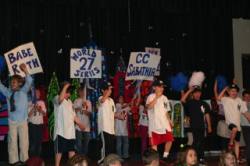
 Edgewood third graders culminated their study of New York City with a musical performance of “NYC -- The Place to Be” attended by the entire school, parents and invited guests on April 13.
Material for the play was gathered through a research project held during lunch hours, lead by third grade teachers, Margaret O'Farrell, Beth Martin, Palmer DelMonaco and Dylan Cadalzo. Using books, the internet, and pamphlets, students gathered facts on the city that became the basis for the script and fifteen New York themed songs. Student performed well-know favorites including “Sidewalks of New York," "Native New Yorker," "Downtown" and "Empire State of Mind." Over a five-week period, the third grade teachers and music teacher, Lisa Forte prepared student for the show. Ms. Forte taught the students to play the recorders and melody bells so that they could accompany her on the piano. Art teacher Helen Pasternack helped the students create scenery during their art classes and Margaret O'Farrell worked on props, posters and the large banner with the children during lunchtime. With the help of technology teacher Paul Tomizawa, three girls, Felicity Huang, Anne Conlan, and Aimee Azambuya-Skoupy, created the slide presentation that served as the backdrop for the opening scene.
The show was about a group of tourists who visited all five boroughs of New York City by taxi, subway, ferry, and on foot to visit famous sights, museums, parks, and events. The students shared their understanding of the many interesting places to visit in the five boroughs. For example, they talked about NYC's other names - New Amsterdam and New Orange. Most were surprised to learn that NYC had been the first capital of the United States. They explained that twenty-one elephants were paraded across the Brooklyn Bridge to be sure that it was safe and that the cost for a ride on the Staten Island Ferry has decreased over time. They discussed the number of restaurants and taxis and skyscrapers found in the city and told the audience where to get a hot dog in each of the five boroughs.
"The third graders came away with an awareness of the cultural richness of NYC as they read about the museums, parks, theaters (especially Broadway theaters), and parades that celebrate the cultural diversity of New Yorkers and the world. They were surprised at how many songs were devoted to this great city. As they sang, they learned even more information about city life and the treasures to be found just twenty miles from Scarsdale. In addition, the students came away with an awareness that we at Edgewood are a community of learners. Sometimes it was hard to tell who was having more fun - the teachers or the students - as we prepared for the performance," said teacher Margaret O'Farrell.
Text and photos by Margaret O'Farrell and Tracy McCarthy

And So it Was Resolved
- Details
- Hits: 6638
 After months of meetings, study-sessions and public outcry, the Scarsdale School Board agreed on its 2011-2012 budget. It was a tough go for the Board. Big cuts from Albany and rising pension, health care and energy costs presented unprecedented challenges. All along, the Board worked hard to keep within the fiscal constraints while maintaining Scarsdale’s dedication to excellence in education. It was no easy task and everyone noted at the meeting last week that it was a job well done. These were long meetings and a lot of details, so we decided to break down the biggest issues and show how they were resolved.
The Money:
- Overall budget $138.4 million
- Projected property tax increases are 4.81% for Scarsdale and 3.19% for the Mamaroneck strip
- Budget-budget increase 2.75%
- Tax levy growth 3.18% higher due to revenue losses
- Two thirds of the budget increase will go to pensions
- 10% cut in investment in equipment and supplies
- 50% cut in facilities budget
- There will be 17.5 fewer teaching and support positions than in the 2008-9 budget
- The faculty agreed to forgo a salary increase salvaging 20 positions and saved the taxpayers $1.9 million over 2 years.
- The latest numbers out of Albany showed a restoration of less that 20% of funding cuts
- Scarsdale did however receive $271,000 in state aid
- The District is eligible for $243,000 in federal aid for job funding
Mandarin:
The board decided that the $243,000 in federal aid will be used to hire a teacher and to fund a pilot program teaching Mandarin Chinese in the high school. The Board noted that while they are aware that no student will become fluent with this single class, teaching Mandarin is critical in this day and age and will provide a strong foundation for future study.
Class Size:
This was the hottest and most contentious issue this budget season. After much public debate and weighing the issues, the Scarsdale Board of Education decided to maintain current class levels and not increase the cap size at the elementary school level.
The board and the administration is keeping a close eye on the large 8th grade class that will be entering high school in the fall. Dr. McGill spoke on how scheduling and class section times may need closer inspection in order to accommodate that many incoming students and not causing overcrowding in certain classes.
As in past meetings, class size continued to be a big issue at the April 7th meeting. Several community members and parents spoke out ahead of the board’s vote. Among them, Nancy Berdon, Chair of the Scarsdale Forum, formerly known as the TVCC (Town and Village Civic Club Education Forum).
She summarized the Forum’s recommendations:
- Maintaining elementary school class levels
- Studying class sizes across all grade levels
- Exploring options for District personnel before increasing the number of overall positions
- Reducing reserves in the coming year ( Full Report Here )
On behalf of the Forum Berdon praised the Board for making the hard decisions and putting the needs of the schools and the students’ education under tough fiscal times.
The League of Women Voters also issued their report. That report praised the board for it’s hard work during these challenging times. The League cautioned that continued deferral of capital expenses cannot continue indefinitely, and hopes that the District will select priority projects to undertake as funds become available. Their full statement will be available on their website.
School Nurses:
 Surprisingly, one of the more difficult issues dealt with that night was not education, but student health and the number of school nurses on staff.
Parent Cynthia Kantor expressed concern that children’s health needs will not be met if the schools let go of the nurse ‘floater” particularly at the middle school. Kantor explained for example, a nurse must accompany a class if a diabetic child is on a field trip. This will then cut the number of nurses available at the schools during the day.
There was much debate on the board that night weighing the needs and the costs of maintaining this position. An idea was raised to use the federal funds for this position and the Mandarin teacher with reserve fund money.
Ultimately, it was decided to cut the floater and maintain steady rotation of substitute nurses. The board did agree to reassess the issue early in the new school year.
Looking Ahead:
Much of the meeting on Monday April 11 focused on the idea of creating a foundation. This would be a way of raising money to help fund some of the classes and activities that makes Scarsdale a premier school during economically difficult time. The foundation would look to alumni, residents and outside donors to raise money. While many concerns were raised, including a donor’s interests at odds with the school’s objectives, as well as disenfranchising taxpayers to the schools’ needs, the Board ultimately felt that the idea was worth of further study and will form an exploratory committee.
A foundation could solve a lot of the problems that the district faced this year. There might not have been debate about the inclusion of a Mandarin program if foundation funds were available. The question of increasing class size might never have been raised. I am all for giving the private sector or individuals incentive to help a community. But if mismanaged or handled incorrectly this could have negative implications for years to come.
The Board already highlighted some potential pitfalls:
If there is a foundation, will the community be willing to pay high taxes to live in this community and attend the schools? (Frequent commenters --I’m sure you have GADS to say about that one)
What if a generous donor has an objective that is very different from the schools? Does the school have the right to take the money if it won’t adhere to what the donor wants? Does a donor have the right to dictate what’s done with the money?
Also, other issues that come to mind:
Currying favor: It’s an old joke that sometimes a kid attends a great school not because he’s such a good student, but his family’s name is on a building. Will some parents expect that a check will lead to a good grade, or a lead in a school play or a spot on the varsity team for their child?
Competition and division: There are some very wealthy people in town, some, less so. Will a foundation divide the ‘haves’ and the ‘have nots’ and the ‘givers’ and the ‘takers’? If you don’t give, will you be made to feel like you have less of a say in what happens at school?
These may not be real troubles and are easily dealt with. Readers, what do you think?
 Jen is a freelance journalist who has covered the economy and markets for over a decade at a major financial news outlet. She lives in Scarsdale with her husband and 2 children. Jen has yet to bake a successful batch of cookies.
Edgemont's Proposed School Budget
- Details
- Hits: 5488
Nancy Taddiken, superintendent of the Edgemont school district, and the other administrators have been hard at work on Edgemont's proposed budget for 2011-12. They are trying to maintain academic excellence, make curriculum and infrastructure improvements while minimizing the tax-rate increase. At an April 6th PTSA Parent Forum in the high school library, Taddiken once again stressed her belief in maintaining class sizes in the Edgemont schools (except in select cases at the high school level). Currently Kindergarten through second grade, classes are capped at 22, third through sixth grade classes are capped at 24 and at the junior/senior high school level, the classes are capped at 25 students.
In the latest plan submitted to the Board of Education on March 29th, there was a spending increase of only 2.54% which will result in a 3.12% tax increase to residents. However, at the Parent Forumon Wednesday, Taddiken projected an even lower increase due to a loss of $160,000 in state aid (versus the previously anticipated $200,000). The new tax increase may be as low as 3.03% and will be finalized at the April 12th BOE meeting. The previous drop in the budget increase resulted from the administration's efforts to find even more cost reductions in an already tight school budget and was brought about by a decrease in the health insurance expenditure line and a very generous gift from Edgemont Recreation for equipment and supplies.
Previously Taddiken requested a spending increase of 2.85%, which would have resulted in a 3.48% tax increase for Edgemont residents next year. The original budget proposal had a tax increase of 4.8% which the Board of Education felt was too high an increase to present to voters in May. The initial 4.8% tax increase was reduced by offering an early retirement incentive to teachers that twelve veteran teachers opted to exercise. Many parents voiced concerns over losing veteran teachers and asked that the Board of Education not pursue this option but the Board felt it would help to reduce the increase significantly.
Additional savings came from having the department chairs at the high school teach a full case load next year and requiring faculty members who have children in the Edgemont schools (but are not residents of Edgemont) take over the proctoring duties for the SAT and ACT exams. There was also a substantial gift from Edgemont Recreation for AEDs (Automated External Defibrillators) and athletic uniforms. Furthermore there will be some savings by eliminating various stipends such as the stipend for the Student Activities Fund treasurer.
While the majority of the tax increase will cover rising salaries and benefit costs, there is a new math program at the elementary schools and money will be spent to upgrade the district's technology capabilities. On the high school campus, two buildings will have roofs and windows replaced and science lab upgrades will continue at a third building. The high school is also introducing two new course offerings this year: AP Statistics and First Aid/CPR/AED. Both courses were approved by the Board of Education in an earlier board meeting this year.
The Board of Education will vote on the final proposed spending plan on April 12.
 Caroline Tzelios is a "stay at home" mom of three kids who never stays at home. She has spent the past twelve years volunteering in the Edgemont Schools and recently completed her two year term as PTSA co-president of Edgemont High School and is the current co-chair of Edgemont's PISA Theater Committee.
The Search Begins
- Details
- Hits: 5465
 With the news that Scarsdale High School (SHS) Principal John Klemme was resigning, speculation began on who would replace him. Scarsdale 10583 recently met with
Superintendent Mike McGill to get his overview of how the job would be filled. He began with a caveat saying, “getting the job filled immediately is less important than getting the job filled correctly.” Dr McGill hopes that the Scarsdale community will get the message and be patient as the District goes though the process of identifying candidates, conducting extensive interviews and background checks and finding the best person to lead SHS forward.
The search will begin with ads in the New York Times as well as professional journals. Internal candidates may also come forward. “ At the same time,” Dr. McGill explained, “this will be an opportunity to examine where we’ve come from and delineate the major challenges and opportunities ahead.”
McGill says that since the District has done these searches before they have a standard procedure. “Of course we’ll be speaking with all our major constituencies and they will be part of the process.” Initially Dr. McGill said that department heads will talk with the faculty about priorities and ideal characteristics for a candidate. The PTA will canvas parents and student government leaders will be involved. Once a pool of candidates is identified, the resumes will be screened by a committee that will include a representative from all the constituencies (administration, faculty, parents, students). Then 10-15 candidates will undergo an interview process that will narrow the field to 4-5. “We are hopeful that we will find 2-3 outstanding candidates who will then meet for extensive interviews with a broad group that includes those already mentioned as well as members of the Board of Ed.” Dr. McGill also noted that in the final phase the District will conduct complete reference checks including conversations with the candidates’ current employers.
While we may think that candidates are going to be banging down the door, Dr. McGill dampens that optimism with his more recent experiences that have shown a shrinking pool of candidates. “We used to get 75-100 qualified resumes when we advertised for a principal and that is just not happening any more. People are more conservative about changing jobs and let’s face it, we know Scarsdale has an A1 reputation but the word’s out that it’s also a very demanding place. Of course to know us is to love us and in the end we just need one excellent candidate.” Dr. McGill cited the recent search at Mamaroneck High School where he understands there just weren’t a lot of qualified candidates available. While there is a possibility that a candidate may be selected by the fall, the administration believes it will be necessary make an interim appointment. As reported in 10583, John Klemme will return in April and will finish up the year.
Dr. McGill has not put together his definitive list but said ideal qualifications include: educational vision, congruence with the work being done on thinking skills and higher order skills, and interest in interdisciplinary work. “There are also personal qualities including, high energy, interest in connecting with teachers, parents and students, resilience, leadership, exemplary character, strong academic background…just to mention a few.” “One danger,” noted Dr. McGill, “is that you look at the strengths and weaknesses of the last principal and try to make up for them in the next candidate. But that’s a mistake. You need to just look forward and stay focused on the job requirements and the desired skill set. In the end, this is a very productive process. It’s an opportunity for all the people who have been working on different pieces of the puzzle to come together and help the institution define its direction for the future.”
Anna Decker is a longtime community volunteer. She was President of the HS PTA, PT Council and has served on numerous school and community boards. In her former life she was in charge of Corporate Communications for the Institutional Bank at Citicorp and she continues to do a variety of freelance projects.
School Board Discusses Full Day Kindergarten, Revenue Sources, Class Size and Staffing at March 21 Meeting
- Details
- Hits: 6562
The Scarsdale Board of Education covered a lot of ground at their March 21 meeting, reporting on the full day kindergarten program, presenting the findings of the Board’s Revenue Committee and conducting discussions on district staffing of nurses and class size caps
Lynne Shain the Assistant Superintendant for Instruction presented the findings of an assessment of the new full day kindergarten program that began in the fall of 2010. The district formed a program review committee with representatives from each of the five elementary schools and this group designed surveys for parents of kindergarten students and teachers. She reported that though there are 305 children in kindergarten, only 85 parents completed the survey that was issued in February. In regard to the low completion rate, the group surmised that if parents were unhappy with the program they would have used the survey to voice their concerns.
Response among the parents was overwhelmingly favorable:
- 91% of parent respondents said the program was positive for their child
- 97% said their child was having a good experience in kindergarten this year
- 92% agreed that the teacher knows their child’s learning need.
Responses from teachers were also favorable with 93% reporting they were able to meet individual children’s learning needs.
Shain also reported that some teachers favor moving the cut-off for entry to kindergarten to those who are five years old by September. Though the committee did not make a recommendation to the change the cut off now, they did collect data on this issue.
So it looks like full day kindergarten is a keeper. Watch a video of the assessment here:
Board member Elizabeth Guggenheimer presented the findings of a Revenue Committee that was created last May to explore other sources of revenue for the district. The committee was chaired by Joan Weber and members explored methods to raise additional revenues to supplement the school budget.
Here is a summary of their findings and recommendations:
- In a survey of other districts they determined that Scarsdale is among the more conservative in their gift policies.
- In districts that have educational foundations, cannibalization of other fund raising efforts and erosion of support for the school budget were not a problem
- The group discussed other means to raise revenue such as including permitting advertising in the school, charging tuition for out-of-district students, development of school-owned land, and the rental of school facilities – and determined that were many obstacles to each one and that significant funds would not be raised by these means.
- The foundation would have it’s own Board of Directors, though the School Superintendant should sit on the Foundation Board.
- The foundation would need to be established and run by the community.
- The committee concluded that the BOE should consider supporting an educational foundation as it would be a viable option in this financial climate could generate funds to support programs.
BOE President Jill Spieler proposed a discussion of a foundation at the next Board meeting. You can watch the video presentation here :
Next on the agenda was a discussion of the staffing of nurses in the district. The proposed budget reduced the number of nurses at the Middle School from two to one and a conversation ensued about that decision. In 2010 -11, the district had the following staffing of nurses:
- High School – 1 nurse
- Middle School – 2 nurses
- Elementary School 1 nurse at each school
- 1 floating nurse – deployed where needed or to fill in for an absent nurse
The Board considered eliminating the floating nurse and adding back a nurse to the Middle School staff. They discussed the benefits of a floating nurse versus hiring substitute nurses when regular nurses were absent.
Parent Nicole Moser spoke and said that she has a child with diabetes and there is an increase in the number of diabetic children and it is a “management heavy” illness. According to Moser, eight students in the Middle School are diabetic. This year, the floating nurse has been stationed at Quaker Ridge because three children have diabetes there. Those students require the most time. Next year, there will be six incoming students at the Middle School with diabetes. If we reduce the headcount to one nurse at the Middle School we may risk the health of these children. From the tone of the conversation it appeared that the Board favored restoring the second nurse at the Middle School in place of the floating nurse.
Also discussed on 3-21 was class size, with each Board member giving their views on the potential policy change. The Board had proposed a more flexible approach to class size, which would allow them to add a student to an elementary school class if needed, rather than break into another section and hire an additional teacher.
The Board was impressed by the outcry from parents and assured them that they were heard. All, with the exception of Lew Leone agreed that the class caps should be maintained for at least one more year and the discussion turned to how to fund it. Some suggested using reserves and were hopeful that additional funds would be found by the end of the budgeting process. The school budget now calls for two undesignated teachers that could be used to teach additional elementary school sections. The Board explored the possibility of including a third undesignated teacher, though Mike McGill reported that in fourteen years at the district, this had not been necessary. Joan Weber reported that as of now, kindergarten enrollment does not appear to be high, so she did not anticipate a problem.
By the end of the discussion it seemed that the Board would try to find a way to maintain the class size caps for the 2011-12 school year.