









Finding a Voice: How Community, Justice, and Song Shaped One Cantor’s Journey
- Thursday, 02 April 2026 18:29
- Last Updated: Tuesday, 28 April 2026 10:31
- Published: Thursday, 02 April 2026 18:29
- Wendy MacMillan
- Hits: 2134
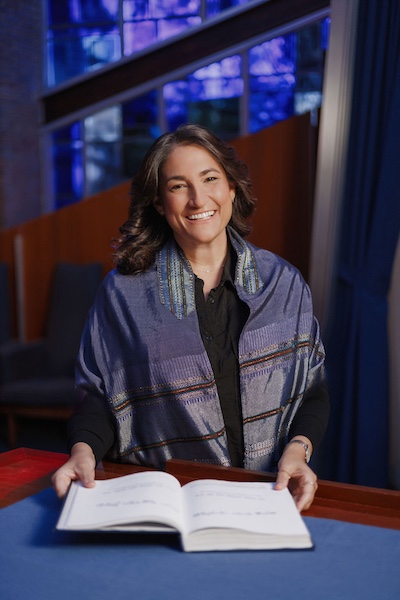 Long before she ever stepped onto the bimah as a professional, Cantor Laura Stein’s voice was already echoing throughout the spaces that shaped her: her family’s home, her synagogue, her schools, and the streets of Scarsdale itself. Singing came naturally. So did Judaism. What took time was landing securely where she is today, in a place where her musical talent, commitment to Jewish values, and pursuit of justice coalesce to define a career of using her voice for progress.
“I was always a singer,” she recalls—choirs, school plays, and the first 4th-grader to ever be accepted into all-county chorus. At the same time, Judaism was woven into her daily life. Her family nurtured a strong Jewish identity grounded in community, learning, and social justice. Synagogue wasn’t just a place you went on holidays; it was where relationships were formed, values were passed down, and belonging was solidified.
As a child at Westchester Reform Temple (WRT), she slowly became part of its musical life as well. Her passion for singing and her interest in Judaism began to converge, helped along by Cantor Stephen Merkel of blessed memory, who first took her under his wing. As she got older, that mentorship expanded. “It really felt like the ‘it takes a village’ mechanism kicked in,” she says. The clergy there, including Senior Rabbi Rick Jacobs, Cantor/Rabbi Angela Buchdal, and Rabbi Ken Chasen, recognized something in her and encouraged her to explore it.
Her Bat Mitzvah became a turning point. Learning to chant Torah, interpret tradition, and share it with the community was empowering in a way Cantor Stein hadn’t anticipated. “That was when I first understood what it meant to pass down Jewish tradition in a way that actually moves people, and maybe even helps make the world a little better.”
From there, she became deeply embedded in the congregation’s musical culture. She supported Cantor Buchdal on the bimah, subbed for her at teen events, and attended Kutz Camp, a Reform Movement leadership camp, where she learned to songlead. Surrounded by other young people dreaming of Jewish leadership, guitar in hand, she began to see a future where her voice could inspire others through prayer and music.
That sense of encouragement extended well beyond the synagogue walls, though. Growing up in Scarsdale, Laura experienced what she describes as a “360-degree” support system. Her parents moved to town when she was just two weeks old, and she went through the full K–12 Scarsdale school system. While not a small town in the traditional sense, Scarsdale felt intimate, with familiar faces in the village, neighbors and family friends who she spent holidays with, and a community invested in watching young people grow.
“The biggest thing that Scarsdale did for me was give me a home base,” she says. A place where the parmesan bread at Parkway Diner always tasted the same, Halloween window painting reliably arrived each October, and someone was always playing tennis (or paddle tennis) at the Brite Avenue courts down the street from where she grew up. That consistency created a container—a place from which it felt safe to take risks and explore new paths, and a place she could always return to, knowing she’d be welcomed back.
Cantor Stein’s musical and theatrical development was nurtured at every stage. Mentors like Fox Meadow music teacher Connie Rybak Shelengian, the Middle School’s music teacher Lorraine Brooks and Popham’s English teacher Kathleen Connon, and High School Choir Director John Cuk didn’t just instruct, they showed up. One even attended a singing performance while she was in graduate school for cantorial studies. “I think of Scarsdale as a place where I was supported at school, in the village, at synagogue, at home…everywhere. I was valued for my unique path.”
She still remembers a moment from 2004 that captured that spirit perfectly. After returning from Jewish songleading camp, the Scarsdale Inquirer ran a feature about her experience. Soon after, a non-Jewish parent of a younger student she only knew peripherally called her house just to say how impressed she was. “It really felt like people, even from totally different backgrounds, were rooting for me.”
That thread of community has never broken. When Laura would return home on breaks and was invited to sing at her home congregation, people who had known her since childhood would approach her. “I remember when you were ten and sang on the bimah,” they’d say. “We always knew you’d become a cantor! We’re so proud of you.” She pauses when she reflects on that continuity, tearing up. “I can’t tell you what it’s meant to have that thread woven through my entire life. It’s been the biggest blessing on my journey.”
Yet her path was not without struggle, especially when she entered seminary at Hebrew Union College-Jewish Institute of Religion, the Reform Movement’s graduate program that trains cantors and rabbis. While cantorial school gave her theological grounding and liturgical skills, it fell short of what she hoped clergy training would provide, and its somewhat toxic culture challenged what she’d come to understand about justice during her Jewish childhood. “I wanted to learn how to minister to the whole person, and to do so in an environment that not only gave me skills but also lifted me up as a person, a woman, and most importantly, a Jew.” When that training and growth-oriented support didn’t materialize in her seminary, she sought them elsewhere, enrolling in NYU’s social work program part-time while also completing her cantorial degree.
That decision, she says without hesitation, changed everything. Through a field placement working with Jewish seniors living with hoarding disorder and an internship doing case management for homeless queer youth, she gained clinical skills that transformed her relationship to pastoral care. “My social work degree is the best thing I ever did,” she says. “It’s the reason I can show up as a cantor the way I do today.”
Now pursuing a PhD in Practical Theology at Boston University, with a focus on the psychology of religion, she is doing the integrative work she once longed for as a student. Her research explores clergy formation, justice, trauma, burnout, and flourishing—asking not just what spiritual leaders can do, but who they are becoming. Studying at BU’s School of Theology, where Dr. Martin Luther King Jr. earned his doctorate in theology as well, has only deepened her commitment to justice-centered work, which she names as her most important commitment.
At the heart of everything Cantor Laura Stein does is integration—between belief and behavior, spirituality and psychology, tradition and lived experience. “Flourishing isn’t about erasing differences,” she says. “It’s about stitching together wholeness.” That philosophy shapes her work with individuals navigating trauma, identity, and religious struggle, as well as with wedding couples and families looking to bring Jewish joy and meaning to their life transitions. It also informs how she understands mindfulness and what it really means to “live Jewishly”—as attunement to values in the present moment that help people connect to others and community.
Today, as a cantor, social worker, and psychologist of religion in training, her voice still rises in song on the bimah, during lifecycle moments, and in chaplaincy settings. But it also speaks in classrooms, therapy sessions, and in research and advocacy settings. She’s proud of how this journey has led her to where she is, and feels ready to start sharing what she’s learned with the community that formed her into the professional and person she is today.
Looking back, it’s clear that none of it happened in isolation. Family, temple, school, teachers, neighbors, and extended communal networks all played a role, and were patient as she explored her different passions before finding a path that would combine them. “I am so grateful,” she says, “to have been championed by so many people who saw potential in me and wanted me to thrive.”
And in many ways, they still do…cheering her on, just as they always have. But now, she feels, it’s time for her to rise to the occasion of this next chapter.
“I’ve been in school, deepening these various passions and in this pursuit of integrating them for so long, but it’s finally coming together. It’s time to start giving back and to hopefully be someone who inspires another little girl in Scarsdale to follow her dreams. I remain very connected here! My parents still live in the house where I grew up and WRT, where I now work part-time to support congregants along their journeys, is still my spiritual home. What a privilege to still feel held by the community that shaped you. Not everyone has that. I feel so lucky.”
Comments