







Scarsdale Schools Propose $197M Budget for 2026–27 Within State Tax Cap
- Details
- Written by: Wendy MacMillan
- Hits: 765
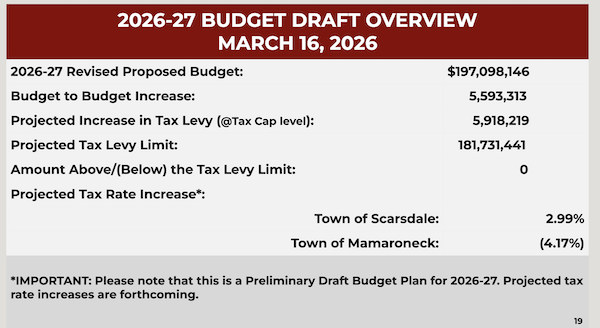 At the third Budget Study Session held Monday March, 16th the Board of Education presented a substantially revised proposed $197.1 million budget for the 2026-27 school year and outlined a plan that stays within New York State’s property tax cap but requires nearly $2 million in reductions, including several staffing adjustments.
Superintendent Dr. Andrew Patrick related that remaining within the cap was a deliberate decision this year, especially as the district plans to ask voters to consider a separate capital bond. “This year we’re asking the community not only to support a budget but also a $101 million bond referendum to make much needed capital improvements to aging buildings across our district. With all of this considered, I felt compelled to recommend a tax cap compliant budget.”
He went on to explain that the revised proposal aims to preserve core academic programs while limiting the financial impact on taxpayers stating, “We must be cognizant of the impact of school taxes on our community, and have to find a balance that maintains our exceptionally high quality of education and allows for Innovation and Improvement while minimizing the impact on our tax paying community, despite the fact that that balance is harder and harder to come by.”
Patrick details the rationale for this difficult, decision making process in a recent letter shared with the community:
Budget Details
Before highlighting the revised financial numbers, Patrick shared, “The school budget provides the necessary financial resources to operate the school district and to help achieve the goals and objectives of the school district, as set forth in our strategic plan.”
As he has done in past presentations, Patrick described the district as being organized with structures that “foster favorable student teacher ratios, create smaller learning communities within a larger school setting, and allow students to express agency over their course of study. The resources directed toward this fundamental organization of our schools, create the foundation that allows us to attend to the whole child while pursuing innovation and thoughtful adaptations to meet the needs of our learners. This is what we are desperately trying to preserve within the ever tightening financial realities that we are facing. I want to emphasize that we've been thoughtful, principled, transparent and responsible in our budget development process to date. Arriving at this budget has required difficult choices…This district has a long history of investing in education, which has enabled program innovation and expansion to take place while maintaining outstanding educational outcomes. This community has shown a level of financial support that reflects the real cost and value of an exemplary public education.”
The current proposed budget totals $197,098,146, an increase of about $5.6 million, or 2.92 percent, over the current school year.
To remain within the state tax cap, the district’s tax levy would rise by 3.37 percent, the maximum allowed under the formula for the coming year. Because the proposal stays within the cap, it would require a simple majority of voters to pass rather than the 60 percent supermajority needed for a tax cap override.
School officials estimate the increase would translate to roughly $715 more annually for the median homeowner in Scarsdale, based on current assessment data. Due to property assessment changes, homeowners in the Mamaroneck portion of the district could see a decrease.
Also highlighted during the presentation is the fact that in Scarsdale, property taxes account for about 92 percent of the district’s revenue, making the school system more reliant on local taxpayers than all neighboring districts because it receives the least amount of state aid.
Rising Costs Drive Budget Pressure
Patrick also made clear that the district began the budget process facing significant cost increases that outpaced the revenue allowed under the tax cap.
Major projected increases included:
- $2.8 million in health insurance costs
- $3 million in salary and wage increases
- $400,000 in Social Security and Medicare costs
- $1.1 million in contractual obligations, including student services and insurance
Even without new programs or staffing, those increases alone would have pushed the district over the cap.
Assistant Superintendent for Business Andrew Lennon said district leaders therefore needed to identify reductions across multiple areas.
Staffing and Spending Reductions
To close the remaining gap, administrators proposed about $1.99 million in reductions since the previous budget study session.
Assistant Superintendent for Human Resources, Meghan Troy outlined several staffing changes, including:
- Removing a proposed middle school special education teacher position
- Eliminating a planned high school math position
- Reducing two contingency positions to one
- Leaving some positions unfilled after retirements
- Reducing hours for teacher aides through attrition
- Eliminating a proposed elementary social worker (a contracted position)
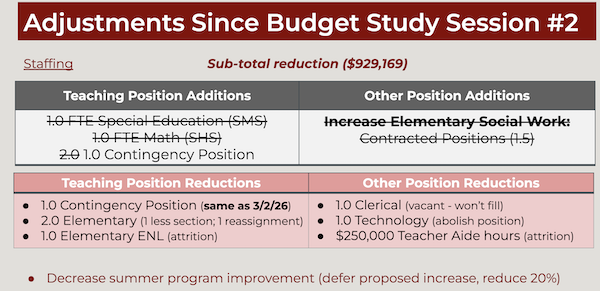
Overall staffing would decline slightly to about 661.7 full-time equivalent employees, five fewer than the current year’s staffing level.
The district also proposed smaller cuts in several operational areas, including technology leases, conference travel, supplies, and certain software services. One change would involve shifting most district meetings from Zoom to Google Meet to reduce costs.
Concerns Raised During Discussion
After the presentation, board members engaged in a thoughtful discussion, sharing concerns about the cuts made to the current proposed budget. Many acknowledged the difficulty of the decisions required to reach cap compliance, with several expressing concern about cumulative impacts on staffing, student-to-teacher ratios, and program quality over time.
To begin the conversation, BOE member Leah Dembitzer drew attention to the fact that reductions made in the proposed budget would not only affect future programming but the cuts would also mean that we cannot keep our current program as it is right now.
Dembitzer went on to express her concern that losing current positions through attrition for the second year in a row, could cause additional pressure to the remaining faculty.
Some noted the possible effect on class sizes in high school math courses, where enrollment demand has been growing. Anish Mehta, one of the BOE’s student representatives, echoed those concerns, saying large classes can make it harder for students to receive help during office hours.
Board members also raised questions about reductions in teacher aide hours and the decision not to expand elementary social work services.
Though he acknowledged the concerns, Patrick emphasized that the proposed budget preserves the district’s core instructional structure, including small elementary class sizes, the middle school team model, and the high school’s broad academic program.
Long-Term Financial Outlook
Board members acknowledged that the state’s property tax cap continues to put pressure on school district budgets, particularly in communities where property taxes make up the vast majority of revenue.
While districts can propose budgets that exceed the cap, those proposals require a 60 percent voter approval threshold, making them more difficult to pass.
Patrick said that dynamic has forced districts across New York to make difficult trade-offs in recent years.
“The evidence suggests the cap is a tool that has to be used carefully,” he said. “A failed budget vote can be devastating to a district’s educational program.”
Next Steps
The board will continue reviewing the proposal before adopting a final budget.
Key upcoming dates include:
- Budget Forum: March 23
- Board Adoption of Budget: April 13
- Annual Budget Vote: May 2026
School officials encouraged residents to stay engaged in the process and share feedback ahead of the final vote.
Watch a video of the meeting here.
To see the slides from the Budget Presentation see here.
District Struggles to Resolve $1.96mm Budget Gap
- Details
- Written by: Wendy MacMillan
- Hits: 1047
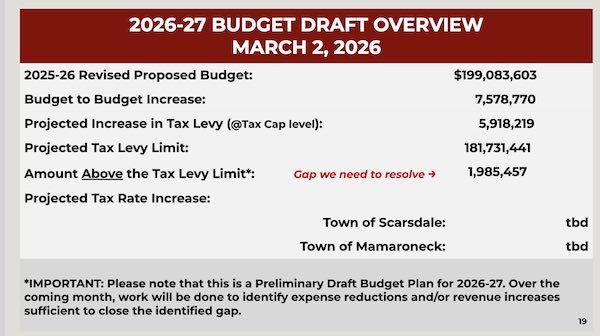 The Scarsdale Board of Education held their Budget Study Session #2 on Monday, March 2nd and reviewed a revised 2026–27 spending plan that trims nearly $600,000 from earlier projections. Despite the District’s efforts to curb spending, the proposed budget still sits $1.98 million above the state tax cap, setting up difficult decisions ahead of the third Budget Study Session to be held on March 16th. The current proposal calls for a 4.5% tax levy increase, which would require a 60% supermajority vote if it remains above the cap.
To start the session, Superintendent Dr. Drew Patrick briefly reviewed the school budget development process and highlighted that the students are always at the center of the planning and that, “the school budget provides the necessary financial resources to operate the School District and to help achieve the goals and objectives of the School District.”
Patrick also framed the discussion within broader statewide pressures. Referencing guidance from the New York State School Boards Association which noted:
-Districts are contending with the 2% tax cap that by design doesn’t keep up with inflation, rising health care costs and new mandates such as zero-emission buses.
-School districts have many costs that they little or no control over and health care costs are a prime example
-Sate educational initiatives (such as transitioning to zero emissions buses) have local cost impacts.
Patrick expressed that these factors (and more), greatly affect costs across the board and makes budget planning exceedingly difficult.
The New York State School Board Association article can be found in the presentation here
Athletics: Cost Controls Without Cutting Programs
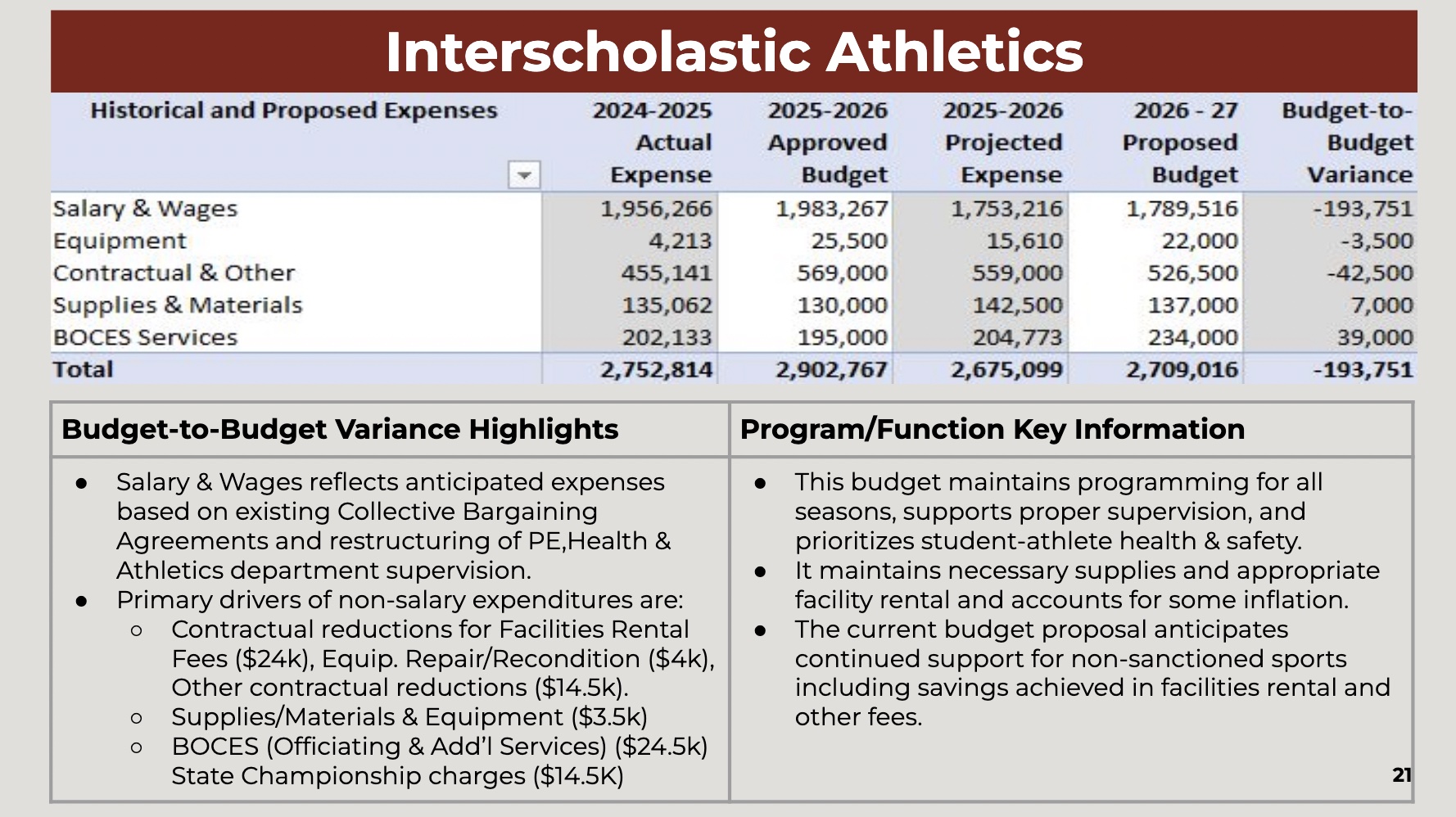
Athletic Director Cindy Parrott told board members the current proposed budget “maintains support for the current level of athletic offerings, supports proper supervision and prioritizes student-athlete health and safety.”
The plan preserves supplies and facility rentals while factoring in inflation and tariff-related equipment surcharges. However, the athletics budget shows a notable drop in salary and contractual lines.
“Most of that decrease is due to the restructuring of the leadership of athletics, physical education and health,” Parrott explained. Additional savings came from replacing long-standing coaches who retired or moved on “with coaches that are starting at lower salaries, as per the teachers contract.”
Contractual reductions reflect closer alignment between projected and actual spending.
“For example, our bowling team used to be enormous,” Parrott said. After physical education exemption rules changed and participation declined, the district had been carrying a contract “incredibly high compared to what the actual expense was.” That figure has now been adjusted to reflect reality.
Similarly, choreography expenses for cheerleading were reduced after the program downsized. “We haven’t had a JV team,” she noted. “There would be no reason to spend money on a JV choreography. And if you know anything about cheerleading, nothing is cheap.”
Still, some increases are unavoidable. Officials’ fees are rising 3–5%, and new BOCES bill-backs for individual state championships will add an estimated $14,000 next year.
“These are costs we don’t really have a lot of control over,” Parrott said. Using outdoor track as an example, she noted Section One’s total projected cost for state competition is $115,000, billed at $418 per participant. “We’ve been super successful. We’re sending a lot of kids. That’s the good news, but we need money to cover them making it to the state championships. And I think that’s money well spent.”
Participation in non-sanctioned sports remained steady despite newly implemented fees, and attendance improved. “Most of the feedback I’ve heard from parents has been, ‘We’re just happy our kids still have this opportunity,’” she said.
Special Education
Assistant Superintendent Eric Rauschenbach began his presentation by reminding the board that, “The vast majority of students can be accommodated in a “regular education” classroom with appropriate supports and classified students have the right to receive all of the accommodations and modifications on their IEPs.”
Rauschenbach further explained that the district currently serves 662 students with IEPs (14% of enrollment), which falls below state and county averages. He noted, “We must look to expand the continuum of service, in a financially sustainable manner, to service the greatest amount of students within our own programs.
Rauschenbach went on to share that while classification rates have leveled off, spending pressures persist. “We’ve seen a major increase in the non-resident tuition rates,” he said, referring to state-controlled costs for out-of-district placements. Additionally, the district experienced two unexpected residential placements at the high school level, “which cost in excess of $225,000 each.”
The budget also reflects increased use of contracted Registered Behavioral Technicians at the elementary level. Though only a small number of students require the service, Rauschenbach described it as individually very high cost because of the high level of training the technicians have.
The proposed special education budget rises by $854,720 (3.8%), maintaining current programs while expanding Integrated Co-Teaching (ICT) services in middle school English and math. “We’ve tried to move ICT up through the middle school for the benefit it has to students,” Rauschebach said, noting the goal is to provide a “just right fit” between restrictive and less supportive environments.
Rauschenbach also pointed to long-term savings from expanding in-district special class and SSP programs, reducing reliance on outside placements.
To learn more about the special education program in Scarsdale see here.
Student Services and Safety
Mr. Rauschenbach also reported that the Student Services budget maintains counseling, nursing, psychology and social work programming and increases elementary social work support. Slide 29
Safety and security funding remains steady, with a $50,000 equipment reduction following completion of major door sensor upgrades. Remaining funds would allow for modest camera additions next year. Slide 30
Technology: Infrastructure, AI and Cybersecurity
In her presentation, Jeannie Crowley Director of Technology and Innovation, emphasized that while the department represents a small slice of the overall budget, continued investment has enabled device upgrades, a new website, improved emergency communications and a transition to updated HR and finance systems.
Crowley also stated that, “Annual investments in our supporting infrastructure (switches, storage servers, network controllers, phone system, firewall, etc.) are necessary to ensure our equipment is up to date, secure, and meeting our needs. Investments in infrastructure are primarily driven by manufacturer end-of-support dates.”
She noted that a lease restructuring aligns equipment payments with useful life spans, lowering annual principal costs. The budget also includes new Chromebook carts for high school humanities classrooms.
On cybersecurity, Crowley described weekly vulnerability reviews, phishing simulations and active monitoring.
One board member commented, “It’s very hard in today’s day and age with AI to recognize threats, but I’m constantly pleasantly surprised by how adept our community is at flagging concerns in real time.”
The district is also developing its 2026–29 instructional technology plan, with growing focus on AI literacy, ethics and data privacy.
After the presentations, board members had the opportunity to ask questions and acknowledged during their discussion, the difficulty of closing the remaining $2 million gap. “We’re struggling to identify Scenario A right now, let alone Scenario B,” Patrick related, indicating the March 16th meeting will likely present a specific set of recommended reductions.
One board member suggested providing clearer illustrations of tradeoffs and potential tax impacts for households. Administrators agreed to consider ways to contextualize what various levy levels would mean for residents.
A public budget forum is scheduled for March 23rd, with final adoption required by April 13th.
Scarsdale Boys Basketball Rolls Over Port Chester in Section One Playoffs
- Details
- Written by: Jack Capobianco
- Hits: 671
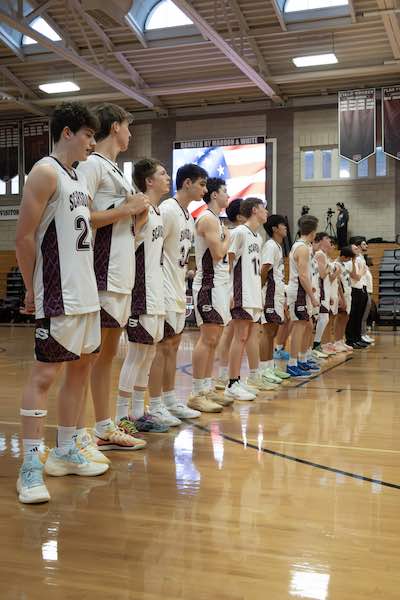 On Wednesday, the Scarsdale Raiders men's basketball team played the Rams of Port Chester in the first round of the section one playoffs at SHS. The game, originally scheduled for Monday, got moved because of the snow.
In the end, Scarsdale dominated, beating Port Chester 93-29 to advance to the quarterfinal round of the playoffs.
Scarsdale started the game hot right out of the gate, pulling ahead of Port Chester early and not looking back. At the end of the first quarter, Scarsdale owned a 29-0 lead! They continued this high scoring throughout the game and played good defense throughout.
Scarsdale having such a strong lead allowed for everyone to get an opportunity to play; including sophomore Jackson Brown who was making his Varsity debut after getting called up from the JV team. Brown was able to see some game action and be able to score his first career varsity points.
Scarsdale, as the seventh seed in this game, will now take on the two seed Mount Vernon Knights in the quarterfinals of the Section One Class AAA playoffs. The game will be at 5PM on Friday at Mount Vernon High School. This will be the third time Scarsdale and Mount Vernon play this season; with each team winning one game each and this third match being the rubber match in the season series for what is a big rivalry between the two schools. If Scarsdale wins this game, they will advance to the Semi-final round which will take place at the Westchester County Center next week and will be the second year in a row that the Raiders make it to the County Center.
This will be Scarsdale’s first time playing Mount Vernon in the playoffs since the 2023 Class AA semifinals when Scarsdale in upset fashion took down Mount Vernon to advance to the section finals.
A First Pass at the 2026-27 Scarsdale School Budget
- Details
- Written by: Wendy MacMillan
- Hits: 1260
 On Monday February 9th, the Board of Education held their first in a series of special Budget Study Sessions in which administrators “outlined the why, how, and what of the budget; presented the overall preliminary budget draft, discussed the key budget components and drivers; and discussed five key budget components: Curriculum, Instruction, & Assessment; Transportation; Facilities & Capital Projects; Debt Service & Lease Purchases; and Employee Benefits.”
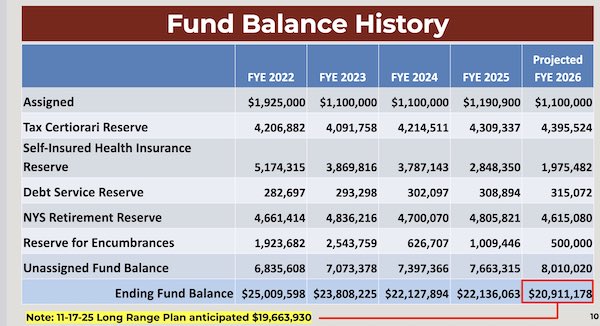
Andrew Lennon, Assistant Superintendent for Business, reviewed the district’s current position as it prepares for the 2026-27 budget cycle. The district began the 2025-26 school year with a fund balance of $22.1 million and now projects $190.7 million in revenues and $191.9 million in expenditures, resulting in an estimated year-end fund balance of approximately $20.9 million, an improvement over earlier projections. Administrators noted two key trends: a continued decline in the self-insured health reserve, which has helped absorb rising and unexpected health care costs, and growth in the unassigned fund balance, which remains capped at 4 percent of the subsequent year’s budget under state law and provides flexibility to address unforeseen expenses.
The district also outlined the state property tax cap calculation, which determines whether a simple majority or supermajority voter approval is required. Based on current factors, including a consumer price index cap of 2 percent, a tax base growth factor of 1.013 percent, and more than $9 million in capital exclusions, the district’s tax levy limit for a cap-compliant budget is $181.7 million, representing a 3.37 percent levy increase.
Revenue projections for the current year show an estimated $1.7 million above budget, driven by electric vehicle bus grants, higher-than-anticipated tuition revenue (particularly for special education programs), and additional state reimbursements. Looking ahead to 2026-27, the district anticipates a slight decline in state aid tied to lower expense-driven aid and a continued reduction in aid ratios for transportation and BOCES services. The proposed budget also reduces reliance on reserves, including a $250,000 decrease in the use of the health insurance reserve as part of a multi-year plan to gradually phase down its use in balancing the budget.
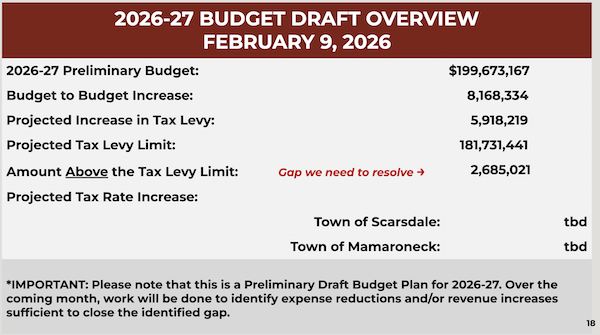
On the expenditure side, the draft budget reflects an $8.17 million, or 4.27 percent, increase over the current year. Major drivers include approximately $3.1 million in additional salary costs, $2.7 million in increased employee benefits, $1.1 million in contracted services, and higher utility and supply costs largely attributed to inflation. Debt service is also projected to rise, while transportation costs are expected to decline due to reduced bus purchases.
Overall, the proposed budget would require a tax levy increase of approximately $8.6 million, or 4.9 percent, about $2.7 million above the state tax cap. If proposed, the budget would need to be passed with a 60% majority. The administration acknowledged this gap and indicated that the next phase of budget work will focus on identifying expenditure reductions or additional revenues to bring the proposal within the tax cap ahead of final adoption.
Curriculum, Instruction, and Assessment
The presentation also highlighted curriculum, instruction and assessment initiatives supported by the budget. These include expanded performance-based learning, global education partnerships, arts enrichment, sustainability projects across all seven schools, and ongoing evaluation of district programs through surveys, consortium reviews and alumni feedback. Edgar McIntosh, Assistant Superintendent for Curriculum, emphasized that these investments are intended to ensure Scarsdale continues to innovate, respond to student needs and maintain its long-term financial and educational leadership.
At the instructional level, the proposed budget prioritizes learning by maintaining class size norms and expanding targeted staffing. Plans include the addition of a math position at Scarsdale High School, continued planning for elementary class sections, and further development of the special education continuum to ensure students receive appropriate services and meet graduation requirements. Investments are also directed toward sustained professional development, curriculum refinement and continuous improvement of instructional practice.
Student well-being and belonging remain a key focus, particularly at the elementary level. The budget includes a proposal to expand social work services through a partnership with Scarsdale-Edgemont Family Counseling Services, adding 1.5 full-time equivalent social workers to strengthen support for students and families. McIntosh framed this investment as part of a broader effort to create school environments that promote resilience, inclusion and emotional health.
Facilities
District officials spotlighted the work of the facilities department this week, emphasizing expanded in-house capacity, cost savings, and a proposed $1.815 million capital plan for 2026-27.
Assistant Superintendent for Business, Andrew Lennon explained that the department has made a concerted effort in recent years to reduce reliance on outside contractors by building internal expertise and promoting from within. With his promotion to Director of Facilities, Nick Ferraro and his team oversee custodial, grounds and maintenance teams responsible for approximately one million square feet of building space and 115 acres of property. Beyond daily cleaning and upkeep, staff have taken on larger-scale projects in-house, including office and classroom renovations, drainage improvements, field upgrades, playground repairs and capital-level work previously outsourced. Lennon said this shift has resulted in significant cost reductions while improving responsiveness.
Among recent efforts are field renovations at multiple schools, site beautification projects, playground repairs led by a certified in-house inspector, and a pilot initiative to create collaborative “nooks” in high school hallways. The department has also addressed priority building conditions and code-related items internally.
Despite these efficiencies, administrators noted ongoing challenges, including rising electrical costs, inflation affecting supplies and materials, increasing prices for contracted labor and the demands of aging facilities. The proposed operations budget reflects a $200,000 increase in utilities driven largely by electricity, an $85,000 equipment increase for maintenance vehicle replacements, including the district’s first EV maintenance vehicle, and higher BOCES costs tied to environmental testing such as asbestos, air quality and lead monitoring. Contractual spending is projected to decline as more work shifts in-house.
Officials also reported progress through a partnership with Synergistics, an energy management firm. Improved heating controls have reduced comfort complaints and are expected to yield energy savings, with a formal update anticipated this spring.
The proposed five-year capital plan, informed by facilities studies and bond discussions, aims to address building needs while stabilizing long-term tax impacts. Year-one projects total $1.815 million and include high school life skills classroom renovations, replacement of an aging oil tank and sewer line at Fox Meadow Elementary, a new playground structure at Heathcote, replacement of high school gym bleachers, a heat exchanger at the high school library, hot water heaters at two elementary schools and major paving work at the middle school.
Officials said the department will continue refining priorities for years two through five of the plan, which may include additional playground upgrades, classroom renovations, roofing, windows and other building systems.
Administrators described continued investment in facilities as essential to maintaining safe, functional schools while avoiding costlier repairs caused by project deferrals.
Transportation Upgrades and EV Bus Plan
Scarsdale school’s transportation department is undergoing major improvements under new Supervisor Nadia Pettignano, who has focused on stabilizing operations, strengthening safety and compliance systems, and modernizing communication and record-keeping.
Key initiatives include updated inspection procedures, standardized driver manuals, upgraded radio systems, and planning for GPS tracking and telematics. Pettignano emphasized that recruiting and retaining bus drivers remains the department’s top challenge amid a nationwide shortage.
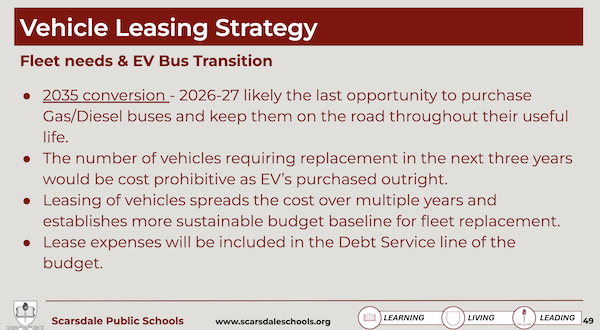
The district is also preparing for New York State’s zero-emissions mandate. Four electric buses have been procured, and charging infrastructure is being installed, with permanent stations expected in six to eight months. A fleet review identified 25 vehicles in urgent need of replacement. To bridge costs and meet operational needs, the district plans to lease 12 gas buses and two electric buses in the upcoming budget cycle.
Officials described the upgrades as a balanced approach to improving safety, efficiency, and environmental sustainability while navigating staffing and budget challenges.
Debt Service
Andrew Lennon also reported on key changes in debt service, salaries, and benefits. He explained that an increase of $246,000 is tied to the auditorium bond, while $408,000 reflects planned bus lease costs. Offsetting reductions come from prior grounds equipment purchases that have improved department operations, including performance during recent snowstorms.
Personnel costs remain a major focus, with the New York State Employees Retirement System contribution rising $482,000 due to higher rates for custodians, clerical staff, nurses, aides, and drivers. Meanwhile, the Teachers Retirement System contribution decreased, reducing the budget by $964,000. Social Security, Medicare, and health insurance costs are also projected to increase, with preliminary estimates suggesting 8-10% growth in claims.
Lennon emphasized the continued use of unassigned fund balance, historically around $1.1 million, to help mitigate tax levy increases. While long-term budget projections show potential deficits, administrators stressed that careful planning and monitoring of health reserves will prevent major impacts.
Next steps include refining revenue assumptions, reviewing expenses, and presenting updated projections at the second budget study session on March 2. The district reaffirmed its commitment to a balanced, thoughtful approach amid rising costs and inflationary pressures.
You can see the slides from Budget Study Session One here or watch a recording of the presentation here.
District Updates Bond Scope to Include Middle School Turf Field
During the Business portion of the marathon meeting on Monday evening, administrators presented an updated bond proposal ahead of the May 19th public vote. The overall bond scope increased from $98.69 million to $101.7 million to restore the middle school turf field, bringing the total field-related costs to $5.44 million.
Other aspects of the bond, including infrastructure, spatial renovations, and air conditioning, remain unchanged. The middle school turf field is now scheduled in Phase Five of the project. District officials emphasized coordination with village drainage projects to ensure smooth implementation and minimize conflicts with interior renovations.
The district continues toward referendum adoption on May 16th, with full details and phasing available on the district website.
SEQRA Review
Board members reviewed the State Environmental Quality Review Act (SEQRA) process for the proposed 2026 capital bond project and responded to questions from the public about potential impacts to the timeline.
Consultants determined the bond qualifies as a “Type I” action, requiring a more comprehensive environmental review. The designation is largely due to the historic status of three buildings included in the scope of work, which lowers the threshold for reviewing building additions. The high school does not carry the same historic designation.
As part of the process, the district must prepare and circulate a Full Environmental Assessment Form (FEAF) and allow a 30-day comment period for involved agencies. A resolution formally declaring the district’s intent to serve as lead agency and initiating the review process will return to the board for action.
During public comment, resident Christian Callaghan of Webster Road asked whether the 30-day review period would affect the district’s approval timeline and whether evaluating the bond as a single, comprehensive project means an issue at one site, such as the middle school turf fields, delay the entire proposal.
District officials said they do not anticipate the SEQRA process will disrupt the current schedule and expect to meet the March 16th deadline for board action. Based on consultations with environmental experts, legal counsel and project consultants, administrators said they do not foresee any significant environmental impacts that cannot be addressed through standard mitigation measures.
While the bond is being reviewed as a whole, meaning a major issue in one component could potentially delay the entire project, officials emphasized that no such obstacles are expected.
To watch all of the highlights from Monday’s meeting, see here.
The $101mm Proposed School Bond: Where it Stands Now
- Details
- Written by: Joanne Wallenstein
- Hits: 966
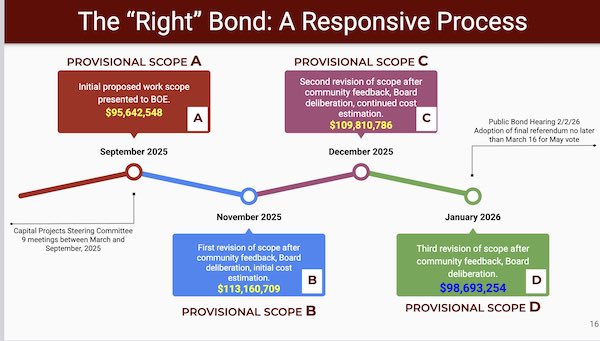 The Scarsdale community faces one of the biggest decisions in its history – that is whether or not to approve a $101 mm+ bond for infrastructure and spatial improvements to the schools and fields, to be voted on in May 2026.
Though traditionally the district has proposed bonds that match the amount of expiring debt in order to keep payments tax neutral, in this instance, $40 million in debt is rolling off, and the district is proposing to replace it with two and half times that amount, with a $101.7mm bond referendum. Compounding the question are annual school budget challenges which require the district to use diminishing reserves to balance the budget.
At the same time, the Scarsdale Village Board approved plans for a $70mm replacement and improvement to the Scarsdale Pool Complex, which will include an indoor/outdoor pool at the site, another first in Scarsdale history.
Is there adequate support for the investment in the schools at this time?
That was the question of the day at a bond forum, hosted by the Scarsdale School Board on Monday night February 2, 2026.
Before inviting public comments, Scarsdale School Superintendent Drew Patrick explained the evolution of the bond proposal, demonstrating how the district arrived at the $100mm target figure, how needs were evaluated and why the work is essential at this time. Assistant Superintendent Andrew Lennon provided a financial analysis, phasing the debt and the impact on Scarsdale taxpayers over the life of the bonds. See the presentation here:
This is the total scope of the bond as proposed prior to the February 2, 2026 meeting.
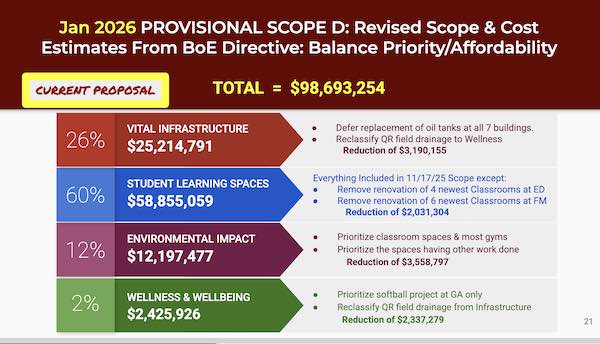
A large addition to Edgewood was based on a demographer’s projections of increased enrollment at the school. The $22.3 mm addition includes 6 classrooms and 5 small instructional spaces needed for services such as occupational, physical and speech therapy. The plan is to make a permanent home for three Special Education classes, with a current population of only 21 Scarsdale students. Since overall district enrollment has been decreasing for the past 10 years, and home sales are slow, some asked for the Board to hold off on this addition until a population increase could justify the addition.
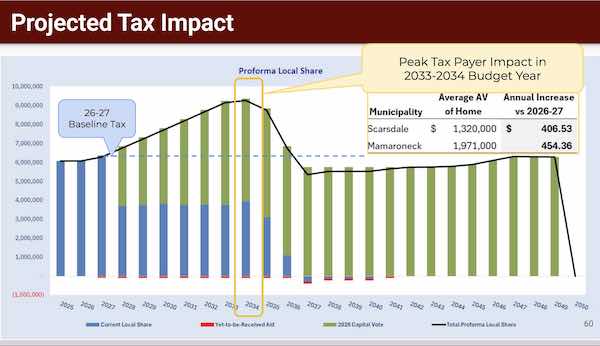
PTA representatives asked the Board to also include a turf field at Scarsdale Middle School that was removed earlier on. The field would add $3.2 mm to the proposal, bringing the bond to $101.7 mm.
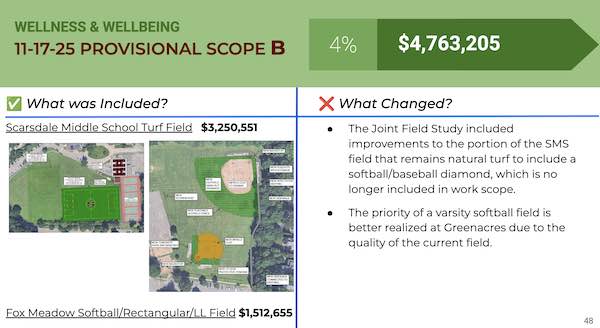
After the community requested further details on the estimated tax impact, Assistant Superintendent Andrew Lennon explained the phasing of the debt and showed this slide outlining the tax impact for a homeowner with an assessed value of $1.32mm. At the peak, it would mean a tax increase of $406.53 a year, on top of the regular 2-3% school tax increase.
Following the presentation and the public comments, the district answered questions raised by the Board.
In a discussion about the turf field, Lennon explained that the Village Board has a long range plan to build a large detention basin under the SMS field. This would require grants and further planning and there is no firm dates for this work. If the school district planned a turf field there, it is assumed they would need to coordinate with the Village on the planning. Lennon explained, “A significant logistical plan would be required. This would be a complicated system.”
Asked what the tax impact of including the $3.2 turf would be, Lennon estimated $45-$50 for the average homeowner per year.
Board Vice President Colleen Brown reported on the many emails the board had received advocating for the turf. She said, “School needs reflect our priorities. Mental health needs are a priority. We have gotten many emails about the turf. When fields are wet it affects our mental health as well. It touches every single person. It encourages healthy, active, well-rounded students.”
After a discussion of increasing the bond over $100mm, the health benefits of more playing time and flood mitigation, the Board voted to include the $3.2 mm field in the plan, hoping to build it in the future phases of the construction.
A board member asked why the 3 special education classes at. Edgewood could not be shifted to Greenacres, which has more space per student than the other elementary school, Patrick responded, “No other elementary school has three available classrooms – without shifting other classes. Greenacres has only one available class that is used for related services.”
The session included lengthy public comments on the bond. The PT Council, PTA’s, STA and Maroon and White all spoke in support of the bond. The League of Women Voters and several individual speakers expressed reservations. Read summaries of these comments here.