







Someone to Talk To: A Conversation with Scarsdale Middle School's Youth Outreach Worker Liza Fahey
- Saturday, 26 September 2026 10:20
- Last Updated: Saturday, 26 September 2026 11:34
- Published: Saturday, 26 September 2026 10:20
- Maggie Xie
- Hits: 85
 Another email from the middle school landed in my inbox, and one line caught my eye: an activity hosted by a Youth Outreach Worker. Those words — Youth Outreach Worker — show up in school emails every so often, and I wonder if you've ever found yourself curious, like me, about what these women actually do. As the mother of a high schooler, I know that one of them has become one of the people my own child trusts most at school, and I'm grateful for how they've walked alongside him through the anxiety and emotional ups and downs of adolescence.
I've more than once recommended their services enthusiastically to friends here in Scarsdale, explaining that these clinicians are licensed counselors from Scarsdale Edgemont Family Counseling Service (SFCS), stationed full-time at the middle and high schools, providing support for kids' growth and emotional wellbeing, free to the families.
But how their work actually unfolds day to day — what they do, how they interact with students, why it makes such a difference — I'll admit, I only had a vague picture. So, out of curiosity, I sat down with Liza Fahey, one of three SFCS clinicians stationed at the middle school.
What Does a Youth Outreach Worker's Day Actually Look Like?
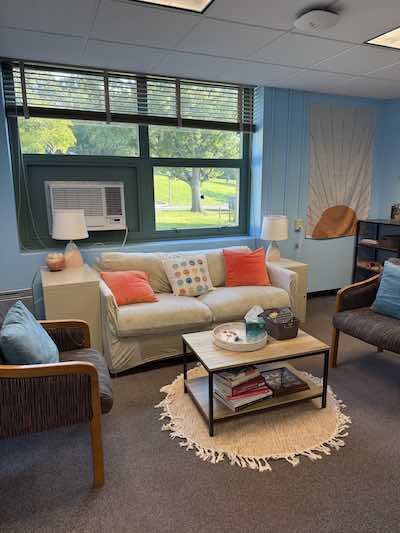
Liza's office sits on the first floor of the middle school, where a few of the school's houses meet. Settling onto the comfortable little couch inside, met with her easy, put-you-at-ease smile, I felt like I was catching up with an old friend rather than making small talk with someone new — so I got straight to my questions.
“We have a caseload of students that we meet with. We’ll reach out to them by email and schedule times to meet throughout the week. The frequency of our meetings depends on the student and whether they want to meet weekly, biweekly, or once a month. It really depends on their individual needs and how frequently they want to meet with us.”
A lot of her time throughout the week is spent meeting with students individually, or sometimes in small groups when there are friendship challenges and the students want to come together. “Sometimes it can be a little intimidating for a student to come in and meet one-on-one with us, so we always give them the option of bringing a friend if they feel like that would make them more comfortable.”
When a student has a 504 plan or an individualized education plan, Liza is often part of the related meetings for students on her caseload, "to make sure that we are supporting the student to the best of our ability and advocating for what they need throughout the year." With a family's permission, she also stays in ongoing contact with a student's house counselor and teachers — checking in on how they're doing, or making sure school administration is aware if a friendship conflict is escalating into something bigger.
Every other week, Liza's entire counseling and clinical team — the outreach workers, the social worker, all the house counselors, the school psychologists, the administrators — meets to make sure everyone's on the same page about the cases they're tracking. On top of that, every quarter the team goes into health classes to co-teach a lesson with the health teacher, "so students continue to get to know us." Liza covers bullying prevention, self-advocacy, and communication skills with sixth graders; her colleague Olivia talks with seventh graders about mental health; and Megan covers social media use with eighth graders.
Why Bringing Mental Health Support Into the School Matters
Asked about the benefits of putting mental health services directly inside the school, Liza's first answer was accessibility. “Having easy access to mental health support in school is really important” she said — whether a family can't afford outside support, or a student simply isn't ready yet to talk to their own family about what's going on and wants to start in a school setting first.
Time is a real, practical factor too. “Sometimes students will say they don’t have time for counseling after school.” At school, seeing Liza becomes almost part of the day itself — they're only pulled from things like PE, music, an elective, or lunch and before/after school, never from academic class. " Meeting with us becomes a part of their day.” as she put it, so they don't have to spend what little downtime they have after school to get support.
Having so many mental health professionals inside the building also quietly chips away at the stigma. “We get referrals from house counselors, parents, and teachers. Having so many people talk to students about the benefits of mental health support has helped reduce the stigma around it in school.” She's noticed how normal it's become — students asking, "can my friend come next time?" or "my friend wants to talk to someone now." It spreads by word of mouth.
Early identification and intervention is another idea Liza kept coming back to. “That’s a big part of why we have these services in the school, to identify challenges and mental health concerns and give students a space to talk through them before they become more serious. And finally, being embedded in the building lets her see a fuller picture of a student's life “We’re able to see where they’re at socially and academically and understand the day-to-day dynamics of the school.” As she put it, only half-joking, "I know what the lunchroom's like — an outside therapist might not.”
What Are Today's Students Actually Going Through?
Asked about the most common challenges she sees, Liza didn't hesitate: anxiety, and the school stress that comes with perfectionism. "Scarsdale is a very high achieving district," she said, with high expectations around academic performance that put a lot of pressure on kids. She'll talk with sixth graders who tell her, "if I get a B, I'm not getting into a good college.” "They’re thinking so far into the future and it can have a negative impact in their well being” That stress and fear of failure, she says, genuinely affects students' mental health.
She's also noticed more students tying their self-worth directly to academic performance — feeling like a failure when grades slip, feeling okay about themselves only when they do well.
“We work with students on separating the two. Helping them raise awareness that their self-worth is important, and it’s important that they love and appreciate themselves without tying that solely to their academic performance.”
Constant comparison through social media is another theme she's seen intensify. “This is such a pivotal time socially for kids. They really value their social connections. “It’s not just about fitting in with peers in person anymore — kids are also watching everything happening online: “For some students seeing how others present themselves and spend their time can create a sense of pressure to fit in. Social media can amplify these comparisons, making it easy to feel that there is a certain way one is expected to look, behave, or participate in order to feel accepted.” On top of comparing themselves to influencers close to their own age.
At the same time, middle school is naturally a period of figuring out identity — values, gender identity, sexuality — and some students, she's noticed, start realizing they may be more neurodivergent as they compare themselves to peers: “I’m struggling in this area more than some of my peers. What’s going on with me?" All of it together, she said, "can contribute to low self-esteem, a lack of confidence, difficulty advocating for themselves, and difficulty feeling good about themselves overall.”
What About the Kids Who Aren't Ready to Ask for Help?
Not every student says, "I need help" — and Liza is candid that this is something they're constantly navigating. “Sometimes a student will say, ‘I don’t want to talk to anyone.’ Whatever the reason, we can’t force them. Our services are voluntary, and our goal is to meet students where they are, respect their boundaries, and support them when they’re ready.”
Her approach leans on patiently building trust. “We always try to highlight that there are many trusted adults in the building that they can go to.” Teachers work on building relationships with students, and the outreach workers do the same — staying visible around the school so students start to trust them before they ever need to ask for help. “Some students who are referred to me may initially be hesitant to meet or feel like they don’t need support, but because we’re visible throughout the school, they may get to know us through everyday interactions. Once they’ve had a chance to meet me and get to know me a little, they may feel more comfortable and decide they want to give meeting a try.” They need to form that initial relationship, she said, before they feel ready.
When she senses a student isn't ready yet, she doesn't push. “If a student isn’t ready or comfortable opening up, I won’t push them. I’ll focus on getting to know them and building that rapport first.” She'll ask something lighter — "how's your day," "what do you like to do outside of school," "what are your interests" — so it doesn't feel like she's presenting them with a problem, but simply building a connection: "Okay, now I know who Liza is. Maybe I can talk to her about something that’s troubling me.”
Every student moves at their own pace. “Sometimes I’ll have students who walk right in and are ready to talk about everything that’s going on. Other students may take two months or more before they feel comfortable opening up. That’s why we use activities like games and coloring—to help students feel more at ease, build trust, and develop that connection.” She also noted how easily that trust can break: “If they come to you or share something and feel like they’re being shut down, dismissed, or not heard, they’re going to pull back,” she says. Staying open and validating their feelings matters because “the second they feel like they’re being shut down, especially as a teenager, they can pull away very easily.”
Is There a Moment That Stands Out to You?
Without sharing identifying details, Liza described a student she'd actually known years earlier, back when she worked at the elementary school level, though only in a group setting — never one-on-one. The student remembered her. When they reached sixth grade and started meeting with Liza individually, they slowly opened up — about social struggles, and about feeling really down, depressed, hopeless.
“I said, ‘Why didn’t you tell me you were feeling this way last year?” Liza recalled asking. The student explained that back then, it never felt like a setting where they could talk about any of it. “The middle school setting with counseling is a little different. They have a lot more privacy and confidentiality, so they felt more comfortable opening up about struggles.”
That familiarity with Liza, combined with a space that felt confidential, safe, and non-judgmental, is what finally let the student open up — and the two were able to work through it together. Today, Liza said, that student is doing much better, both socially and emotionally. “They had been feeling this way for probably five years and had never talked about it. Eventually, they reached a point where they felt comfortable opening up and talking about it.” Liza still thinks about it: "What if I didn't meet with you? What if you didn't get familiar with me and then decide to utilize services? What would have happened? Where would you be right now?" There's no answer to that question — but it says everything about what it means for a student to have a private, safe place to talk.
Beyond One-on-One: The LEAD Club
Beyond individual counseling, SFCS also runs a leadership club at the middle school called LEAD( Leadership Advocacy Empowerment and Development) which Liza co-leads with a house counselor. “I think it’s a valuable program because it gives students another opportunity to connect with me and the house counselor. We also get to work with them on leadership skills and on building a stronger school community rooted in inclusion, empathy, and kindness.” It's been well attended.
The club also does community service and fundraising. “We focus on helping students learn to advocate for themselves, use positive decision-making, and lead with empathy and kindness. “In Liza's view, it also reinforces something important: “You can be a strong leader and have all these strengths while also needing support or wanting to talk about things going on in your life.” Every September, the school holds a club fair where any interested student can sign up on the spot. Just before this interview, the club held its last meeting of the semester — the students raised money for the Prospector Theater through a fundraiser and are headed there on a field trip. The club members have great ideas for implementing even more leadership opportunities, like picking a leader each week help teach a new leadership skill.”
And the Parent Support Groups?
Outside of her in-school work, SFCS also runs parent support groups for every grade, sixth through twelfth, each led by a different clinician.
“The purpose of these groups are to provide a space for parents to connect with each other, receive support, and talk about things going on in their lives, whether it’s positive experiences or challenges.” Liza said the goal is a supportive, collaborative environment where parents share what they're facing with kids at that age and find common ground with other parents — “parents often hear someone share an experience and say, ‘Oh my gosh, I’m experiencing something very similar right now,’ or, ‘I’ve been there. This is what worked for me.’” As she put it, “it’s a space where parents can come together, share their experiences, and feel less alone in what they’re going through.”
Alongside the grade-level groups, there's also a specialty group called Beyond the Basics for parents of children with learning differences, where families can talk more specifically about social or academic challenges, or navigating an IEP within the school system. Common topics across the groups include academic stress, the social dynamics of group chats and social media, feeling excluded or navigating friend groups, and conflict resolution — “I think a lot of middle schoolers are still learning how to handle and work through conflict.”
Parents also talk about how to communicate with their kids and create a more open, supportive environment at home, along with mental health and social-emotional learning, screen time and phone-use agreements, and the executive-functioning and study-habit shifts that come with the transition from elementary to middle school and middle to high school. “More recently, we’ve been talking a lot about how parents can have difficult conversations with their children at home”— whether because of what's happening in the world, or simply the territory that comes with adolescence.
In Closing
Toward the end of our conversation, Liza said, simply: “I believe the Youth Services Project, through Scarsdale Edgemont Family Counseling Service, provides an important and accessible resource for students and families in the community.”
She and her colleagues talk often about how fortunate it is that a school district offers this kind of accessible resource. “The students and the community are great. Making sure families know about and can access these services is so important, especially at this age, so students can get support when they need it.” She also mentioned that the program started at the middle school level, but as it grew, the team realized early intervention was needed even earlier — which is why, three years ago, the program expanded into the elementary schools as well, “because they saw a need for these services in the elementary schools.” For Liza herself, the most rewarding moments are with the students who take longer to warm up — when it finally clicks, and she can tell they're comfortable and open. “It’s really rewarding when we can work through a challenge together and I can see that a student feels comfortable enough to open up.” I really enjoy the work I do.”
Read Liza's bio here.
Author Maggie Xie is a Scarsdale resident and mother of two school-aged children. A board member of Scarsdale Edgemont Family Counseling Service (SFCS), she is passionate about supporting families and strengthening community connections. Through her work and community involvement, she hopes to help local families discover the resources and people who can support them along the way.