








Community thanks Dr. McGill for exemplary service
- Details
- Written by: Joanne Wallenstein
- Hits: 13461
 At the final Scarsdale Board of Education meeting for the 2013-14 school year, there were many tributes to retiring Superintendent Dr. Michael McGill. Here are a few of the comments: Art Rublin and Diane Greenwald, speaking for the Coalition for Scarsdale Schools lauded Dr. McGill and announced an annual book award to be given in his name. Here are their remarks:
(Art Rublin) Ms. Seiden, you delivered a lot of thanks and congratulations in your opening remarks. I'd like to offer a tribute to Dr. McGill, but before I do I'd like to thank you and congratulate you on your extraordinary, extraordinary leadership this year.
I've been pleased to hear many wonderful tributes to Dr. McGill about what he has accomplished in Scarsdale. I want to focus tonight on what Dr. McGill will continue to accomplish in Scarsdale. Now, Dr. McGill, you might say, Well, I know the community is demanding, but how can they expect me to get things done in Scarsdale after I leave the Superintendent's seat? Well, we in the Coalition for Scarsdale Schools, as well as CSS supporters and other members of the community are eager to carry forward your vision for Scarsdale schools in the years to come.
I'll remind everyone that as Dr. McGill prepared to depart his post, he wrote an important article in the Scarsdale Inquirer in which he laid out six reasons why, "at a time when some voices are demanding that public schools do more with less, a more progressive spirit is important today." Dr. McGill suggested that this more progressive spirit is important in Scarsdale not only today but over the next decade.
Dr. McGill, you'll recall that you gave Scarsdale six reasons for a more progressive spirit for Scarsdale schools into the future:
First, you noted that Scarsdale students continue to compete for college admission with others from the strongest independent and public schools in the world, and that those other schools are not standing still. You urge Scarsdale to continue to develop students who are intellectually and personally distinctive.
Second, you suggested that we need to expand beyond a strong traditional education in Scarsdale – that other nations are reinventing their schools, emphasizing critical thinking and innovation over test results, and we need to do the same.
Third, you said a more progressive spirit is important in Scarsdale because rising demands such as invasive new education regulations drain time and other resources from Scarsdale's primary mission of educating young people.
Fourth, you note that in a world of technology, Scarsdale schools must adapt to remain relevant – for example, integrating innovations such as makers' spaces.
Fifth, you noted that Scarsdale is attempting to promote more collaboration and synergy among faculty, and suggested that Scarsdale should continue to sponsor strong administrative teams, teacher leadership and other support systems.
Finally, you noted that, "the impulse underlying much of today's educational discourse is the spirit of retrenchment." You observed, "ironically, absolutely the easiest course for Scarsdale would be to fall back on what it has been and to slip into sleepy complacency. That is a prescription for decline. A school is a living, breathing organism, and any organism that is not growing is dying."
Dr. McGill, you concluded, "Most who are part of this extraordinary community appreciate how unusual it is and how fortunate they are to be part of it. Privilege entails responsibility. In the words of the old saying, 'To those to whom much is given, from them much is expected.' As it has been in the past, may Scarsdale live up to that legacy in the future."
Dr. McGill, your writing that article during the summer before your last year as Superintendent, and your speaking here tonight – to inspire us for the future – speak volumes about the extraordinary leader and visionary that you are and I know will continue to be. Rest assured that I am not alone in my effort to see your wishes for Scarsdale's future be realized. We will do all we can to prevent Scarsdale from, as you say, "fall[ing] back on what it has been and [ ] slip[ping] into sleepy complacency."
Thank you for everything you have done for our community.
(Diane Greenwald) Coalition for Scarsdale Schools, (CSS) is delighted to sponsor an annual award for a deserving senior at SHS in honor of the 16 years of exceptional service given to Scarsdale by Dr. McGill.
The Michael V. McGill Book Award, will be given to a graduating Scarsdale High School senior who has demonstrated great promise applying the values of Non Sibi, making a contribution as a global citizen.
The student should be honored who has demonstrated interest in address complex global issues and developed a sense of their global citizenry in the classroom and/or the community.
We would like to ask that Dr. McGill, you make yourself available annually to recommend a book selection for the student honoree.
Susie Rush, Scarsdale League of Women Voters:
President of the Scarsdale League of Women Voters Susie Rush presented the following on behalf of the league:
Anyone who has gotten to know Mike over the past years has dreaded this moment. Of course we knew the time would come that you'd leave; we just hoped it wouldn't come when we were still here.
It couldn't have been easy to adapt to our charming hamlet where the pressure is unrelenting and acceptance accorded sparingly. Yet you quickly learned to negotiate the waters and earned the respect and affection of the legion of those who have worked with and come to know you – administrators, teachers, parents and students. You managed to become comfortable with the most demanding of the bunch – parents -- and I guess I can say parents got comfortable with you even though many of us don't always understand what passages you're quoting, why you're quoting them or what they mean, and they're usually way too long for us to follow. (Joanne, thanks for that explanation of Begun of Bengal.) You've embraced us and maybe at times even reveled in the exchange of ideas and debate of issues, energized by the community and the possibilities that it offers to provide a first-class education to our children.
Your commitment to educational excellence is the hallmark of your tenure here. But the promise of an exemplary public education in the liberal arts tradition is not limited to every child in Scarsdale; you aspire to realize that promise for every child in America.
You have been the passionate voice within our community, throughout the State, across the country and outside the U.S., urging us to focus on developing critical and creative thinking skills, reasoning and problem-solving skills, independent and collaborative learning, always striving to develop a curriculum that meets the highest standards not just nationally, but internationally.
You have been the rational voice, engaging in the Sisyphean task of questioning the wisdom of imposing a business model on efforts to reform education, including standardized testing, using APPR to evaluate teachers, and the adoption of common core earning standards, wrought by No Child Left Behind and Race to the Top, all to prompt us to examine whether any of these strategies will actually improve learning or teaching. Yet in addition to asking legislators, educators and other stakeholders to critically consider this ill-advised approach to reform, you offered an alternative vision, a Declaration of Intellectual Independence.
You have been the indefatigable voice, daring us to explore and embrace new ideas -- sometimes taking the heat as you did in encouraging us to take the leap from AP to AT, establishing the Center for Innovation and the Global Learning Alliance – and nudging us into imagining what an education in the 21st century in our global community will look like, and leading us there.
And you have been the empathetic voice, underlining the importance of fostering connections between students and adults and among students, and building community.
What underlies everything you do, and which is perhaps most inspiring, is your unwavering recognition of context. Whatever the issue, you are careful to acknowledge the competing interests and the economic realities, the complexities and the nuances. More importantly though, you always remind us that we are a part of history, that we are a part of something larger than any individual and that we are a part of something enduring. You have emboldened us to believe that we are a beacon for others to follow, that what we do here will have an impact in the nation and in the world, and that we must accept that responsibility and discharge it as we have done so in the past. For we are in it for the long-term. As you have said, "we are all custodians of the future."
Mike, you are in a class without peer. We will likely not see someone quite like you again. Thank you for being our Bobby Moch to exhort us to hurl our boat through often treacherous waters across an ever-moving line that could never be a finish line. As you embark on the next leg of your life's journey, we wish you our very best; may you find another boat to steer in search of that magical moment of perfection so few have been able to experience but which you've allowed us to do with you.
Thank you.
Proclamations in Honor of Dr. McGill
- Details
- Written by: Joanne Wallenstein
- Hits: 7564
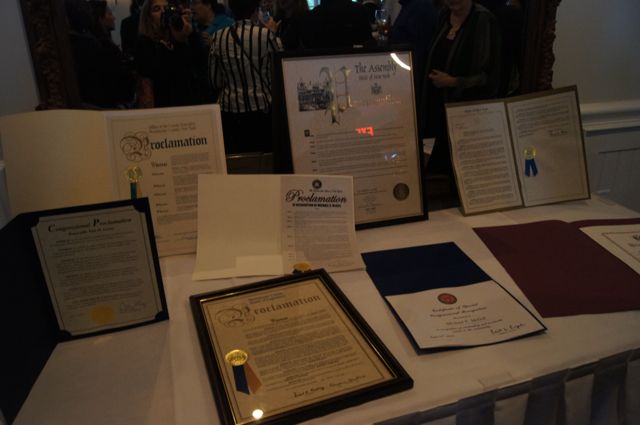 In honor of the retirement of Scarsdale School Superitendent Dr. Michael McGill many proclamations were written and displayed at his farewell dinner on Thursday June 12th. Here are two of the proclamations: one from the Village of Scarsdale and the other from State Assemblywoman Amy Paulin:
Proclamation for Dr. Michael McGill from the Office of Amy Paulin:
Whereas, it is the practice of the New York State Assembly to take note of and publicly acknowledge individuals whose exemplary careers, accomplishments, and purposeful lives of service to their community and their profession have significantly enhanced the quality of education in the state of New York; and
Whereas, this Assembled Body is justly proud to honor Dr. Michael V. McGill who is retiring as superintendent of the Scarsdale Union Free District School District after sixteen years of exemplary service; and
Whereas, Dr. Michael V. McGill has been superintendent of the Scarsdale Public Schools since 1998. A graduate of Williams College and Harvard University, where he earned his doctorate, he was New York State Superintendent of the Year in 2007. Under Dr. McGill's leadership, Scarsdale continued a long tradition of educational excellence and innovation; and
Whereas, Dr. Michael V. McGill is a visionary on the cutting edge of educational policy with a focus on critical and creative thinking, collaborative work, and a global perspective for students. During his tenure, the Center for Innovation (CFI) was founded whose mission is to ensure that Scarsdale graduates think critically and creatively in order to solve complex, non-standard problems, understand their role in an interdependent world, and use evolving technologies for research, communication, and innovation. The Center for Innovation is focused on reimagining education for all students; and
Whereas, Dr. Michael V. McGill was in the forefront of questioning the state and federal government's reliance on testing. He remains steadfast in his belief that standardized tests offer a limited view of learning and that all schools should remain committed to providing students with a deep, rich education. Dr. McGill led the movement in Scarsdale to replace the Advanced Placement classes with district-created Advanced Topics where students delve deeper into the subject; and
Whereas, Dr. Michael V. McGill has had many other accomplishments including expanding the facility to address the growing student population, a renewed focus on curriculum, instruction and teaching, and, spearheading the introduction of foreign language at the elementary school level. Dr. McGill's legacy of truly caring about what students are learning sets a standard that will prevail for many years to come; and
Whereas, Dr. Michael V. McGill has written extensively on every aspect of education and has shared with enthusiasm his knowledge of teaching and learning through numerous presentations and by participating in workshops and on councils and committees; and
Whereas, the merit of any society can and will be measured by the actions of those individuals and organizations who, by way of unparalleled exhibitions of diligence and conviction, inspire those fortunate to bear witness; now, therefore, be it
Resolved, as a duly elected member of the New York State Assembly, I congratulate
Dr. Michael V. McGill on the occasion of his retirement from the Scarsdale Union Free School District.
Dated: June 12, 2014 Amy R. Paulin
New York State Assembly
88th Assembly District
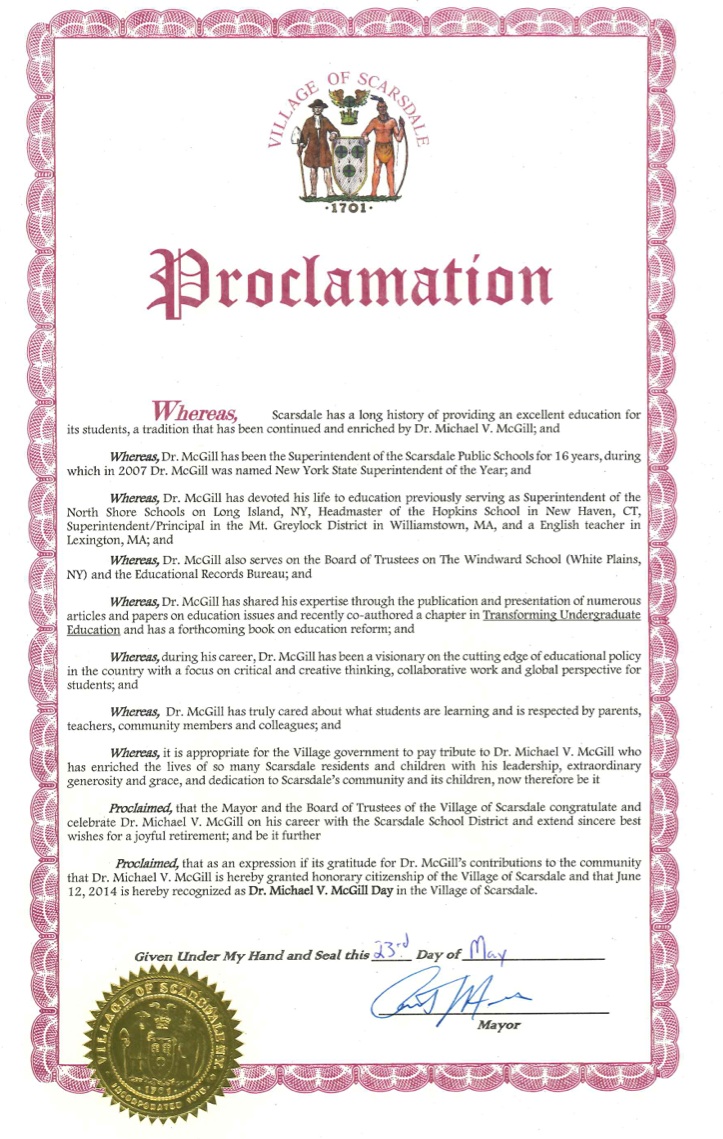
Proclamation from the Village of Scarsdale
50th Anniversary of Freedom Summer
- Details
- Written by: Joanne Wallenstein
- Hits: 4050
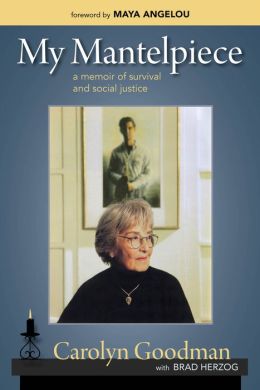 On Wednesday June 18th at 7:30 pm, Brad Herzog, co-author of My Mantelpiece: A Memoir of Survival and Social Justice will share the story of Carolyn Goodman, mother of slain activist Andrew Goodman who died in 1964.
Andrew Goodman left home for Mississippi in 1964, one of hundreds of young men and women who traveled to the South to register African-American voters. On June 21, he, James Chaney and Michael Schwerner disappeared, abducted and murdered by local law enforcement and the Ku Klux Klan. Goodman's mother's memoir, My Mantelpiece: A Memoir of Survival and Social Justice, tells of tragedy and survival, of the transformation of anguish to activism.
Goodman and Schwerner exemplify the role that Jews played in the Civil Rights Movement. Standing alongside African Americans like Chaney, parents and grandparents, rabbis and leaders helped transform the position of minorities in the United States. Carolyn Goodman's life demonstrates not only how we can live our values but how we can learn from our children and loss to make our world a better place.
The book, which includes a foreword by Maya Angelou, is the first time that a victim's family member has expounded about the experience and the emotions—from guilt to resolve—that it spawned. Ultimately, the late Carolyn Goodman's message (and Brad is prepared to speak on her behalf), is one of hope. Carolyn turned her son's martyrdom into a mission. She formed The Andrew Goodman Foundation, organized an anniversary Freedom Summer, and produced documentary films celebrating young activists. In 1999, she was arrested at a protest in New York City—at the age of 83 and passed away in 2007
The event will be held on Wednesday, June 18 at Westchester Reform Temple, 255 Mamaroneck  Road, Scarsdale, New York 10583 at 7:30 p.m. It is free and open to the public.
Maroon and White Celebrates Spring Athletes
- Details
- Written by: Carly Glickenhaus
- Hits: 9541
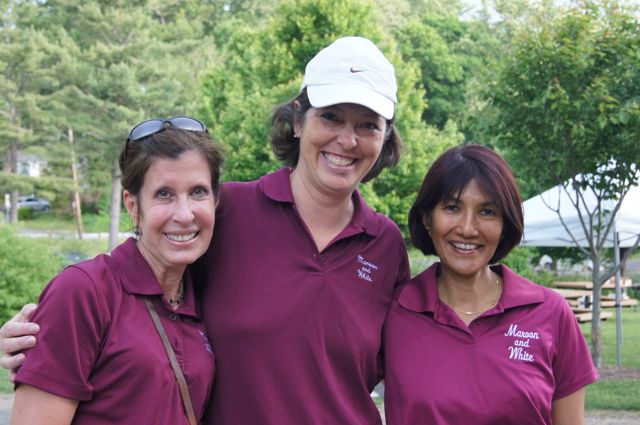
 Thunderstorms descended on Scarsdale late Tuesday afternoon, just in time for the Maroon and White barbeque to honor spring athletes. The dark clouds forced the event inside-- and the threatening weather was reminiscent of the spring season. Between sudden downpours and astounding rises and drops in temperature, the athletes faced a tough spring and learned to work through unfavorable conditions. After long days at school preparing for finals, it took leadership and morale for teammates of all sports to motivate each other at practice in preparation for fierce competition. All teams had successful seasons, and many athletes were awarded individual honors at the local and state levels.
Here are photos of the senior athletes and season highlights from each team:
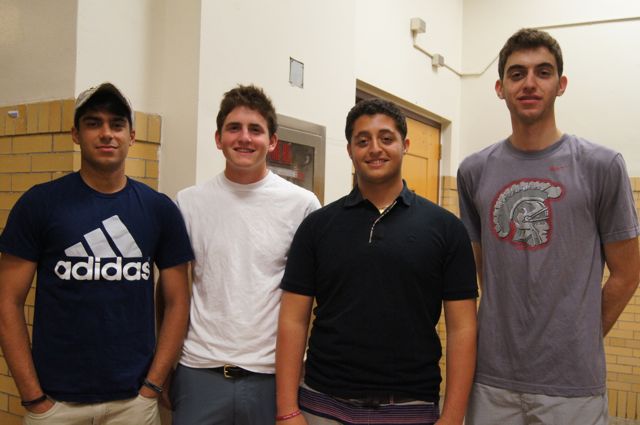 The Boy's Golf Team had a season that will be difficult to top next year. For the second year in a row, they were named Section I Champions. The team sent three players to the state tournament in Ithaca this past weekend to play the championship match at Cornell's Golf Course. Josh Goldenberg, James Nicholas and Anthony Scarcella were among nine players on the team representing Westchester, Putnam and Duchess Counties and came in first in the event.
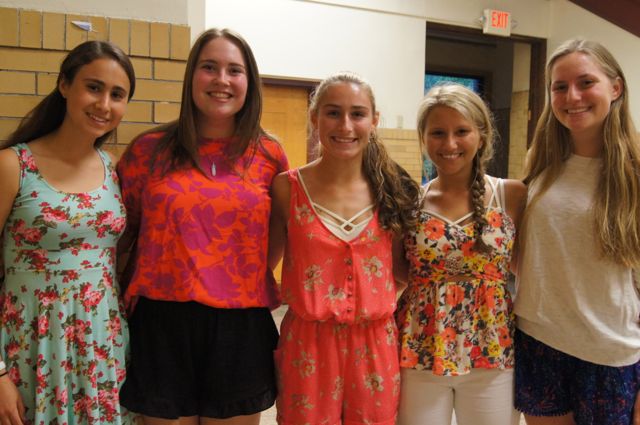 The Girls Lacrosse Team was 10-7 this season. Julia Ross was awarded All League and All Section Honorable Mention, Olivia Romano was All League, Lindsay Repp was All Section and All League. Both Julia Ross and Lindsay Repp were Golden Dozen. Since all these girls will be graduating this year, their talent will surely be missed, but this will also motivate younger athletes to step up next spring.
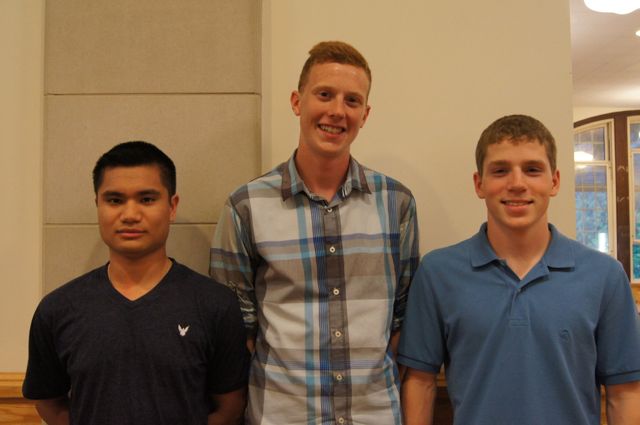 The Boys Lacrosse Team will graduate seniors James Felix, Brandon Schweikert, and Nicolai Ferraris. Their team was 9-9 this season.
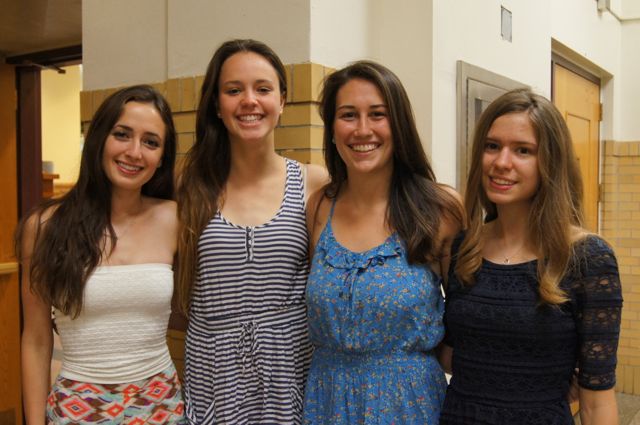 The Girls Track Team has already proven themselves dangerous to their competition this season, placing 2nd at the League meet ... and they are not finished yet, They will compete in three events at the New Balance Nationals from June 13 -15 in Greensboro, North Carolina. The 4x800 relay team will be Helen Clapp, Laura Cutlip, Maggie DeRosiers, and Nicole Feibelman. Livvy Meyers, Maggie OʼKeefe, Rebecca Kearns, and Hailey Thornton will run the 4x100, and Maggie OʼKeefe, Maggie DeRosiers, Livvy Meyers, and Rebecca Kearns will run the Speed Medley Relay.
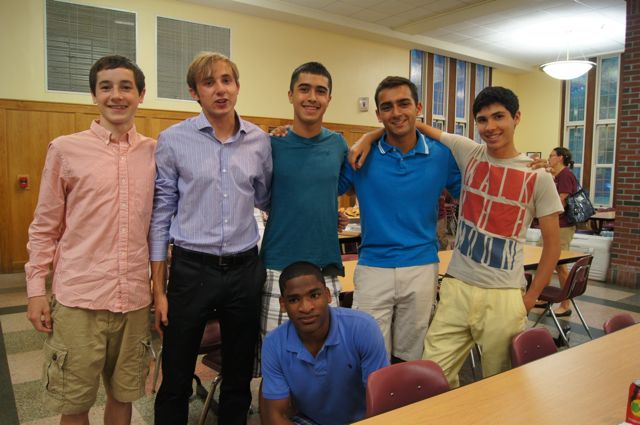 The Boys Track Team also placed 2nd at Leagues, behind New Rochelle, and will also send a relay team to Nationals. Brian Somar, Anito Akuetey, Marcus Holloway, Kavon Hueston, and Raza Khan are looking forward to competing there.
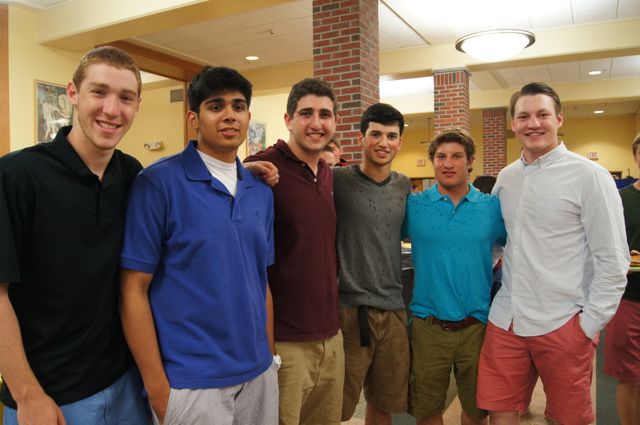 The Baseball Team was 10-11 this season. Frank Schwall was All League Honorable Mention, Grant Goodman All League, Will Eisler All League Honorable Mention, Tyler Mandell All Section, and Raj Palekar All Section.
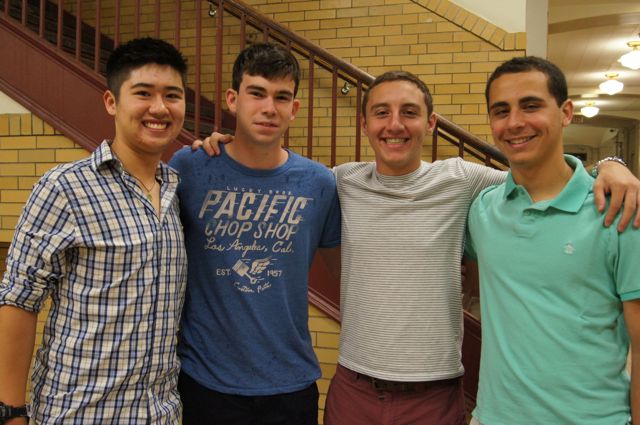 The Boys Tennis Team also had a stellar season with an overall record of 9-2 and a league record of 8-0. The team was league champions, conference champions and finished second in the section for the team competition, losing to Byram Hills in the finals. Two doubles teams qualified for sectionals: Jonny Dorf and partner Sam Gray and Zack Shulman with his partner Richard Bennett. All league players: Jonny Dorf, Sam Gray, Zack Shulman, Rich Bennett, Dan Markowitz, Alex Johnson.
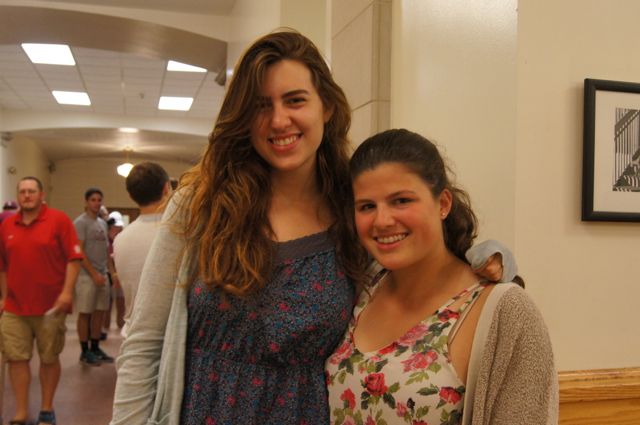 Girls Rowing: Although several of her teams' races were cancelled, Senior Rower Melanie Norman says the team trained hard and progressed. The girls rowed with the Pelham Community Rowing Association which has qualified as a scholar-athlete team for the ninth consecutive year by the New York State Scholastic Rowing Association.
Tuesdayʼs event was a bittersweet moment for seniors. Even for those athletes who will continue playing in college, Maroon and White brought a close their four special years as Raiders.
Police Search for Armed Robbers
- Details
- Written by: Joanne Wallenstein
- Hits: 5224
 Greenburgh Police are asking the public to assist them in finding two suspects who held up the employees of Radio Shack on Central Avenue at gunpoint on Saturday night May 24th. Shown here, a male suspect entered the store and displayed a silver handgun. He ordered the two female employees to go to the back of the store and open a rear door where another man entered. The two suspects tied up the employee's hands with duct tape and then stole electronics and cash. They fled through the back door with the stolen items and money.
The first suspect is a black male wearing a grey jacket with a blue hold and black writing on the left sleeve. He was wearing a baseball cap with silver sticker on the lid, blue jeans with flaps on the back pockets, maroon underwear with a black elastic waistband, grey and white sneakers and blue latex gloves.
The second suspect was wearing a gray hoody, blue baseball cap, blue jeans with flaps on the pockets, a white belt, dark shoes and blue latex gloves.
Anyone with information regarding this incident should call theGreenburgh Detective division at (914) 682-5325.