







Rooted in Stories: Connecting Scarsdale Through Personal Histories at the Scarsdale Public Library
- Tuesday, 27 October 2026 12:40
- Last Updated: Tuesday, 27 October 2026 14:58
- Published: Tuesday, 27 October 2026 12:40
- Joanne Wallenstein
- Hits: 74
 Libraries are places where stories are shared, preserved, and passed from one generation to the next. At the Scarsdale Public Library, storytelling takes many forms—from young people documenting family histories, to authors inspiring children to create their own stories, to community members sharing firsthand accounts of the past.
This summer and fall, several Library programs explored the power of stories to connect us. Teens reflected on differences, belonging, and finding their place in the community. A children’s author gave young readers a behind-the-scenes look at how stories are created. And a series of programs brought the stories of Holocaust survivors to the community, creating opportunities to listen, learn, and remember.
Together, these programs remind us that stories do more than entertain. They help us understand where we come from, appreciate perspectives different from our own, and recognize what we have in common. As teen Emma Florence reflected, “The Scarsdale community has more in common than we think, and by sharing stories, literature, and historical anecdotes, we come ever closer to internalizing that truth.”
Rooted in Stories
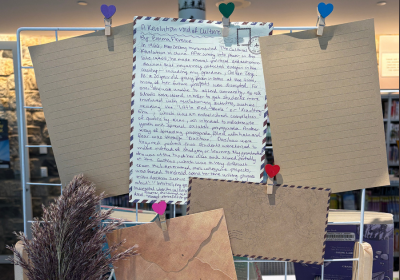
Scarsdale High School student Emma Florence invited the community to become storytellers, interviewers, and historians. She asked teens in grades 5–12 to speak with a family member or someone who has shaped their life and ask them about a memorable moment, an unexpected challenge, or an experience that changed them. She then recorded and shared their stories with the community in a curated scrapbook display in the Teen Room at the library.
Teen Services was proud to support Emma’s project, noting that it encouraged thoughtfulness and introspection while fostering connections between generations. “We are very lucky to have teens like Emma who are invested in working toward making our community even better,” said Jane Hennessy, Teen Librarian. Below, Emma shares her experience this summer, followed by the stories submitted for display.
“In a world where catchy one-liners often make the front page, complex, contextualized narratives that bring people together are sometimes left behind. This past summer, my project, Rooted in Stories, helped connect the Scarsdale community through literature and personal history. As a member of the Scarsdale Public Library’s Teen Advisory Board, a frequent library-goer, and a passionate reader, I have always been captivated by stories—especially those of the people around me. With the help of the teen librarians, this passion came to life.”
Below are some of the stories submitted for display.
My Second Home 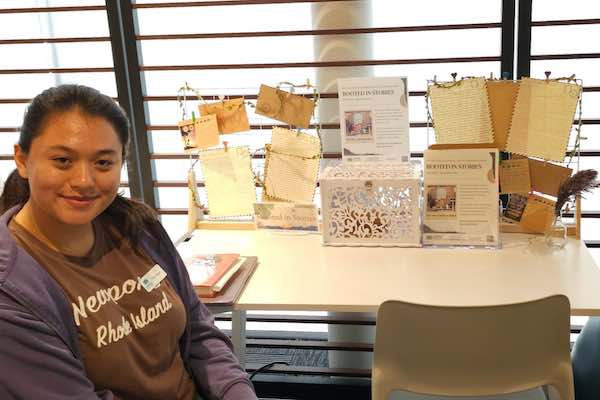
Home is more than the place where I live—it is where I feel rooted. For me, that place is my grandparents' house in Mumbai. Every year, I looked forward to the fifteen-hour flight from Scarsdale, knowing that once I stepped through the creaky gates, I was entering a world filled with family, tradition, and warmth. Mango and guava trees lined the walkway, the scent of spices drifted through the air, and airplanes taking off nearby became the soundtrack of my childhood. My family gathered around the table for every meal, sharing chicken vindaloo, buttery naan, and stories, while my sisters and I spent afternoons making colorful marzipan. My Nana seemed to know everyone—from the fishmonger to the gardener—and wherever we went, people treated us like family.
As I grew older, I began to notice another side of the city I loved. The overflowing trash bins, plastic-covered streets, and haze from nearby industrial sites replaced some of the vibrant images I remembered. My Nana often spoke about Mumbai's polluted rivers and how contamination threatened the livelihoods of fishermen and farmers who had depended on the land and water for generations. Watching a place so deeply connected to my family's history struggle with environmental decline changed the way I saw both my second home and my own responsibility toward it.
Growing up between Scarsdale and Mumbai has given me two different perspectives on community. One taught me the comfort of quiet neighborhoods; the other taught me the strength of traditions, close relationships, and resilience. Although pollution remains a challenge in Mumbai today, so does the determination of the people who call it home. Carrying both places with me has shaped my values and reminds me that preserving the places we love is just as important as cherishing the memories we make there
Saigon to Scarsdale
My great-grandfather and great-grandmother were born in Canton but fled to Vietnam during the Chinese Civil War to escape communism. They lived in Saigon and worked as merchants for many years, and when the Vietnam War broke out, my grandfather and great-uncles were drafted into South Vietnam's army.
When South Vietnam lost and the Americans withdrew, my family was worried they'd be imprisoned or persecuted. My great-grandfather sold all of the gold he'd been saving to pay for the ship out of Vietnam. My family lived in a refugee camp in Malaysia for a year before moving to the US. My great-grandparents and grandparents worked hard to provide for my mom and her sisters, and eventually, we ended up in Scarsdale.
Moving to America
The person I am writing about is my babysitter, who once told me about moving from Brazil to the United States with her family when she was younger. She said that when they first arrived, everything felt unfamiliar because the language, school system, and daily routines were different from what she was used to. She did not know much English, so she spent a lot of time trying to learn new words and understand what people were saying. She said that in school she sometimes had to ask teachers or classmates to repeat directions because she did not always understand them the first time.
At home, her family mostly spoke Portuguese, but they also tried to practice English so they could get better at it. She said it took a while before she felt comfortable speaking English in class, and she was usually quiet because she was worried about making mistakes. Eventually, she got more used to the school, learned the language, and made a few friends.
She told me that after a few years, everyday life became much more normal, and she stopped thinking about how different everything had seemed when she first arrived. This happened in the early 2000s when her family immigrated to the United States. The main ideas in her story are adjusting to a new place and getting used to changes over time. I think these themes are still relevant today because people continue to move to new countries and have to adapt to different languages, schools, and everyday routines.
Children’s Author Visit
For children who love a book series, getting to meet the author is an amazing experience. This month, children had the opportunity to learn how their favorite stories are created during a fantastic visit with Tracey West, creator of the Dragon Masters series. Families learned how she comes up with each dragon, helped create a “Library Dragon” (with one lucky child chosen to draw it), asked questions, and met the author for a book signing.
Tracey West is a prolific author of children’s books for early readers. She has written more than 400 books, including The Cupcake Diaries, the Underdogs series, and Pokémon chapter books. She is best known for her popular Dragon Masters series, in which eight-year-olds are chosen by a magical Dragon Stone and paired with a dragon that has special abilities. Together, the Dragon Masters and their dragons solve problems and embark on adventures that emphasize teamwork and curiosity.
Tracey and her husband, Billy Hancock, live in the Catskills, where they run the Dragon Wagon, a mobile bookstore. Proceeds from the bookstore help them host pop-up events where children in rural communities can choose a free book to keep. Through the Dragon Wagon, they work to increase book choice and access for children in their community.
Preserving Stories of Survival
This October, the Library hosted Survivors Among Us, an exhibit presented in partnership with WJCS and the Friends of Scarsdale Library. The exhibit shared the stories of Holocaust survivors currently living in Westchester. This powerful photographic exhibit was the centerpiece of a series of programs designed to bring the community together to hear these stories, learn from the survivors’ experiences, and increase awareness and understanding.
Visitors to the Library had the opportunity to share their thoughts and reflections on the exhibit and related programming. Holocaust survivors Hanne Holsten and Lisa Tobias-Hutter shared their stories in person, leaving a lasting impact on those who attended. One visitor commented, “I LOVED hearing Hanne’s story. It is so important for everyone, no matter one’s identity, to remember the Holocaust and learn more from survivors—just as Hanne had stressed.”
The program was very well received, with many attendees commenting on the impact the exhibit had on them. One visitor wrote, “The exhibit was beautiful, knowledgeable, and heartaching. It is incredibly important to learn and carry on the story of everyone involved.”
WJCS describes the importance of the exhibit: “This exhibit was created to preserve their voices and their stories. As the generation of Holocaust survivors grows smaller, we know that soon there will no longer be opportunities to hear these stories firsthand. By sharing them here, we hope to ensure that their legacy will continue to inspire and educate generations to come.”
For libraries, programs, exhibits, and discussions like these are an important part of our role in the community. They create opportunities to learn from history, encounter different perspectives, and come together to listen, reflect, and remember. As firsthand accounts become less accessible, creating spaces where stories can be shared and preserved becomes all the more meaningful—and helps ensure that they continue to inform and inspire generations to come.