






Superintendent Expresses a Commitment to the Safety and Dignity of Community Members and Announces New Initiative
- Tuesday, 12 May 2026 13:06
- Last Updated: Thursday, 14 May 2026 12:40
- Published: Tuesday, 12 May 2026 13:06
- Joanne Wallenstein
- Hits: 1146
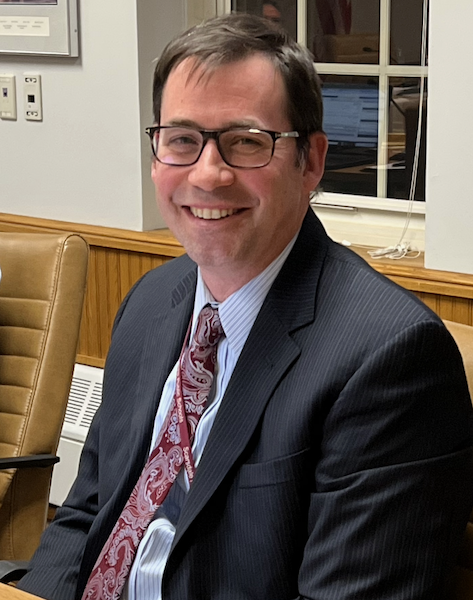 Superintendent Andrew Patrick addressed recent events and the divisive times in which we live at the opening of the Scarsdale School Board meeting on Monday May 11, 2026. The following morning he announced a new community initiative, Common Circles, Understanding Ourselves and Others in a community wide email. See the details about this new program below.
(Monday night May 11, 2026)
Good evening to everyone who has joined us both in person and online. While we are here tonight to conduct the business of the Board of Education and the regular work of governance that keeps this district functioning, I know that is not the only matter on the minds of our community tonight. I want to take a few minutes to acknowledge the last several weeks in our community and to share some thoughts about how we move forward together.
Our community is hurting deeply, and is wondering what it means for the future, and what comes next. I have served as Superintendent for four years, and in that time I have been guided by two unwavering principles - our work must be driven by the needs of our students, and trust with our community requires honesty and transparency. As we gather tonight, I say to you honestly and transparently that moving forward will require the collective work of our entire school community. That means that we are listening, seeking to learn from all of the feedback we are receiving, and putting our deepest, most concerted effort into promoting a safe, welcoming, positive school environment with the tools at our disposal- education, policy, and dialog.
We are living in divisive times. Our country is engaged in conflict on the other side of the world. Our domestic politics feel increasingly polarized. And members of our community are feeling the impact of these larger forces in very personal ways. When global issues reach into our schools, into our shared spaces, into our homes, we feel it deeply. Many of you are here tonight because you are carrying both what has happened here and what is unfolding in the broader world.
It must be said clearly: we are also living through a moment in which concerns about anti-Jewish hate have intensified in ways that are deeply felt by Jewish families in our community, contributing to a palpable sense of fear, vulnerability, and destabilization. National data helps explain why: although Jews make up roughly two percent of the U.S. population, they are the target of nearly seventy percent of religion-based hate crimes. Jews have been murdered in antisemitic attacks in the United States in Washington, DC, Colorado, Pittsburgh and elsewhere, attacked physically in communities across the country, and targeted in violent incidents in places like London, Australia, France, Belgium, and Canada.
At the same time, hate-fueled violence is not limited to any one community. Multiple minority communities are also experiencing heightened bias, hostility, and fear. Here in the United States, we have witnessed the shooting of Palestinian university students in Burlington, VT and the murder of a 6 yr old boy, because he was Palestinian. It is not surprising that these broader dynamics cause members of our own community to carry their weight. But bias, hostility, violence, and fear have no place in our country.
As Viktor Frankl wrote after surviving The Holocaust, there is a space between what happens to us and how we respond—and in that space lies our freedom to choose what comes next. We are in that space right now. Tonight. Together.
As an educational institution, we are holding closely to that idea. The students in our care—and the adults in this community—are being asked to navigate a difficult moment. Between events that have caused pain and the actions we take next, there is an opportunity to be deliberate and to act in alignment with our values: kindness, respect, care, and empathy for all. It is also true that, in recent weeks, some of those values have felt strained.
The intersection of advocacy, politics, and bias in this moment can cloud our ability, and at times our willingness, to acknowledge when harm is happening, including in our own community. While that may be a human instinct, it cannot be where we stop. We remain responsible for engaging these realities with clarity, care, and accountability.
In this community, we will not rank suffering or turn away from one another. We stand with our Jewish neighbors, and with anyone targeted by hate, bias, or harassment. That commitment to the safety and dignity of every member of our community is foundational to who we are.
As an educational institution, we are guided by a core premise: when issues become difficult, we do not avoid them, we turn toward learning. Education gives us a framework for naming what we are seeing, understanding how bias operates, and building the skills required to respond thoughtfully rather than reactively. That includes being clear about how anti-Jewish bias manifests today, sometimes overtly, sometimes in more coded or distorted ways, and ensuring that our response strengthens, rather than fragments, our broader commitment to the dignity and safety of all members of our community.
In the near term, we will be putting forward a structured plan to move this work ahead. One component of that includes new Guidelines for Student Expression at School-Sponsored Activities, which appear in tonight’s agenda. These guidelines have been developed in consultation with experts, and a link appears in Item 12.01 for members of our school community to share feedback. Other components of this plan may include opportunities for input through surveys and small, facilitated focus groups, as well as engagement with outside experts who can help us assess where there may be gaps in knowledge and skills, particularly around civil dialogue and engaging across differences. This moment has surfaced the need to strengthen those capacities, and we are actively considering how to ensure that our students, especially at the high school level, graduate with stronger skills in these areas as they prepare for college and beyond.
In the medium term, I am honored to announce some important news. After many months of collaboration and preparation, we will be introducing a new program to our schools next year called The Common Circles Experience: Scarsdale. The program features two connected parts: We Are Scarsdale! Bridging, Belonging & Building Community and Voices Against Hate: Lessons from the Holocaust. We are very excited about the opportunities for students, faculty, families, and community members to help shape and become part of the experience itself through local stories, photography, art, and participation. The program is an immersive research-based experience that blends art, technology, and storytelling to explore our shared humanity, build community, and teach the lessons of the Holocaust. In a moment marked by growing polarization, rising antisemitism, and increasingly dehumanizing rhetoric, the exhibition celebrates identity and strengthens historical understanding while inviting reflection. Above all, the experience encourages dialogue and fosters a space where everyone is seen, heard, and valued.
While these are important steps, we also need to continue to listen to our community. Tonight is part of that process, and your perspectives will help shape what comes next. We will share more details about those next steps in the coming weeks.
I want you to know that we see you, and we understand that this has been a challenging moment.
Our goal tonight is to listen carefully, to learn, and to take responsibility for how we move forward. We are committed to doing that work with seriousness, with care, and with a clear sense of our responsibility to one another. The fact is, we can't do it alone, and we can’t do it all in a matter of days. But we will move forward as a school community, together - students, teachers, administrators, staff, parents, our Board of Education and our broader community. I appreciate the opportunity to share these remarks.
We Are Scarsdale: Bridging, Belonging and Building Community
(Sent May 12, 2026)
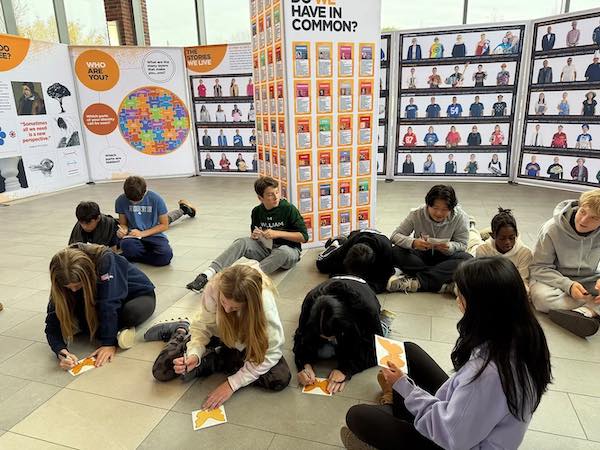
I am writing to share some exciting news related to a program we will be bringing to Scarsdale during the 2026-27 School year. The program is called Common Circles: Moving to Understand Ourselves and Others, and it is an immersive research-based experience that blends art, technology, and storytelling to explore our shared humanity, build community, and teach the lessons of the Holocaust. In a moment marked by growing polarization, rising antisemitism, and increasingly dehumanizing rhetoric, the exhibition celebrates identity and strengthens historical understanding while inviting reflection. Above all, the experience encourages dialogue and fosters a space where everyone is seen, heard, and valued.
We have been working to bring this opportunity to our students for nearly ten months. The exhibit was installed at Rye Country Day School during the 2024-25 school year, and I, along with building leaders and teachers, had the chance to visit. We were struck by the power and effectiveness of the learning experience, and eagerly discussed its potential applications to our learning community. At the end of last school year, the installation moved to Southern Westchester BOCES for the summer. I organized our annual summer Administrative Council leadership retreat to take place there, and our full leadership team had the opportunity to take part in the experience first-hand. Since July, we have been discussing the potential value of bringing this opportunity to our students, and we have invited faculty and parent leaders to the experience as well. We have finally reached a point where we can announce a personalized version of Common Circles, The Common Circles Experience: Scarsdale, thanks in part to the generous support of SSEF (Scarsdale Schools Education Foundation).
About the Experience
In the first section of We Are Scarsdale! Bridging, Belonging & Building Community students and visitors are invited to go beyond first impressions through art, photography, optical illusions, and interactive installations that reveal the multi-layered individuals in our shared community. Visual storytelling invites reflection on how we see one another and the world around us, and how easily both people and history can be reduced to a single story. By beginning with this exploration of connection, the experience prepares learners to encounter Holocaust history not as distant events, but as deeply human stories.
The second section is called Voices Against Hate: Lessons from the Holocaust, and is presented in partnership with USC Shoah Foundation’s Dimensions in Testimony. Visitors to this portion engage in life-like conversations with Holocaust survivor Anita Lasker-Wallfisch and Jewish American liberator Alan Moskin. Using advanced interactive technology, visitors ask their own questions and hear firsthand testimony. This section also provides historical context, examines antisemitism past and present, explores Jewish life and peoplehood, and highlights local stories of hope and survival that connect global history to contemporary community life. Because visitors first encounter one another as layered human beings, they can meet Anita and Alan not only as survivor and liberator, but as unique individuals. It is also important to note that this second portion - Voices Against Hate - holds the potential to change over time to examine other historical events. Thus, Common Circles is an experience that can evolve and develop with input from our rich, multicultural community.
Curriculum Connections
The Common Circles exhibit will build on our Developmental Relationships work and serve as a powerful catalyst for our existing curriculum, creating a cohesive thread of empathy, interdependence, and inquiry from elementary through high school. It will logically extend the identity work at the elementary level, and connect to the practices emphasized in Responsive Classroom. The exhibit also mirrors the core values students experience at SMS through units of study that emphasize culture, identity, and understanding of diverse experiences and hardships faced by different groups throughout history. This work helps students build a deeper awareness of society and develop empathy for a wide range of perspectives. These concepts are also embedded in creative ways throughout our classrooms and addressed through the advisory program.The exhibit complements the rigorous work on civic engagement and global interdependence that takes place throughout the disciplines at SHS, and invites consideration of audience, purpose, perspective, and bias when confronting opposing viewpoints. In short, Common Circles serves to foster school environments grounded in respect, connection, and a shared commitment to understanding one another and the uniqueness of our experiences as individuals and members of a community.
The Exhibit is Us
One of the things that makes this experience unique is that it is customized to our community, with multiple opportunities for teacher, student, staff, and community involvement. One of the more powerful components is The Stories We Live in which members of our school community and broader community are featured in five different outfits that reflect aspects of their lives. These images are surrounded by words that characterize the individual. Other ways that members of our community can contribute include:
Common Threads: What Do We Have in Common - a tower of trading-card style biographies
Stories of Hope & Survival - personal narratives from members of our community or those connected to them about their experience.
Interactive biography - a tool that enables students to create their own digital interactive biographies.
Student artwork is also a central component of the exhibit.