







Social/Emotional Learning Model Helps Students Develop a Sense of Purpose and Belonging
- Details
- Written by: Wendy MacMillan
- Hits: 3525
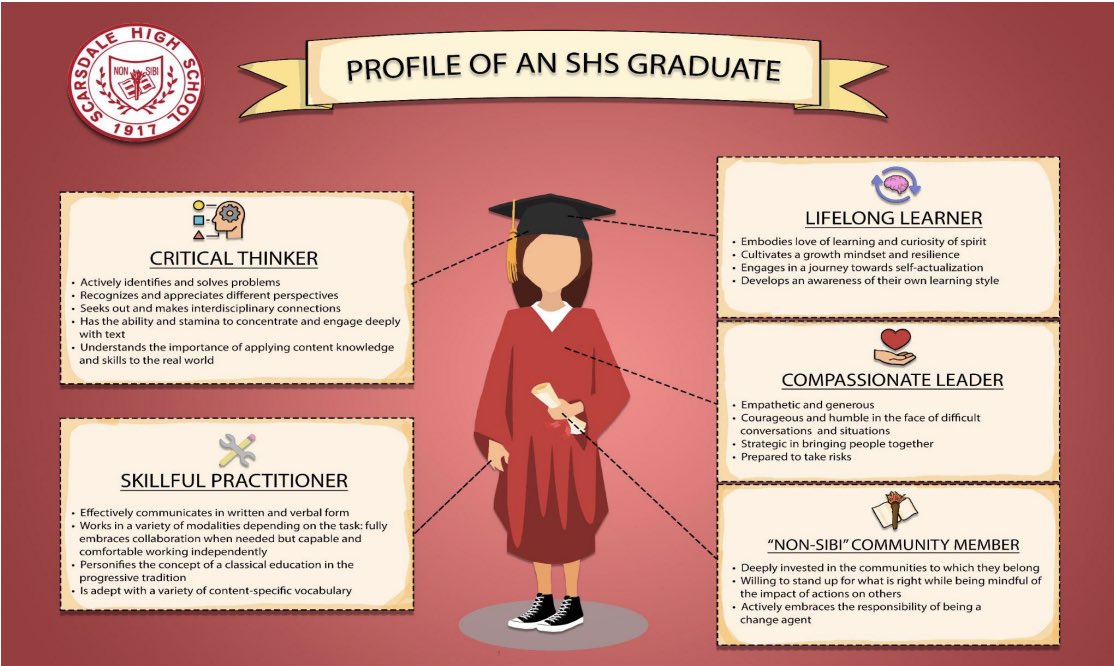 As parents living in Scarsdale, one can easily assume we all value a quality education and want our children to flourish at school and in life. But “flourishing” in such a rapidly changing world often encompasses much more than good grades and top test scores. In fact, when colleges and companies are reviewing applicants, they often tend to look for far more than just a stellar GPA, and instead want to see qualities such as: critical thinking, the ability to collaborate and work well with teams, flexibility, a willingness to learn, problem solving skills, communication skills, and much more.
The Scarsdale School District is well-known for carefully working to develop the “whole” child and in this vein it has developed a “Profile of an SHS Graduate” that outlines similar qualities to those named above. It has long been the District’s hope that upon graduation, each student will embody these characteristics to ensure that they are prepared for college, the workforce, and the world beyond our small community:
In addition to making sure students engage in first-rate, core academic learning, an integral element of this Profile of a Graduate is the District’s work on Social/Emotional Learning (SEL) and “Belonging”.
According to Edgar McIntosh, Assistant Superintendent for Curriculum, “There is sometimes a misconception that Social/Emotional Learning (SEL), is just about feeling good, when in actuality it is about so much more. The results are in and conclusive, students thrive (not only socially, but also academically) when they feel a sense of purpose and belonging, and that they matter in a community.” Simply put, the Responsive Clasroom model is about understanding that all of children's needs—academic, social, emotional, and physical—are important. The teacher creates an environment that responds to all of those needs so that your child can do his or her best learning.
As Dr. Drew Patrick once said in a BOE meeting, these are the fundamental building blocks which enable students to fully attend to their learning.
In a recent conversation, Dr. McIntosh added, “The concept of creating inclusive spaces that acknowledge the importance of belonging, mindset, and risk-taking is not new in Scarsdale. Our teachers take part in purposeful STI courses and are guided by research-supported frameworks like PERMA, Habits of Mind, and CASEL which have been studied and shown to meaningfully impact teachers' practice. Also, secondary structures such as Keystone, the HS tutorial model, the Freshman Seminar, and Civ Ed acknowledge the key role well-being and belonging play in student learning and success. The recent Belonging Survey energized and informed this work.”
In addition to these important frameworks, over the last few years the District has begun to engage teachers in Responsive Classroom (RC) training which, according to their website, “is an evidence-based approach to teaching and discipline that focuses on engaging academics, positive community, effective management, and developmental awareness. Our professional development, books and resources help elementary and middle school educators to create safe, joyful, and engaging classrooms and school communities where students develop strong social and academic skills and every student can thrive.”
Also according to their website, “Independent research has found that the Responsive Classroom approach is associated with higher academic achievement, improved teacher-student interactions, and higher quality instruction.”
When asked, Dr. McIntosh explained that the District chose the Responsive Classroom framework because they “were looking for an approach rather than a set of prescribed activities or set of lessons. To have the best impact, we were looking for a set of guiding core beliefs and a set of strategies and structures that attend holistically to students' social, emotional, and academic needs.”
Importantly, the Responsive Classroom isn’t a set of activities that need to be added into the school day, but rather a foundation which fosters a consistent approach to SEL and provides a common language, tools, and strategies for teachers to employ at each of our seven schools. McIntosh further clarified that RC is not something in addition to core academic learning, but rather a set of tools and strategies that are interwoven throughout all instruction and learning. He related that the District’s new math curriculum already has some SEL components built into the math practices that recognizes individuality, gives students voice, and encourages them to take risks.
McIntosh also noted that, “While the RC training has been open to all educators, the focus of the training has been at the elementary. There is a range of formal training with Responsive Classroom (Introductory, Advanced, and two teacher leaders in the process of becoming RC trainers). So far, the formal training has happened during non-school hours through the STI (Scarsdale Teacher Institute) in partnership with the District. We are in our third year of offering the training (Summer and weekend) and have had full classes at all levels. Informal sharing, modeling, and application have also happened at faculty meetings, grade-level meetings, and during summer program improvement planning sessions. In a positive way, the opt-in training is making its way through our educators across the elementary level.”
He went on to explain that as teachers experience real-world success employing RC strategies, their powerful, positive outcomes motivate other teachers to take part in workshops and training as well. Adding, “There is growing excitement as teachers engage in the work across all schools. As we approach critical mass, we will provide assured opportunities for all educators to experience the vocabulary, structures, and core values of RC.”
In all, studies prove that students only truly thrive if they feel like they belong, like they matter, and that they are essential members of the community. To see what Responsive Classroom might look like in a classroom, please click here.
The Scarsdale School district has long worked to create this sort of environment where in turn, students feel safe to be critical thinkers, to take risks, to challenge themselves and much more, all while celebrating differences and recognizing the various strengths of each student. For more information about Responsive Classroom and how it supports the District’s mission and the Profile of an SHS Graduate, please click here.
Westchester in the Movies
- Details
- Written by: Joanne Wallenstein
- Hits: 3308
 Carrie Coons in The Gilded Age32 movies that were filmed in Westchester County received Emmy nominations this year.
Westchester County Executive George Latimer said: "Westchester County's film industry is a true powerhouse that showcases the beauty of our region. The industry's economic impact is undeniable, generating over $2 billion in economic activity in 2022-2023. These Emmy nominations are a testament to the world-class productions that choose Westchester County as their backdrop."
Here's where you can see familiar locations around the county on the big screen.
Leading the pack this year is the critically acclaimed Amazon Prime drama series, "Fallout," which filmed at the Verplanck quarry in Cortlandt, with an impressive 16 nominations across acting, production, and writing categories. The returning miniseries "Feud: Capote & The Swans" (FX) secured 10 nominations for casting, costumes, directing, and acting, among others. The production spent several days filming at the C.V. Rich Mansion in White Plains. HBO's "The Gilded Age" also shines with six nominations, including one for best drama series. The production filmed at several locations across the County including Lyndhurst, Manhattanville College and the Jacob Purdy House in White Plains.
Westchester County Tourism & Film Director Natasha Caputo said: "These nominations celebrate the unique appeal Westchester County offers to filmmakers. Seeing our locations come alive on screen in such captivating productions fills us with immense pride. Congratulations to all the nominees – we are rooting for you."
Westchester County Tourism & Film plays a pivotal role in fostering the film industry's growth. The film office offers invaluable services, including location scouting, technical visits, and permit streamlining. This comprehensive support system makes Westchester County an attractive filming destination for industry professionals.
The 76th annual Emmy Awards will be held on September 18th. A complete list of nominees is available at emmys.com.
Neighbors Plead with the Planning Board to Turn Down a Subdivision in a Flood Prone Neighborhood
- Details
- Written by: Joanne Wallenstein
- Hits: 3667
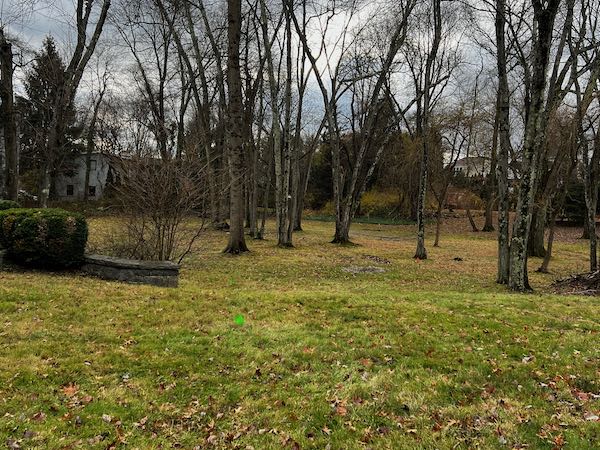 What is the role of the Planning Board? Should they permit new development in flood prone areas if the work will pose further risks to neighbors?
That was the question at the heart of a Planning Board hearing on June 26 when the Planning Board allowed an applicant a sixth hearing of his proposal to subdivide two lots into three at 46 Lincoln Road and 101 Carthage Road and to construct a third home in a recessed area between the two homes that originally housed a pond. The applicant is proposing to relocate a buried drainage pipe from the privately-owned parcel of land and into the Village right-of way, raising objections from neighbors.
Why the Planning Board has allowed so many hearings and why they still have not voted on the application remains a mystery. If the applicant, his attorneys, engineer and landscape architect have not been able to put forth a convincing case in six months of meetings, why are they permitted unlimited hearings?
More puzzling is the relationship between the applicant and the engineering consultants that the Village retained to review the proposal. Rather than evaluating the plan, the consultant seems to be working in lock step with the applicants and the Village to craft a project that will gain the approval of the Planning Board.
During the six months of meetings scores of neighbors have voiced their objections to the proposal. They have written lengthy letters, sent videos of the flooding and attended many meetings to relay the extent of the existing problems in the area to the Planning Board. They have outlined their fears about what further development will do to their homes and those downstream. At each meeting the Board listens, nods and then invites the applicants to come back yet again. It’s baffling.
On June 26, the applicant and an entourage of professionals were on hand seeking to demonstrate that the proposal would not cause further harm to the flood prone area. They contend that replacement trees, underground cultecs and a watercourse diversion would allow the property to retain as much water as it currently holds. What they did not address is how the outflows from the three lots might impact everyone else.
On hand for the developer were attorney Lucia Chiocchio from Cuddy and Feder, engineer Eliot Senor, civil engineer Sharon Burke and certified arborist Aaron Schmidt.
Since the last meeting in May the applicants submitted “a revised plot plan and an updated tree replacement and planting plan.” They said their will plant 78 trees including 38 large deciduous trees to replace 94 trees that will be removed to accommodate the construction.
According to the applicants they met with the Village retained engineering consultant to “refine the stormwater management system design,” and did an analysis of the runoff from an underground pipe. They claimed to be “reducing runoff by 45% to 48%” and said the project is designed for a 100-year storm. They continued, “We had many meetings between our team and Mott’s team to satisfy everything they wanted to see.”
Arborist Aaron Schmidt was asked about the ability of the new trees to absorb as much water as the old ones they were replacing and he said, “In ten years the trees will provide 90% of the absorption needed. In 15-20 years they will provide all absorption needed.”
The applicants also explained, “This is without the grass and the stormwater infrastructure. With those the site and surrounding areas will experience improved water absorption.”
Board Member Mark Seiden said, “It is going to takes 10 years to get to 90% of where it is today? “
The arborist replied, “Yes! The old trees can take up more water than the new ones will.”
When asked what happens in year one, the arborist explained, “The current trees can absorb 9,500 gallons of water. The new trees can absorb 1,700 gallons of water. In year one there will be an 80% reduction in tree absorption.”
Engineer Eliot Senor added, “There is a 4% grade so water will run through the grass. The 5,000 gallons that the trees are not absorbing will be absorbed by the grass and the detention system. Run off will be improved.”
Seiden responded, “You have to see the data. These neighbors want proof that it is going to get better. We have to overlay these other factors to prove that it will get better.”
Senor replied, “There is no computer program about grass absorption. We now have .46 acres of land. What we are proposing will have 1.15 acres of lawn which will absorb more water.”
Board member Lynn Brooks Avni said, “You’re adding a third house and all the impervious surfaces but adding an acre of lawn?”
John Ruschke, the consulting engineer from Mott MacDonald hired by the Village said, “I feel confident with the current data that I have – and that it will improve conditions on the site. They used a more complex model that captures the situation. I feel confident that it is accurate. They are proposing to do onsite mitigation. I feel comfortable with the relocation of the pipe. It will not increase flooding.”
He conceded, “There is a significant flooding problem along Lincoln Road. What they are proposing will not change the conditions along Lincoln Road. It will still flood. When you look at the entire drainage area it is unrealistic to think there is something they can do impact the flooding there. It’s not a big enough site to change the situation there. What they are doing is not going to reduce the flooding.”
About pipe he said, “All they are doing is rerouting a pipe onto Lincoln. Right now the pipe is broken. It would not be vastly improved by changing it into an open channel pipe rather than a buried one.”
Board member Deb Pekarek asked, “Is there anything more the applicant can do it to make it better? Adding a house and increasing the size of the other two houses will not impact existing conditions even more?
Ruschke replied, “They are saying that they are reducing the overall flow. I can’t represent that what they are going to do will help. I am not comfortable saying there will be flood reduction.”
Seiden said, “You have a property that currently floods – why is the yardstick that we are applying “don’t make it any worse.” It seems to me that engineers are supposed to make things better.”
During public comments, several neighbors spoke.
Perci Battiwalla from 129 Carthage Road said, “You have heard from every resident that we have a huge problem. On May 23 we had 30 minutes of rain and the whole place was flooded. I have heard a lot of conflicting information. We are adding an additional house – we are not changing the width of the pipe. Where is the water going to go? We have to fix this problem. This is not a solution.”
Divya Jain of 54 Lincoln Road said, “Some of the water will be released in the open stream on 58 Lincoln. Where is the analysis of the increase in water that will be released into that open stream?”
Diana Hurwitz of 45 Fayette Road said she has lived there for 25 years and “the water table has changed. Flooding is more pervasive, This year the weather service predicts over 20 big storms.
This is a sensitive area that I consider a wetlands. I think it is a horrific idea. I think two houses should be built. The role of the Planning Board is to protect existing residents. So far the Planning Board has held six meetings on this. This plan will only exacerbate the flooding which gets worse every year. The simplest most elegant solution is usually the one that comes closest to the truth. The plan is not an improvement. The application should be rejected as it puts the neighbors at risk.”
Nelson Soares of 49 Lincoln Road said, “We have lived there since 1989. Developers will build and then move on. What about a bond to address this when it hurts us? What happens when you have a significant amount of rain in a short period of time. The math does not make sense on the amount of permeable service.”
Laura Kalmanoff of 38 Crossway said she has lived there since 2005. She said, “It is a terrible idea to put three houses in this area. It was a beautiful piece of land. This town is beautiful – it is being destroyed. There is a stream that runs down Lincoln Road. It’s obvious that the weather is getting worse,” and she spoke about the effects of development on the wildlife and the birds.
Jack Miller from 45 Fayette Road said, “From the beginning this has been controlled by the applicant. I went to the library and I found (an old map) with the pond on that property. There is a dangerous precedent for approving this project. There are major changes to weather patterns. There used to be a stream and a pond. The next applicant will apply to build on a pond or a stream and divert it into the street.”
About the neighbors’ advocacy he said, “I am proud of my young neighbors. They are at the Justin Timberlake concert tonight. People are bringing their kids to camp. No one is here saying this is a good idea.”
A man from 50 Lincoln Road said he sent a video to the Planning Board. He said, “I have lived in the next house for 5-6 years. It looks like a pond in the winter.”
Sam Blakely of 47 Fayette said, “There was always a lake behind my house.”
David Goldschmidt of 108 Carthage Road said, “I live directly across the road. The project is not going to improve the situation …maybe keep it the same – if the trees grow, the system is maintained. After the developer has long gone, it will take years for the trees to mature. The risk is completely on the neighbors. That’s not fair. At first I thought a bond was a good idea. But it doesn’t help the situation. If we have to access the bond we have been damaged. It won’t help the neighbors. I think the Planning Board should make sure they we are not harmed.”
Chairman Clapp asked the engineer, “What about the downstream effects?” Ruschke replied, “They did not do a downstream model. It is a more extensive, expensive approach. The infrastructure is undersized – it is not designed to accommodate the conditions. It would take a much bigger flood mitigation project – more infrastructure….. It is only a matter of time before FEMA changes these definitions.”
During deliberations Chairman John Clapp reminded the Board that the pipe was not being relocated to improve drainage solely, but rather to help allow for the new third lot.
Attorney Chiocchio said, “We did have a wetlands scientist look at the site. This is not a stormwater site – it is too small to address the stormwater in the area.”
The Planning Board deliberated and approved projects at 9 Ogden Road and 5 Cayuga Road but did not vote on 46 Lincoln and 101 Carthage, saying some of the reports had been submitted too late to be considered at this hearing.
The site is on the agenda again for July 31, 2024.
The project calls into question the role of the Planning Board and Village Engineering Department. Should they allow further development in a flood prone area when neighbors are already suffering significant damage during rainstorms?
Since the developer is already building two new houses, could he be required to convert the “pond” between them into a timed-release retention pond that would help to slow the flow of flood water rather than attempt to divert the water into the street?
If the Planning Board is weighing whether the developer will take to the court system on appeal if he is turned down, should they also weigh this risk against the possibility of a lawsuit against the Village from the neighbors if they are further harmed by the project?
We shall see.
Sunday Mornings Come Alive at the Scarsdale Farmers Market
- Details
- Written by: Eian Tsou
- Hits: 2319
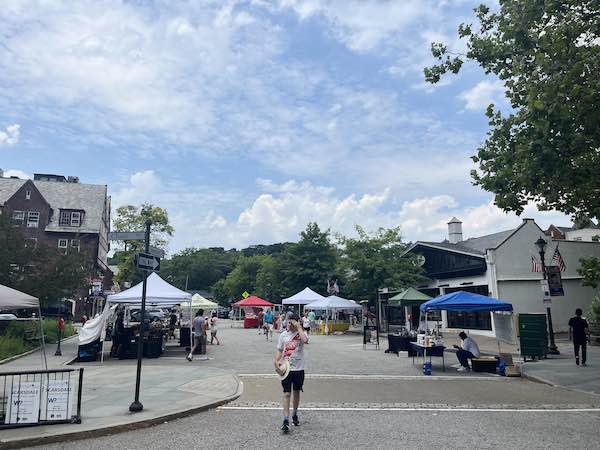
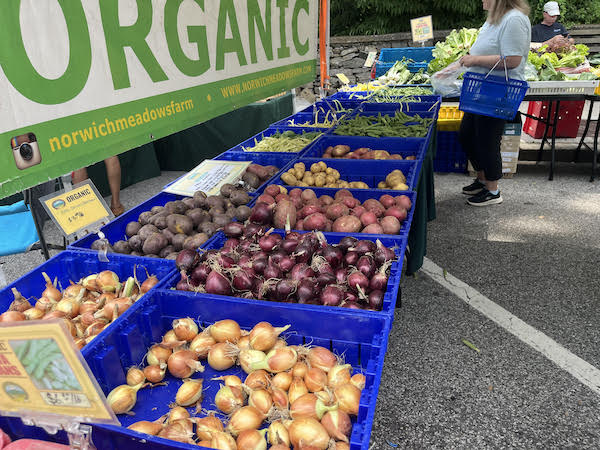 The Scarsdale Farmers Market showcases local produce every Sunday from 9 AM to 2 PM just outside of Chase Park. Down to Earth – a company devoted to connecting cooks and consumers with local farms and producers – helped make this weekly venue possible.
This past Sunday, despite the heat, friends, families, pets, and more gathered to enjoy the tranquil atmosphere. Visitors browsed a variety of foods and drinks such as artisanal baguettes from Wave Hill Breads and rich coffee from the Cano Coffee Company.
Children played in the park while the adults engaged with the friendly vendors and sampled delicious treats. The market also offered live music for attendees to enjoy. Indeed, Sean Lippin hit the stage and captivated the audience with his soulful guitar performance, setting a lively tone for the rest of the afternoon. Amidst the music, vendors passionately explained their products, origins, and inspirations to curious customers.
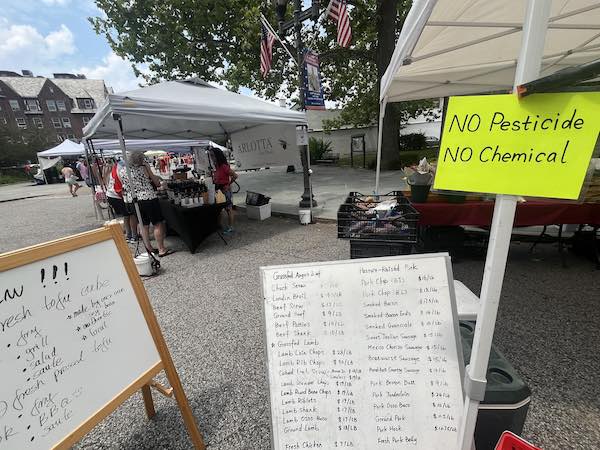
“We’re among the few potato vodkas in the United States, but most potato vodkas are made from freeze-dried potato flakes,” commented Dorcas Roehrs from 1857 Spirits. “We’re one of the few distilleries in the United States that actually grows, harvests, distills, and bottles all of our own product.”
This dedication to quality was echoed by many of the other sellers present.
“We do granola,” said Bliss from Blissful Table. “We do three different types of grain: local oats sourced from River Valley Community Grains, quinoa, and brown rice. We also sweeten with organic maple syrup or organic agave. We love granola because it’s so versatile – you can make it a thousand different ways.”
In addition, the market featured handcrafted goods such as wood carvings by Casa Cherrywood Carvings and customized decoupaged oyster shells by Sparkle and Splash. These offerings brought a unique charm to the venue, attracting those seeking more than just food. Shoppers took home one-of-a-kind items suitable for gifts, decor, and personal accessories, all while actively supporting the talented local artisans behind them.
The Scarsdale Farmers Market has proven to be a beloved event for the community, offering something special to everyone who visits.
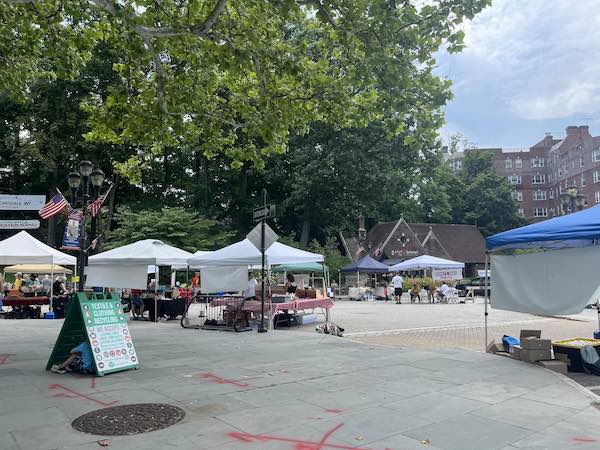
“It’s [the farmers market] vitally important,” Bliss continued. “It’s vitally important to support our local agriculture. When you taste the difference in freshness and quality, you realize how special it is to have this market right here.”
Roehrs corroborates this:
“I think this is all brilliant, especially with the new group that has taken over – Down to Earth. They’re very successful with what they do and are very supportive of us. That’s why this market will grow exponentially. It’s really quite wonderful.”
Be sure to visit next Sunday to experience the unique charm and support your local farmers and artisans.
To learn more about each of the vendors, visit here.
Writer Eian Tsou is a current junior at Scarsdale High School who loves the creative process of writing. Outside of writing, Eian loves to volunteer, play with his dogs, kick around a soccer ball, and eat tasty foods.
Scarsdale Students Honored by State Senator Shelley Mayer
- Details
- Written by: Joanne Wallenstein
- Hits: 3072
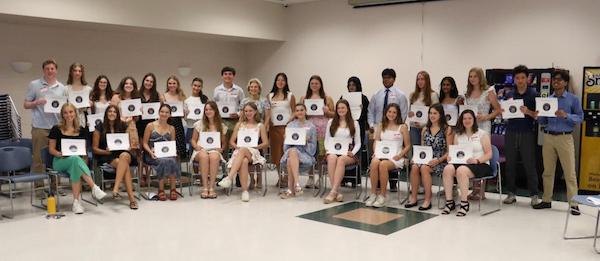
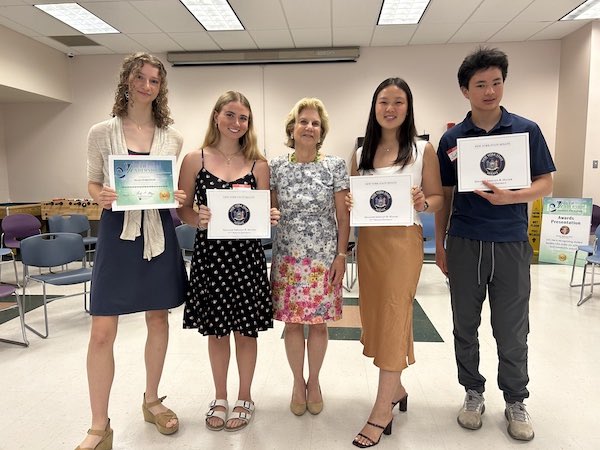 Five Scarsdale students were honored by State Senator Shelley Mayer on June 13, 2024. They were among 30 in the 37th Senate District who received 2024 Citizenship Awards and 13 students who received Youth Leadership Awards at Blind Brook High School. Pictured above are Julia Fenigstein, Christina Semple, [Senator Shelley Mayer], Carolyn Chen, and Justin Zhang.
Senator Mayer’s Citizenship Award recognizes students who have made exemplary contributions through community service, extracurricular activities or daily actions to serve their schools or community. The NYS Senate Youth Leadership Award recognizes outstanding high school students for excellence in the classroom, athletics, and in extracurricular or community activities.
Senator Mayer led a roundtable discussion with the student recipients to showcase their activities and to learn more about each student’s work for their communities. The students were able to discuss the initiatives they pursued and the ideas they have. Senator Mayer then presented the students with certificates of achievement for their outstanding involvement in the community.
Senator Shelley B. Mayer said, “I am delighted to present the 2024 Citizenship Awards and Youth Leadership Awards to these remarkable students in my district. They have all done excellent work in the community, investing much of their time and energy into making Westchester a better place for us all. As Chair of the Senate Education Committee, I am inspired by their work and I appreciated learning their stories and hearing about their plans for the future. I would like to thank Principal Dr. Jennifer Chirles and Blind Brook High School for hosting this ceremony.”
Students from Blind Brook High School, Byram Hills High School, Rye Neck High School, Scarsdale High School and White Plains High School were recognized with the Youth Leadership Award.
Students from Bronxville High School, Blind Brook High School, Charles E. Gorton High School, Eastchester High School, Fox Lane High School, Harrison High School, Mamaroneck High School, New Rochelle High School, Port Chester High School, Rochambeau Alternative High School, Roosevelt High School, Rye High School, Rye Neck High School, Scarsdale High School, Tuckahoe High School, and White Plains High School were recognized with the Citizenship Award.
Julia Fenigstein shared details of her “Scarsdale Healthy Yards” initiative which has helped the environment by decreasing the use of pesticides, herbicides and insecticides in our community.
The program has two parts:
First, she designed a sign which residents can put in their lawn to indicate that they have a “healthy yard.” A healthy yard is one where no pesticides, insecticides or herbicides are used. By having something indicating that a yard is healthy, Julia is hoping to inspire more people in the community to do the same. Once people see a beautiful, chemical-free lawn, it will be proof that toxic pesticides are not needed.
The second part of her program is that her sign has a QR code which links to a Scarsdale Healthy Yards website which she created, which gives advice and tips about how to create and maintain a healthy yard.
Julia is hoping to see more healthy yard signs and less of the small yellow signs posted on people’s yards which indicate pesticides having been applied! Here’s the link to her Scarsdale Healthy Yards website and where residents can request a free Scarsdale Healthy Yards sign: https://juliafenigstein.wixsite.com/healthy-yards-scarsd.
Each student was nominated by a teacher or school administrator.