






Superintendent Drew Patrick Outlines Priorities for the 2025-2026 School Year
- Category: Schools
- Published: Saturday, 23 August 2025 15:19
- Joanne Wallenstein
 Welcome to the 2025-2026 school year! I hope that the summer has given you and your loved ones the chance to pursue your interests, visit new and familiar places, and disconnect from the pressures and routines that characterize the rest of the year. While the pace in our buildings is decidedly different without our students, a tremendous amount of learning and revitalization takes place. As our facilities team took on major projects and completed a top to bottom cleaning of our buildings, our support staff was busy updating systems and communications, and readying us all for the year ahead. Meanwhile, our teachers were collaborating on hundreds of program improvement projects and engaging in exciting coursework. Despite being cyclical, these summer rituals and opportunities seed creativity and amplify the energy and excitement our educators bring to their learning environments for our students.
Earlier this summer, the administrative team gathered for our annual summer retreat to learn, reflect, and plan for the year ahead. We met at Southern Westchester BOCES where we had the privilege of experiencing the Common Circles exhibit, temporarily relocated after a year at Rye Country Day School. The innovative exhibit integrates the arts, technology, and storytelling to explore our multi-layered identities, and the importance of finding our shared humanity. By engaging with some really compelling technology, we are able to interact with two “voices from history” — Holocaust survivor Anita Lasker-Wallfisch and World War II veteran and liberator of the Gunskirchen Concentration Camp Alan Moskin. The technology enabled us to ask these incredible people questions about their lives and experiences that prompted real-time responses based on dozens of hours of pre-recorded video interviews. Advanced filming techniques, specialized display technologies and next generation natural language processing capabilities combined to create a truly interactive experience. We all walked away incredibly moved, but also excited by the possibilities we saw for our students.
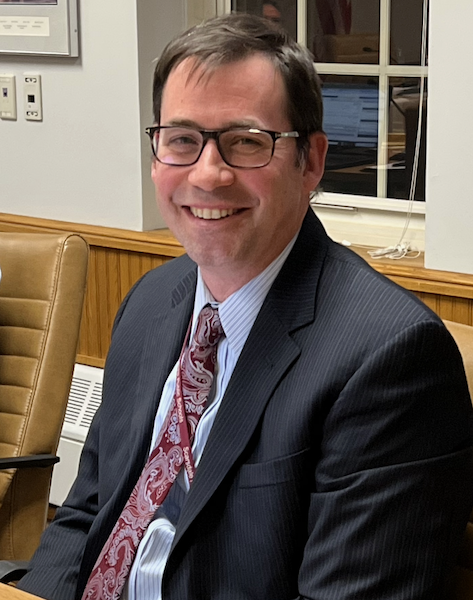 Superintendent Andrew PatrickIn the weeks that followed, I have reflected on how powerfully the exhibit modeled what a truly immersive educational experience can look and feel like. The structure of the environment actively prepared me to engage in the living biography by first emphasizing why it is important for all individuals in a community to be seen, valued, and heard. As an educator, it caused me to wonder how we might create more immersive learning environments here in Scarsdale that are rooted in belonging and foster the other AI — Authentic Intelligence? I am certain there are multiple ways to creatively combine visual media, technology, and storytelling to deeply engage our students and encourage the authentic application of knowledge, skills, and understandings to help them think deeply about what they are learning. What I know for certain is that this form of learning requires the kind of thoughtful, caring, and responsive educators we have in Scarsdale, who spend every day creating conditions for authentic learning. I am excited to continue this exploration of what is possible as the year unfolds!
Scarsdale’s strategic plan provides a framework for helping us to thoughtfully determine and enact educational changes in a systematic and sustainable way that best equips Scarsdale students to be successful in achieving the future they desire. By design, the plan has flexibility to incorporate new ideas and priorities that emerge over time. Since its adoption in the spring of 2024, we have intentionally linked our priorities and goals to the plan’s core themes, Learning, Living, and Leading. In anticipation of the schools’ opening, I am eager to illustrate some of the high priority work that is underway and demonstrates our commitment to innovation and improvement. Here are just some of the priorities we will be working on throughout the 2025-26 school year.
Learning - Generative AI
Is generative AI good or bad? Will it transform education forevermore, or resemble many other educational technologies that were high on promise but low on results? Whatever one’s view, generative artificial intelligence (Gen AI) is a subject that is impossible to ignore. One only has to look at the abundant media coverage to see the hype cycle in action. A sample of titles aimed at teachers and school leaders sheds light on what this looks like in the education space.
The Inevitable Shift to AI: Leading Education in the New Age of Intelligence
What AI-enhanced EdTech Tools Your District Should be Using
AI and [College] Enrollment
Academic Integrity in the Age of Artificial Intelligence
Can an AI-Powered Tutor Produce Meaningful Results?
Education-related publications are justifiably focused on the impact of artificial intelligence. Given the rapid rise in the power and use of large language models (LLMs), managing and planning for their impact is an unavoidable reality in the work of teaching and learning. Notably, one of the things that makes this technology so different from so many others is that, rather than being introduced gradually, AI arrived—literally in the pockets of our students—with no introduction or warning label. So yes, we are and have been thinking about AI. In fact, faculty members across our schools have been engaged in learning about AI since ChatGPT launched at the end of 2022, and many have experimented with Gen AI tools in their planning work. At the secondary level, some teachers have carefully integrated Gen AI and introduced it for student use in various ways. Based on our work to date, I want to share four early takeaways that have emerged through practice and discussion here in the Scarsdale Public Schools.
1. Resist the temptation to, “adopt first, figure it out later.”
While some organizations have dived headfirst into adoption, we have taken an approach consonant with our culture. During the 2024-25 school year, faculty study groups formed at the elementary, middle, and high school levels. Teachers and leaders engaged in research and dialog about the various Gen AI platforms, and assessed their potential for use in the work of teaching and learning. The groups were informed by reading, experts, and speakers, including Jesse Dukes (MIT Teaching Systems Lab) and Jerry Crisci. That work will continue this year, with thoughtful inquiries and explorations of Gen AI use cases taking place by both individuals and groups of teachers. We will document and evaluate these experiences and assess their implications to inform next steps.
2. Develop sensible guardrails based on research and lived experience.
While the promise of Gen AI is exciting, the potential for real harm exists. Both legal and ethical responsibilities have to be named and prioritized even as we explore and discover how Gen AI can benefit teaching and learning. Student data privacy and cyber security concerns necessitate thoughtful, clearly articulated guardrails to guide our experience. This year, we will develop and communicate these guardrails, monitor their effectiveness, and adjust them accordingly.
3. Clearly communicate what forms of AI use are allowed, when, and how it is to be cited.
Gen AI is a tempting tool that can effectively allow students to offload critical thinking and skill building experiences in the curriculum. Teachers must be clear with students what is and isn’t allowed. When Gen AI is allowed, we need to guide students to understand the nuances of its use in the context of academic honesty, credit, and attribution.
4. Gen AI literacy and media literacy must be taught in tandem.
Gen AI intersects with all three domains of the Scarsdale Digital Competencies framework. Arguably, however, Gen AI holds the potential to have an outsized impact on media and information literacy. The ability of our students to decode and comprehend media, assess the reliability of information, and curate and author digital media will increasingly depend on a strong understanding of AI, its capabilities, and its prevalence within the media landscape. Thus, we will be working to develop the assured learning experiences our students will have in order to develop strong media literacy skills in a Gen AI world.
I recognize that this approach will feel too fast for some, and too slow for others. Despite this, I believe it is the best way to tackle something this complex and potentially transformative. As this graphic from Harvard Business Review illustrates, Gen AI use cases are rapidly changing and evolving. Where three of the top 10 uses were learning and education related in 2024, only one is in 2025. We will continue to take a thoughtful approach, balancing learning and discovery of the potential uses for AI.
Living - NYS Device Ban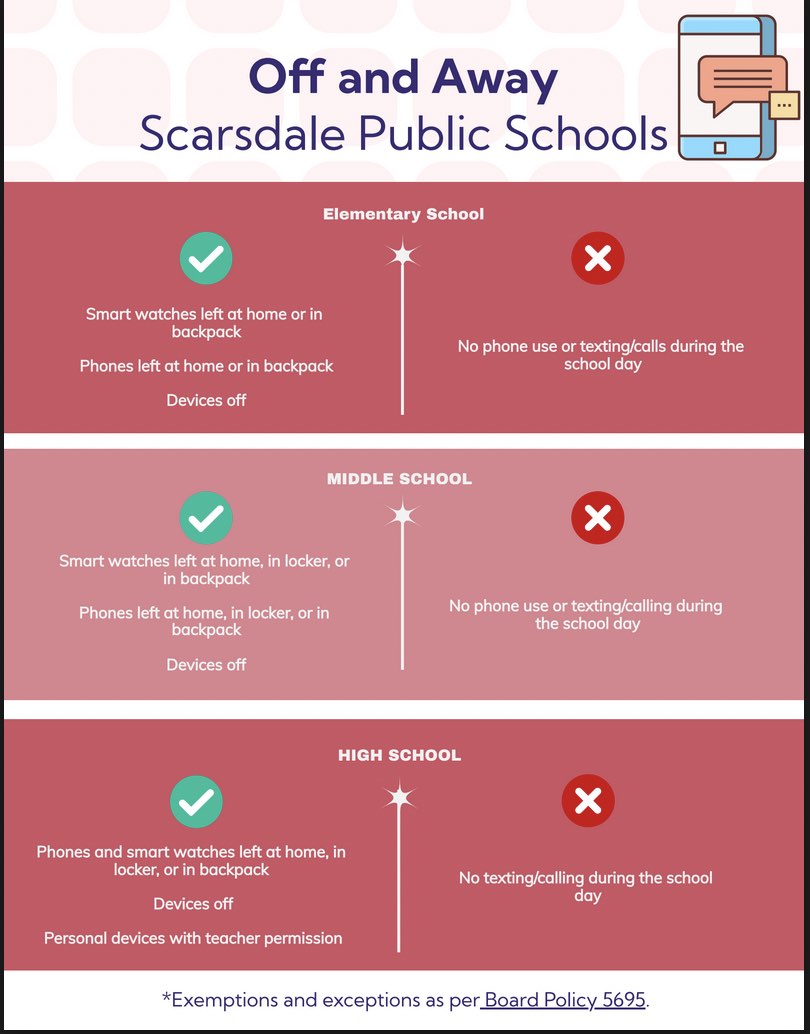
New York recently became the largest state in the nation to adopt a bell-to-bell ban on student cell phones and other internet-connected devices. As this legislation made its way through the NYS Senate and Assembly during the winter and spring months, Scarsdale’s Board of Education reviewed and discussed Policy 5695 - Students and Personal Electronic Devices. This new policy, required as part of the ban, was informed by a survey that received 356 responses, and a significant amount of public comment. The policy was formally adopted on July 1, and will be in place for the start of the 2025-26 school year.
All student devices are required to be Off and Away for the Day. If that sounds familiar, it is because that has been our tagline for the past several years. Throughout that time, we have educated and informed our students about the impacts of phone use and the ways in which phones are addictive, all in an effort to support healthier habits. So what is different now? The major impact will be at the high school level, where cell phone use has been permitted during passing time, at lunch, and during free periods up until now. The new policy requires that phones are off and put away throughout the entire school day, including during these times. Our updated graphic summarizes the policy, and a communication directly from the High School will be sent to all SHS students and families with additional details related to enforcement of the ban, and the consequences for not following it.
Leading - Bond Referendum Planning
The District’s Capital Projects Steering Committee (CPSC), composed of parents, community members, Board members, teachers, and administrators, along with consultants from BBS Architects and Arris Contracting Company, just completed their eighth meeting since March 2025. The charge of the group is to recommend a potential scope of work to the full Board of Education, consisting of high priority capital projects across the District. The work is timed to coincide with the anticipated decline in debt service following the 2026-2027 school year. Traditionally, such a decrease in debt service signals the next opportunity to present a bond proposition to our community in order to improve our educational spaces, building envelopes, infrastructure, and athletic facilities. The original timeline for the process anticipated a bond referendum in the spring of 2026, and we are currently on track to achieve that. There will be a great deal of public discussion throughout the fall and winter, with opportunities for input from our community throughout. Information about the process, including presentations to the Board, can be found here. We look forward to the recommendations of the CPSC, and robust community engagement as the work moves ahead.
In closing, these are just some of the priorities we will be focused on in the months ahead. You are invited to read more about the strategic plan on our website. If you are not already a ParentSquare subscriber, I also hope you will consider joining our email list which includes the weekly “Friday Five” and messages pertaining to the work of our Board of Education. I want to extend my sincere gratitude to our families, caregivers, community partners, and collaborators for their continued efforts toward our shared mission. On behalf of the faculty and staff, we look forward to welcoming our students back on September 2nd for the launch of another fantastic school year!
In partnership,
Dr. Drew Patrick
Superintendent of Schools