






Planning Board Declares Themselves Lead Agency for a SEQR Review of Proposed Development at 80, 88, and 90 Garden Road
- Wednesday, 14 January 2026 14:01
- Last Updated: Wednesday, 14 January 2026 18:06
- Published: Wednesday, 14 January 2026 14:01
- Joanne Wallenstein
- Hits: 1714
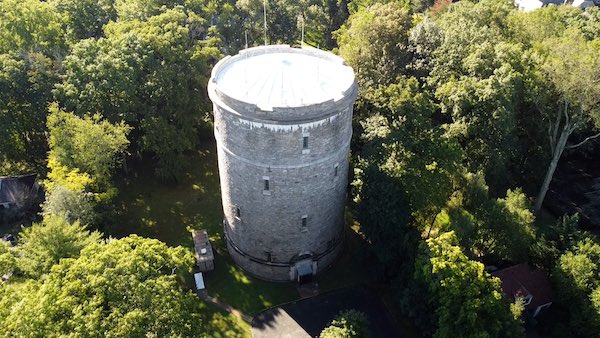 The Water Tower on Garden Road in ScarsdaleIt’s the project that won’t go away.
Scarsdale has very little undeveloped land – and for the most part, the remaining open spaces are protected or prone to flooding.
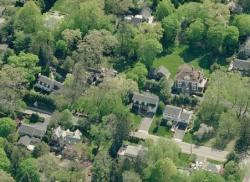
But that has not stopped a developer from seeking approval to subdivide and build luxury homes with swimming pools on a six-acre tract where the ground water is just two feet below the surface. Since 2013, the developer has filed application after application to take down trees, truck in tons of soil and raise the grade by four feet in order to accommodate large homes with full basements.
The project is further complicated by downstream neighbors who already experience considerable flooding from runoff from the property. They have hired experts and attorneys to document how further land disturbance on the site at 80. 88 and 90 Garden Road will raise the risk of inundating their properties.
Following the last hearing of the Planning Board in September 2025, the Planning Board voted to express their intention to make themselves lead agency for a SEQR review which would cause a full investigation of the environmental impacts of the development of the property.
The applicants then withdrew their application for eight new homes and came back with a similar plan to build five new homes on the site, in addition two new homes to replace two existing homes on the site that they plan to knock down.
Though the configuration has changed, the plans still involve extensive tree removals, excavation, trucking of soils and a disturbance of the land. The applicant claims that the work will improve water retention on the property and control stormwater run-off and these claims were the subject of questioning from the Village’s engineering consultant John Ruschke of Matt MacDonald, from Planning Board members, the public and their lawyers at a packed meeting on Tuesday night January 13, 2026, scheduled expressly to review this application.
At the meeting, the Village’s consultant John Ruschke of Mott McDonald reviewed the new application and posed questions to Gabriel Senor, the applicant’s engineer. Ruschke noted that this latest iteration eliminates the retaining wall to hold the landfill and increases changes in elevation between properties.
His question concerned the classification of the existing soil as HSG-C which is defined by the USDA as “Soils having a slow infiltration rate when thoroughly wet. These consist chiefly of soils having a layer that impedes the downward movement of water or soils of moderately fine texture or fine texture. These soils have a slow rate of water transmission.”
He questioned the use of landfill for the purpose of reclassifying soils from D to C, saying, it is a “critical design component of the proposed stormwater management plan but is not specifically outlined in the NY DEC Stormwater Management Design Manual as an accepted management practice.”
Furthermore, since the plan called for stripping the existing topsoil and stockpiling it for reuse Ruschke said the soil would need to be tested for conductivity as a C soil, and the quantity for reuse and the quantity for removal should be identified.
He had a long list of issues with the plan that you can see here:
But perhaps his main issue with the plan was that the proposed method for achieving the reduction in site runoff which the regulations say, “shall be achieved by infiltration, groundwater recharge, reuse, recycle or evaporation/evapotranspiration of 100 percent of the post-development water quality volume.” The SWPPP (stormwater pollution prevention plan) from the applicant says “runoff reduction by infiltration is infeasible due to the presence of high groundwater, and a waiver would be necessary.” But Village Code states that any waiver issued by the Village Engineer shall not result in an increase in the rate or volume of surface water runoff.” Ruschke explained, “The application is unique because they are proposing soil replacement to manage stormwater. That is not listed as an approved method by the DEC.”
Ruschke asked, “Are they following the proper steps to propose a deviation from the code? Was this a good faith effort? Good faith is to follow the example in the DEC manual. They did not use approved methods. They did not justify why they cannot use DEC methods.” He continued, “They should go through the steps and demonstrate why they can’t meet DEC requirements using approved methods. They could reduce the lot size and reduce the amount of land disturbance – but they have not. They should say they could not meet the standard and show why. They need justification for their good faith effort. If you don’t meet the requirements you should propose something that is approved. They should be going through the process and proposing something that complies.”
Following Ruschke, Planning Board Chair John Clapp said, “Your main point is that you don’t see the work for the analysis to show that they have complied with the design manual. They need to go through the steps to justify that their solution is the only one available. If the calculations are not correct, they might not be able to meet the DEC requirements for volume reduction.
They have to show that none of the approved methods will work. What constitutes a good faith effort? What is the margin for error? They say they have taken a conservative approach – but how do we define conservative? The soil is clay – I don’t think they will be able to strip it and replace it. They should test the soil.”
Planning Board member Mark Seiden questioned Senor:
Seiden: On a macro level do we agree that stormwater management is measured by a standard of care?”
Senor: Yes
Seiden: Do you agree that the DEC stormwater manual is an appropriate standard of care?
Senor: Yes
Seiden: So why are you not going with their practices before proposing a deviation? Is the replacement of soils with fill a practice that is endorsed by the DEC?
Senor: The fill is not part of the stormwater practice.
Seiden: The soil replacement is the whole theory on which this application is predicated.
Senor: We are not using the soil in our runoff calculations. We can’t lower the water table, so we will raise the ground – we are doing this to increase the clearance.
Seiden: What kind of structure is going to prevent the houses from floating away?
Senor: "Four foot thick concrete slabs underground to anchor the structures.
Seiden: Can you show us another property where you raised the ground level by removing and bringing in soil? Where this methodology has been successful? Creating a larger elevation differential by importing soil? Do you agree that you have not satisfied the criteria for a good faith effort that conventional methods won’t work?
Senor: We can’t use those methods because Scarsdale does not permit some of the them.
He added that a similar method for constructing homes on a property with high groundwater had been used on a 1.25 acre project in Port Chester.
Planning Board member Lynn Brooks Avni asked, “Did you do alternative analyses? For cluster homes or just building on two or three lots? You don’t show that you have done any alternative studies. How long will it take for the new trees to absorb as much water as the current ones.?
In public comments, Lena Crandall pointed out that trees planted in wetlands often die. She said “soil gets compacted by construction equipment and compacts the roots and the existing trees die. The new trees planted have circular root balls and often fall over during storms.”
Elaine Weir expressed concern about an infrastructure program that was dependent on a homeowner’s association for maintenance. She said, “If flood mitigation structures are not working it will impact other Scarsdale neighborhoods. Or if these neighbors fail to maintain the flood mitigation structures, will the Village be forced to maintain it? All Scarsdale homeowners could be forced to pay for this. It has long term consequences for the neighborhood and the Village as a whole.”
Attorney Helen Mausch speaking on behalf of a group of Garden Road neighbors said, “I think it is abundantly clear that this project will result in severe environmental impacts. Our clients’ experts concur with Mott McDonald’s concerns. A positive declaration would allow a full analysis of all the questions we discussed tonight. Soil, mitigation, flooding, alternatives. We need a pos dec – for full discussion and transparency.”
Brad Schwartz, attorney for Bob Falk said, “The methodology for the downstream analysis needs accurate inputs to do the analysis. For all the same reasons discussed tonight, in 2013, the Village Board conditioned the construction of the homes on Cushman Road on the de-mapping of Woodland Place and no further development on the site.”
Helen Maccarino said, “I have been coming here for years. When you disturb the ground water table, the home is protected but the water is displaced – it flows laterally – around each of the foundations. The plans show swimming pools that will displace more water – that will also flow around. The downstream issue has been neglected. I witnessed firsthand Mr. Falk’s flooding You had to wear galoshes. There is ponding adjacent to the water tower.”
Richard Cantor said, “The thing that bothers me most is the amount of damage that will be done is way out of line with the mitigation that will be done.”
Andy Rodman said I have lived on Cushman Road for 30 years. It’s hard to imagine how the water is going to get down the hill.” About the new homes he said, “Four foot basements? Explain that.” He added, “I lost 13 trees in Hurricane Sandy. I have planted 27 trees and it is hard to get them to grow in these conditions.”
During deliberations Chairman Clapp said that the Planning Board needs to have a meeting soon to decide on the SEQR. There needs to be a written determination of significance, and then the Board would vote yes or no. A negative declaration speeds up the review process. A positive declaration (that the project is likely to have a significant environmental impact) would slow things down because it would require more environmental reviews and consultant reports.
At the conclusion of the meeting the Planning Board voted unanimously to declare the board as lead agency for a SEQR review of the proposal. They scheduled another public hearing for March 18, 2026 with a deadline for further submissions from the applicant and Mott McDonald by February 23, 2026.