






How Many Classrooms Do We Need? Board Lines Up Enrollment Projections with Building Plans
- Thursday, 30 October 2025 08:42
- Last Updated: Thursday, 30 October 2025 13:54
- Published: Thursday, 30 October 2025 08:42
- Joanne Wallenstein
- Hits: 2650
 After learning that a recent demographer's report explored the possibility of redistricting sixty Fox Meadows elementary students as a means to ease spatial concerns at the school, parents showed up at the October 27, 2025 Board of Education meeting to voice their strong opposition to the idea.
Before the Board’s presentation of the Demographic Study, several Fox Meadow parents expressed their worry that redistricting students would divide their community without solving the root problem of overcrowding. In addition to social and emotional concerns, many of the speakers also focused on how the loss of being able to walk to school would erode their tight-knit community for the students who all live just a stone’s throw away from their current beloved school. While many of the comments echoed the sentiments of this letter to the editor, throughout the Public Comment period of the meeting, speakers shared a common message: protect Scarsdale’s community bonds, prioritize student safety and well-being, and ensure that all investments and policy decisions serve the district’s long-term educational values.
Purpose and Context of the Study
Opening the Demographic Study presentation, both BOE President, Jim Dugan and Superintendent Dr. Drew Patrick gratefully acknowledged public input and emphasized the importance of helping residents “see themselves in the study.” Addressing the concerns, they also reassured the Fox Meadow families that no redistricting plan is being considered at this time.
They clarified that the new demographic study, which the district received on Friday, October 24th and quickly shared with the broader community that afternoon, included data examining potential boundary adjustments but the analysis was only part of a broader planning process and not a signal that redistricting is planned or proposed.
As was explained, the study which is conducted regularly, was commissioned to support work on the district’s upcoming capital projects bond, which began last spring. A stakeholder committee including parents, staff, and community members has been studying school conditions, enrollment trends, and facility needs across the district.
At Fox Meadow, the committee identified two key challenges: rising enrollment pressure and aging facilities. The group recommended adding classrooms at the school, and that proposal has been discussed publicly as part of the bond planning. During those conversations, some community members questioned whether adjusting elementary school boundaries could be a less costly alternative to construction and as a part of their due diligence, the Board explored all of these possibilities.
The comprehensive demographer’s report, which analyzes current and projected enrollment, was meant to give the Board a complete picture of potential options before making any decisions and to help guide long-term planning.
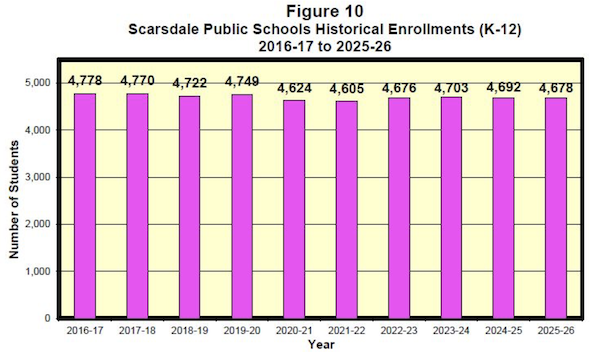
In addition to the topic of a redistricting analysis, the presentation of the report highlighted a detailed “space utilization analysis” of each school as well as district enrollment trends and projections. On this topic, Dr. Patrick shared that enrollment trends between 2016 and 2026 have remained largely stable, with a temporary dip during the COVID-19 pandemic (2020–2021). Numbers rebounded in 2022–2023 and have since stabilized. Current enrollment stands at 4,678 students, down by about 100 from 2016–2017.
Here is the overall district enrollment for the past 10 years:
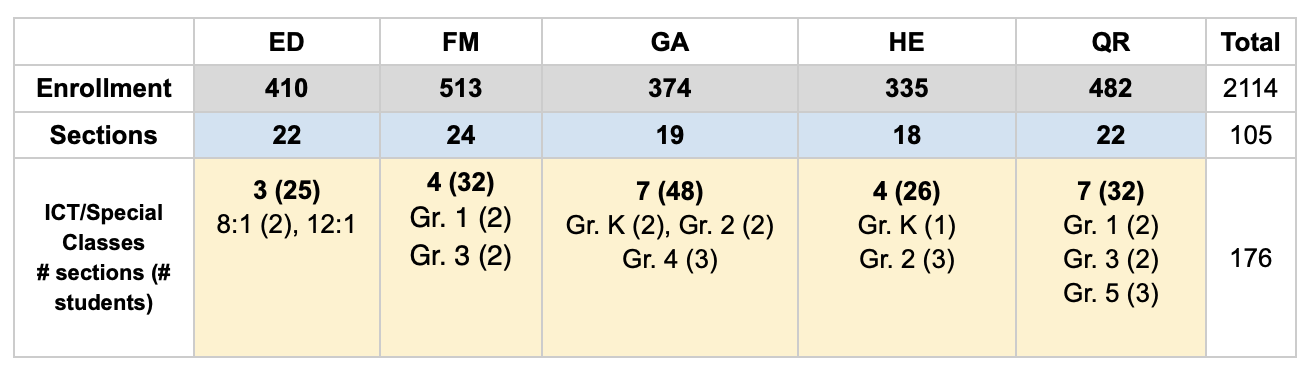
Below is a summary of sections by school. At Edgewood, there are 19 general education sections and three special class sections totalling 22. At all other schools, the total number of sections is also inclusive of the ICT sections. The final row in the table identifies the # of ICT sections in that school (special class sections in the case of ED) and the total number of ICT students in parentheses. Below that the grade levels appear.
Looking ahead, projections through 2030–2031 show an increase in the number of elementary sections needed:
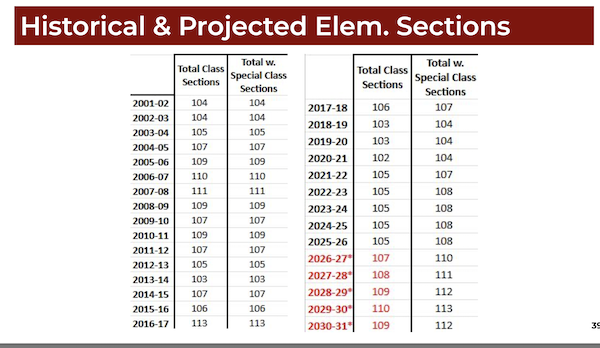
The projection calls for 113 class sections in 2029. Note that in 2016-17, before the construction of the eight additional classrooms at Greenacres, there were 113 class sections. However things have changed since then and Dr. Patrick explained why more classrooms are needed now than ten years ago.
The Superintendent said, "The only way we would have enough classrooms is if we did not provide a dedicated space to some number of our so-called specials - music, art, or Spanish. Assigning certain ICT sections does not solve the problem because the majority of the students (at least 60%) in these sections are general education students from that elementary school. We can't tell them to move to another school as they are districted to that particular school. Our program was different in 2006 and 2007. Our Spanish program has grown, we offer instrumental music starting in grade 3, and the growth in the number of classified students requiring related services (OT, PT, speech) has been significant (not just here - across the State). There could be years where we have enough space with just the FM addition followed or preceded by years when that wouldn't be true. Educationally, I cannot support moving the 3 special classes around to different schools in different years to relieve Edgewood's issues, and we currently do not have any school with 3 available classrooms without displacing another part of our program."
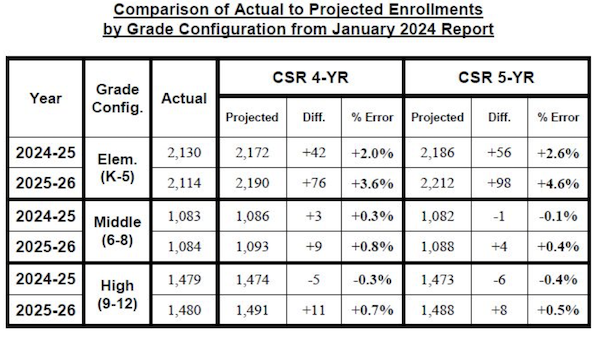
Further complicating matters is the fact that the previous demographers report overstated enrollment numbers so it’s difficult to make decisions on increasing school size based on these projections.
Here is a chart showing actual to projected school enrollments from the January 2024 demographers report:
Board members and community speakers raised concerns about how redistricting could affect neighborhood cohesion and traffic safety. One participant asked whether the proposed bond project could alleviate the need for boundary adjustments. Board members acknowledged these concerns, emphasizing the importance of community engagement and continued data-driven discussion before any decisions are made.
As the district looks ahead, officials agreed that ensuring sufficient space, particularly at Edgewood and Fox Meadow Elementary Schools, and maintaining balanced class sizes will be key priorities in the next phase of planning.
Capital Bond Projects Update
Concerns regarding the Demographic Study report spilled over into the next part of the meeting when the Board presented a Capital Projects Bond update. Dr. Patrick delivered a detailed update on community feedback regarding the district’s developing capital project plans, as administrators emphasized transparency, equity, and ongoing collaboration in shaping a potential spring 2026 bond referendum.
Dr. Patrick opened the presentation by reaffirming that the planning process remains aligned with the district’s guiding principles. “We’re in an iterative phase between the Facilities Committee, the Capital Project Steering Committee, and the board,” he said, noting that the district is still on track for a possible referendum in the spring.
He also noted that the October 16 public feedback session drew 80 in-person participants and the survey generated a record 828 survey responses, the highest level of community engagement in recent memory. Attendees also submitted 238 written comment cards, offering suggestions, concerns, and questions.
Transparency, Equity, and Facility Priorities
Patrick reported that participants expressed a strong desire to understand how recommendations were made, including the data and equity criteria used. “We’ve been asked to define what we mean by equity in facilities planning,” he said. The district views equity both in terms of ensuring fair distribution of essential infrastructure upgrades, like air conditioning, and maintaining program quality across all schools over time.
Edgewood Elementary emerged as a central topic of concern, with parents and staff citing capacity constraints and the need for additional classroom and therapy spaces.
Field improvements also drew mixed reactions. Some community members worried about costs and priorities, while others emphasized that athletic spaces are integral to student learning. “Fields are places where students learn,” Patrick noted. “They are competition and physical education spaces, part of our program.”
Survey Findings
The 828 survey responses were divided into four categories: spatial projects, building infrastructure, air conditioning, and fields.
Air Conditioning: 66.7% of respondents said cooling large spaces is a necessity; 25.6% called it a “nice-to-have,” while 7.7% said it’s not a current priority. Comments emphasized energy efficiency and equitable distribution, particularly at Heathcote and the high school gymnasiums.
Spatial Projects: Nearly half (47.7%) said proposed projects strike the right balance between need and affordability, though many urged the district to address Edgewood’s space limitations.
Building Infrastructure: 62% agreed that the proposed $33 million in maintenance projects were appropriately balanced.
Fields: Opinions were nearly evenly split — 28.7% supported prioritizing field improvements, 37% supported both major field projects, and 33.9% said they should not be a priority.
Overall, 51.7% of respondents felt the total project scope was “just right,” while 27.4% felt it was too high.
Next Steps and Cost Review
Assistant Superintendent Andrew Lennon said cost estimators from ARIS are refining figures for air conditioning, infrastructure, and field projects ahead of the board’s November 17 meeting. “We believe we’ll be able to share updated, far more detailed cost estimates,” he said.
Administrators have also met with faculty and PTA representatives from Edgewood and Fox Meadow to hear additional feedback. A virtual community session is scheduled for November 6.
Board Discussion: Balancing Space and Affordability
Board members voiced strong interest in reassessing Edgewood’s needs. Board member Bob Klein said, “We need to make sure we can build what we want to build successfully, not just squeeze it in.” Others stressed the importance of prioritizing classroom space and equitable access to therapy rooms for services like occupational and physical therapy.
Member Laura Lui added that the Board must weigh new space requests against overall affordability. “I don’t want this bond to get out of control,” she said. “If there are lower-priority items that can move into budgets, we should look hard at those.”
Several board members agreed the field portion of the bond warrants further review given community ambivalence. “Few things impact kids every day like classroom renovations,” one member said. “But we need to distinguish between what we need and what’s just a bell and a whistle.”
Dr. Patrick concluded that the administration would refine estimates and revisit Edgewood’s options, balancing the addition of classroom space with potential scope reductions elsewhere. “We’ll do the best we can to present a plan that meets educational needs and remains responsible to the community,” he said.
During Public Comment, PTC Budget Chairs, Rachna Singh and Mayra Kirkendall-Rodriguez encouraged the community to attend the second feedback session November 6th at 7pm on Zoom.
In addition, Singh shared a recommendation adding a simple online tax rate calculator or chart to the district’s Capital Bond webpage. This tool would allow residents to enter their home’s assessed value and instantly see their estimated annual tax increase, using the same formulas shared in the presentation.
Kirkendall-Rodriguez also added a few questions regarding the district’s recent audit and the proposed Emergency Plan.
You can see these questions and the entire meeting in this video.
For the Bond and Capital Projects Presentation see here .