







Board Considers Use of Reserves to Fund 2025-26 Proposed School Budget
- Details
- Written by: Joanne Wallenstein
- Hits: 2992
 Reserve funds, electric school buses, special education and a self-insured health plan were all on the minds of the Scarsdale School Board and administration at their third budget study session on March 10, 2025.
Under consideration is a draft budget of $191,504,833 for the 2025-26 school year. It represents a 3.55% budget to budget difference over the 2024-25 budget which translates to a 3.4% increase in the tax levy or a $415 a year difference for the median assessed homeowner in Scarsdale. Those in the Mamaroneck strip would see a modest decrease. The increase meets the 3.40% tax levy limit or tax cap.
The proposed budget includes:
Four electric school buses and an agreement to build the infrastructure to charge and maintain the buses.
A new synthetic turf practice field at Scarsdale High School and plans to replace elementary school playgrounds.
Two additional full time special education teachers and a teaching assistant to facilitate the expansion of two new special education programs at the middle school and high school.
It also eliminates a half time math teacher, a data services position along with 6 additional positions eliminated due to enrollment or attrition along with $226,000 in teacher aide hours.
At the outset of the meeting, the board appeared to be poised to move forward with the plan.
However, after a discussion about the use of reserves and the volatility of the self-insured health plan it wasn’t clear if further changes might be made.
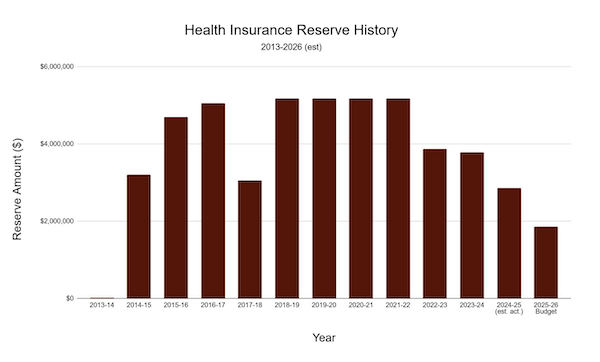
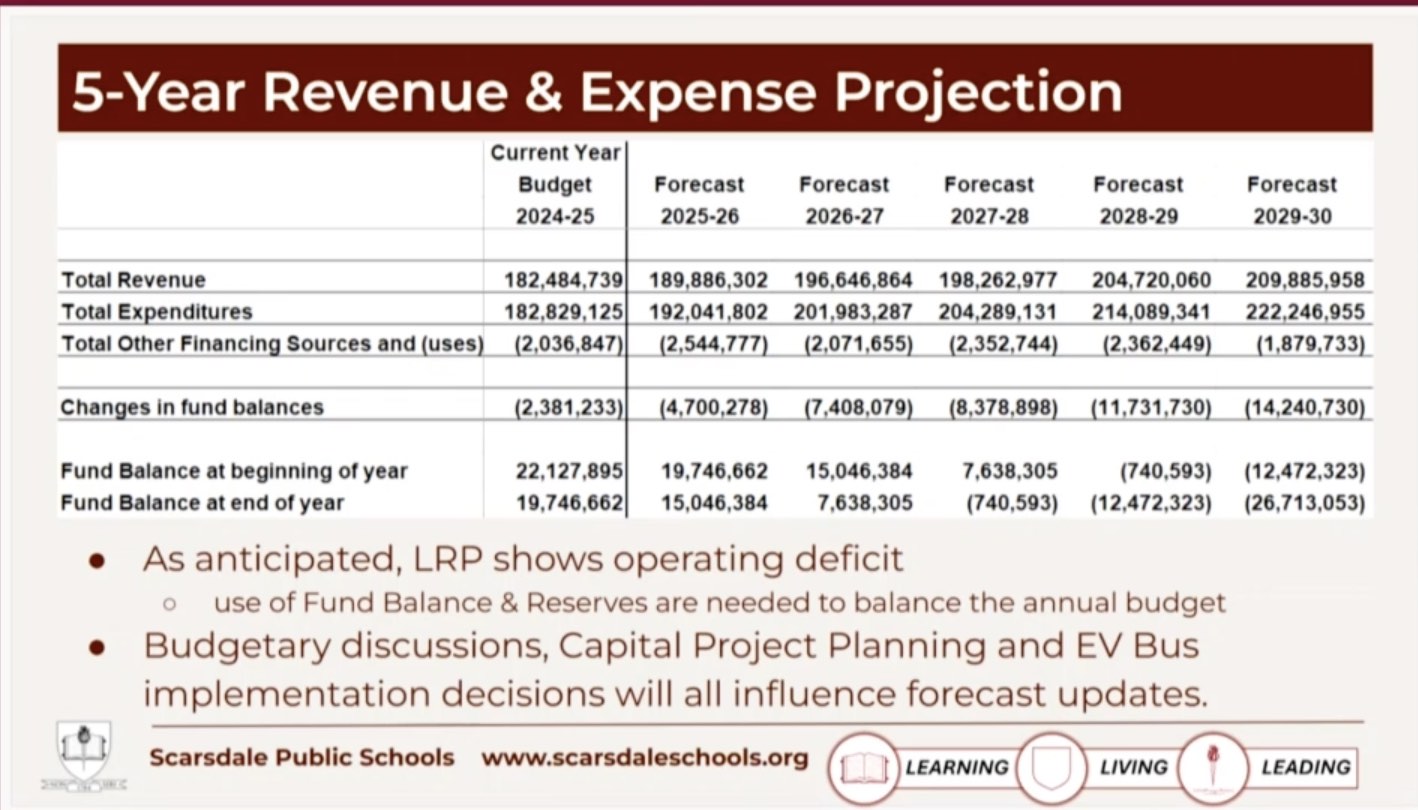
At issue was the use of $2,290,000 of reserves to balance the budget, with $1,190,900 coming from the unassigned fund balance,$1,000,000 from the health care reserve and $281,233 from the employee retirement reserve.($90,900 will be replenished to fund balance from the bond offering.) A long range financial forecast in November 2024 showed that if reserve funds continued to be used at the current rate, the district would face a negative fund balance by 2027-28.
Furthermore, the contribution to the budget from the health care reserves could expose the district to risk if health care costs continue to rise.
Health Care Plan
 Following the budget discussion the district’s Health Plan consultant showed the history of the plan and his projection for next year.
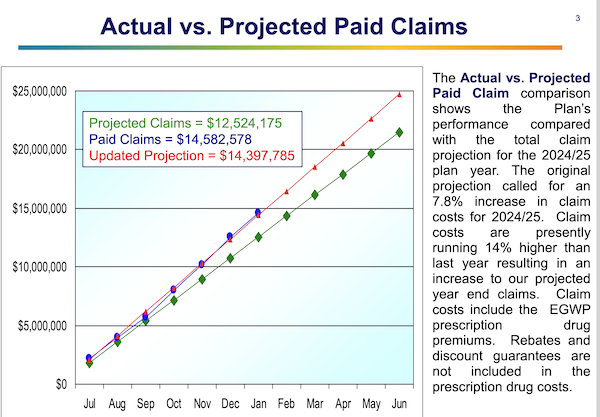
His data showed that health care costs for 2024/25 were exceeding projections for this year. The budgeted projected claims were $12.5 mm and the updated projection is $14.3 million. Driving this increase are the following:
-A 26.8% increase in ER visits
-A 19% increase in outpatient surgery
-A 75% increase in claims above $100,000
-A 10.5% increase in the amount paid per visit.
About prescription drugs, the consultant said, “Just 4% of district members utilized specialty medications accounting for 68.9% of the drug spend.”
See the chart below for further details.
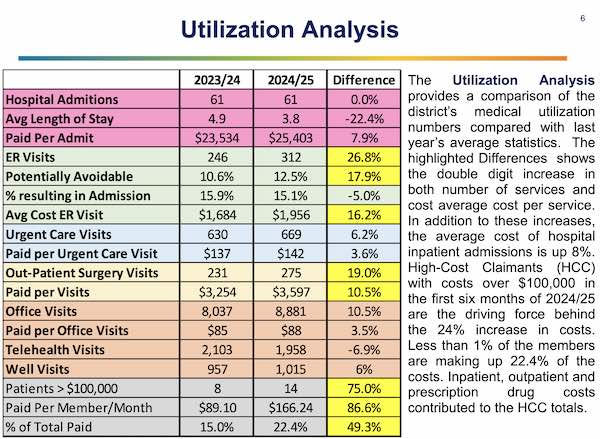
Statistical models were used to forecast the districts expense in 2025-26 and the consultant estimated it to be $23,846,157. The proposed budget includes $24,096,143. However, using the experience of the past three years, the costs could be closer to $25 mm so reserves might be needed to pay the bills.
The Board has few choices for reductions as health benefits, pension costs and salaries are fixed. However, the continued expansion of the Special Education program to the middle school and high school requires new hires and could be up for discussion.
The administration estimates that it is more cost efficient to offer these two special classes in district rather than pay outside tuition for students to attend other schools, which is estmated at $84,000 per students plus transportation. For the 2025-26 school year, enrollment is projected at 3 students for the 8:1:2 program and 4 students for the 12:1:1 program. The administration proposes to bring in tuition paying students from other districts to defray expenses.
There was no data presented about parent-student satisfaction with the program. Also with so few students, shifts in plans for next year could impact the financial scenario. An estimated 4-8 additional full time staffers will be needed in the next 3-4 years to continue the special education program expansion. With every hire, the district pays lifetime pension costs and healthcare costs.
In the last ten years, district head count has risen by 70 full time employees at a time that school enrollment has decreased.
At the same time that the two additional Special Education teachers will be added, a half time math teacher position will be eliminated at the high school. This will cause some AT math sections at the high school to be oversubscribed. In addition, the multivariable calculus class that was offered in person this year will return to being an online course next year. Students from that class came to the Board meeting to urge the board to keep the class in person.
Funding cuts to non-sanctioned sports such as fencing, crew and squash are also under consideration.
Board Discussion
Discussing the level of risk posed by the diminished reserves in the proposed budget, Board members posed questions:
Leah Dembitzer asked if reserve levels would affect the district’s ability go to out to bond for capital projects? Assistant Superintendent Andrew Lennon said, “It may, but the wealthy tax base in Scarsdale should help to get it approved.”
Asked about requirements for the unassigned fund balance, Lennon said, “It is capped at 4% of the prior year’s budget – next year it will be 3.7%.”
Dembitzer expressed concern about the amount of reserves we are pulling from the budget to cover our expenses asked how this year’s decisions affect the next budget cycle.
About the proposed expansion of the Special Education program she said, “Parent input and feedback is needed for the Special Education program for evaluating the program.”
Ron Schulhof questioned Eric Rauschenbach about a budget transfer of $250,000 for related services that was approved at the meeting for special education services. Schulhof said, “It feels like an area where we could be over budget next year – our ability to absorb these is being reduced.”
He said, “I want to reiterate my concerns about using fund balance to balance the budget. If everything goes okay next year at this time [with healthcare costs], you will be start in a $1 million hole. It is not sustainable. The reduction of fund balance eliminates our ability to take risks.”
About a proposal to cut funding for non-sanctioned sports including crew, fencing, dancing and squash, he reiterated his stance that he does not agree with cutting any of these sports. However if expenses are going to be cut, he said “I don’t think it is fair to just cut expenses in those five sports – if expenses need to be reduced, we should look to cut expenses in any sport that is much higher on a per player cost. In fairness it should be for all sports."
Bob Klein asked Lennon, “Are there other benchmarks from the state or other school districts for the percentage of fund balance?”
Amber Yusuf said, “I have concerns about the reserves as well. We cannot continue down this path. We have to continue to look at what we’re doing. We have to watch this closely.”
Board President Suzie Hahn asked, “Should we go over the tax cap? Polling the board she said, “Is anyone thinking they cannot approve it (the budget)?”
Board VP James Dugan said, “I don’t hear anyone saying that this year we need to do an austerity budget to make this up.” He added, “And it will have significant repercussions when I am board president next year.”
Schulhof said, “I have serious reservations about this budget.” However the others said they were ready to move forward and would like to keep an eye on it for next year.
School Administration Proposes Budget In Compliance with State Tax Cap
- Details
- Written by: Wendy MacMillan
- Hits: 2206
 The Scarsdale’s Board of Education hosted their second Budget Study session on Monday March 3rd and presented a proposed 2025-26 budget to comply with the state mandated tax cap. The Board sought to balance draining reserves against funding district priorities such as athletic programs, class sizes, course choice, teacher aids and a new special education program.
At the first Study Session held on February 3rd, administrators put forth an initial draft budget proposal that exceeded the state-mandated tax cap by approximately $2,000,000. Though administrators believed that this draft of the budget would best support students and teachers, some members of the Board (and of the Scarsdale community at large), expressed concern about trying to pass a budget over the tax cap for the second year in a row.
Dr. Drew Patrick announced at Monday’s meeting that several adjustments had been made to the most recent draft proposal including increased revenue assumptions and reduced expenditures, which together worked to close the $2,061,479 gap to make sure the budget stays within the tax cap.
In his presentation, Dr. Patrick gave a thorough explanation of the adjustments starting with a slide that outlined the increased revenue assumptions:
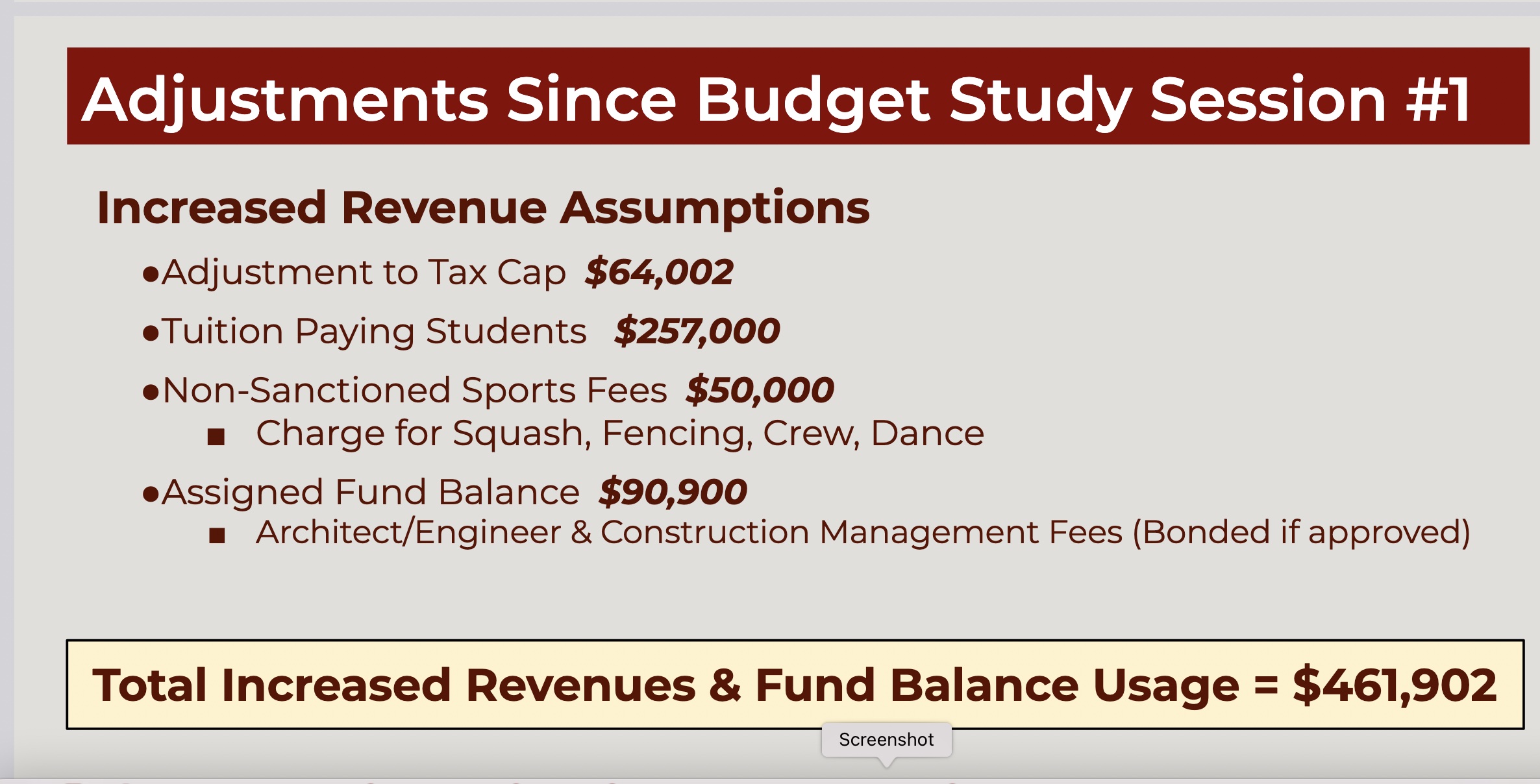
In describing the adjustments to the tax cap calculation, Andrew Lennon noted the EV bus infrastructure plan and said, “In the research we've been doing since our last budget study session, we do believe that those (EV) expenditures that we've included in the budget are considered to be capital expenditures in regards to the tax cap.”
At the first Budget Study Session, the public also learned that in an effort to save money, several “newer” varsity sports could be cut and no longer offered to high school students. Many student athletes spoke during Public Comment imploring the District to keep teams such as Crew, Fencing, and Squash. At the second session, Dr. Patrick discussed the possibility of asking for parent contribution (charging a fee) for these sports which would enable those activities to run pretty much as they're currently structured. He added, “With that said, we are also continuing to look at how to reduce our expenditures. How might we be more efficient in our transportation? Do we need the same number of adults that we provide to be part of that? If there are any savings that we think we can achieve between now and the start of the school year in those areas, it would come off of this amount.”
Lastly, Patrick explained the proposal to add an additional $90,000 of assigned fund balance to the $1.1 million in the budget, saying that money would be used, “to fund the architect, engineering, construction management pre referendum costs and would ultimately be bonded if we pass a referendum, and then returned to fund balance.” Another $1,281,233 will be transferred from the health care reserve in order to balance the budget for a total of $2,381,233 in reserves.
In terms of reduced expenditures, administrators have identified a number of additional reductions which were outlined on this slide of the presentation.
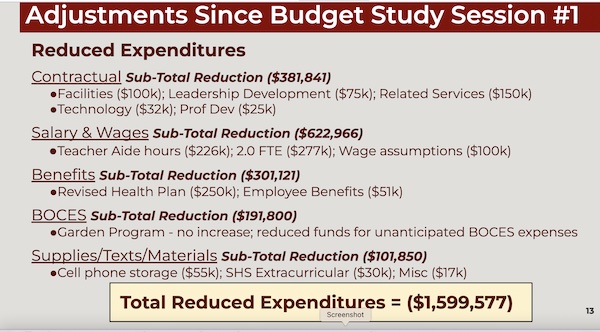
Patrick briefly described each area of the proposed reduced expenditures. In regards to salary and wages, Patrick said, “We are proposing reducing teacher aid hours in the amount of about $226,000. How that would actually look, is work to be done but that amount is roughly a 10% reduction in eight hours across our general education aid budget.”
Patrick went on to describe the reduction of two additional FTE teaching positions. He explained that based on enrollment projections the District is predicting a shrink or collapse of one of the ICT sections. Patrick also announced that instructional technology specialist Meredith Dutra is leaving Scarsdale High School and has accepted a position to be a Director of Technology in North Salem. Patrick offered her his congratulations and noted that the District would reduce that position.
For a detailed explanation of all the proposed adjustments you can watch the full presentation here.
Before addressing questions about these proposed changes, administrators delivered presentations that explored important components of a Scarsdale education that the budget supports. These components include: Curriculum, Instruction, and Assessment, Special Education and Student Services, Safety, Security, and Emergency Management, and Technology and Innovation.
The presentations made clear that students are at the center of everything the District does and that the budget supports student development through responsive change, multiple perspectives, and authentic learning experiences.
Assistant Superintendent for Special Education and Student Services Eric Rauschenbach described how the Special Education programs saw a rise in enrollment to 627 students, a 14% increase since 2010. He discussed plans to expand in-district programs to SMS and SHS to reduce out-of-district placements, which he estimates will yield $1.2 million in savings over five years. In order to make the program cost efficient, he estimates that the district will receive $257,000 in tuition revenue from other school districts who will place their students in two new programs, The proposal requires the district to hire two additional full time special education teachers.
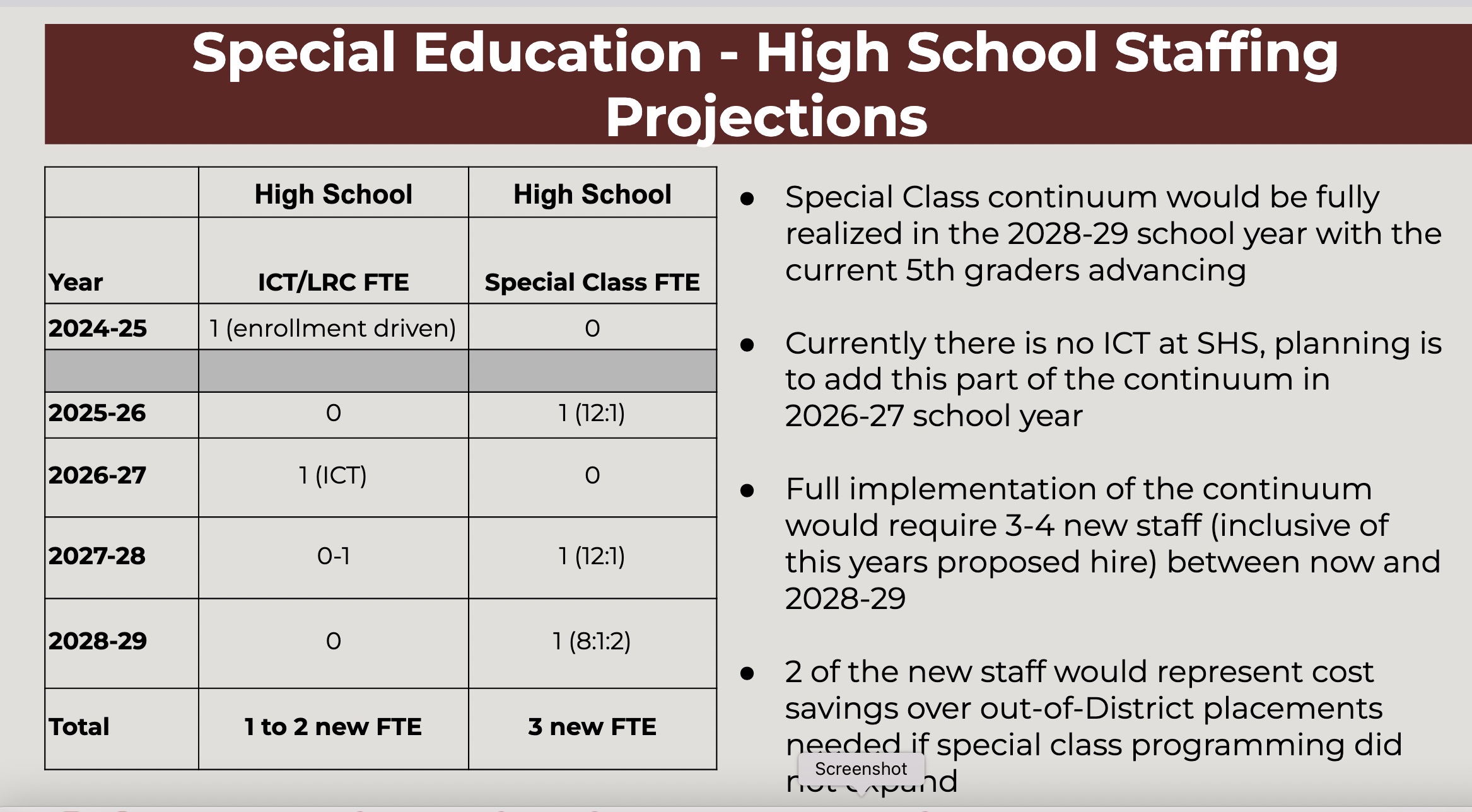
The technology budget calls for a 2.1% increase, focusing on instructional software and cybersecurity. To view the presentations in their entirety, see here.
Following the presentations the Board was given the opportunity to ask questions. All board members participated in the thoughtful Q and A session where they asked clarifying questions to deepen their understanding of the proposed changes and also provided their constructive feedback.
Leah Dembitzer shared her thoughts about athletics saying, “I think it's important to do our best to keep these sports. I think we've heard from a lot of parents and students, and we know what these sports mean to the students…they very articulately and passionately shared those with us. These sports represent belonging, wellness, physical, mental health, wellness. And so I just want to say I understand what we're in and I appreciate the troubleshooting and thinking about how to keep these sports.”
Dembitzer also acknowledged that Dr. McIntosh will deliver a Reveal Math presentation later in March, but she hoped to better understand if metrics are used to measure student progress and to help us understand if/how the curriculum is working.
McIntosh responded by inviting everyone to watch the Reveal Math presentation on March 24th where they will discuss the variety of metrics used to assess progress including star assessments, problem solving skills, performance assessments, and benchmark assessments. McIntosh added, “Since there's been a shift in the Next Gen standards towards an emphasis on these mathematical practices, we're looking to lean into those assessments that best describe how kids are developing in those areas. And so on the 24th we'll have an opportunity to hear from students, see students and teachers in action, and to talk about what these evolutions, the pedagogy and the content have meant…and how they're performing in the classroom.”
BOE member Ron Schulhof expressed his concern about using the fund balance to help balance the budget. He stated, “I think it's important to acknowledge when we say this budget proposal has closed “the gap” it is with the use of over $2 million from the fund balance. This will be the sixth year in a row that this district will balance the budget with the fund balance, which means we are spending more than we are taking in for six years in a row. What is the plan to address that?”
Dr. Patrick responded by saying, “I think we're trying to get those building blocks in place with a long range financial plan, with a fund balance and reserve use plan.” Patrick also highlighted two major forces, the experience of health claims and the retirement system rates which are outside of the District’s control. He added, “Yes, we're proposing to use reserves in both of those areas. Our goal would be to hopefully reach a point through some of these constraints and reductions in expenditures, we slow down the growth of expenditures to hope for a year where we're actually spending less than we're taking in, and that we restore those reserves, as we've done in the past.”
Claudine Gecel also expressed her concern about using the reserve funds to balance the budget. Gecel said, “I think that it's really great that everybody's working so hard on trying to pull this together and try to get it close to the tax cap. It is distressing that the reserve reduction is an important component of the process right now as it stands….It’s true that nobody can really control the pension part of the budget, because that's provided by New York State. But Health Care is within the control of the district, and maybe next time, we'll find out more about it. … The self insured (health) plan was put in quite some time ago, before the financial collapse, and, you know, it might be time to revisit that.
Also during Public Comment, many athletes took the podium to eloquently advocate for the District to continue to offer crew, squash, and fencing as varsity sports. To hear these students speak and to watch the Budget Study Session in its entirety see here.
Another budget study session will be held on Monday March 10, 2025 at 6:30 pm.
School District Explores Ways to Close a $2mm Budget Gap for 2025-26
- Details
- Written by: Joanne Wallenstein
- Hits: 4521
 Struggling to fill a $2,061mm budget gap for the proposed 2025-26 school budget, the Scarsdale School Board held their first budget session on February 3, 2025 where they explored expenses, revenues and possible cost savings to allow the proposed budget to come in below the mandated tax cap.
As Superintendent Drew Patrick explained, “The tax cap continues to place constraints on our ability to provide an ideal program. Salaries continues to go up more than 2% and we have experienced some big health care claims.” Since the district has a self-insured health plan the 25% increase in claims this year projected $1.6 to be $1.6 mm higher than budget is one item that is impacting the bottom line. Also significant is a projected $564,000 in retirement and social security costs and $245,000 in transportation due to the mandate to purchase EV buses.
Personnel
Included in the proposed budget are two full time teachers to support two new special education programs at Scarsdale Middle School and Scarsdale High School. The teachers will support an 8:2:1 class at the middle school which will be staffed with a teacher, a teaching assistant and an aid. Three students are expected to enroll in that class, though presumably it could hold up to eight students. At the high school a new 12:1:1 class will be formed for four or five students. That class will require an additional teacher and an aide. The district did not provide the associated costs for the teaching aids and assistant in the budget presentation.
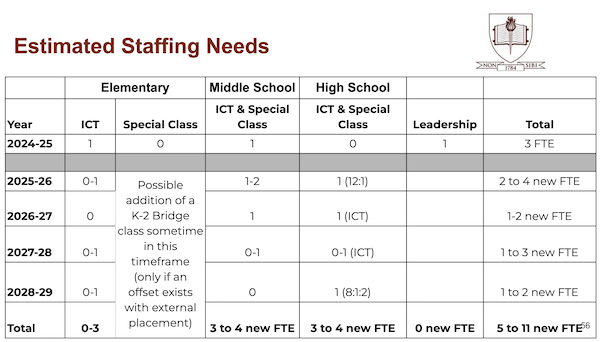
Later at the meeting the Board reviewed rising healthcare costs which are driven by higher than expected claims. However it should be noted that healthcare costs may also be driven by the number of full time teachers which has grown by 74 in the last ten years from 599 in 2015 to 673 in 2024. During this ten-year period, overall district enrollment fell from 4775 to 4693 students. A report to the Board in December 2024 anticipates that another five to eleven special education teachers will need to be added to the staff in the next five years. See below:
Proposed Cuts
The administration made several proposals to reduce costs and also asked Athletic Director Cindy Parrott to explore what could be cut.
To start, Patrick removed the proposed addition of a half time math teacher at the high school, who would have taught an AT course in statistics.
Without offering details, he proposed to eliminate 6.5 full time teaching positions through attrition, i.e. not replacing some retirees.
He proposed that cost savings could be achieved by not including two contingency positions for elementary school classes in the budget. These contingency positions are customarily included in the budget to guarantee that the late enrollment of new students in the summer does not cause elementary school classes to exceed 22 students in grades K-3 and 24 students in grades 4 and 5.
Patrick proposed a change in policy that would permit 23 students in Grades K-3 as a result of late enrollments and 25 students in grades 4-5. However, if a section rose to one more additional student the district would propose to use reserves to hire an additional teacher.
He said that there are currently an average of 19 students in the K-3 classes and 21 in grades 4 and 5. He also said that this year there are ten classes at the maximum enrollment and three that are over the maximum.
Additional cost cutting proposals included reducing the flexibility of schedules at elementary schools which use extra staff to allow teachers meeting time during the school day, as well as “tolerating a lower rate of flexibility in the high school schedule.” This refers to the availability of class choices to meet students’ requests.
Patrick discussed looking for alternate revenue sources for some improvements, such as flexible furniture at the high school which the Scarsdale Schools Foundation might be willing to fund.
Reserves
Discussing the district’s reserves, Assistant Superintendent Andrew Lennon reviewed this slide.
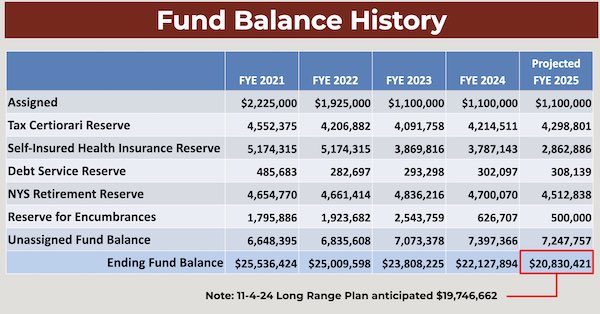
It shows that overall reserves are projected to fall from $25.5 mm at the end of fiscal year 2021 to $20.8mm at the end of June 2025. This is a $1.1 million improvement over a November 2024 projection. The improvement is due to the restoration of $500,000 in foundation aid and higher than budgeted interest earnings. However, the Board was concerned about the healthcare reserve which was $5.15mm in 2021 is projected to fall to $2.8mm at the end of this school year.
In summary, the district would need to find $2,061mm in savings to allow the budget to fall within the state mandated tax cap, which Lennon estimates at 3.36%.
Interscholastic Athletics
Director of Athletics Cindy Parrot presented the $2.8 million budget for interscholastic athletics and the proposed $287,122 increase.
The proposed increases were for:
-Athletic Trainers ($20K)
-Uniforms, supplies and equipment including new football helmets ($15K)
-$7K to provide for the presence of police at athletic events
-$20 K for facility rental fees
-$30K for BOCES officiating and additional services.
She noted that the entire athletic budget is just 1% of the almost $200 million school budget and was reluctant to propose cuts.
However, since she was asked how funds could be saved she provided the numbers on running programs for three non-sanctioned sports, including crew, fencing and squash.
See the slide below for the expenses associated with these sports.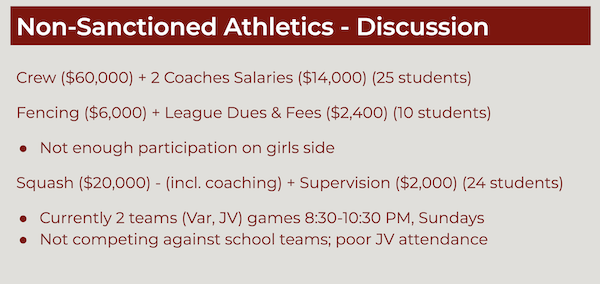
Parrott discussed participation, transportation and scheduling for each of the three sports which have fewer students competing than other sports. However, parents and students are passionate about these teams and there was considerable pushback on the proposal to cut them at the Board of Education meeting that followed.
Before making a decision on this proposal, Board member Ron Schulhof asked Parrott to provide a “broad analysis of the cost per participant for all athletics.” He said, “Just picking the non-sanctioned sports is not enough. What are all the costs for all athletics by sport?”
At this point in the meeting, a student in the audience started shouting that he wanted to correct some of the information. He was asked to wait until the Board of Education meeting and to speak during public comments.”
Transportation
Ass’t Superintendent Andrew Lennon explained that new laws will require any new buses purchased by 2027 to be electric vehicles and by 2035, all buses on the road must be EV’s.
He explained that in the 2025-26 school year the district will acquire three large EV buses, which will be funded with $800,000 awarded by the EPA along with additional funds from through NYSERDA.
Moving forward, Lennon provided two plans to finance EV buses and the infrastructure needed to charge and maintain them. He said the district could “go it alone,” or partner with the Fleet Electrification Firm who will build out the required infrastructure and offer financing through 10 year leases.
The board indicated that they would opt to partner with the Fleet Electrification Firm.
Capital Projects
There are some capital improvements included in the current proposed budget. Among them are the first phase of field improvements identified in a joint field study done by the Village and the school district. The current budget calls for $1,250,000 in field improvements.
Also in the budget is $250,000 to replace elementary school playgrounds. Patrick explained that many of the elementary school playgrounds are 30 years old and are beyond their useful lives. He suggested that the district might partner with the PTA’s and the Scarsdale School Foundation for funding to revitalize the equipment.
Much discussion followed about the self-insured healthcare plan and whether or not it would be more cost efficient to enroll in a group plan. Patrick said that the district’s healthcare consultant and their health advisory committee will examine trends and attempt to determine why costs have escalated so dramatically.
Board Comments
Board member Ron Schulhof said he was not in favor of using $1 million from the health reserves to fund next year’s budget. He said, “We were at $5 mm in health reserves a few years ago. I would not be comfortable with another $1mm draw down of the health reserve to balance the budget. If we do that our health reserve will drop to $1.5 mm. We should be funding our reserves back up. Even with $2 mm more in revenues, we are drawing down reserves. There is a projected $3.743mm increase in health care costs increase for next year. What are the options? It is the prudent thing to do for our taxpayers. I don’t want to use our fund balance in years when the stock market is on a tear.”
He added, “I don’t personally support touching our class sizes. The proposed reductions were all in student experience.”
Leah Dembitzer said, “I agree with Ron about class sizes -- it is a hallmark of our school. It can also strain some of our classroom sizes. How much enrollment change is there historically after August 15?” She also said, “Pulling the math teacher will affect 28 students who want to take AT statistics.”
Colleen Brown agreed. She said, “Thinking about what makes Scarsdale, Scarsdale. It’s small class sizes, the house plan at the middle school and the ability to take courses you want at SHS. I would like to see the data around elementary school class sizes and class enrollments at the high school. We need data to guide us.”
Turning to Ron, Amber Yusuf said, “Thank you for your candor. I appreciate your thought process. I agree that we need a better understanding of our healthcare options because we are facing a difficult situation. It’s hard to understand if we are $2 mm above our projection, how would the Empire plan work?”
See the presentation here. The next budget planning session will be held on Monday March 3, 2025.
Board Reviews Personnel Requests for 2025-2026 and Unveils a Draft of the 2025-26 School Calendar
- Details
- Written by: Wendy MacMillan
- Hits: 4225
 The Board held a budget meeting on 1-27-25 where administrators highlighted current staffing levels, discussed new staffing requests for next year and detailed the programming that staffing will enable the District to provide for Scarsdale students.
To start the discussion, Superintendent Patrick took a few moments to remind meeting attendees that the “District budget provides the necessary financial resources to operate the school district and to help achieve the goals and objectives of the school system as set forth in the strategic plan.” He went on to demonstrate through several slides how the District’s new vision statement complements their mission statement and how both are supported by three big ideas represented by the areas of Learning, Living and Leading. These slides are available for viewing here.
Patrick also took time to outline the programming and structure of the elementary schools, middle school, and high school including small class size, special education, and course offerings. He added, “We think it's important to reaffirm how valuable these structures are and how they contribute to a positive school experience for students and it's also important to point out these are the assumptions that we're making going forward that these things would continue.”
Assistant Superintendent for Business Andrew Lennon addressed the Board next saying, “As we start to think about the staffing needs of our district, we also have to have some financial context for this conversation.” In addition to reviewing the tax cap, Lennon highlighted an important takeaway from Governor Hochul’s recent proposal that directly impacts Scarsdale's budget. Lennon related that Foundation Aid, a category which the District feared would be reduced in last year's budget, will have modest adjustments in the Governor's budget proposal. Based on the information shared in the proposal, the District anticipates a small increase in Foundation Aid of about $75,000, and essentially flat expense based aids in the coming year..
Before delving into the staffing recommendations, Meghan Troy, Assistant Superintendent for Human Resources, first took a moment to review the District’s current and historical staffing and student enrollment providing needed context for where the District has been and where it is headed. In the slides, Troy highlighted the historical district wide staffing of full time employees and noted an increase in district wide staffing as student enrollment has remained steady over time. She explained that this increase in staffing numbers was in line with the work the District has done to develop special education, ICT classes.
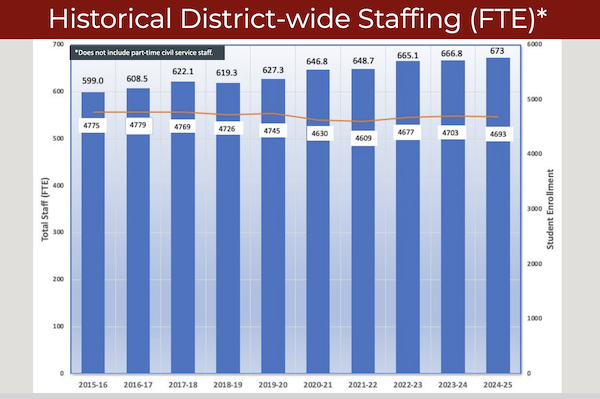 Headcout has climbed by 74 and enrollment has declined by 82 students in the last ten years.
Troy made clear that as an important part of the budget process, “We ask our principals and district leaders to think deeply about what they're requesting and what the impacts are both financially, and on other programs.” She went on to explain that the rationales for the proposals also involve many conversations with the administrative council and leaders and added, “Over the past several years, we've organized our proposals in a three tiered system to help identify the level of importance of the request and its match to our guiding principles. So our Tier One recommendations are strongly aligned to our guiding principles and therefore have our full endorsement as necessary to deliver the program we envision for our students and our necessities for the effective operation of our schools.”
Troy then detailed the Tier 1 staffing recommendations for the 2025-26 school year which include a 1.0 Special Education Teachers at SMS, a 1.0 Special Education Teachers at SHS, and a HS Math .5 FTE. The rationale for these recommendations can be found in the following slides: 32, 33, 34.
Assistant Superintendent Eric Rauschenbach is proposing to expand the Special Education Program in the middle school and high school. If approved by the board, in the middle school there would be a new 8:1:2 class requiring an additional teacher, a teaching assistant and an aide to accommodate three students with significant and unique needs. At the high school, he is proposing an additional 12:1:1 class, requiring an additional teacher and an aide. This class will accommodate the needs of 4 or 5 students.
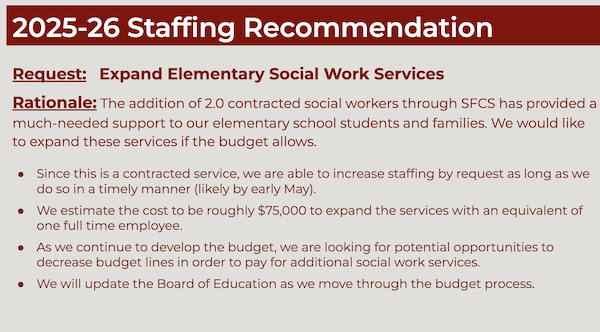
Troy went on to relate that there are two staffing recommendations that are not directly related to additional FTEs. The first, she explained, is changing a district math coordinator position to a probationary position from what is currently not a probationary position. The second looks at elementary social worker contracted positions and expanding them if the District finds additional financial opportunities. Rationale for these changes is highlighted slides 35 and 36 of the presentation which are included here:

Math Coordinator
Assistant Superintendent of Curriculum, Dr. Edgar McIntosh provided the rationale for the math coordinator position stating, “I’m very happy to provide rationale and advocacy to maintain the second elementary math coordinator position going forward. In the third year of our program and implementation using the Reveal Math resources, we found that the additional support provided by the second math coordinator effectively elevated adult learning and corresponding student growth. Robust math instructional coaching remains critical in order to responsively address the needs of our students and teachers during implementation. Beyond a successful rollout, ongoing cohesive and responsive professional development is crucial to ensuring content coverage and skill development while expanding mathematical practices, As well this current model will guarantee capacity to support new faculty in those reassigned to a new grade. Curricular adaptations are always essential to any program. Our coordinators have been skilled at facilitating both meaningful and collaborative supports and enrichments for Scarsdale students and have begun the important work of designing performance assessments. You'll be hearing more and more about performance assessments in the coming year as they challenge students to authentically demonstrate deep understanding.”
He went on to say, “Vertical articulation of methods and resources is a positive practice that can be particularly complex when bridging elementary and middle school levels. We plan to adjust one math coordinator's schedule to enable professional development with middle school math educators focusing specifically on sixth grade while continuing to support grades four and five. Having coaches with the depth of knowledge of both elementary and secondary practices will help facilitate the translation across the two levels, providing a smoother transition for students.”
Social Workers
In support of finding funding for additional elementary social workers, Assistant Superintendent for Special Education Eric Rauschenbach shared, “In looking at our elementary social work services we added two years ago, the addition of two contracted social workers through Scarsdale Edgemont Family Counseling has provided much needed and appreciated support to elementary school students and families. Our elementary administrators and psychologists have seen the tremendous impact these social workers have had in the support of our children and families. However, the challenge of only having two social workers across five buildings is obvious in that they're limited in their availability. We would like to expand these services if the budget allows. While this is a contracted service and does not actually fall under an FTE, if we are able to find offsetting finances within the budget, we would like to add an additional contracted social worker, which would be roughly $75,000 to increase the availability of social workers in our elementary schools.”
Budget Schedule
Dr. Patrick ended the presentation with a reminder that Budget Study Session number one will be held on Monday February 3rd and will focus on current year end projections and a first draft budget plan for next year. On March 3rd, Budget Study Session Two will discuss an update to the draft budget plan and a focus on instructions, special ed facilities, safety and security and technology. Then Budget Study Session Number Three on March 10 will focus on an update to the budget plan and a full budget presentation. March 24th the board will hold a Public Budget Forum and review and then on April 7th the Board will be asked to adopt the budget so that we can meet all of our statutory requirements before the May 20th budget vote.
Board Questions
After the presentation several Board Members asked a number of thoughtful questions to help clarify their understanding of the proposed recommendations. Among other questions, Board Member Leah Dembitzer asked, “Regarding the timeline, do you have any potential timing of when you would have a budget book in this process?” Andrew Lennon fielded this question and answered, “The majority of the information is populated after the Budget Study Session One so we can kind of correspond to where we are at that point in the process. So somewhere between Budget Study Session One and Two.”
After asking several questions, Ron Schulhof said he was surprised about the number of staffing requests and questioned how the community might respond to a request for more staffing additions given constant enrollment. Schulhof also questioned the administrators about space limitations and where these new classes would go.
Board members also asked Troy for information behind the projected enrollment increase of 80 students. She explained that the number was from the demographer but these projections are not done every year.
A robust discussion covered these topics and questions concerning making the second math coordinator a permanent position, how an additional Special Education FTE would be utilized at the high school, why high school students seem to be more drawn to courses like AT Statistics and so much more. Viewers can watch the discussion and the entire Budget Presentation here.
Reserves
During the Public Comment portion of the Board meeting that followed, Fox Meadow resident Claudine Gecel spoke to share her concerns about the District’s diminishing Reserve Fund reported on at a previous meeting. Referring to the scenario below, Gecel stated, “I am here because I heard that the budgeting process is starting to get off the rails. Money has been taken from reserves – we were in an emergency situation. In 2 years the fund balance looks like it will be halved – this is not a good trend. Referring to balancing a budget she said, “ As a fiduciary, you can’t consider a 2-legged stool. Using up the fund balance is not going in a good direction. NYS suggests a capital reserve and we don’t have one.”
After the Budget Presentation, the Board held a business meeting in which several noteworthy topics were discussed. A few of the highlights include:
Board Coffee
President Suzie Hahn invited the community to attend the next “Board Coffee” On February 11th at 7pm in Conference Room 170-172 at Scarsdale High School.
Friday Five
Dr. Patrick drew attention to the first edition of the new Friday Five, a communication piece that aims to share five things about our schools in a brief digestible format. Patrick related, “This may include upcoming events announcements or requests for community input or participation. We will also use this format to share good news about learning and teaching in Scarsdale. At the bottom of the message is a link to our public information address to share ideas, feedback or questions.” The Friday Five was emailed to parents via Parent Square.
After School Childcare
Patrick also explained that the District is currently conducting a survey regarding after school child care. He explained, “We've been studying the feasibility of opening our elementary schools to license child care providers in order to meet the growing demand for after school child care for our students in grades K through five.” He made clear that Scarsdale Schools would not be the provider of this care. It would be delivered by a licensed third party provider. He went on, “We know the data that we're collecting through this survey will help potential partners determine if offering a program is viable or not, so we have sent the survey out in time for a decision to be made for the start of the 2025 2026 school year. The survey closes this Friday and the results will be shared with those partners.”
Smartphone Ban
Another highlight included information about Governor Hochul’s proposal that would require all school districts to adopt a policy prohibiting the use of internet enabled devices by students on school grounds during the school day. Patrick explained that policies would be required to include one or more methods for onsite storage of a device during the day, but said that exemptions would be allowed, for example, if authorized for a specific educational purpose necessary for managing health condition, or where the device would be needed as a part of an individual education program or 504 plan. He also described the policy and funding discussions that have already been taking place at the administrative level and expects to have more information at the BOE meeting on March 3rd.
Academic Calendar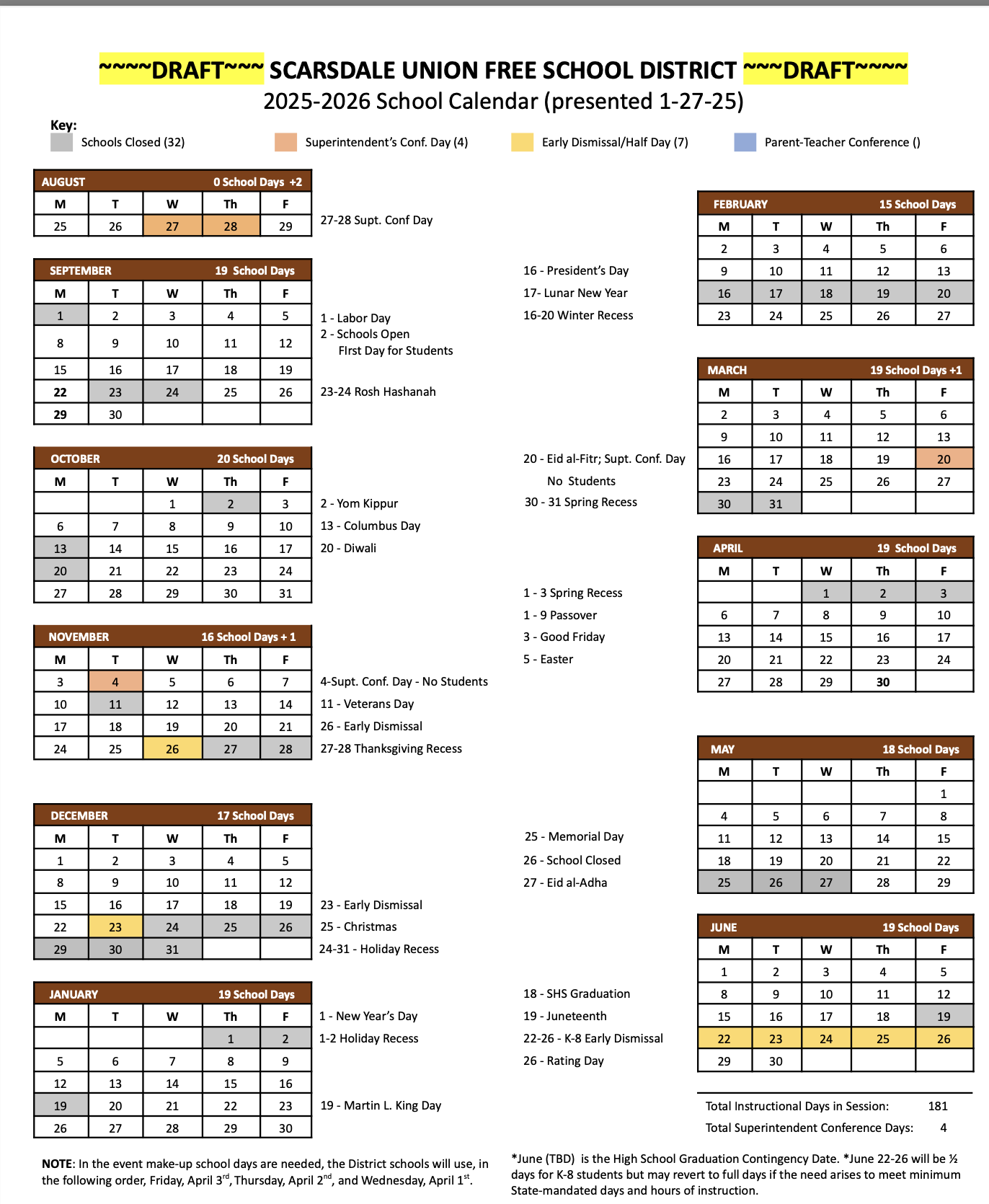
Dr. Patrick presented a brief overview of the draft 2025-26 calendar and said that the calendar is influenced by a number of factors and that they work hard to arrive at a calendar that represents the best solution to a complex problem. He also highlighted some of the changes made in recent years to include days off from school for our students and families who observe particular holidays. Some of these holidays include the Lunar or Chinese New Year, which Patrick mentioned, “In addition to being a locally determined school holiday, chapter 359 of the laws of 2023 established Asian lunar New Year as a New York State school holiday for students. Since the holiday fell on a Saturday last year, this is actually the first year it's being observed statewide as a school closure.”
The proposed calendar also includes a day off in observance of Eid al-Adha on Tuesday, May 27th, which makes Memorial Day weekend a five day break. You can see the proposed calendar here.
Watch the meeting in its entirety here.
Cell Phone Bans in Schools: Protecting Focus or Limiting Freedom?
- Details
- Written by: Lachlan Isaacs
- Hits: 3205
 Smartphones are not going away. Nonetheless, at a joint presentation from Scarsdale High School (SHS) and Scarsdale Middle School (SMS) on November 20, 2024, titled “Phone Smart: How Can We Support Our Youth in the Smartphone Era?” – suggested that Scarsdale students can benefit from a “bell to bell” phone ban.
The evening panel discussion, with an introduction by Scarsdale Schools Superintendent Drew Patrick, highlighted the impact smartphones and social media have in our classrooms. Patrick noted that “living” with technology and smartphone use would need to be a partnership between teachers, students, and parents. He presented a short video taken at a conference this summer addressing this issue with New York Governor Kathy Hochul, various New York State teacher organization representatives, and students from across the state who offered views on the harms and benefits of smartphones.
Patrick referred to the US Surgeon General’s claim that 95% of 13-17 year olds report using social media, and the understanding that kids are constantly dinged and buzzed throughout the day, making them more eager to take a peek at the small screens.
What are other districts doing?
New York is poised to join states and school districts across the U.S. that are trying to ban cell phone use in the classroom, but this action has been postponed until at least January 2025. As head of the nation’s largest public school district, New York City Public Schools Chancellor David Banks favors a ban. The Los Angeles Unified School District (LAUSD), the nation’s second-largest, has already initiated restrictions on phones in schools. California Governor Gavin Newsom has signed legislation giving the state’s school districts until July 1, 2026 to start restricting cell phone use during school hours. While deliberations grind on in New York, Governor Hochul is encouraging individual school districts to implement their own cell phone policies.
What’s the policy in Scarsdale?
Currently there is an “Off and Away For The Day” school policy in Scarsdale. For elementary school, children's phones and smart watches ideally should not be brought to school at all. Even in exceptional cases, they should be turned off and put away in backpacks. At Scarsdale Middle School, smart watches do not need to be put away, but phones are left off and away in lockers. At the high school, students entering class place their devices in the phone caddy at the door to be picked up on their way out at the end of the period.
What’s the controversy?
The debate on cell phones in schools boils down to tension between educational, social-emotional, and safety concerns. Proponents of restricting phone use argue that the devices can be a major distraction in class, hindering focus and academic performance. Social media, texting, and gaming draw students’ attention away from lessons and reduce social interaction in person, potentially affecting their social skills and cognitive development.
As reported in Politico, a 2024 poll by the National Parents Union revealed that parents nationwide remain deeply divided on the issue. Many fear that in an era of school shootings, banning phones removes their children’s first line of defense for communication and support in a catastrophe – not to mention the convenience that phones provide for contact between students and their busy working parents during the school day. Some also argue that smartphones should be part of the curriculum - learning tools that can be integrated in classrooms for access to unlimited information.
At the local, state, and national level, politicians and experts are wading through the controversy on phones in schools. While the Senate Health, Education and Labor committee is backing an Education Department study of various school districts’ cell phone policies, The Anxious Generation by New York University social psychologist Jonathan Haidt has raised the collective consciousness about the pervasive societal and psychological implications of phone use on children and youth at a time when social media companies have been under fire for their impacts on young minds.
What do Scarsdale students and parents think?
Some students defend phones as essential learning tools: Blake Feinberg, a SHS senior, says he uses his phone for research “way more than I use my computer, depending on the topic. To me, the phone is easier to navigate and organize, and that is why I write my homework for the day, my to-do lists etc. on my phone.”
Other students, including senior Lorenzo Galeano, note that strict phone policies infringe on students’ rights. “To be frank,” he says, “I don’t think it is fair for a teacher, principal, or whoever to take my phone away as it is my private property. It reminds me of my parents punishing me by taking my car away or grounding me at home. I understand the problems with having our phones stowed away in our pockets, but we should be able to keep them in our backpacks and not the phone caddies.”
James Roth, a Scarsdale resident with three children, offers another perspective: “Smartphones offer zero value in the classroom and actively harm a student’s ability to focus, retain knowledge, and engage with their studies,” he told me in an interview. “The current policy, which allows students to keep their phones with them under limited restrictions, invites constant distractions and undermines the purpose of education. We owe our children more—they, like adults, cannot resist the pull of these devices, which are designed to demand attention.”
Roth advocates a school-wide policy that separates students from phones throughout the day, with no exceptions. “Frankly, we need to do more than this across the entire school system, not just at the high school, but this is an important and necessary first step. Only by creating a distraction-free environment for all students can we ensure equity, focus, richer social relationship building and a commitment to learning as the foundation of their school experience.”
Some students agree with Roth about the benefits of phone detox. Sophie Kushnick, a SHS senior, admits that during her first two years of high school, she was “very distracted in class because my phone, like always of course, vibrates to every notification. Remember though, this was before our school’s off and away policy. Then in my junior year, when the caddies were introduced, I felt a whole new level of focus and undivided attention in class, and in turn, my grades went up.”
Scarsdale High School English teacher Jennifer Rosensweig helps to lead the Scarsdale district on the current school policies on smartphone use. At the November meeting, she invited a panel of SMS and SHS students and faculty to discuss their opinions on smartphones and social media and their effects in the school setting. Rosensweig insisted that, based on her experiences and observations as a teacher at SHS and the many studies she has researched over the years, technology has a negative impact on students.
She explained that, in 2015, she started noticing a drop off in reading ability, which led her to investigate data on screen time’s effect on the adolescent mind. Since then, she has undertaken “a long journey of research.” She states that “the research is so strong, we can’t look away.” She referred to her personal experience with more than 1,500 students, in whom she has seen a difference in concentration, sleep habits, and even an increase in anxiety. Students are now starting to ask for help with this issue, she said.
As a member of the SHS Wellness Committee, which implemented the start of the phone caddy systems last year, she has received reports from teachers that the program has given them back their classrooms. Rosensweig said phone caddies “make a difference but not enough.” She added that it is not realistic to eliminate smartphones altogether, but that each student needs seven hours a day without pings and buzzes demanding their attention.
As Drew Patrick questioned student and teacher panelists on their personal smartphone use, it became clear that few support smartphone access during the school day. One student commented that a “phone cleanse makes my day better. I can think better and just do more.” Another concurred that “without the phone, it felt mentally refreshing. I can enjoy my classes, clear my mind during the day and have great conversations at lunch with my friends.” One student admitted that she “goes straight on it after class in the hallway and is on it the whole walk to my next class. I don’t even look up.”
Rosensweig inserted that, in her research, she found that students “need down time between classes to absorb the information just taught, and if they look at a screen, that information is immediately lost”.
At one point a student exclaimed that smartphone use “is an addiction. I get a craving to be on it.” Having phones in the phone caddies this past year and a half, teachers have seen some real progress. In fact, one teacher commented that there has been “an enormous reduction in bathroom trips and they are far quicker.” Rosensweig also cautions us to be wary of “hyperbolic language for the threat of an emergency when students feel obliged to answer texts from parents.” She added that ipads and laptops also have social media messaging.
A math teacher commented that in her class, she doesn’t really need technology except to submit scanned homework (which takes at most a minute). However, she does notice that when she returns tests at the end of class, there is a mad student dash to retrieve their phones. She informs her students they don’t need to use their phones to calculate their grade percentages! There was definitely a chuckle or two from the audience here, but her story relates to Rosensweig’s comment that this is “not a children’s problem to solve.”
Recognizing this, the district's Technology Department has been working very hard to figure out a balance between the technology smartphones use in the school and how teachers should use it in the classroom.|
As a final question, an attendee asked the panelists: “If you could change something, why and what would you do?” Overwhelmingly the panel asked for a “more unified effort to keep phones off and away.” Rosensweig’s closing words expressed her gratitude to be at this event. Though she would like to see more progress, she believes we have come a long way already. She is glad that the community is talking more honestly about phones in school, and reiterated that kids deserve a more communicative and cooperative learning experience.
Patrick closed the evening discussion with information on the Bell to Bell without phones program implemented in the Bethlehem Central School District. There, phones brought to school are placed in pouches that are sealed up as students enter school. The pouches demagnetize the phones. As the students leave for the day, they unlock the pouches at exit stations to retrieve phone service. The pouches sparked improvements in student connectedness. Patrick sees the smartphone policy as a partnership between the schools and parents. “We can’t do this alone,” he stated. “There is not a big solution” at the moment but he is hopeful for “a discussion for future dialog.”
He directed parents who would like help to use The Scarsdale Family Forum, designed and supported by the District’s Technology Department to help parents, teachers and administrators start discussions on challenging issues.
Lachlan Isaacs is a senior at Scarsdale High School. He has witnessed first-hand the effects of cell phone usage in school. He rowed for 5 years before getting injured and channeled the time spent on the water to the page. He also reports on sports for the SHS Maroon magazine and is passionate about sports and traveling.