







Should the Westchester Ethical Cultural Society be Preserved?
- Sunday, 19 October 2025 17:31
- Last Updated: Monday, 16 March 2026 17:45
- Published: Sunday, 19 October 2025 17:31
- Joanne Wallenstein
- Hits: 2492
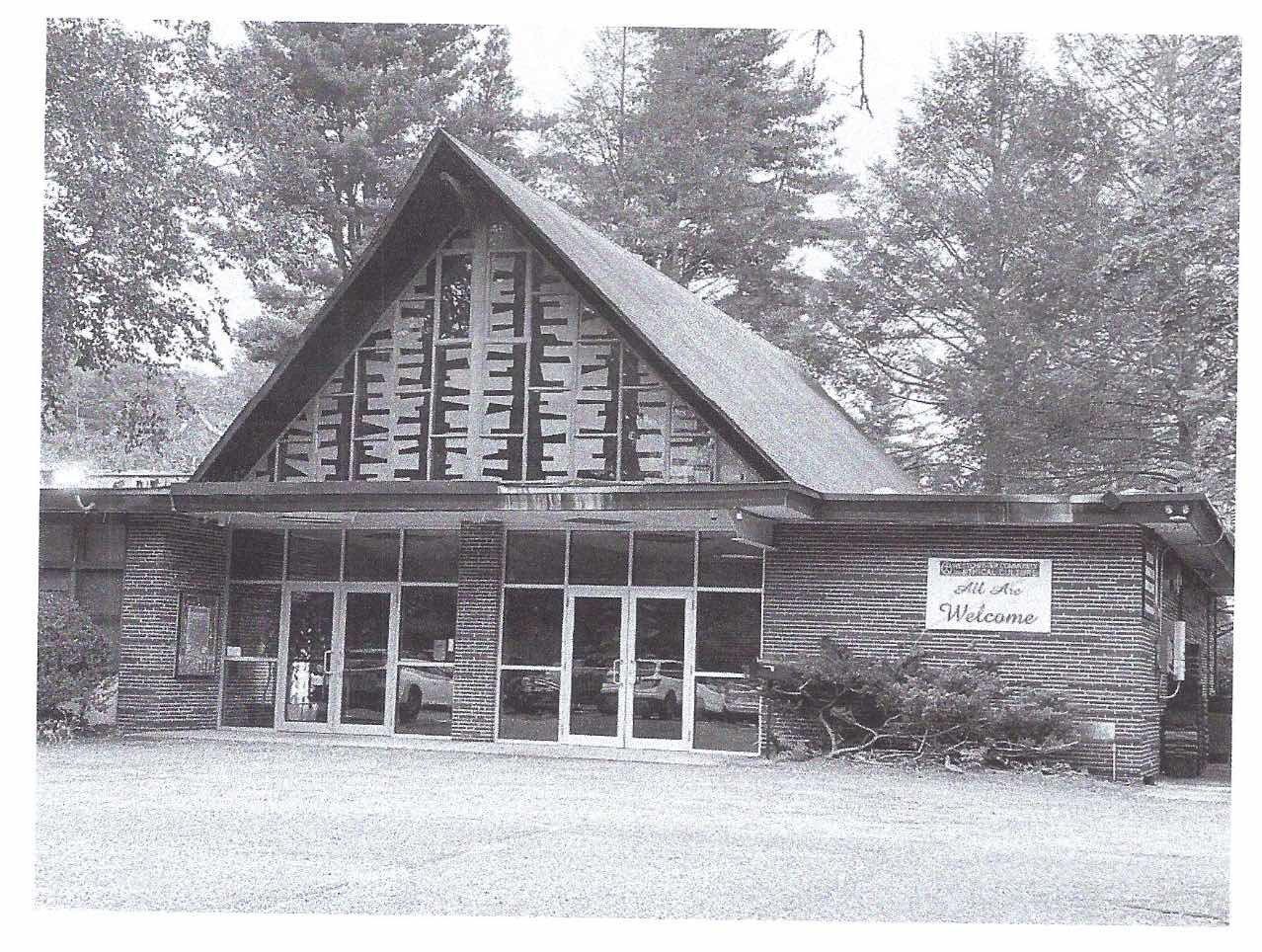 Westchester Ethical Cultural Society: Photo Credit: Andrew Dolkart
(Update: At their October 21, 2025 meeting, the Committee for Historic Preservation approved the application to tear down the Ethical Cultural Society)
Though I often drive by the A-frame structure on Saxon Wood Road, I did not realize it was primarily sited in Scarsdale, though it sits next to the Saxon Woods Pool. I did a bit of digging and found that though the entrance to the Westchester Ethical Cultural Society is from White Plains, the property is within the borders of Scarsdale and is now adjacent to the Ambassador Senior Living Center. And the Saxon Woods Pool, which opened in 1958 also sits on land owned by Scarsdale.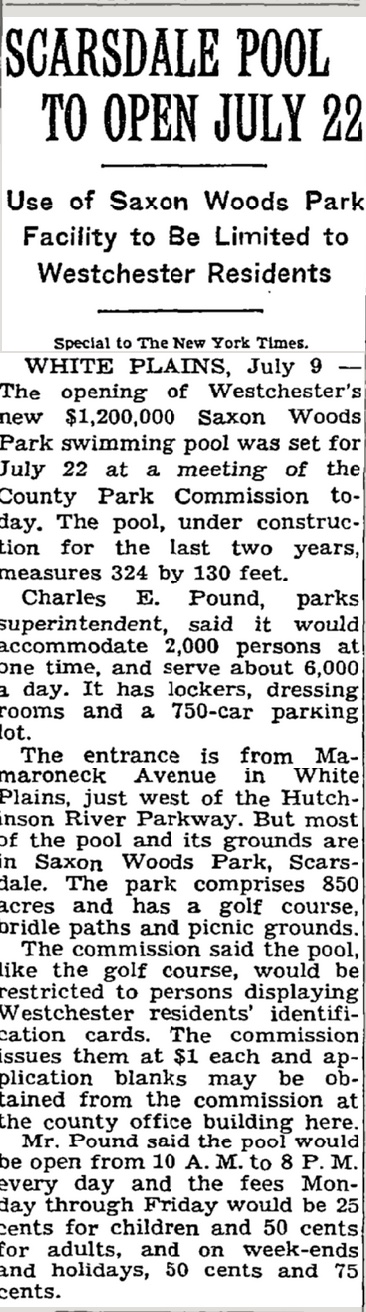 A 1958 clipping announcing the opening of Saxon Woods Pool.
Now the fate of the structure, built in 1963, hangs in the balance as an application has been filed by Sunrise Senior Living to raze the building and construct a 110 room senior leaving facility in its place.
The Committee for Historic Preservation considered the applicatiaon at their Spetember 16, 2025 meeting and requested the opinion of expert Andrew Dolkart on whether or not it merits preservation.
Below find Dolkart’s history of the building and the movement and his suggestion that the A-Frame portion of the building be incorporated into the structure of the senior living facility. Read below for some interesting local history:
(From Dolkart)
Westchester Ethical Culture Society, 7 Saxon Wood Road, Scarsdale: Preservation Assessment
As part of my contract with the Village of Scarsdale to review buildings for which a demolition permit has been requested and which may meet the criteria for historic status under the laws of the Village, I visited the Westchester Ethical Culture Society Building at 7 Saxon Woods Road in September 2025. I have also undertaken research on the buildings at the site, including an examination of the limited number of drawings in the Village records.
The site on which the Ethical Culture Society Building stands is located on a large plot of land at the eastern edge of the Village of Scarsdale, surrounded on three sides by Scarsdale's Saxon Woods Park. The site is accessible only via Saxon Woods Road in White Plains. The site consists of the Ethical Culture Society's A-frame auditorium, a long, one-story education wing connected to the auditorium, and a freestanding cottage. Construction of the Ethical Culture Society' auditorium and school wing took place in 1962-63 to the design of architect Harry Wenning. The cottage pre-dates this construction, but it was redesigned by Wenning.
The Ethical Culture Society was founded in New York in 1877 by Felix Adler. Adler, the son of the rabbi of Temple Emanu-El, was studying to become a rabbi himself, but became increasingly interested in ethical concerns that were not deist centered. He believed that individuals could lead a just life by following a code of ethics and that these ethical concerns could help improve the world. Adler's new organization focused on morality, social reform, and education. He preached "deed over creed." The Ethical Culture Society never had a large number of adherents, but it was influential in teaching ethics and in educational reform. In its early years, the Society was centered in large cities, but after World War I it grew in suburbs such as Westchester. It was a significant alternative to religious organizations, but like these religious organizations, it sponsored Sunday schools and other educational endeavors that taught ethics to children.
The Ethical Culture Society's building in Scarsdale was a significant part of the suburban development of the organization, consisting of an auditorium that seated 250 people and a school wing with twelve classrooms that could be combined into a single space when needed.
The Ethical Culture Society's building was designed by architect Harry Wenning. Wenning was born in Elizabeth, New Jersey in 1928 and educated as an undergraduate at William and Mary College and then studied architecture at MIT. After serving in the army, he established his architectural practice in Westchester, working primarily in the lower Hudson Valley, in Westchester, Putnam, and lower Dutchess counties. He designed a variety of buildings, including Modern houses, apartments, a garage, and the Ethical Culture building. His works were published in several newspapers and magazines, including articles in Popular Science, and an article about an all-electric house that was syndicated nationwide in newspapers. Several of his works are featured in the New York Times. He was a member of the American Institute of Architects, and its 1970 Yearbook notes his office in Hastings-on-Hudson and home in Fishkill. In the listing of his principal works (submitted by Wenning), the Westchester Ethical Culture Society is 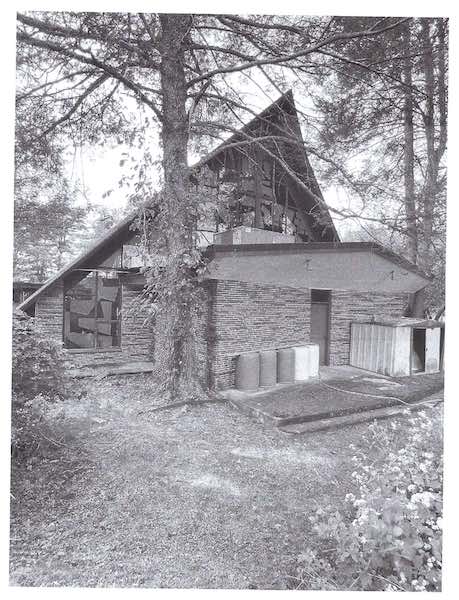 The rear facade: Photo Credit Andrew Dolkartthe first work listed, indicating the importance that Wenning placed on this design.'
The Ethical Culture Society's auditorium is an A-frame structure that was both stylish in the early 1960s and economical to build. This stylish modern character and the economy of building explain why A-frames were especially popular for religious structures (although the Ethical Culture Society was not a religious organization, it did hold meetings in the same way that churches and synagogues held religious services).
According to the architectural historian Gretchen Buggeln, an expert on A-frame design, the form was popular across the country, but especially in the Midwest in the decades following World War II.? The form was far less common in the northeast. The form is distinguished by a rigid triangular frame with a steeply pitched roof and, generally, has substantial windows at the front and the rear. According to Buggeln, the form "emerged out of a matrix of national and international historical and vernacular influences, economic necessity, and contemporary design." The form was modern, without being radical, served the needs of congregational meetings, and could be constructed in a cost-effective manner.
Cost was especially important for the Ethical Culture Society, which did not have a significant budget for its new building. The first two architects that the society met with presented proposals that were too expensive. Members of the society then spoke ot Hary Wenning who proposed the economical A-frame. When contractor bids were too high, Wenning suggested that the Society act as the general contractor and he worked with them to keep costs down.* One way to erect an economical A-frame was construction using glulam, a laminated timber product that was quite strong structurally. Glulam became popular in America after World War II. Construction was begun on the auditorium and school wing in 1962, and it was completed a year later.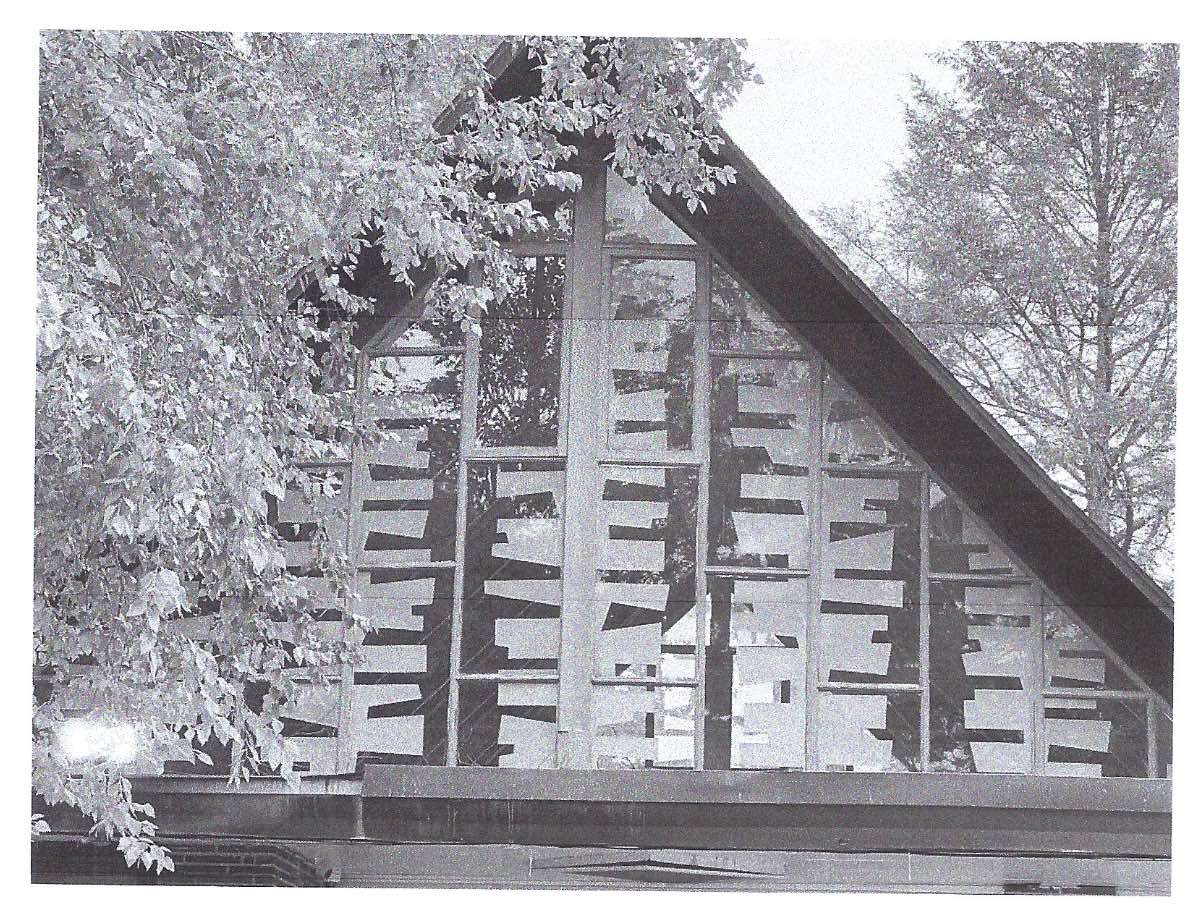 Ornamental glass: Photo Credit: Andrew Dolkart
Wenning designed an unusual building within the format of the A-frame. The front of the building, marking the location of the lobby and offices, is constructed of an unusual red brick. The bricks chosen were probably manufactured by the Belden Brick Company and were known as "tex-shadow" bricks (texture providing shadows). These are long and thin Roman bricks with a raised central horizontal band on each brick that has a rough texture. Some of the bricks project slightly. The texture and projections provide interesting overall texture to the lower facade. This front pavilion also includes the entrances, wide glass openings separated by a brick pier and capped by a canopy. The original entrance doors have been replaced.
The A-frame rises behind the entrance pavilion. On the front and rear facades, the large triangular window expanse is separated into two sections by a central vertical support. The glass is then divided by muntins into irregular rectangular shapes. These are filled with an unusual ornamental glass, with abstract patterns probably created by sandblasting. At the rear elevation, one section has a large star or sunburst. The glass echoes contemporaneous abstract art and is an especially notable feature of the building. One panel is missing on the front elevation. In an email Gretchen Bugge notes that she has never seen this type of blasted glass on an A-frame. At the side and rear elevations, the A-frame meets the ground in an unusual tent-like arrangement, not typical of A-frame construction. The tapering "buttresses" of the A-frame are anchored at ground level by concrete bases cast with a rough aggregate. This permits light to enter interior spaces.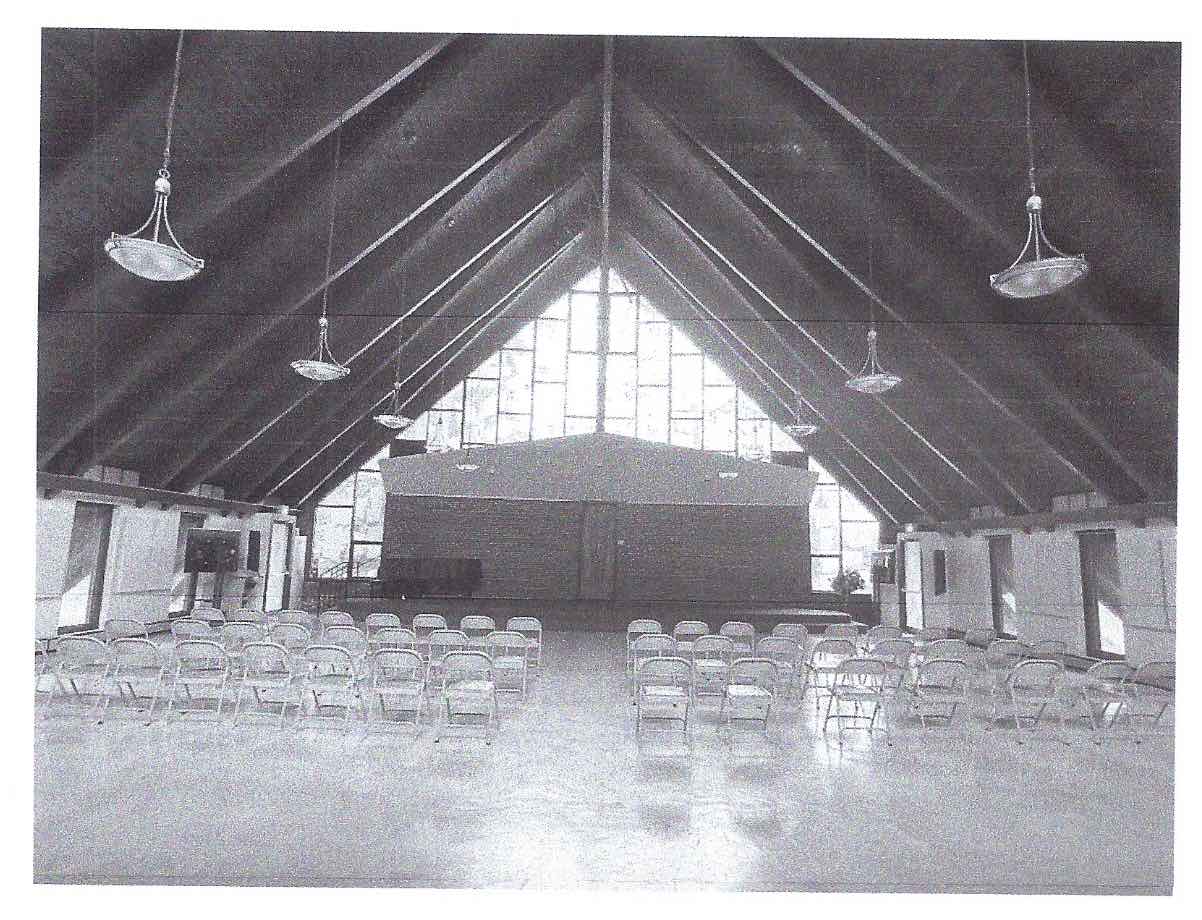 The Auditorium: Photo Credit Andrew DolkartThe interior of the auditorium is a large open space that is extremely flexible as befits the requirements of the Ethical Culture Society for a space to hold meetings and community events. The New York Times likened the interior to a concert hall. The glass is especially striking from the interior, linking the members to nature outside. Another interesting feature of the interior is the rear with the speaker's platform which includes a wall of the same brick used on the exterior and a central door with a beautifully carved tree design. The door leads out to an outdoor stage where the group could hold outdoor meetings (the land to the north has been sold and is now senior housing)
On the exterior, to the left of the entrance is an office with a row of windows. The office is separated from the school wing by an area of brick. The school is largely glass, with stucco panels below the windows and brick piers. The design is not significant although the use was important to an organization that stressed youth education and instilling ethical values in young people. The site also includes a cottage that predates the construction of the Ethical Culture Society's building but was redesigned with irregular ashlar stone facades by Wenning at the same time as the designed the main building. This cottage is not of major significance.
The current proposal calls for the demolition of all of the buildings on the site and their replacement with senior housing. I believe that the auditorium building meets the criteria for preservation and should be considered for preservation. I do not believe that the school wing or the cottage need to be preserved. The major criteria on which t h e conclusion for preservation rests is that the building "embodies distinctive characteristics of a type, period or method of construction that possesses high artistic value." The building si a significant example of A-frame construction, a type of construction that is relatively rare in the northeast as compared with the Midwest and far west. It has a number of significant material and artistic features, including the unusual brickwork, the sandblasted brick, and the carved door, as well as the beautiful sense of space and light on the interior. For a building to be significant, it does not need to be the first of its kind or a pioneering example. The fact that the Ethical Culture Society's building was erected a decade after the form first became popular and that it is not an early use of glulam in no way takes away from its place as a distinctive work of local significance.
The Ethical Culture Society site is quite large. With some creativity, I think that the senior housing could be pushed back on the lot, permitting the preservation of the auditorium and its conversion into a handsome, light-filled community space for residents of the new housing complex. There is extensive land to the rear of the plot, between the auditorium and Saxon Woods Park, as well as a large parking lot to the south.
Although I hope that this building can be preserved and I believe that it meets the criteria for preservation as set out by the Village of Scarsdale, if the Village Board opts not permit demolition, I hope that the Board will require that the building be documented to HABS (Historic American Buildings Survey) standards and the photographs be deposited in local depositories, such as the Scarsdale Public Library, the White Plains Public Library, and/or the Westchester Historical Society, where they will be available to future researchers.
Andrew Scott Dolkart October 2025