








Scarsdale Lawyer Calls for Immigration Reform
- Thursday, 19 November 2026 12:55
- Last Updated: Thursday, 19 November 2026 13:52
- Published: Thursday, 19 November 2026 12:55
- Marc Bussanich
- Hits: 113
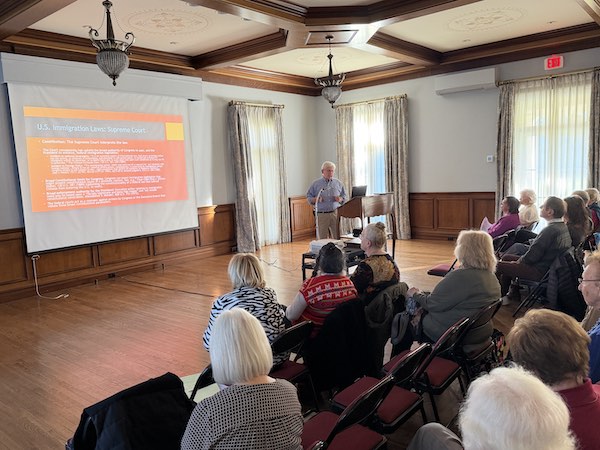 Robert Groban spoke at the Scarsdale Woman's Club on November 18.A Scarsdale resident through and through, the venerable lawyer, Robert Groban, came to the Scarsdale Woman’s Club on November 18, 2026 to inform the citizenry why it is important for Congress to enact new immigration reform legislation while also providing his own observations of the failings of the current federal administration’s objectives to enforce current immigration policies.
Mr. Groban, a graduate of Scarsdale High School, spent decades in the immigration law filed, eventually becoming a partner at a leading national immigration law firm. Now retired, Groban was asked before his lecture why the issue of immigration and its enforcement should matter to Scarsdale residents. His response was matter-of-fact: Scarsdale doesn't exist in a vacuum.
“The people in Scarsdale are citizens of the state. They’re citizens of the county, citizens of the country. They vote,” said Groban.
While Gorban is in favor of the efforts the current federal administration of President Trump has done to restrict the flow of illegal entries into the United States along its southern border, he bemoaned how the current tactics being deployed the administration, namely the stops and arrests of foreign nationals by the U.S. Immigration and Customs Enforcement is causing, to say the least, social disharmony.
“The mass arrests of ordinary foreign nationals is causing preventable economic, social and political problems, undercutting our social security system, and making us far less safe, and doing great damage to our system of justice,” Groban said.
Groban stated the nearly one-hour discussion with an explanation of what are the immigration laws of the United States, noting that they are the laws, regulations, guidelines and procedures that govern the admission and/or expulsion of foreign nationals from the United States.
The current guiding governing statute for immigration law, dating back to 1952, is the Immigration and Nationality Act.
“Life has changed; the statute, by and large, has not,’ Groban noted.
He explained an essential tenet of the statute defines immigrants who are permitted to arrive and become permanent residents of the U.S.
It also defines which foreign nationals can arrive in the U.S. as employees sponsored by their employers via the H-1B visa, a temporary U.S. work visa that lets employers hire foreign workers for specialty occupations requiring specialized knowledge.
Groban would say towards the end of his lecture that the restriction of foreign workers could weaken American economic competitiveness in a growing multi-polar world whereby other blocs of countries are asserting their economic competitiveness.
“The [Trump] administration is undermining the U.S.’s ability to attract young scientists and seriously threatens the American dominance in research and innovation. This is a major competitive problem, and with an ageing population it is going to increase,” Groban said.
Groban emphasized that the U.S. Constitution imbues Congress with the authority to enact immigration reform and for the U.S. president to enforce it. And the Supreme Court has upheld that tenet for decades.
“Historically, the court has upheld the broad authority of Congress to pass and the president to enforce immigration legislation,” noted Groban.
But the big issue, pertaining to the 1952 Immigration and Nationality Act, is that that statute is being interpreted differently by the Trump administration, which Groban says is a sea change from prior administrations.
“What’s different than any other administration is that they have taken radical interpretations of the law to try and arrest and detain as many people who are not here legally as they possibly can, irrespective of a criminal background,” he said.
This “interpretation” is the cause of all the controversial enforcement activities that have rocked the country for the past nearly two years, leading to an overwhelm within the court system.
According to Groban, there have been over 93,000 immigration-related cases filed in federal courts, and it’s forcing the U.S. Department of Justice to divert critical law enforcement resources just to defend them.
Groban penned an article more than six years ago, imploring Congress, not the courts, pursue immigration reform. Along the way, Congress will have to answer some tough questions.
“Immigration laws reflect difficult policy questions. Who should be allowed to come here? Under what conditions and for how long? What levels of enforcement are necessary to promote what is clearly a compelling national interest in immigration,” noted Groban.
Marc Bussanich is a New Rochelle-based freelance journalist and video producer with experience covering local news, community events, and public affairs. He is the founder of MarcB IT, which provides technology support and video production services throughout Westchester County. Learn more about Marc here.