






Authorities Seize Illegal Products at Smoke Shops
- Details
- Written by: Joanne Wallenstein
- Hits: 3168
 Though the sale of marijuana has been legalized in New York State, it’s still illegal to sell or display many tobacco products and smoking paraphernalia in Greenburgh. In addition these products cannot be sold within 750 feet of a school with students below the age of 21 or a public park.
These laws caused the closure of Scarsdale Convenience Store at 455 S. Central Avenue when members of the Greenburgh Drug and Alcohol Task Force along with the New York State Office of Cannabis Management (OCM), White Plains Police Department Intel Unit, and the Town of Greenburgh Building Department conducted multiple inspections of smoke shops on April 24, 2023.
Here’s what they found at the store:
-Approximately 676 tetrahydrocannabinol (THC) products, which the store was not licensed to sell.
-Approximately 395 packs of untaxed cigarettes.
-1 package of psilocybin infused candy.
Additionally, the Town of Greenburgh Building Department issued approximately 84 building code violations resulting in the store being temporarily closed until further notice. Due to the serious nature of the Building Department code violations, Con Edison was contacted and all power to the business was shut off.
The group also issued building code violations resulting in the temporary closure of other smoke/vape shop locations including 205 East Hartsdale Avenue (Hartsdale Tobacco), 760 S. Central Avenue (Cloud House Convenience), and 1088 S. Central Avenue (#1 Convenience and Tobacco). Additional summonses were also issued at three other locations (74 S. Central Avenue, 610 S. Central Avenue, and 1000 S. Central Avenue) for tobacco-related violations.
Scarsdale in Bloom
- Details
- Written by: Joanne Wallenstein
- Hits: 3360
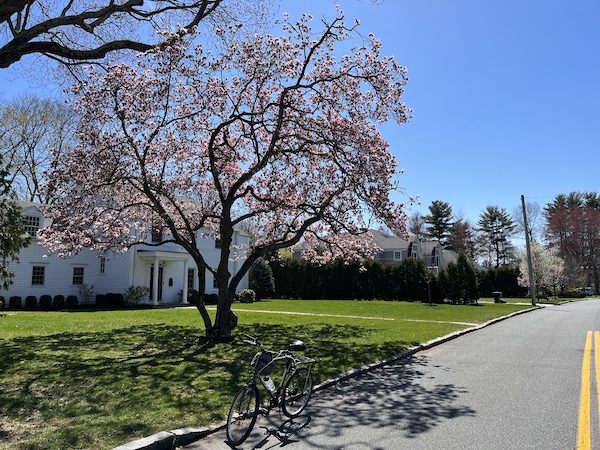 Spring has finally sprung - and magnolias, cherry blossom and forsythia are in bloom. Scarsdale looks dazzling this time of year and as you walk, bike or drive around town you're sure to notice the colorful display.
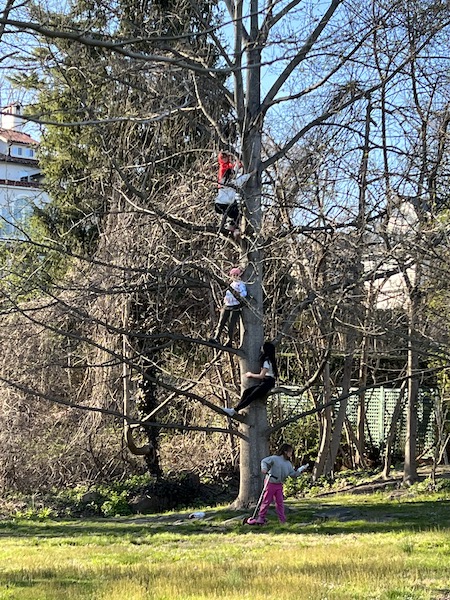
Here are photos of some beautiful trees, the first four from former Scarsdale Mayor Jon Mark and the balance from yours truly. Kids were clearly happy with the warmer temperatures too. Check out the bottom photo of a bunch of enthusiastic climbers in a tree on Brite Avenue.
Share your photos of springtime in Scarsdale. Email us at [email protected] and we'll publish your pictures on Scarsdale10583.com.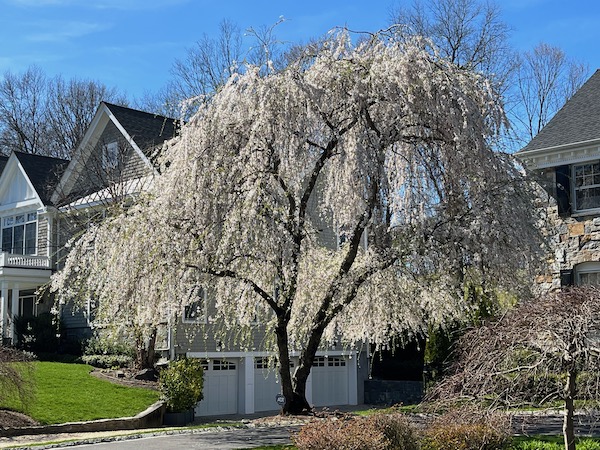
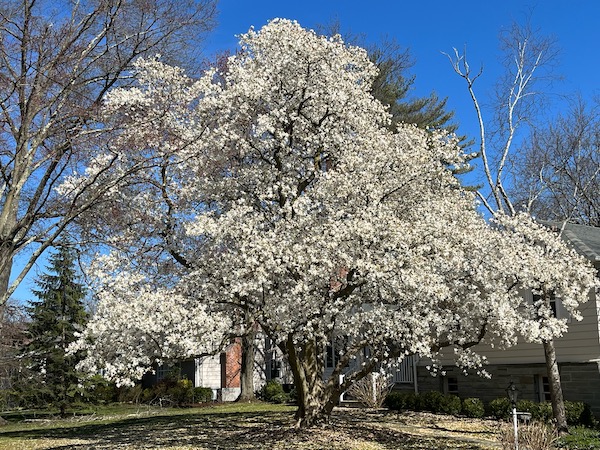
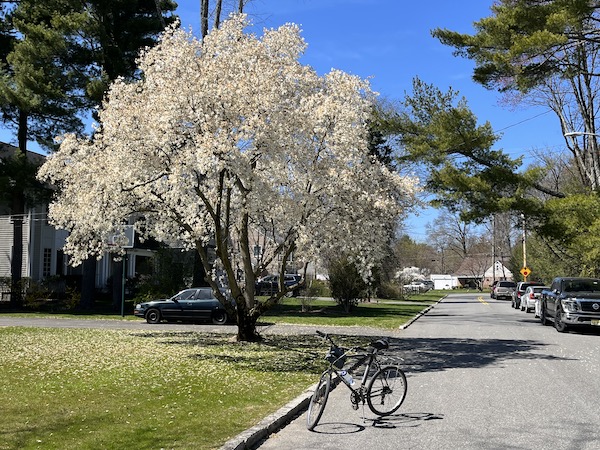
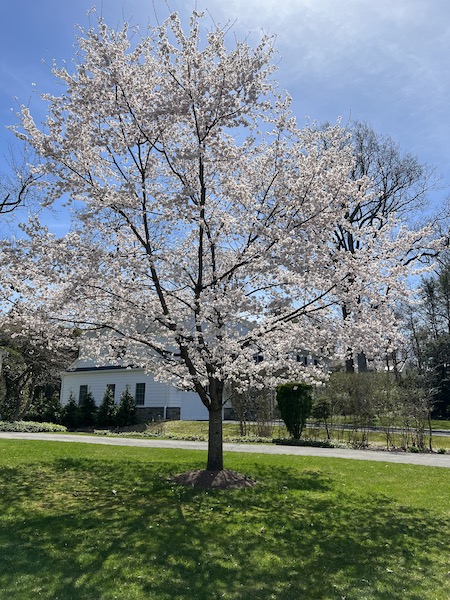
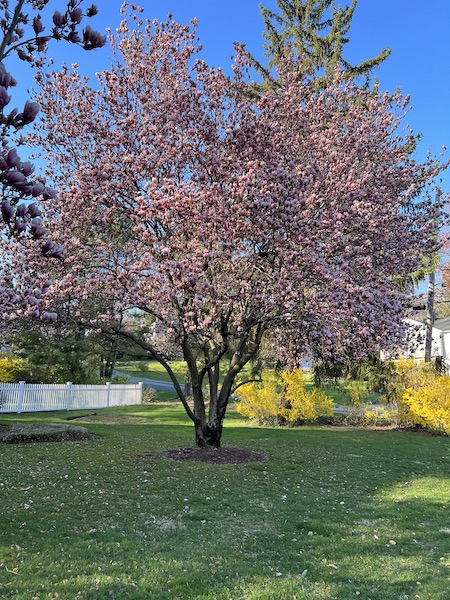
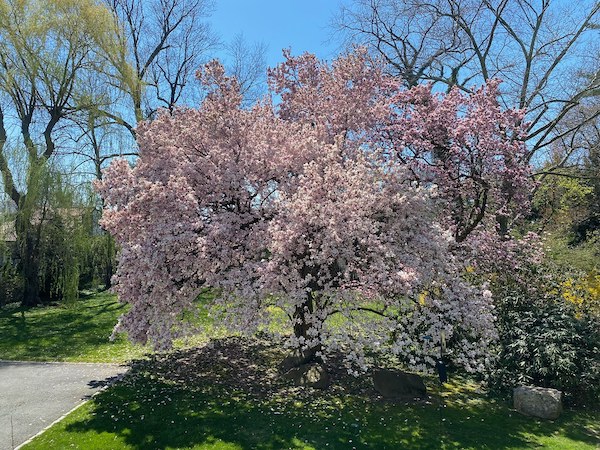 Magnolia on Fenimore Road by Allyn Dunn
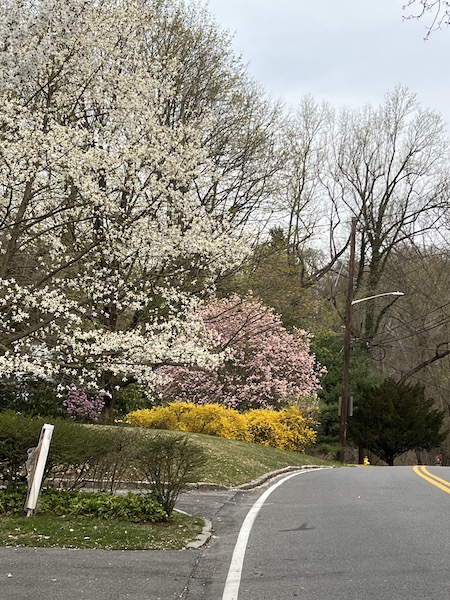
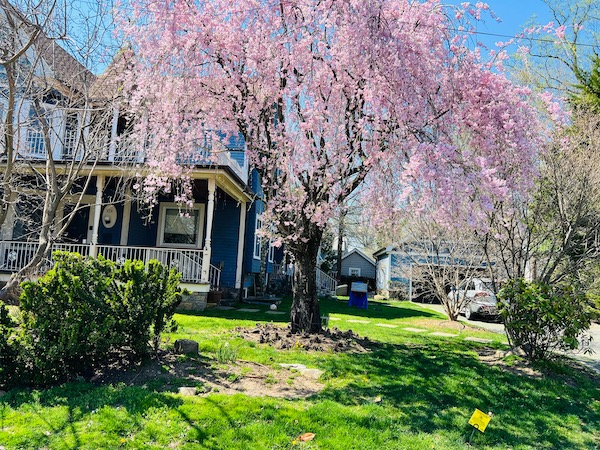 Nelson Road by Mark Mathias
New Leaders Sworn in at Scarsdale Village Hall
- Details
- Written by: Joanne Wallenstein
- Hits: 2737
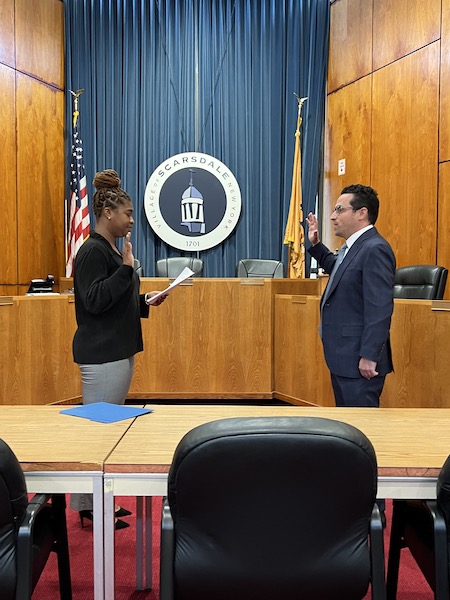
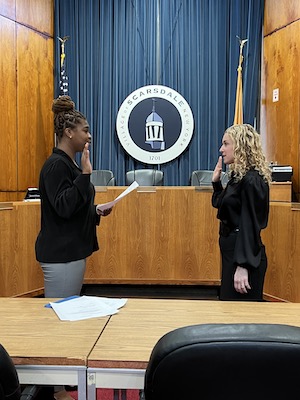
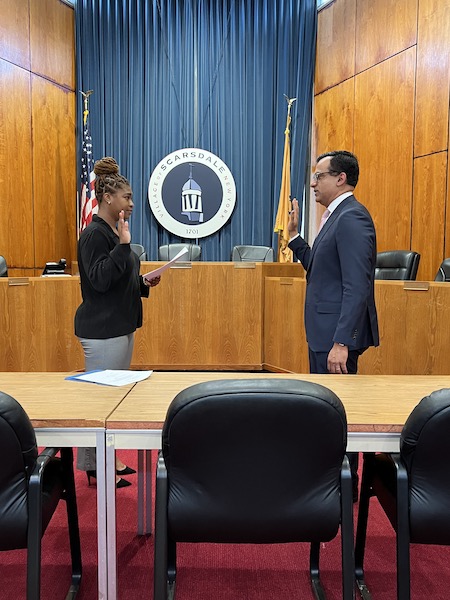
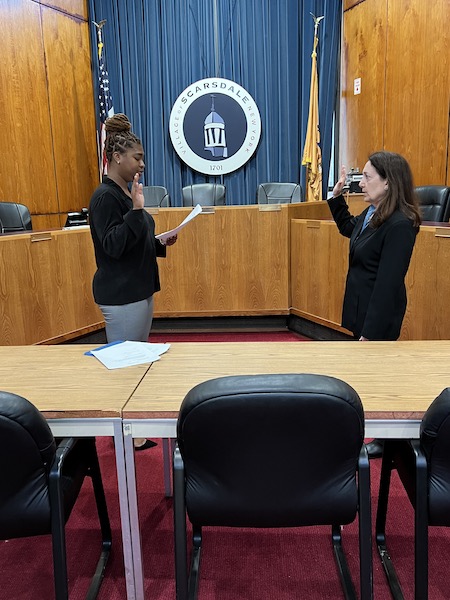
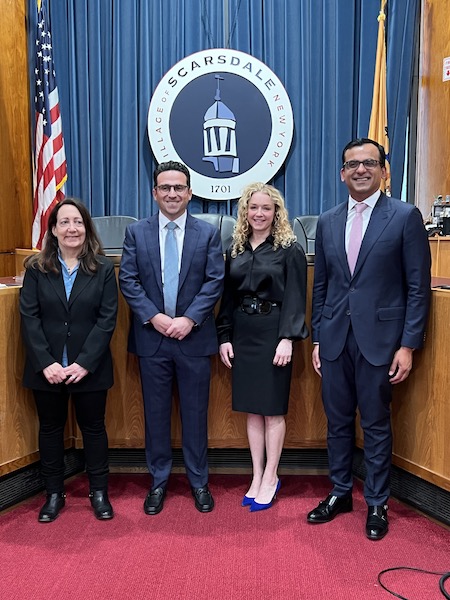 Scarsdale’s newest leaders were ushered into office at Village Hall at noon on Monday April 3, 2023. Three trustees and the Mayor were sworn in by Village Clerk Taylor Emanuel, surrounded by their families, parents, friends, Village staff and volunteers.
The group ran in an uncontested election and the transition from one Village Board to the next was calm and celebratory. All four of the newly elected group have extensive resumes of volunteer service to the Village and are well known around town.
Village Manager Rob Cole opened the ceremony by thanking these volunteers who, he reminded the group, spend countless hours working for the benefit of residents, without pay.
Sworn in were:
Mayor Justin Arest: A former two term trustee, Arest received the nomination of the Citizens’ Nominating Committee after completing his four years in Village Hall in March 2022. Well versed in the issues before the Board he appeared poised to hit the ground running.
Trustees Sameer Ahuja and Karen Brew were re-nominated to serve additional two-year terms, having completed their first two year terms this month. They have both been active and engaged members of the Village Board and were enthusiastic about continuing to serve.
Newly minted Trustee Dara Gruenberg has already put in years of service to the Village. As the Co-Chair of the Scarsdale Library’s Capital Campaign she played a pivotal role in raising the funds and planning the extensive renovation and expansion of the Scarsdale Library. She has also served on the Advisory Council on Communication, on the Foundation of White Plains Hospital and as Vice President of Westchester Reform Temple. With years of experience on many Village committees she has in-depth knowledge of how the Village is run and is familiar with many of the challenges Scarsdale will face over the next two years.
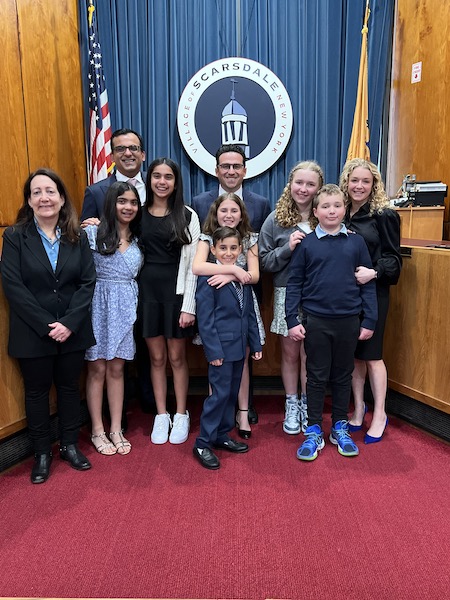
Most notable on Monday, were the children of three of the Board members who came to cheer on their parents. Check out they photos of the next generation of leaders with their proud families.
Candidate Dara Gruenberg Sets Her Sights on Scarsdale Village Hall
- Details
- Written by: Joanne Wallenstein
- Hits: 3997
 Candidate for Village Trustee Dara Gruenberg already has a long resume of volunteer service to Scarsdale and beyond. In fact, in 2018, Dara received the Scarsdale Family Counseling Rising Star Award for her leadership within the community and volunteerism. In 2021, New York State Majority Leader Andrea Stewart-Cousins selected Dara as one of her three Women's History Month honorees in recognition of her Covid relief efforts.
Now she has turned her focus toward Scarsdale Village Hall, where she is on the ballot for her first term as Village Trustee in an election to be held on Tuesday March 21, 2023 at Scarsdale Public Library.
We sent Gruenberg the following questions in an effort to get to know her better:
Tell us about yourself – including your past volunteer work and your professional life.
I moved to Scarsdale almost 12 years ago with my husband Jon and our very young children. I immediately started volunteering at my daughter’s school which blossomed into a career of volunteerism here in Scarsdale and in Westchester.
I am completing my sixth year as the President of the Friends of the Scarsdale Library. During my tenure, I concurrently co-chaired the Library’s Capital Campaign for the renovation, a public private partnership that, after a decade in the making, has resulted in a beloved resource for the community. I also have the honor of chairing the Village’s Advisory Council on Communications (ACC) and serving as a member of the Village Board of Ethics. Additionally, I am wrapping up my second term as a Vice President at Westchester Reform Temple where I have been on the board of trustees for the last 8 years.
In recent years, I served as a board member of the Scarsdale Forum and the League of Women Voters Scarsdale and was a member of the Scarsdale Bowl Committee. I was also a member of the Citizens Nominating Committee and was co-chair of the Scarsdale Citizens Non-Partisan Party Campaigns in 2018 and in 2020.
Outside of Scarsdale, I am the Vice Chair of the Foundation Board at White Plains Hospital and a board member of Feeding Westchester.
Prior to moving to Scarsdale, I worked as an administrator, advisor, Director of Community Service (K-12) and Latin teacher at an independent school in Manhattan. I have a B.A. in Classics from Barnard College, Columbia University and a Master of Education in School Administration from Bank Street College of Education.
What were your most significant achievements as a community volunteer?
Some of the achievements that standout the most are helping transform Scarsdale Public Library for the 21st century; connecting resources to needs for Scarsdale’s COVID Relief efforts; and fundraising for White Plains Hospital, particularly during COVID. I have also taken great pride in chairing the Village’s Advisory Council on Communications (ACC) as it has restructured and enhanced the processes by which our Village engages residents. The ACC also helped rebrand the Village’s interfaces, to optimize communications between residents and Village staff. This work has given me unique and valuable insight into every Village department and how they operate.
I have been most fulfilled by the relationships made with fellow volunteers and professionals. Scarsdale can be a welcoming place to get involved, and I can honestly say that as much as I have given, it is only a fraction of what I have received from the friendships I have made and the satisfaction I have felt from collaborating with others.
Why do you want to serve as Village Trustee? How do you think you can contribute?
I am grateful to the Citizens Nominating Committee for their nomination and their faith in my ability to serve this community as a trustee. I have spent most of the last decade involved civically in Scarsdale and this feels like the next natural step. Because I have spent so much time working with residents and Village staff, both in my roles on the ACC and with the Library, I feel ready to take on this new role. My time with both the Scarsdale Forum and League of Women Voters Scarsdale have also contributed to my depth of understanding about Scarsdale’s budget, our municipal services and operations, and what our residents value most about living here.
The Village has significant infrastructure needs and capital projects on the immediate horizon. These issues are going to require thoughtful solutions and the ability to balance competing demands and interests. We are fortunate to have such capable members of Village staff as well as a talented board and resident volunteers on boards and councils to think through these problems and find solutions. I look forward to continuing to support the village in this dynamic but in a new role.
My favorite part of all of my volunteer work, and I suspect serving as a trustee will afford me the same opportunities, is the ability to collaborate with others and to problem solve. I listen carefully to all sides of an issue and seek to find a path forward that is thoughtful and can integrate multiple viewpoints. I think this will help me greatly as a Village Trustee and has prepared me to be tactical in how I help solve problems.
There are many initiatives pending before this Village Board that are controversial including the pool renovation, the traffic study and changes to the Village Center. How would you prioritize these projects and what would be your process for reaching consensus so that we can move forward?
Investing in infrastructure is essential both for quality of life and also our property values. I am eager to meet with the board and Village staff to discuss the current status of the pool project and next steps. Regarding the Village Center, we have a tremendous opportunity to pilot projects before making any permanent changes. We need to be methodical in our approach as well as conscious of how we spend taxpayer dollars. Traffic issues are chronic. We need to continue to focus on them and continue in our efforts to improve the traffic safety of our village. We must also be cognizant that we have limited resources and I look forward to having prioritization conversations with the board, staff, residents and the business community.
Each year, setting the Village budget becomes more and more challenging. There is increased demand for services, rising costs and on the other hand, pressure to keep tax increases to a minimum. Explain your views on paying for everything we would like.
As you know, approving the annual Village budget is one of the most important duties of the Board. Our Village professionals work extensively with the Board, spending a great deal of time scrutinizing spending rationales and seeking savings opportunities as well as balancing service expectations against overall costs to the taxpayer. I have seen great process improvements made over the last several years that have improved transparency and have allowed for more input.
I do not see a scenario where we can pay for everything we would like, which is why effective communications between village government and residents is so essential. We always have to start with what we need and then figure out how to pay for that and then figure out what we want and how to prioritize those wants.
Scarsdale Citizens Non-Partisan Party cordially invites community members to stop by for a candidate meet and greet on Sunday, March 19th from 3:00 - 4:30pm at the Scarsdale Public Library. This is an opportunity for residents of the village to meet the candidates for an informal gathering. The candidates are Justin Arest for Mayor; Sameer Ahuja, Karen Brew and Dara Gruenberg for Village Trustee; and Cynthia Dunne for Village Justice. The event will take place in the Scott Room. Refreshments will be available. As a reminder, the Village election is on Tuesday, March 21st at the Scarsdale Public Library from 6am to 9pm.
Cell Phone Service Coming to Scarsdale
- Details
- Written by: Joanne Wallenstein
- Hits: 5352
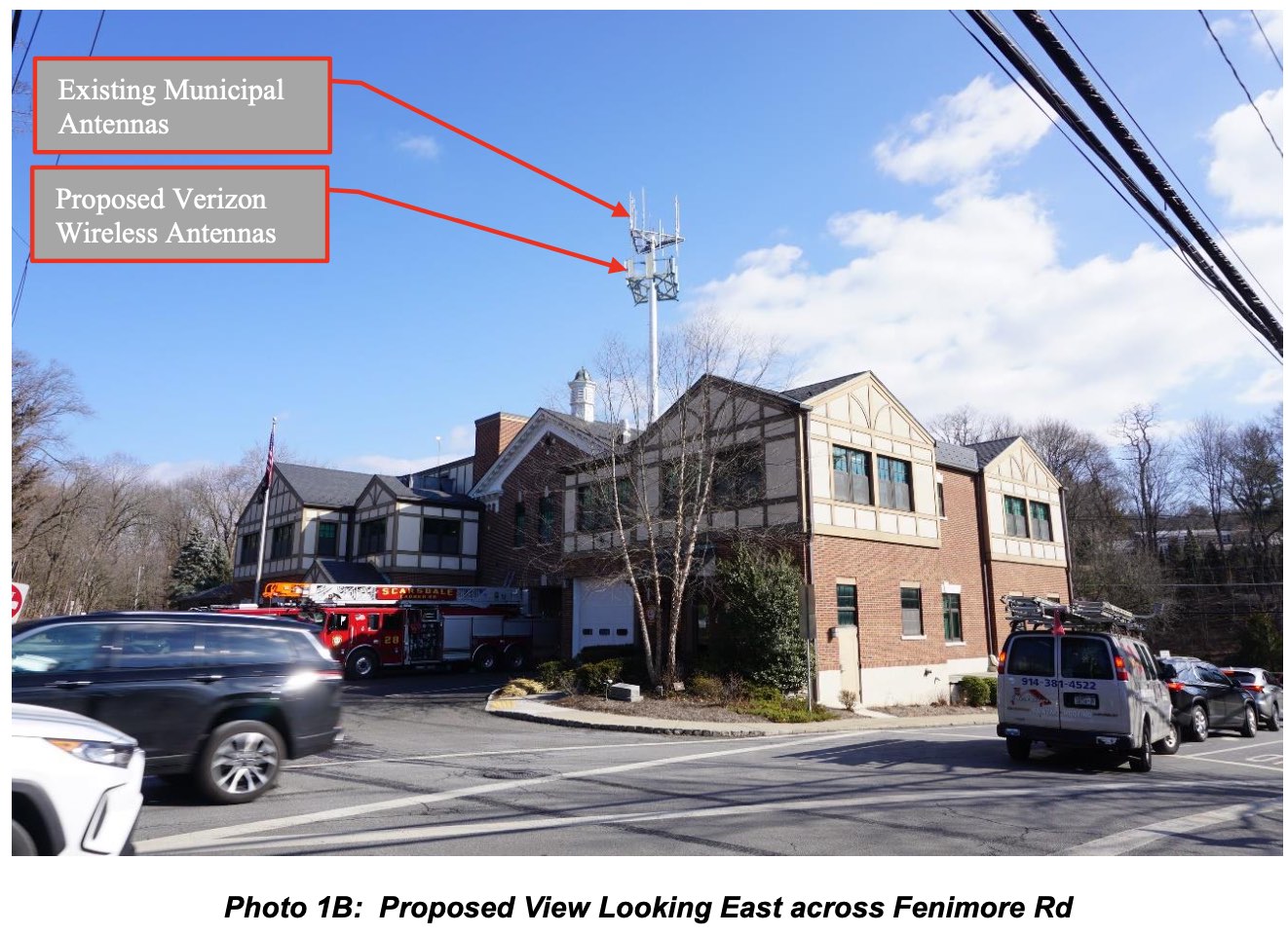
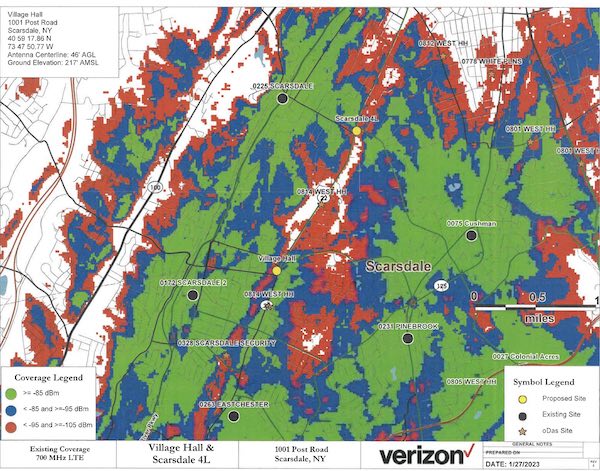 Verizon will install antennas at the Public Safety Building and Village Hall to address the cell phone gap (white portion) that runs along Route 22 in Scarsdale.A resolute Mayor and Village Board voted unanimously to approve leases for Verizon to install antennas on existing facilities to address a large cell phone gap in Scarsdale at their meeting on Tuesday February 28, 2023.
The move was not an easy one, as the Board balanced the need for cell phone coverage for the public and safety officials against those who claimed that radiation from these antennas would pose risks to people working in Village Hall and living nearby the two locations at Village Hall and the Public Safety Building.
The plan was the work of an 18 month initiative spearheaded by the Village’s Technology Advisor Council, who determined that the placement of the larger antennas were the only way to deliver a strong signal due to Scarsdale’s tree coverage and topography.
Those who objected to the plan claimed that a series of smaller antennas could deliver a solution, however a study showed that these antennas, which would be placed in front of people’s homes, would not provide adequate service.
Village Attorney Nick Ward-Willis reviewed information presented at a February 14, 2023 meeting, explaining that that antennas would be placed at Village Hall and at the Public Safety Building. The service would meet the needs of the school district, the police department, the fire department, the ambulance corps and the Fox Meadow Neighborhood Association for communications along the Post Road corridor and in Fox Meadow. He highlighted the importance of having a communications infrastructure in place in case of a community emergency.
Addressing health concerns voiced by the public he said that the issue has been investigated by the Federal government who provide regulations. He said, “cell phones have been around for years,” and shared a report that the Village had commissioned from CityScape, consultants who found that Scarsdale’s plan to co-locate the antennas on existing facilities was consistent with best practices.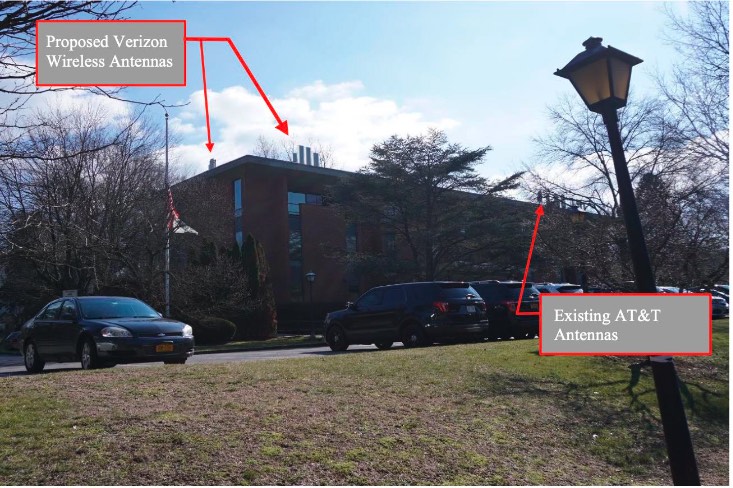
To those who called for use of small cell antennas he said, “Small cells would not work due to the foliage. They could not support data transmission and do not have back up power. If a tree knocks the small cell out, or a car hits the utility pole, there is no coverage.” Even with the 18 small cells that would be required there would be many coverage gaps…. It is not a viable alternative for the Village.” He also said that the environmental assessment found no negative impacts from the antennas.
The resolution says, “The proposed macro cell facilities are the best solutions to be utilized to address the undisputed need to resolve the coverage gaps to meet the public safety needs of the community. There was consideration of the use of small cell wireless facilities to fill the gap in coverage, but it was determined not to be a viable alternative due to a number of reasons, including but not limited to: 1) due to the limited range of the small cell facilities, dense vegetation and building interference, the small cells facilities would not be able to adequately cover the gaps in the same manner as the proposed macro facilities; 2) a multitude of small cell facilities just for Verizon Wireless would be needed (without accounting for the other 3 wireless carriers) and they would be located at a height of 25 feet or 45 feet on utility poles or additional poles located within the residential streets and along the Route 22 corridor; 3) small cell facilities do not have emergency backup power and would not be available during power outages; and 4) small cell facilities would be located closer to homes than the proposed macro sites so as to be more visible. Such a solution would be inefficient and inappropriate for the magnitude of the problem at issue.”
In public comments prior to the vote, the Board heard impassioned voices for an against the proposal.
School Board President Amber Yusuf and Vice President Ron Schulhof returned to Village Hall to speak on behalf of the entire Board of Education who urged the Village Board to “close the gaps in and around the school to improve school safety.” They said, “We understand a significant amount of work has been done – thank you!”
Amy Frank of Burgess Road who is President of Maroon and White said, “We feel that this needs to be passed. People are doing away with their landlines. People are dependent on their cell phones to call an ambulance, the fire department or for help. You can’t reach your children on the fields.”
Speaking on behalf of the PT Council Executive Committee, Leah Dembitzer said, “The Scarsdale PT Council Executive Committee, comprised of the PTA Presidents of all seven schools and the four officers of PT Council, supports improving cellular coverage around Scarsdale High School and Fox Meadow School in order to ensure that students are safe, reachable and have access to help from adults as needed in everyday life and in the case of an emergency. We thank the Village for doing its due diligence and working to close the cell phone service gaps that have created a very real safety and security issue for families and students over several years.
 As Mayor Veron said during the February 14 Village Board meeting: “We can no longer endure dead zones, particularly surrounding our schools. Over these past several years, with increasing intensity, our emergency workers, school officials, parents and students have called for reliable telecom service.” The unreliable and nearly non-existent cellular coverage around the High School and Fox Meadow School has proven a difficulty and a challenge for our school community and we urge the Village Board to move forward on improved cellular reception.”
Brian Culang read a statement from Randi Culang and Janice Starr on behalf of the Fox Meadow Neighborhood Association. He said, “We have received 100 complaints about the lack of cell service… We support the installation. We look forward to having appropriate cell coverage in our neighborhood.”
Heath Sroka of Whig Road remarked, “We travel with phones in our pockets all day. If you’re really worried about the tower I would get rid of your cell phone too.”
Bob Harrison said, “We have suffered from terrible cell service. We need improved cell service. The proposal seems like a good one.”
However there were vociferous objections from many. Doug Mignone, representing the Firefighters Association said that the International Association of Firefighters opposes the co-location of cell towers at firehouses due to radiation. He said, “The government recommendation is based on non-continuous exposure. But we continuously occupy these facilities. We are asking for the Board to consider safer options. We have inherently dangerous jobs and protect the public We are there to keep the people safe. We take our own safety seriously – ---Cell tower puts us in an unnecessarily unsafe situation….We urge you to consider other options as this poses a risk to firefighters and nearby residents.”
Carrie Fishman of Ridgecrest East said, “In the late 90s I was instrumental in preventing a cell tower going up at the Public Safety Building. I am disappointed with the way this is being handled. I only found out about this on Monday February 13. We have no way to hire our own expert to rebut that report. The FCC has not changed its guidelines since 1996. They are not interested in protecting health – but in promoting big business…. A new study showed that within a 1600 foot radius of the cell tower people will be severely affected. There are 200 houses wi,thin 1,600 feet of the tower. The Village needs to take a step back to work with residents to find an answer. Please do the right thing and let’s see what else we can do.”
Bob Berg said, “I am an expert in telecommunications. This is a terrible thing you are about to do tonight…We are going to jeopardize our first responders by putting up 22 antennas. The scientific literature shows the danger of close proximity to these cell towers. It’s sick and its evil. CityScape is a joke. They favor whatever the telecoms want. What a joke. I don’t understand how you can sleep tonight if you pass this.”
The Village Attorney replied, “This will not open a pandora’s box. This does not require us to allow other carriers to co-locate. Private property owners cannot be prevented from co-locating. City scape is a fine organization. They provide good, fair independent analysis. We should speak with respect. They call the balls and strikes.”
Responding to the firefighters, Ward-Willis said, “The Village also puts safety as it’s number one concern. For over ten years, there have been AT&T antennas above where we are sitting right now [Village Hall] – directed away from the building and 50 feet from the Station 1 firehouse. The Verizon signals are no different than those of AT&T.... Before the antennas are installed, there will be RF measurements taken for a baseline. They will look at emissions from the facility annually, certified and submitted to the Village.”
Jess Lerner who grew up on Hampton Road said that the emails she sent to the Village Board bounced back. She said, “I am electrically sensitive and my mom is also. It happens to people with a range of medical issues. My mother is battling cancer and this would be a nightmare for her. CityScape is not independent. I hear the lack of respect for the firefighters. Look at the other options and get a truly independent study. Please protect our health.”
Her mother, Jan Flanzer said, “That was my daughter speaking. I have lived here since I was four
and my grandparents lived here. I have never known the Village to make a decision like this in two weeks. This has not had longitudinal studies. This is going to be over your head – when you’re meeting. Take time to consider this important decision. I am adamantly opposed to passing this.”
Jingquing Chai from Rochambeau Road said her house is near Village Hall. She said, “We need to change the conversation – from the lack of coverage to the cell tower pollution. Young children and adolescents are still developing, This is a severe risk to children whose brains are still developing. 5% of children or more who live near the cell tower will develop brain cancer.”
Xue Su of Kingston Road asked the board to “Give serious consideration to the concerns of those living near the locations. The Chinese standard is 15 times lower than the FCC standard – which dates back to 1996. You have only given us two weeks. We deserve better protection from our local government. This is RF radiation – this is something you can’t see or touch. It is 24/7 over the houses near those locations. Hold off your vote for tonight to explore safer options.”
Zoe Berg of Black Birch Lane said, “Ironically most of the people supporting this don’t live near these locations. You have firefighters who put their lives on the line to protect us. They need you to protect them now. We are talking about people’s health – cancer, brain damage, fertility. People will be forced to leave the only place they have only called home. The FCC has no health expertise. They lost a major lawsuit in 2022 regarding arbitrary and capricious decision regarding harm from cellular towers. There is absolutely no need to bathe our first responders and residents in radiation. (Lapses in the cell coverage prevented her from being fully heard.)
Someone who only identified himself as Jeff said, “If there is no safety concerns why can’t it be installed on the high school tower?”
Thomas Giuffra of Ridgecrest West said, “I am concerned on the reliance on a single expert report. They said for years that cigarettes did not cause cancer. We have the same problem now. The regulations are now 30 years old. Cityscape is routinely engaged by the telecommunications company – they have inherent biases. You would need to have a separate expert who is not beholden to an industry. You should have a balanced assessment to make an informed decision. The balance should not come from the people who are pushing it. Verizon is interested in profits – not in people.”
Ward-Willis spoke again saying “TAC has been examining this for a year. It has not been rushed. The Board of Ed approached the Village Board in August 2022. Verizon said, due to the public safety concern we want to get this installed sooner than later.”
Before the vote, Trustees commented.
Sameer Ahuja, who is the trustee liaison to the Technology Advisory Council condemned a letter to the trustees received from Bob Berg at 4 pm that day in which he compared village employees and trustees to Nazis.
Berg's letter said, "When I think about how poorly the Village Board has handled this entire wireless matter, I'm reminded most of Hannah Arendt's famous series of articles in The New Yorker, "Eichmann in Jerusalem: A Report on the Banality of Evil. Arendt concludes that Adolf Eichmann, the executor of the Final Solution, simply was an efficient bureaucrat, performing his duties in an efficient, unquestioning manner. Was he simply banal and efficient or unthinkably evil and monstrous? As you contemplate how you will vote tonight, please don't be banal and definitely don't be unthinkably evil or monstrous. Think about the Pandora's box you will be opening. Think about the lives whose health you may impact. There is a better, safer solution at hand. You owe everyone, including yourselves, to table the resolution and hire an independent expert to explore that alternative before steaming ahead with banality."
Ahuja told Berg, “You have shown your true colors on the record – it is you who will need to reflect on your life’s work.”
Ahuja credited all who worked on the proposal for the cell phone service project. He said, “This has been an 18 month project – one of the more complex things I have seen the board work on. I hope this is a model for how we can work with other Village organizations in the future.”
Karen Brew thanked Ahuja and said, “I support the resolution because it supports the safety of the community.”
Jeremy Gans said, “It was a group effort. I joined this board 11 months ago and I am more enthused about voting for this than any other thing I have voted on. It is rare when we have the opportunity to pass a resolution that will improve our daily lives. I am a Type 1 diabetic and rely on wireless networks to monitor my blood sugar. Parents deserve better. 1500 high school students will be able to communicate when outdoors. Some ask why we need this? We need to get with the times.”
He continued, “Bob Berg compared this board to the actions of Adolf Eichmann – and said this may be the most important decision we make. I agree with this. It is important we vote yes and I am proud to do so.”
Randy Whitestone said, “We represent the whole community. We spend a lot of time researching the issues. It is high time that this happens. And it is the right time to do it. Scarsdale should be the leader that our citizens expect.”
Ken Mazer outlined why he supported this resolution:
-It is supported by the professional leadership of this village including the police, fire chief and SVAC
-These antennas have been widely installed throughout the US.
-It is supported by independent consultants who were hired by the Village.
-There is a compelling need for the service and no compelling alternative.
-I am confident these will be monitored on an annual basis.
Jonathan Lewis said, “The public interest is best served by this installation. I will sleep well tonight. For the almost four years I have served on the board I have agreed and disagreed with others – but always valued public comment. I recognize that my neighbors are operating with good intentions.” Looking out at the audience he said, “Bob – I hope you will reflect on your language – calling us Nazis and calling us evil. I think the use of language matters and I hope in the future we won’t see that language used. Comparisons are not fair and not right.”
Mayor Jane Veron said, “I feel very proud that we can deliver what has been sought by people at home, at school and at the fields. Our duty is to listen to residents, do research, advocate on their behalf and find solutions.”
The resolution passed unanimously.
Water Bill Forgiveness Program
In other business, the Board held a Public Hearing on a Water Bill Forgiveness Program for people who had leaks and were unaware of them. If the customer works to resolve the leaks they will be charged the base rate for water, not the higher rates. A memo from the Village says, “In sum, the proposed Water Forgiveness Program would provide the Village with the authority it needs in order to provide relief to consumers who suffer a water leak which caused their exceptionally high water bill. Moreover, the Program would also establish rules and procedures, such as verification of leaks and repairs and eligibility, which are necessary to prevent inequitable outcomes or abuse by consumers.”
Village Manager Rob Cole suggested that they change the look back date to January 2022 to allow more customers to be forgiven.
Jonathan Lewis spoke about work in the Safety Pillar involving the coordination between the Village, the Schools and safety officers. He supported the emergency training that had been done and called for more training down the line. He supports strategic planning for public safety and encouraged more collaboration in the future. He said, “I am impressed by all of the resources in place.”
Use of Sidewalks
The board passed a resolution to allow owners and lessees in the Village Center or other owners or lessees of rental or food establishment properties in other areas of the Village, to store, display and or sell goods, wares and merchandise on or directly above Village-owned rights of way through December 31, 2023.
Fees and Charges
The Board approved a schedule of Village-Wide Fees and Charges relative to current operating costs, chronology of previous increases, and the completion of comparative municipal surveys in conjunction with review and discussion with the Board of Trustees as part of the annual budget review process.
Collective Bargaining Agreement with the Firefighters
The Board approved a new collective bargaining agreement with the firefighters who have been working without a contract since May 31, 2021.
Illegal Sewer Connections
The board passed new local code to reduce the inflow and infiltration into the Village’s sanitary sewer system. The law accomplishes this goal by requiring inspection, testing, repair, replacement and ongoing maintenance of Sewer Laterals.
Replace and Furnish Water Meters
Another resolution authorizes $368,702 for the purchase of new water meters from Rio Supply., 100 Allied Parkway Sicklerville, NJ 08081 and to undertake all administrative as may be required pursuant to the terms of this agreement.
Voting Machines
Last, the Board passed a resolution to use voting equipment from the Westchester County Board of Elections for the Village election on March 21, 2023.