








When Will Scarsdale Children Return to School Full-Time
- Details
- Written by: Joanne Wallenstein
- Hits: 3035
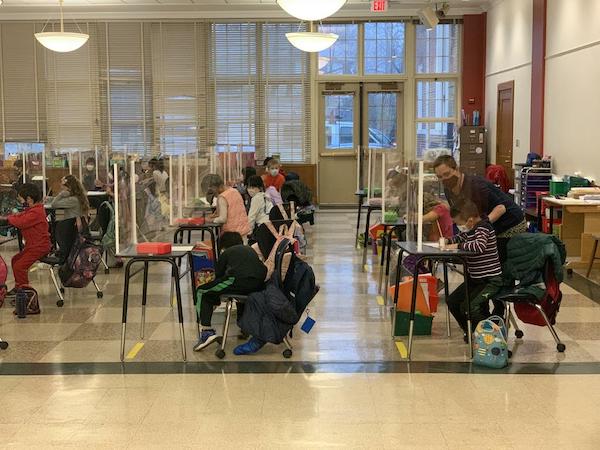 When will Scarsdale children return to school full-time? Scarsdale resident Irin Israel has posed this question many times and receives the answer, “when appropriate."
According to Israel, “This is a phrase that gets thrown around quite a bit, yet has no specific definition. Is “when appropriate” defined by rates, vaccinations, time, or a combination of those metrics? Whether a return to full-time school occurs tomorrow, this spring, fall 2021, or even later – these metrics need to be clearly defined and understood.”
He sent the email below to the Scarsdale School Administration and the Scarsdale Board of Education:
Dear Administration and Board,
There is a major Restart Update coming up at the Monday, January 11th BOE Meeting with mid- and long-term planning documents being released and discussed. Since public comment occurs after the Restart Update, I thought it would be more helpful to provide questions that the Administration should explicitly and clearly answer during that presentation, and that the Board should ask if they are not addressed.
The Administration must know the explicit answers to these questions in order to have made current decisions on restart and for decisions going forward. And the Board needs to know the answers to these questions to understand how Restart is occurring, and to judge the effectiveness of Restart itself and the Administration’s performance during this time.
Pam Fuehrer claimed in a 12/22/20 email to me “on behalf of the Board” of these questions that “almost all are within the realm of management and not governance” and has refused to address them. These questions all entail subject matter about the educational, social and emotional well-being and safety of the community’s children, faculty and staff, and as such, are all within the Board’s purview. These questions and answers not only affect our present school situation but are crucial for decisions about fall 2021. Quite simply, they are reasonable and must be answered publicly and transparently.
It has been clearly shown with the Administration’s own documents written by the District Architect (dated 7/23/20) that ALL current K-5 students and faculty can physically fit in our elementary school spaces full-time at six-foot distancing (in cohorts and while wearing masks) when appropriate and have been able to fit since the start of this school year.
1. What is/are the true and explicit reason(s) that ALL current in-person K-5 children are not in school full-time today?
2. If there are risk mitigation strategies that are preventing the K-5 children from full-time school: can you specifically state those risk mitigation strategies that were committed to and the measurements/metrics of those items that are being used that have placed and currently keep grades 3-5 in a hybrid scenario?
3. Are all of these listed risk mitigation strategies in line with NYS DOH mandatory safety guidelines, or are some going beyond what is required? Which strategies are going beyond, how far beyond, and why? Also, where can the guidelines being used specifically be found in the NYS regulations?
4. What are the agreed upon changes (for example: rates, vaccinations, time) that would allow to adjustments in those risk mitigation strategies, and ultimately allow for full-time learning? Or are these risk mitigation strategies agreed upon indefinitely despite any changes to rates, vaccinations, time, etc.?
5. When you mention building density, can you explain specifically what measurements of density are being used, and how they have been and currently are being measured?
6. Which items above (risk mitigation strategies) are the “sticking points", what has been done to solve EACH of those issues, and why they are not solvable? (One example: at the previous BOE Meeting, it was mentioned by Drew Patrick that teachers/aides need safe spaces to eat lunch - what has been done to solve that issue in the event kids move to full-time and why is it unsolvable?)
7. Basically and overall: What is specifically preventing a return to full-time education at each of the Scarsdale school levels (elementary, SMS, SHS), how is this measured, and what metrics/changes will allow full-time schooling to occur today, this spring, or fall 2021?
Thank you again.
Irin Israel
Online Kindergarten Registration for Scarsdale Schools Starts January 15, 2021
- Details
- Written by: Joanne Wallenstein
- Hits: 2340
 The Scarsdale School District offers online Kindergarten registration. Current residents who expect to have a child attend Kindergarten during the 2021-2022 school year are encouraged to complete this process between January 15 and January 31, 2021. Although prospective Kindergarteners may register at any time prior to the start of the school year, completing this process early ensures a smooth screening and placement process. Children whose fifth birthday falls on or before December 31, 2021, may be registered for the 2021-2022 school year.
Please visit www.scarsdaleschools.org/registration for instructions on how to register online.
Enrollment in one of the five elementary schools (Edgewood, Fox Meadow, Greenacres, Heathcote, and Quaker Ridge) is determined by the neighborhood in which you reside. If you do not know which elementary school serves your neighborhood, please call the District Registrar, Nunzia Mauro, at (914) 721-2444 or send an email to [email protected].
Retirements Announced, COVID Counts, Budget Talk and a Report on Culturally Responsive Education from the Scarsdale BOE Meeting
- Details
- Written by: Sammy Silberberg
- Hits: 3567
 As 2020 finally comes to a close, the Scarsdale Board of Education convened their final meeting of the year to discuss their plans for the upcoming academic term. This business meeting was held on Monday, December 21, 2020, and the board members discussed updates with the district’s restart plan and COVID-19 testing, reviewed a personnel report and an education report on diversity and inclusion, and held a preliminary discussion about the 2021-2022 budget.
Restart Update:
The meeting opened with Board of Education President Pam Fuehrer recognizing the difficult decision the district made to transition all schools to virtual learning for the last two days before the winter break (12/21-12/22). Next, Assistant Superintendent for Special Education and Student Services Eric Rauschenbach spoke about the current status of the district.
Scarsdale currently has 53 positive cases of COVID-19, and while the district physician is satisfied with Scarsdale's containment and quarantine measures, this shift to remote learning was necessary in light of the number of teachers, teacher's aides, and substitute teachers in quarantine or out due to seasonal illness. Mr. Rauschenbach noted that there is a substantial student absence trend, with 500 students moving to exclusively virtual learning leading up to the break. He anticipates that these numbers will decrease after the winter break. In response to questions about the utilization of school spaces, Mr. Rauschenbach stated: “the schools right now have students in every conceivable space that isn't being used for other necessary functions. That being said, we need to keep in mind population density, transitions, the ability to keep kids separated throughout the day. It's tough. As numbers come down and as we see an increase in effects of the vaccine, we may very well be able to adjust the switch [the model] because we think that’s the safe thing to do, which will allow us to reach bigger in allowing more kids and where they can be during the day.”
Testing:
Mr. Rauschenbach also updated the board on the state of the district’s testing. Currently, Scarsdale is recruiting volunteers from students and staff members to get COVID-19 testing. In light of the new state Red and Orange Zone requirements, the district will need to test 25-30% of the population over an entire month. While it is no longer necessary to test 100% of the population, testing will not be an effective method of curbing vaccine spread if the same 30% of the population is re-tested over and over again.
The district currently has 1,500 student sign-ups for testing that is evenly distributed across grade levels. The administration is hoping for an increase in signups and plans to re-canvass and promote the sign-ups after the winter break. Additionally, 1/3rd of the staff signed up during this first window. Enough students and staff members must sign up for voluntary testing to have the numbers necessary for Scarsdale to increase and sustain in-person learning. Mr. Rauschenbach also announced that the administration will be launching a mid and long- term planning website “to inform the community on the thinking for the middle and long-term planning to bring us back to traditional learning.”
Personnel Report:
Andrew Patrick, the Assistant Superintendent for Human Recourses and Leadership Development for Scarsdale Public Schools announced that three of Scarsdale's long-term staff members will be retiring at the end of this school year. Richard Clark, a high school environmental science and biology teacher will retire after teaching in this district for 39 years. Jill Schultz, who taught music across the district will retire after 23 years in Scarsdale. Finally, Emma Wixted, who transitioned from a middle school teacher to a middle school house counselor and has spent 32 years with Scarsdale Schools will retire at the end of this academic year. Mr. Patrick stated that “we couldn’t be more grateful for their service” and noted that we will have more formal opportunities to thank these staff members as the year comes to an end.
Education Report:
Edgar McIntosh, the Assistant Superintendent of Curriculum, Instruction, and Assessment for Scarsdale Public Schools presented the board with a fascinating presentation on the efforts Scarsdale is making to build more inclusive, welcoming, and culturally responsive schools. He opened by defining a “culturally responsive sustaining education” as an education that is “grounded in a cultural view of learning and human development in which multiple expressions of diversity (race, social class, gender, language, sexual orientation, nationality, religion, ability) are recognized and regarded as assets for teaching and learning.”
The presentation included multiple video clips of interviews with teachers and students about the efforts made to strengthen Scarsdale’s culturally responsive sustaining education plans. Liz Rosenfeld, a 5th-grade teacher, stated that "we must help students see themselves in characters and those who are different… the more we can use books as windows and mirrors the more educated and culturally responsive our students will be…. We need to address implicit bias and discuss it and open a forum with young students… as a community of educators we need to become comfortable with these uncomfortable conversations.”
In addition to promoting academic success, the Board of Education seeks to promote socio-politically and socio-culturally responsiveness amongst students. Dr. Karine Schaefer, who serves as the High School English Department Chair, stated that “it is essential for students to learn the history of inequality and injustice in this country and to engage with the lived experience of people who aren’t white, aren’t male, and aren’t straight.. part of the reason you read literature is because it fosters empathy with people who are different from yourself.” Dr. Schaefer noted that during the summer of 2020, the department reviewed its curriculum and looked for ways to increase the diversity of perspectives included in texts. In addition to assigning works such as Dr. Martin Luther King Jr.’s Letters From a Birmingham Jail and Ta-Nehisi Coates’s Between the World and Me, the department is piloting new novels and memoirs this year. Some of these new additions include Another Brooklyn by Jacqueline Woodson, The 57 Bus by Dashka Slater, Swing Time by Zadie Smith, and Born a Crime by Trevor Noah. Dr. Schaefer also shared that video content has helped increase the power and responsiveness of printed work and that the department has begun pairing important novels and biographies with films for students to watch. She gave the example of pairing Invisible Man by Ralph Ellison with Jordan Peel’s film Get Out or matching Fredrick Douglass’s memoir The Life of Fredrick Douglass with Ava Duvernay’s documentary 13th. Dr. Schaefer concluded by sharing that “our students genuinely want to talk about issues of race, police brutality, and social justice… while we may have confronted some apathy in the past, that apathy is gone and students have questions and they want to talk. They need teachers to take them through the complexity of the issues.”
Later in the presentation, middle school teachers Meghan Lahey and Will Malderelli and high school teacher Heather Waters discussed the effectiveness of the virtual exchange programs students participated in this year. Middle school students had the opportunity to connect with students in Mexico and Zimbabwe over webinars and learn about the experiences of teenagers across the world. One student commented that these webinars helped her learn about different perspectives and cultures and show her what life is like for people outside of her own lived experience. A second student stated that “we might think we are having a hard time [in quarantine] but so many people have [different] hard times and they can’t do so many things… it’s good to see other perspectives instead of thinking that only we have it the toughest. It’s nice to really engage with other people instead of just reading a textbook.”
The presentation also reviewed the Scarsdale High School Dignity and Inclusion Team, which is a group that was convened in the fall of 2019 after antisemitic and racist graffiti was found on campus. Every student was asked to reflect on the nature of inclusivity and the culture of the highs school in a survey, and the team gathered qualitative information from 175 students through focus groups. This team continues to meet monthly, review the data collected, and develop action steps for how to increase the inclusivity and safety of the school.
Some of the next steps for this project include:
• Prioritize assured experience in student experience (curricular and instructional) and educator training (awareness and methodology)
• Coordinate, mobilize, and engage the diversity within our schools
• Highlight the role and importance of critical thinking, divergent ideas, and multiple perspectives
• Continue to examine curriculum to identify implicit bias and ensure diverse representation
• Assess student understanding of the New York State Education Department framework
While it is evident that there is still much work to be done to make Scarsdale Schools the most inclusive and accepting place it can be, the Board of Education was impressed with the steps being taken thus far to advance these initiatives and improve the inclusivity of the district’s schools.
Budget Development and Financial Projections:
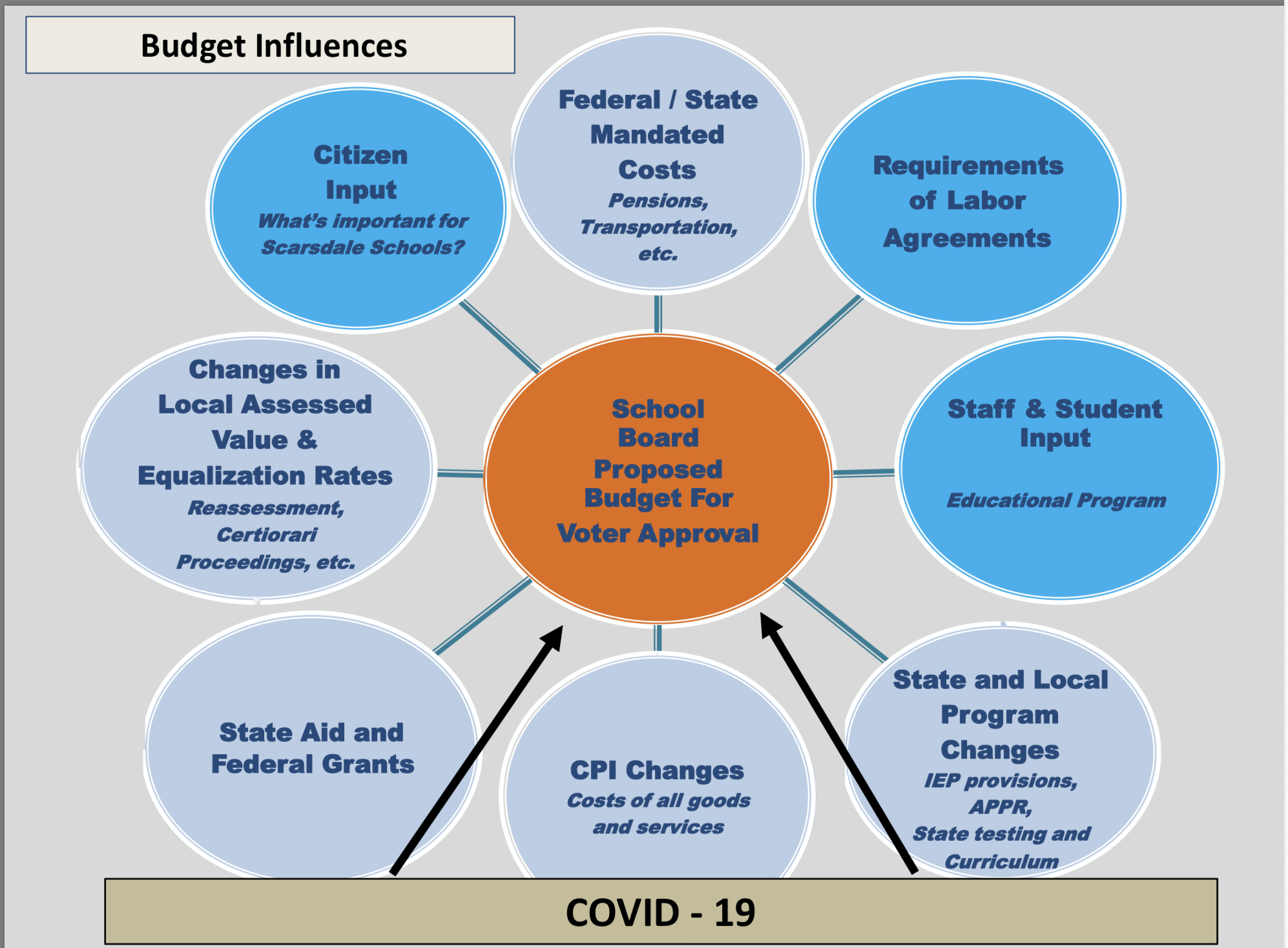
The last major item of the business meeting was the budget presentation by Stuart Mattey, the Assistant Superintendent for Business and Facilities. This budget process is especially complicated with COVID-19 considerations and expenditures, and the board anticipates it will take 4-5 months to finalize it. Many factors contribute to the final budget including resident input, federal and state-mandated costs, requirements of labor agreements, staff and student input, state and local program changes, and state aid and federal grants.
Mattey reviewed projected revenues and expenses for the 2020-21 school budget demonstrating how COVID had an enormous impact on this year’s finances. He expects revenues to be $947,985 higher or 1.69% than projected. Though there was over $2 million in decreased revenues from state aid and interest earnings, this was offset by an increase of $2.5 mm in revenues from the tax levy.
On the expense side, the district is projected to have an increase of $4.6 million in COVID related expenses.
Among the largest of these increases are:
-Personnel and related benefits from hiring nine cleaners and teachers: $1.536 mm
-PPE related expenses: $800,000
-Increased hours for Teacher Aides $895,000
-School lunch fund deficit: $220,0000
-Continuing losses to school lunch fund: $500,000
Mattey explained that the significant deficit of $220 million in the school lunch fund was due to the elimination of sales. Additionally, the district is projected to lose $500 million because of the continuing requirement to provide meals to students in-need across all grade levels.
There were also some COVID savings, totaling $1,157 mm from instructional programs, teachers’ salaries, interscholastic athletics, security monitors, transportation, travel and conferences.
All in, Mattey expected that the district will end the 2020-21 fiscal year with a fund balance of $22,885,349, which is $3.7mm lower than the end of fiscal year 2020. The unassigned fund balance, that cannot be more than 4% of the total budget, is projected to be $5,035,084, which is 3% of the projected annual budget.
This meeting on December 21, 2020, began the long process of developing, reviewing, and finalizing the budget. On January 11th, the board will take the next step in this process and will see a presentation on staffing recommendations. Additionally, three budgeting sessions have been planned for February 1st, February 8th, and March 8th. Finally, the board will conduct a budget forum and review at the Board of Education meeting on March 22nd and plans to adopt the budget at the board meeting on April 12th. Finally, the community will vote on the budget on May 18, 2021.
See the budget presentation online here.
Teachers Aides Get Pay Increase, COVID Testing in School and More from the Scarsdale School Board
- Details
- Written by: Sammy Silberberg
- Hits: 3423
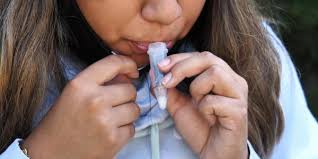 COVID testing, a revision to the contract with the teachers’ aides, the creation of a medical advisory board and athletics were all discussed at a Board of Education meeting held via Zoom on December 7, 2020.
Pam Fuehrer, Board President reported that prior to the meeting, the Board of Ed met with a group of high school students who spoke about their relationships with their classmates and teachers, their tutorial time on Wednesdays and what they appreciate about the current learning model.
Board members Bob Klein and Amber Yusuf said that they toured the Quaker Ridge School with School Principal Dr. Gill. Klein reported, “the school looks great, the mood was upbeat and I left with an energized feeling.” He saw the hybrid model in action and the social distancing in place. He said, “The bottom line is it’s working great, learning is being done and the kids are engaged.”
Assistant Superintendent Edgar McIntosh spoke about the return of grades K-2 to school full time on November 30. He said, “Students in K-2 are happy and engaged.” He credited the teachers and aids for the arrangement of the new class spaces.
Memorandum of Understanding for Teachers’ Aides
In addition to crediting the teaching aides for their wonderful work engaging with students during this difficult school year, Assistant Superintendent Andrew Patrick reviewed the school’s plan to fairly compensate aides for their increased workload. There are around 250 teaching aides across the school district and 150 work at the elementary level. Typically, they provide individual assistance to students who require additional support during school and work as part-time employees.
To accommodate the district’s evolving school reopening plans, many teaching aides will be moving to full-time employment. For the first part of this school year, the elementary school was broken into a morning and an afternoon session and students did not have lunch or recess time at school. To accommodate the new K-2 expansion, aides are now needed to supervise lunch and recess hours, and many aides are shifting to a full-time work schedule. Aides who work 30+ hours per week will now qualify for health coverage.
Additionally, the district is asking 35 aides to step into a new role. These designated teaching aides will now be the sole adult responsible for a group of students when classes are split up. This role is akin to a substitute teaching position and the increased workload and level of responsibility will correspond with a pay increase. The Association of Scarsdale Teacher Aides and Assistants agreed to a rate of $240/day for aides working in the K-2 split classroom model and for $120/day for aides working half days.
Thus far, Assistant Superintendent Andrew Patrick reports that “the feedback so far in K-2 has been very positive” and they are looking forward to the expansion of school hours for this age group.
Update on School COVID Testing
Eric Rauschenbach reported that the positivity rate for the virus in Westchester County overall was at a seven day average of 6%. As of December 10, 138 students and 30 staff members are under quarantine. If the state mandates Scarsdale to be a yellow zone, the district could have to test 20% of the school population per month. To conduct the high level of testing needed to keep the schools open, the district partnered with Sovereign Labs, a company that will provide the testing and analysis for our students and staff.
Scarsdale has received the first shipment of test collection tubes from Sovereign Labs for saliva PCR testing. To take the test, students and staff will fill the tube with a certain amount of saliva. Once closed, an RNA preservation agent will be drained into the tube, and the tubes will be sent to Sovereign Labs for analysis. Rauschenbach had a test collection vial on the call and showed how the process would work.
Moving forward, the district has two options for how to proceed with testing. The In-School Model will require participants to provide the samples in school and the tubes will be shipped from school. The advantage of this option is that the school can closely monitor the test collection process, ensure the tests are being taken properly, and send the tubes to the labs at a faster rate. The disadvantage of this model is that additional staff are needed to monitor the process and students will be required to leave class for a period of time to complete the test.
The second option is the At-Home Model where testing is sent home with students to complete with parental supervision and return to school. An advantage of this model is that students do not miss any instructional time, but it is likely that some students will fail to bring the tests back to school and will not be sent to the lab. As a result, a higher percentage of students must be tested in order to meet the state-mandated number of completed tests. The board is expected to come to a decision about which testing model to use by the end of this week.
Under the district’s agreement with Sovereign Labs, the school will cover the cost of each COVID-19 test ($100/test) if students or staff do not have health insurance. With insurance, Sovereign Labs will provide no cost, no copay testing.
While the district is optimistic about this deal with Sovereign Labs, Scarsdale was approved by the State of New York as a limited-service laboratory. If Sovereign is unable to provide the necessary testing, the district is authorized to request antigen tests from the state and analyze the results within the school district.
In a discussion on testing, Pam Fuehrer asked, “Even if we are not in a zone, why not test anyway?” Rauschenbach replied that the district would be using NYS testing resources (unnecessarily) and it would be a burden on the insurance companies. She also pointed out that the testing might lead to staff shortages if teachers are found to be positive. Carl Finger said that the opposite might be true; that “testing might help the district avoid staffing issues if people are identified and prevented from the spreading the virus.”
Ron Schulhof said if parents are concerned about having the testing done in school, parents should be given a choice of whether or not they want their child tested in school or to go to their own doctor to get a test.
Tutoring for Homebound Students
Because so many students are at home due to quarantine, the board changed their policy for homebound instruction to increase it to two hours per day rather than one hour per day for those quarantined for more than 14 days. This only applies to students who are out of school due to illness or COVID exposure, not for those who opted to do elective travel.
Medical Advisory Board
Erci Rauschenbach provided a response to a petition for the formation of a medical advisory board composed of community physicians, He said, “The administration and the District Physician have discussed this. The district is working under NYS DOH and Governor’s orders for all policies. At this point we’re not sure a separate medical advisory board could give us additional information and it would take time away from our work. At this time we are not moving toward a medical advisory board – but as of now, we are reaching out to community physicians on an as needed basis. We are not recommending that a medical advisory board be created at this point.”
During the public comments portion of the meeting, the two physicians who had drafted the petition replied.
Dr. Richard Schutzer said he was speaking as a concerned father and physician who was in charge of a COVID ICU. He said, “The threats posed by the virus are real. But many fears are unjustified. I have tried to focus on science and board bylaws. I frequently received no response or a dismissive one to communications to the district. …. The PTA has complained of the board’s lack of transparency. The District physician retired 7 years ago because in his own words he couldn’t keep up with the medicine…. Where is there medical representation on the restart committee? Basic questions like how many are currently under quarantine have gone unanswered. I do not care if I am on a committee – but there should be one. Thanks to the one board member who was willing to speak to me.”
Dr. Kim Greene-Liebowitz also spoke. She said, “I am an advocate for the creation of a medical advisory committee….. Why would you refuse expert advice during this difficult period? …There is a delay between policy and implementation. I am concerned that you won’t be able to address the medical issues. The committee alerted you to the need for testing this summer. Are you worried about spitting? Have you thought about a tent and PPE? … We would not take up extra time – we would free you up to do what you do. We can’t distribute anything to the parents or the community – it’s better if we work with you… The use of trusted authorities in our local community will allow us to have base of common knowledge…. It is really disappointing to me that you are not willing to use our expertise. We want to work with you to have a unified front.”
In other public comments, Irin Israel discussed his model that allows all K-2 students to fit in to their classrooms. He said, “it is being flat out rejected though it would save money on aids as students would spend the whole day with their teachers.” He said, the “Full class K-2 model is beneficial. The District architect only used a cursory model for his decisions. We have plenty of room in our schools at 6 feet. I urge the administration to prove me wrong.”
About COVID testing, Claudine Gecel said, “Why not start testing 20% of the people that are in the building? We don’t have a datapoint. Some schools are testing the wastewater – that’s easier to do. I think we should give the testing a shot. We don’t know how the vaccine rollout will go – so this could go on for a long time. In a child’s life, this is a long time.”
Eileen Donovan asked why no one has asked St. Pius if the property is available and what the cost would be. There was talk that it was explored over the summer – but it was not done. She said, “Why were we looking into spending $7 million for space instead of knocking down built ins that are not in use?”
In response, Dr. Hagerman said that they did speak to a trustee at St. Pius and the District architect went there as well. They also inquired about using the former Lord and Taylor space. They had the costs for trailers during the Greenacres discussion.
Facilities Director Stuart Mattey said, “We will not rip out built-ins – as it involves floor tiles and windows – this would be a short-term solution.”
Jessie Timberger asked, “What are the plans for the high school? I was told that lunch time was the stumbling block. Can we use the empty spaces in the high school for lunch?
Sports Update
Ray Pappalardi, the Director of Physical Education, Health and Athletics provided an update regarding fall and winter sports. In the Fall 2020 season, 297 Scarsdale students participated on 14 teams. This is around 20% of the Scarsdale High School student body. While the pandemic certainly put a strain on the season, every fall team was able to complete for their regular season. Additionally, 80% of Varsity and Junior Varsity athletes qualified as scholar-athletes, and every Varsity and Junior Varsity team met the scholar-athlete team criteria.
For the winter sports season, the Gold Card Health History and Consent Form has been reopened for Bowling, Gymnastics, Skiing, Boy’s Swim & Dive, and Indoor Track and Field. With new revisions, it will now also include the higher-risk sports of Basketball, Cheerleading (winter), Ice Hockey, and Wrestling. So far, higher-risk sports have not been authorized for competition. The winter season will begin on January 1, 2021. The district hopes to begin the higher risk sports of cheerleading (fall), football, girl’s swimming and diving, and volleyball on March 1, 2021.
Advocacy
Ron Schulhof presented two potential advocacy issues from the Westchester Putnam School Boards Association. The first involved asking the state to offer aid for districts’ fulfilling mandatory COVID testing and the other was for the state to continue to reimburse districts for transportation expenses even when students may not be transported due to COVID. At times, buses can be used for other purposes such as transporting food or equipment.
The Board opted to advocate for both by passing a resolution from the Board and encouraging residents to send letters to legislators via the Voter Voice website. You can send your own letters here:
Gift from the Scarsdale Schools Educational Foundation
The Board accepted a gift of $59,828 from the Scarsdale Education Foundation to cover the cost of technology to assist teachers with hybrid learning. This gift will fund headsets, speaker phones for audio amplification, and video conferencing equipment. On behalf of the district, Dr. Hagerman and Jerry Crisci expressed gratitude for the foundations support which will help to improve remote learning, especially the sound during transmission of remote classes.
Scarsdale Schools Preparing for COVID Testing, if Necessary
- Details
- Written by: Joanne Wallenstein
- Hits: 2942
 Scarsdale High School is all remote today, December 3, 2020, after the district learned of a positive case at the school on the night of December 2. The district had to advise the community of the schedule change for the high school for December 3 by robo call, given the late hour. Schools are slated to return to the hybrid schedule on Friday December 4, 2020.
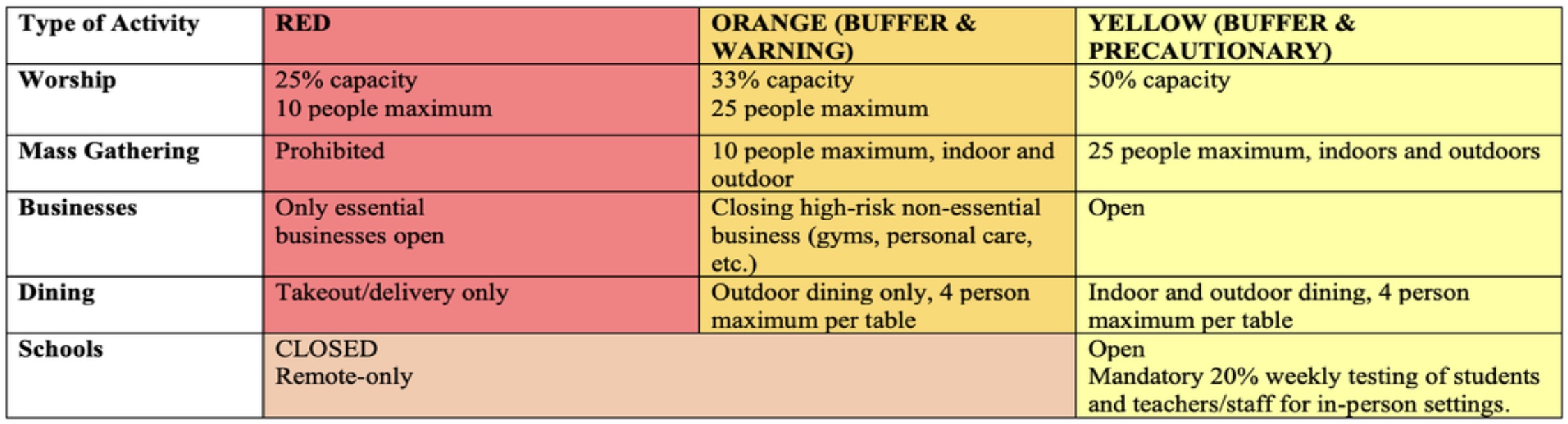
Should the local infection rate continue to go up, there’s a possibility that the Governor could designate that Scarsdale could be declared a Yellow Zone. If this occurs, the Village would need to enforce the following restrictions:
-Houses of worship to operate at 50% of capacity.
-Gatherings limited to 25 people, both indoors and outdoors.
-Indoor and outdoor dining limited to 4 people per table.
-Schools open but require mandatory testing of 20% of students and teachers per week.
To that end, School Superintendent Thomas Hagerman announced that the district is preparing to conduct COVID testing if necessary. In an email below, he says that the district has reached an agreement with Sovereign Labs to provide COVID testing for students and teachers if necessary. The PCR saliva tests will be analyzed at the Sovereign Lab in New Jersey and the cost will be covered by health insurance. The cost to any students or staff without insurance will be covered by the district.
The district will contact families and staff members for consent.
Here is the email from Dr. Hagerman:
District Covid-19 Testing:
The District has been engaged in a dual-pronged process for performing Covid-19 testing in the event it is needed as part of the Governor’s new micro-cluster strategy. As reported earlier, we have both (1) applied to become a limited-service lab and (2) sought contracts with outside vendors for independent testing. Both approaches have pros and cons. We are pleased to announce that we have made substantial progress on the latter. This week, we reached an agreement with Sovereign Labs (a division of Sovereign Health) to provide Covid-19 testing for District students and staff should it be necessary (i.e. being designated as a micro-cluster zone). The testing will be completed through a PCR, saliva test, which will be analyzed in the Sovereign’s genetic lab in New Jersey. The testing lab will use health insurance to cover the cost of the testing at no cost to individuals tested. Students or staff without insurance will have testing covered by the District. Test results will be shared with the District and sent directly to staff members/families, typically within 72 hours (total time for testing, shipping, analysis, and results).
Within the next week or so, the District will be reaching out to obtain family/staff member consent for Covid-19 testing. Since thresholds of testing are required for schools to remain open, it is important that there is broad cooperation between the District and the school community on this front. Currently, New York State is adjusting the requirements for micro-cluster testing, and, depending on that outcome, consent for testing may become a requirement for continued in-person learning. While there are many logistics to iron out, this testing protocol potentially provides a vehicle for us to stay open during this time of increased community spread.
- Edgemont and Scarsdale Schools Make Changes to Learning Plans for K-2 Students
- Restart Plans, Livestream Survey Results and COVID Testing from the Scarsdale Board of Education
- Opinion: Why Aren’t We In This Together? Tri-State Says it – It’s A Top Down Problem
- Students Make COVID Adaptations to Extracurricular Activities