








Edgemont and Scarsdale Schools Make Changes to Learning Plans for K-2 Students
- Details
- Written by: Pam Miner
- Hits: 3457
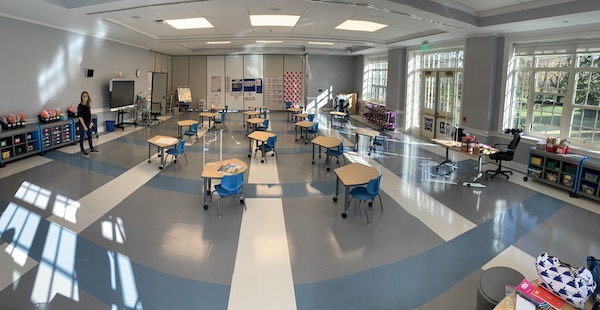 The Learning Commons at Greenacres Elementary School has been reconfigured to accommodate kindergarten students attending school full time. Photo Credit: Sharon HillAs the COVID pandemic continues to sweep over our communities, ongoing steps are being taken to adjust to the difficult environment. In recent weeks, both the Edgemont and Scarsdale school districts have come out with slightly different approaches to creating the best learning environments possible for its kindergarten through second grade students.
Edgemont makes changes to provide more support for K-2 students
Based on the results of focus groups with elementary parents and teachers and on surveys from parents about Edgemont’s elementary program, the District has announced a new plan for the Community’s youngest learners starting November 23.
Currently Edgemont teachers teach in-person, hybrid, and fully remote students from their classrooms. Students are split into AM/PM groups that attend school every day for half the day, while spending the rest of the day in a remote learning setup. It’s been determined, however, that Edgemont’s youngest learners need more support with remote learning, and that they would greatly benefit from having a teacher dedicated to them instead of one who is also trying to balance in-person and hybrid students.
Moving forward, the District will reallocate some members of the existing teaching staff so that remote-only students in grades K - 2 will have teachers dedicated solely to them. This will require a transition for remote-only students in particular, but the District believes the benefits of this change will far outweigh the challenges. Starting November 23rd, remote-only students will have a new classroom teacher. Special-area teachers will remain the same. These reallocated teachers are appropriately certified and are currently in other roles in Edgemont.
How does this affect in-person and hybrid students?
Hybrid teacher placements will remain the same, and these teachers will have more time to dedicate solely to the students who attend their physical classrooms in the AM/PM cohorts.
In the event that a “hybrid” student must quarantine, they will continue to receive remote instruction from their assigned homeroom teacher.
Edgemont is not able to offer an opportunity for all K - 2 students to return due to space constraints and health/safety concerns, but they are still working out the details of plans to safely bring additional K - 2 students to a brick-and-mortar setting. According to one Edgemont parent of a second grader, “We are very happy that Edgemont has decided to provide additional support for on-line learning. We realize there will be a transition period, but we’re confident that this change will work out really well for our kids...and for us parents too!”
Scarsdale takes different approach, returning Kindergarten-Second Grade to full time in person learning starting November 30th
Whereas Edgemont has space limitations that keeps it from bringing back all K-2 students, the Scarsdale School District will offer all kindergarten through second grade currently in the hybrid program a return to full days of instruction in school. On Monday November 30, K-2 students at Edgewood, Fox Meadow, Greenacres and Quaker Ridge will begin full time instruction, creating more opportunities for student to teacher connections and student to student connections.
However, the plan has been delayed a week at Heathcote where an exposure to COVID caused 35 staff members to be quarantined. In a November 24 email from Superintendent Thomas Hagerman he explains, “Heathcote was required to quarantine 35 staff members, representing nearly 40% of all faculty and staff. This included the full custodial team, a number of cleaners, some teachers, and many teaching aides. While we have been able to run school this week, it has been extremely challenging, and only possible through the hard work and flexibility of our staff and the fact that K-2 students were remote to allow for the transition to full-day instruction after the Thanksgiving holiday. The majority of the quarantines necessitated by recent cases will end on December 3rd, reducing the staffing challenges (assuming there are no additional quarantines). As such, we will need to delay the start of K-2 full-day school at Heathcote only until Thursday, December 3rd. From November 30th through December 2nd, K-2 at Heathcote will move to remote learning. All other elementary buildings are expected to start K-2 full-day on November 30th as previously planned.”
Despite another exposure at Greenacres that was reported on Wednesday November 25, the district will move ahead with the plan.
To accomplish this while maintaining social distancing, the district has reconfigured large group spaces to create more classroom space. See photos above and below of the Learning Commons at Greenacres reconfigured for kindergartners, courtesy of Greenacres Principal Sharon Hill who said, "The teachers have done an amazing job transforming these large spaces into inviting learning environments for the children."
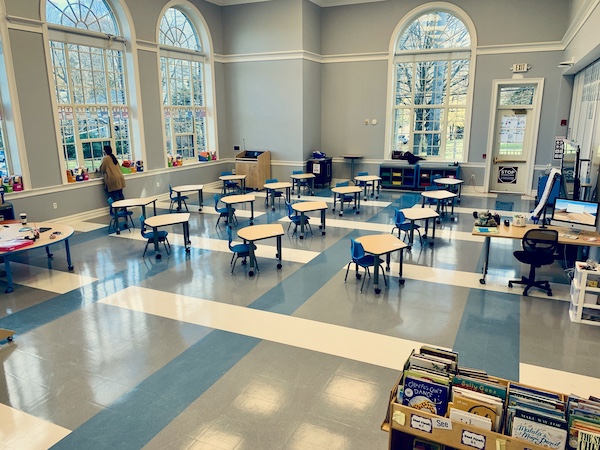 Greenacres Learning Commons with socially distanced desks
Restart Plans, Livestream Survey Results and COVID Testing from the Scarsdale Board of Education
- Details
- Written by: Joanne Wallenstein
- Hits: 3427
 (Updated November 18, 2020) Live attendance at the November 16, 2020 Board of Education meeting was limited when the district received a last-minute advisory from their attorney to allow only 50 people in the SHS auditorium. As a consequence, only a few attended the meeting, but the Board did permit public comments from both the attendees and those online via Zoom. Participants who watched from home were frustrated by technological issues with both the television transmission and livestreaming of the meeting. On television a loud scratching sound drowned out the speakers and many experienced frequent screen freezes on the Zoom version and were not able to see the meeting participants.
Furthermore there was confusion over how to watch and comment via Zoom as the district did not include the livestream link in their email to the community and it wasn't clear that one couldn't actually "watch" via Zoom too.
Here’s what we were able to hear about the Restart Plans.
The district previously announced that grades K-2 would return to school full time on November 30. This was greeted as good news for the youngest learners but left those with children in grades three to five in fear that their kids would not see full time school this year. It appears that the surplus spaces in the schools such as gyms, cafeterias, libraries and learning commons are being reconfigured to house cohorts in grades K-2.
Staurt Mattey said that the district is now looking at other potential space solutions including modular classrooms (trailers) or the use of available spaces such as the French American School building at St. Pius Church that is now available. However the presentation from the architect at the meeting seemed to show why neither of these options would be available on a timely basis.
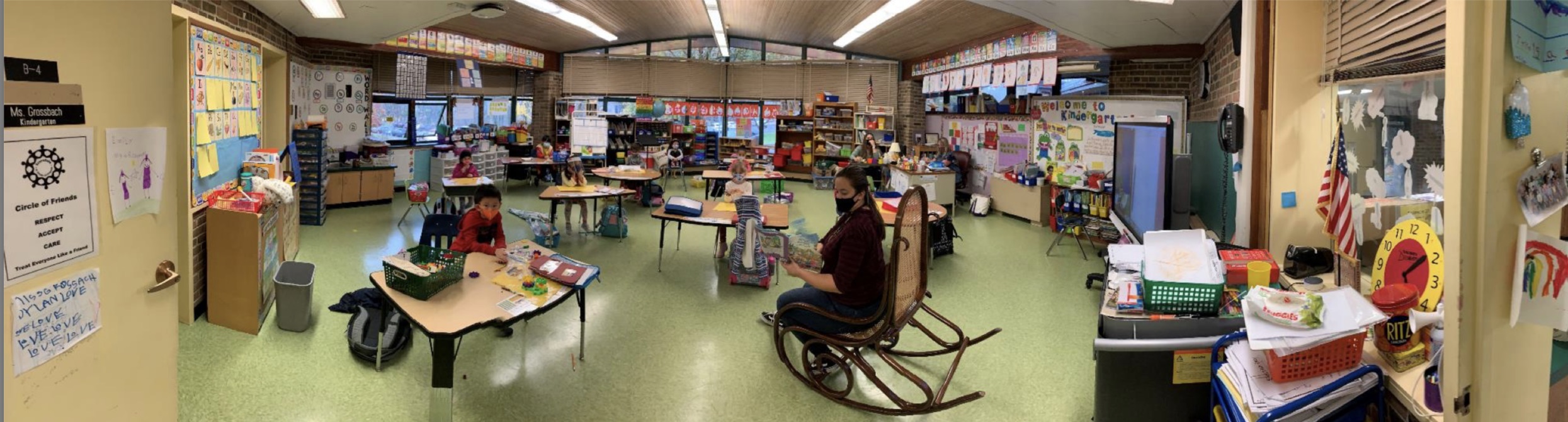 A socially distanced classroom
In an effort to explain how the schools have been configured to comply with the social distancing requirements, Assistant Superintendent Stuart Mattey invited architect Kevin Walsh from BBS architects to share his schematics for the layout of two sample elementary school classrooms, one at Heathcote and another at Edgewood.
Walsh showed how desks have been placed to be six feet apart, with 56 square feet of space per occupant. The layout must allow for two means of egress from each classroom. For a classroom of 785 square feet, 14 students can be accommodated along with a teacher and an aid. Depending on the number of teachers and aids, an additional student or two can be added.
He explained that there also needs to be room for proper access to both sides of the doors. Though they cannot use hallways for instruction, they are permitted to use gyms, cafeterias and music rooms for general instruction and all spaces must meet building code and requirements from the NYS Education Department.
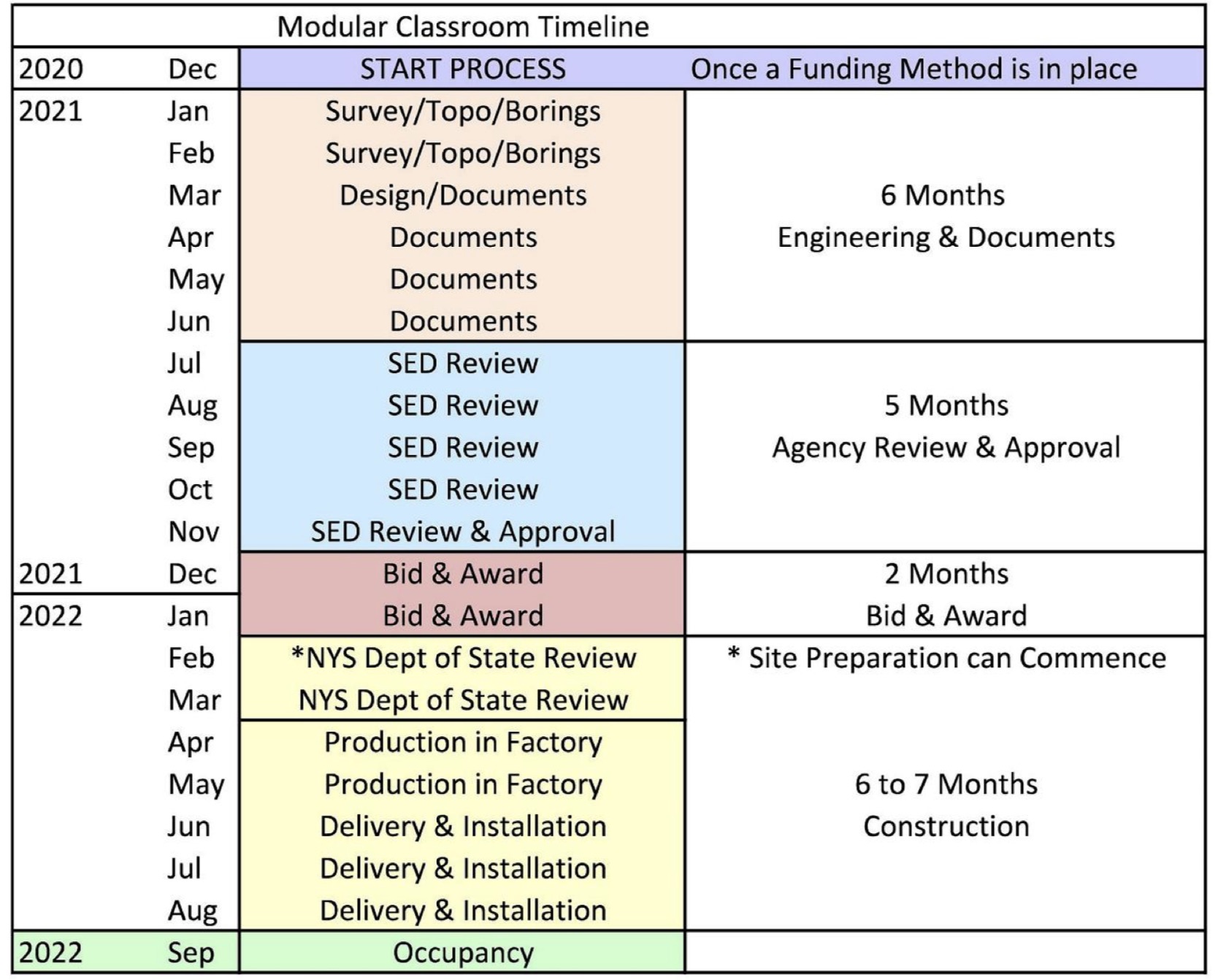
Walsh then turned to requirements for using modular classrooms. He showed a timeline to get approvals and build modular classrooms or trailers that would extend from January 2021 to August 2022 and estimated that they would not be ready for occupancy until September 2022. Furthermore as there are 50 classes of third through fifth graders, Mattey estimated the district would require 50 trailers to house the cohorts of the classes at a cost of $7 million. In order to apply to the State Education Department for permits, the district would need to demonstrate that it had $7 million in hand to underwrite the cost. This would require a bond referendum which is usually a lengthy process.
Board members asked how private schools and other districts had secured and installed trailers so quickly and Walsh responded, that he was “not sure” how they had done it. Others asked if any trailers that were already approved were available for purchase.
Asked whether other district spaces like the high school gym could be reconfigured to accommodate elementary school students, Eric Rauschenbach pointed out that though indoor space might be available it is not necessarily suitable for building multiple classrooms. He pointed out that issues with acoustics could make it impossible for instruction if hundreds of children were housed in one open space.
COVID and Testing
Dr. Hagerman reported that so far this school year the district had a total of 13 positive cases due to community spread or contact from after school sports programs. As of November 16, 120 students and 22 staff members were currently in quarantine due to exposure.
Rauschenbach explained that the state is now designating areas with increasing positivity rates as yellow, orange or red zones, each with different requirements. For instance, Port Chester has had a 3% or higher positivity rate for the last ten days and is therefore an orange zone.
Schools in a yellow zone are now required to administer COVID tests to 20% of the school population, including teachers and students each week. The results must be lower than the wider community or the district is required to continue to test. Schools in orange and red zones must close for 4 days. To return to school they have to test 20% of the population and get results at less than 3% positive.
In order to prepare the district for this potential scenario Rauschenbach has started looking into how the district could administer the tests. He is currently investigating two options:
One, the district would apply for a permit to make themselves a limited service laboratory and they would administer and evaluate the tests at school. In preparation, they have already filled out the paperwork to get permission.
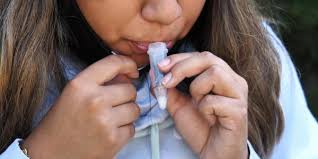
The second option is to make an agreement with a local lab to do the testing and analyses of spit tests. The district is currently in discussion with a lab that would supply collection kits which the district would distribute to the students/staff to take home and collect spit samples. These would be returned to school and the district would send them to the lab and receive results within 24 hours. No additional staffing at the school would be required.
Federal law requires that insurers pay for COVID tests. So in order to pay for the tests, parents would sign onto a portal to provide health insurance information and their insurers would be billed for the tests. The teachers’ tests would be underwritten by their health insurance. If a student was uninsured, the district would underwrite the cost of the test at $100 each.
Rauschenbach explained that this was preliminary information and he would provide further details when he has them.
Livestreaming
Livestreaming to the at home cohort was tested at Scarsdale Middle School and Scarsdale High School. Following a two-week test period both schools held focus groups and issued surveys to students, parents and teachers to determine whether or not livestreaming was effective.
Scarsdale Middle School Principal Meghan Troy reported the following:
The student survey was administered in school and 1,095 students responded.
The parent survey included 323 parent responses.
Faculty met in mixed curricular focus groups to discuss the benefits and challenges of this model.
Here were the takeaways:
Over 50% of parents and students think that synchronous engagement of the at-home cohort, helps students better understand directions to assignments, work and activities. This was also noted by the faculty who identified this tool as a touchpoint for students and a way for them to ask questions about asynchronous work.
48.5% of parents and 37% of students felt that it helped students better understand content. Some faculty saw this model as an effective tool for delivering content as well. Math teachers were most supportive of this statement.
42% of parents, and 32% of students felt that it helped build relationships. Faculty cited that it helped students see their classmates on a regular basis.
Just over 50% of students, and 46% of parents felt that it was too much screen time. The faculty also noted this as a concern and saw a need to balance the time on and off screen.
41% of parents and 28% of students prefer to synchronously engage. Students identified concerns over completing their asynchronous work as a major reason why they would rather not engage in live streaming all the time.
Throughout the survey, a large number of parents and students lived in the middle neither agreeing or disagreeing with a statement. This is an indicator that it might be too early for people to make an informed decision.
Benefits
There were many benefits identified by all groups who were surveyed. For students, the number one benefit was that they can get their questions answered by the teacher in real time. A close second was that they could learn more and better understand the content. They found it to be helpful to have directions explained by the teacher rather than reading them on their own. Faculty agreed with this assessment and felt that it provided a structure and level of accountability for students.
Challenges
The biggest challenge identified by all groups was technology. Students and faculty shared that zoom calls are dropped, “glitchy” or lagged behind. A number of people expressed concerns about the audio in a classroom which made hearing from home difficult. Another challenge shared by students and parents was related to the schedule and not knowing when to join a call. This is something the faculty discussed as well. They shared that clear communication related to the schedule would be necessary going forward. The faculty identified student attendance as a challenge which may be related to the scheduling issue.
There were also responses from all groups who expressed concern about the impact this would have on our special education and ENL schedules given they come to school more frequently than other students. Faculty also worried that their attention was pulled from their in-person students and shifted to the at-home learners. Some expressed concern that our virtual-only students would not be prioritized with so many other at-home students joining.
Conclusions
The survey results support our understanding of middle school students and where they are developmentally. Students are still in a place where they need structure as they develop their executive functioning skills. They are in a place where they have questions. Often, these questions are about assignments and directions. And, while we are moving them to a place of independence, most are not quite there yet. The results also support the idea that certain subject-areas are able to present content through this model more easily than others. Math being one example. Finally, the survey highlights the need to balance screen time for students.
Scarsdale High School Principal Ken Bonamo
The report about live streaming from Scarsdale High School Principal Ken Bonamo was not as positive. He reported that after a trial period of Zooming to the at-home cohort when the other half was in school they did a survey on November 5-6 and received responses from 113 teachers, 1,175 students and 507 parents.
They found that 68% of teachers and parents, and 81% of students disagree that cross cohort streaming was effective for learning. The majority said that streaming does not help students manage their time better with 69% of teachers, 68% of parents, and 85% of students disagreeing or strongly disagreeing that it helps with time management. 81% of teachers, 66% of parents, and 67% of students reported that the in-person experience is negatively affected by live-streaming and diminshes the in-person school time for students in school.
The biggest problem reported with streaming was the audibility of the students in the classroom, with concerns about screen time a close second.
Of all the subjects, math had the highest score for suitable for streaming. As a result of the surveys, teachers are using the data to make informed decisions on how streaming will and will not be used. Bonamo said that streaming will not be used in world language, gym or music classes as these are performance based classed. In art classes, students have been assigned projects and do not need cross cohort streaming. It is not needed for LRC classes as these students already have additional in-person time on Wednesdays. For English, Social Studies and Health classes, livestreaming will not be a regular feature but will be kept as an option to connect. Math and science teachers seem to be the most likely to use it.
Bonamo concluded that "a targeted use of cross-cohort streaming will achieve a balance between appropriate student engagement and curriculum coverage against the commitment of students to be on computers for many hours."
K-2 Transition
Assistant Superintendent Edgar McIntosh discussed the transition to full time in-school learning for grades K-2. He said, “We are working on the shift from hybrid to in school, especially with the special teachers for music, art and Spanish.” He said, “The necessary furniture has arrived,” and teachers will meet with colleagues at Bronxville and Chappaqua to learn from their experiences. Grades K-2 will be all virtual on Monday and Tuesday before Thanksgiving to give teachers time to adapt the spaces. During that time there will be special sessions for the children, including cultural and diversity learning activities led by PTA leaders across the district.
Audit
The district completed a financial audit. An auditor from Buffalo was Zoomed into the meeting and certified that the district was in good financial shape. He did note one area of non-compliance. At the end of the fiscal year on June 30, 2020 the district's fund balance exceeded the 4% permitted by New York State, and stood at 4.28%. However the auditor noted that this was merely a timing issue as the closure of schools in the spring prevented the district from expending the excess funds. In the summer the district transferred the excess to the general fund and used it for COVID related expenses.
Code of Conduct Changes:
The Board accepted changes to the district's Code of Conduct to "include language that mirrors the Title IX policy revisions reviewed at the November 2nd Board of Education meeting and allows for incidents not meeting the burden of Title IX to be adjudicated through the Code of Conduct and DASA. Additionally, the Code was amended to add violations of the COVID health and safety procedures to the list of prohibited behaviors." This will allow for those who do not follow COVID safety protocols to be disciplined.
In the discussion that followed, Suzie Hahn of the LWVS asked if the Board had considered any changes to the Code of Conduct as it relates to remote learning –- for instance code that would bar participants from exhibiting behaviors like juuling or wearing inappropriate clothing during ZOOM learning sessions.
Public Comments
Here is a summary of the public comments made in-person and via Zoom:
Irin Israel expressed confusion about the classroom plans presented by Kevin Walsh of BBS. He said he had submitted plans that would allow for more children in the classrooms and said, “it is unlikely that they all have three aids.” He asked, “Why is St Pius being examined just now? He said, “No parameters were set to move from hybrid to full time. I urge all stakeholders to rectify this issue and define the metrics for a full time return to school. It worries me that my kids won’t see full time school this year – and maybe next.”
Bob Harrison urged the Board of Education to approve the inter-municipal agreement with the Board of Trustees for a comfort station at Scarsdale Middle School. Later at the meeting, the Board voted yes.
Sharon Chesler thanked the Board for “figuring out how to get our littlest learners back to school.” But she said, “When I asked about this at the beginning of the summer we were told we didn’t have the room or the staff. This builds mistrust. I ask you to get as many of the other grades into the schools. What is our maximum – let’s get those kids in. About timing – it takes until 2022 to get mobile units? Look into things earlier. This is frustrating – we were told no and now nine months later we’re starting the process.”
Jesse Timberger asked, “How can we get our high schoolers in the building more? How realistic are our plans? Is lunch an issue? Will the high school space be used for high schoolers or younger students?”
Beth Cukier thanked the Board for being thoughtful and careful as they brought kids back to school. She said, “the space plan helped us work within our reality. We should look into the short term and long term. How can we improve instructional models? How can we coordinate with Kids Base or the JCC to meet childcare needs? Are we looking at out of the box thinking? – what about nontraditional school hours?
Rachana Singh said she was “Happy K-2 will come back to school.” She asked, “What plans do you have for kids with high stakes IEP’s? What specific plans are you making for special education cohort groups?” She also asked that the restart committee plan be on the Board’s Consent Agenda so that she could hear yeas or nays.
Tara Sharp agreed with Irin Israel and said, there are “no metrics stated to get our children back in school. Smart creative solutions have been presented but we seem to say why things can’t work rather than figure out how they can work. It is vital we get our children back in school full time. I urge you to consider the plans that Irin Israel has presented.”
Suzie Hahn of the League of Women Voters of Scarsdale read the following taken from past LWVS consensus statements:
“In these challenging and complex times, the League of Women Voters of Scarsdale Board of Directors (the “League Board”) believes that proactive community engagement and the creation of spaces for dialogue among those of differing viewpoints are of vital importance to the decision-making process of the Board of Education (the “BOE”). As the League Board promotes the active participation of citizens in government, we encourage the BOE to be wide-reaching in soliciting input and feedback and to engage in more extensive dialogue with community members and groups to better and more fully understand the priorities and concerns of the community.
The League Board appreciates the work of the reconvened BOE Community Engagement subcommittee and the fact that the recent Nov. 12 meeting was made available to the public for live-viewing. The League Board further appreciates that the BOE will now allow public comment via Zoom even when the BOE is meeting in person. However, we encourage the BOE to clearly communicate, in advance, both the broadcast medium of upcoming meetings as well as clarify the ways in which the public will be able to comment at a given meeting.
In light of heightened community interest in the complicated issues currently before the BOE, the League Board encourages the BOE to create more engagement opportunities for all stakeholders and to promote a dialogue between the community and the BOE. Additional engagement opportunities are especially important given the BOE’s recently passed resolution to limit public comment to three minutes per speaker per comment session and to limit the overall time of the first public comment session.
The League Board recommends that the BOE solicit early interest in District issues, actively seek input from all residents to identify the range of community sentiment, and engage in clear and timely communication methods. We support a board process that is collaborative and builds community consensus from the ground-up. The League Board believes that a more complete picture of community feedback, combined with relevant expert opinions and research, will serve to enhance BOE decisions on complex issues as well as facilitate community understanding and appreciation of the schools. Thank you for taking our comments and recommendations into consideration.”
Follow up to Public Comments:
Stuart Mattey told Bob Harrison that now that the Comfort Station has been approved by both the Board of Education and the Board of Trustees, the application for the project could be sent up to the New York State Education Department and "get into the line" for approval.
In response to questions about increasing in-school hours for high school students, Eric Rauschenbach said, that the "current synchronous learning schedule allows for more learning time than students would have with a traditional a/b schedule in school. Right now teachers and students say that students are engaged in the learning they have. At this point we are not looking to upend that schedule."
And in response to calls for more in school hours for students with special needs, Rauschenbach said, "We have already taken many steps to increase hours for students with special needs. Our 8:2:1 class is in school full time. Our parallel curriculum students attend with both the A and B cohorts, and there are additional LRC’s in the high school on Wednesday and on the alternate cohort day at the middle school. ICT comes in on both am/pm cohorts."
The Board also asked Mattey to post the architect's presentation on line and you can see it here.
Opinion: Why Aren’t We In This Together? Tri-State Says it – It’s A Top Down Problem
- Details
- Written by: Joanne Wallenstein
- Hits: 4399
 This letter was writting by Diane Greenwald:
There is a saying about consultants, you give them your watch, so they tell you the time. Superintendent Thomas Hagerman just learned from his focus group/survey report, prepared by Tri-State Consortium, exactly what so many in the community have been saying since the summer. We need greater transparency about the decision-making process; improved communications; and we need ongoing and creative focus on students’ structured learning time. So now what?
I am heartsick by the divisiveness that is being fostered in this community. Someone needs to say it – every single parent out here is actually saying the same thing. I wish the Superintendent would notice it. There are no bad parents versus good parents – we are all concerned parents, reasonable parents who are thirsty for information. There is no silent majority or noisy few. And no one is against the teachers. In fact, I am equally heartsick to learn that teachers feel a similar top-down disenfranchisement.
Instead of working with stakeholders, our Superintendent and Board President speak in platitudes or not at all; often leaving blame to simmer. They leave major educational decisions to committees, who should instead be bringing their recommendations to the Board for public discussion and approval. Instead of creating collaborative connections, parents, teachers and students are ill-informed and in distant silos. Stakeholders are labeled, dismissed or pitted against each other.
But there is so much common ground to work with. We can seek more structure and instruction AND value student wellness. We can value teacher autonomy AND seek stronger partnerships during this crisis. We can value our teachers’ health AND hope for more in person (or structured) learning for our students. We can trust and admire our teachers’ skills AND appreciate accountability and communications. We can challenge assumptions and decisions AND be on the same team. We can advocate for our own children AND desire the best outcomes for all children.
The fact that so many new-to-the-mike parents are speaking out at Board meetings and that some Board members want to limit the format, well, it’s concerning. I get that meetings go very late, but limiting speaking is merely dealing with the symptom, not the root problem. The open mike is among the most effective communications tools available not only for the Board, but because it’s how stakeholders can hear each other. It ensures accountability and can create solidarity and understanding. There can be reasonable limits, but usually, by the time folks come to speak at the mike, they have likely already felt dismissed (or worse.) The issue is not the speakers or the length of their comments. The issue is that it is simply too hard to be heard (and understood) by District leaders.
And let’s be clear – spending 40 minutes on Board protocols rather than speaking about children’s education during crisis is tone deaf.
There are examples of great work going on – I know kids are learning, teachers are reaching their students with herculean efforts, our building principals are just plain awesome! But there are also too many examples of the District’s rigid focus on old protocols, underutilization of the community brain trust, and truly poor communications. While I hope this can change, it would take some soul-searching by the Superintendent and Board to adjust their approach.
I believe we need our leadership to focus on broad and deep understanding of our community values, not a collection of specific opinions, which will never be fully aligned. We need open-minded and empathetic problem solving, we need honest learning from successes and challenges, and a strong focus on the children.
Scarsdale has a history of providing programs not to meet the greatest demand or the middle, but to meet each child where they are. We fund small efforts despite the numbers because that’s what excellence is. (At least we used to.) That value should be filtered through every action now, every idea, every piece of input.
I don’t need a survey to know the following:
• We need a clear but flexible plan, with benchmarks, metrics and protocols.
• We need a big toolbox, not one size fits all, and employ their use with common sense. (that means that we buy state-of-the-art equipment, have live-streaming available, have plexiglass where needed, put up some tents or cover vestibules, rent space in unusual venues, build partnerships, train in new ways, etc… Throw it all in!)
• Support teacher autonomy and foster their creativity, their intrinsic motivation, with gratitude.
• Seek out scientific solutions in support of health/safety beyond State regs. (like creating an opt-in covid-19 testing protocol, testing wastewater, etc.)
• Use all community resources and expertise.
• We need public and full-Board oversight of major educational decisions.
• Raise additional funds for teacher and building support.
• Seek out best practices from other places finding success.
• Acknowledge the humanity in this endeavor, the difficulty for each stakeholder.
• Provide support where most needed and broaden horizons through non sibi engagements.
• Focus on the children, whose developmental impact is unknown but real.
• Communicate with care and honesty, not blame, and forgo platitudes and own mistakes.
• Love this brilliant, amazing community.
• Be the District of Yes!
Sure, there are some entitled jerks, lack-luster practitioners and even some obnoxious kids in this town, but that is not who we are, and I am tired of the divisive clichés used to make Scarsdalians seem unable to be satisfied. Scarsdale has strong teachers, eager students, hard-working administrators, engaged parents and a large tax base. We all want safety, quality instruction, creative solutions, honest dealings, transparent decision-making, support for our teachers, and loving kindness focused on our kids. We are worried about the kids. We are worried about this delicate ecosystem that is our home and workplace.
We lost time this fall not maximizing the good weather and are facing a winter that seems headed toward additional challenges. And we need to do better --- with our teachers, for our students and supporting each other. We need leadership to help us feel that we are in this together. That’s what time it is.
Respectfully submitted,
Diane Greenwald
Students Make COVID Adaptations to Extracurricular Activities
- Details
- Written by: Sydney Piccoli
- Hits: 2958
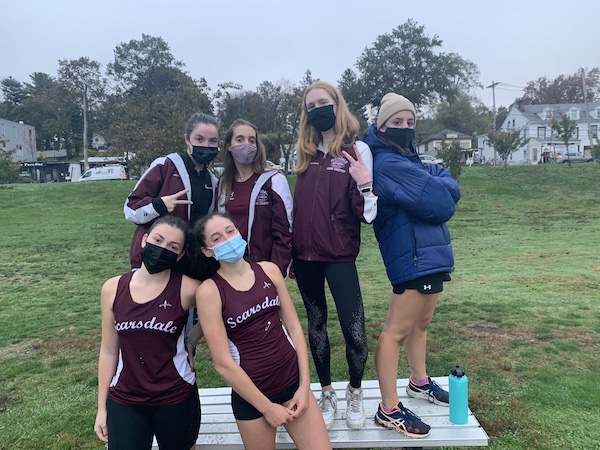 Cross country team wears masks when they run.Classroom learning is not the only school activity that has been forced to change due to the pandemic. Along with a shift in their core curriculum classes, Scarsdale High School students also face challenges participating in extracurricular activities, especially those that cannot be feasibly conducted via an online platform. From clubs to sports teams, Scarsdale High Schools students have had to formulate creative ways to remain involved in their beloved activities while conforming to safety requirements.
Sports
Whether Scarsdale High School students are able to participate in school sports depend on the nature of each sport. Tennis and cross-country teams are able to run as scheduled as they require minimal contact between players whereas the football and volleyball seasons have been postponed as they are more hands-on. The lack of sports for high schoolers has hindered them from experiencing a sense of community and joy that they miss on their academically orientated school days.
Even the sports programs that are in process have required modifications. The tennis team requires all players to wear masks the entire time, social distance, and use their own cans of tennis balls. Students must mark their balls with a sharpie to prevent the spread of COVID while wearing masks to prevent the spread through interactions with teammates. Going to tennis matches is more difficult now as coaches have to balance those parents who feel comfortable with their students taking the bus with those parents who would prefer to drive their children instead. “Overall, the pandemic has not had as big an effect on tennis as it has had for other team sports because, in tennis, players are generally more spread out. During the summer, SHS allowed residents to play singles on the courts as long as they reserved courts beforehand and practiced social distancing,” described Lilac Lin, a junior on Scarsdale’s Varsity Tennis Team.
Likewise, the cross country team has required all athletes to wear face masks during practice, making it more difficult for members to breathe while also maintaining social distance. Furthermore, the shorter season has limited the number of meets this year, which is especially devastating to upperclassmen. The parks where the teams typically race aren’t allowing meets to take place, and they have to compete on make-shift courses and school campuses. “The pandemic has made it much harder to participate in cross country especially because if one person gets sick, pretty much the entire team will be quarantined and we’ll be out for much of the seasons,” mentioned Sara Wong, a junior on Scarsdale’s cross-country team.
Other sports teams such as football have been postponed to the spring, leaving many students saddened by the news, but at the same time aware of the current circumstances. “At the end of the day, when I next get to play football is not a decision in my hands, so while it’s upsetting that I do not get to know when exactly that will be, all I can do is prepare in the meantime on my own and with my teammates for when that time comes,” reflected Julian Glantz, a junior on Scarsdale’s football team.
As many participate in sports to partake in an enjoyable activity while fostering a sense of community with their fellow peers, others see it as a path to the future. The pandemic has made it increasingly difficult for those eager to get recruited to play a sport in college as scouts are unable to see them demonstrate their abilities in-person. “Last summer, I was planning on visiting some college campuses and hopefully building some relationships with coaches. That of course did not happen. I also would have liked to have had some film from the fall season to send to coaches, but obviously no season made that impossible. Especially, considering the fact that there is high school football going on elsewhere, not having a season where we live is a major setback in terms of being able to make connections with coaches,” added Glantz ’22.
Although it is certainly different, Scarsdale High School athletes are thankful for the hard work and planning that the administration has put in to allow them to play their respective sports. “I’m grateful that the administration made the decision to continue sports because, even if we do not get the full experience, playing on a team is still rewarding in many ways,” concluded Lin ’22.
The Arts
Along with sports, the arts have been impacted in a number of devastating ways. Scarsdale High School’s Drama Club, which typically has weekly in-person rehearsals, has now had to adapt to rehearsing via Zoom. In order to produce their current play, Spoon River, they are pre-recording the show and then live streaming it. “The pandemic has made theater very hard to do because it makes it difficult to rehearse and you can’t have an audience. And [with] the way streaming rates work, we are not able to charge for tickets... When it comes to singing, it’s hard to sing in a mask. But actors are resilient and adaptable, so we figured out ways to make it work. The pandemic has really made me appreciate being able to perform,” said Isabelle Haller, an officer of the SHS Drama Club.
Scarsdale High School’s orchestra and band have also had to adjust to practicing via Zoom on 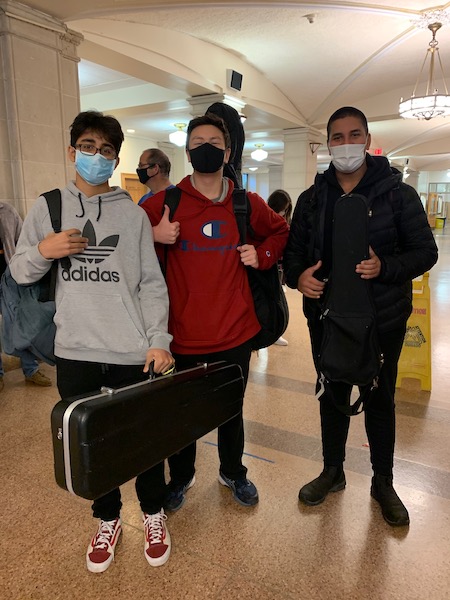 Musicians carry their instruments all day.school days; thus, it is increasingly difficult to produce music pieces as online platforms tend to lag and technology prevents a sense of community. Before the pandemic, the orchestra would all crowd into the small orchestra room four times a week and practice using school instruments as well as school music. Now, the orchestra only meets once a week in-person and every other week classes alternate having early morning rehearsals. They also must carry instruments and music to class to minimize high touch areas while maintaining a distance of six feet apart in the classroom. “With our concert coming up in about four weeks, no one feels prepared because that’s only four classes away. We are not getting as much group playing time and the majority of it is individual. The pandemic really does hinder our knowledge and relationship of/with, not only the music, but our peers and Mr. Williams,” described Alexandra McCarthy, a student in the orchestra.
Clubs
A majority of clubs, both academic and community service based, have had to switch to a virtual setting. For instance, Scarsdale High School’s newspaper, the Maroon, now meets weekly in a virtual setting to produce content for their website. As a result, it makes it harder for students who have recently joined the club to fully participate and gain an understanding of how the club operates. Likewise, the student government has had to move online and are unable to have their normal homeroom meetings because of the adjusted schedule. “[The pandemic] has made accomplishing goals such as raising money and bringing our classmates together more difficult because we are unable to have typical fundraising or community building events. On the other hand COVID has given us more causes and ways to help out with the events we are able to have and money we are able to raise,” reflected Peter Troiano, a house representative in the junior class government.
Whereas some academic clubs have only been affected slightly, the Speech and Debate Team has been altered immensely. The teams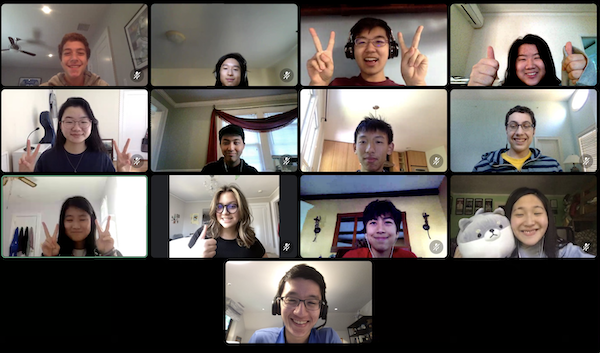 Debate team now meets via Zoom. normally meet twice a week in-person to practice their material, engage with teammates and prepare for competitions. Typically, they have overnight tournaments on weekends where they get to compete with public speakers and debaters in other states, allowing them to meet high school students in new places. Since the coronavirus broke out, students are unable to attend the tournaments that make the team, in large part, so special. Rather than traveling on a plane or bus to other states, they now travel to their bedroom desks where they engage in virtual tournaments that often have technical issues and a lack of moral support from team members. On a positive note, this has made debate space more accessible to competitors whose schedules or resources precluded them from traveling.
“I think the team has been affected in many ways by the pandemic, one of them being the actual team dynamic. It’s much harder to actually connect with new members and old members through the impersonal Zoom meetings. Additionally, it has become slightly harder to engage new members in the material that is being taught,” mentioned Caroline Shi, an officer for Scarsdale High School’s Varsity LD Debate team.
Likewise, Model United Nations (MUN) has been negatively affected as the team is unable to travel to conferences and meet people from all around the world. “Our club is not just conferences and weekly meetings, but also the community involved. In a typical year we host dinners and other out of school events to strengthen the community bond. This is virtually impossible this year,” stated Lindsey Smith, an officer of Scarsdale MUN’s team. MUN is planning their first in-person meeting this week by separating the cohorts and making sure they meet in a large space such as the Learning Commons.
It is certain that the pandemic has made it difficult for SHS students to participate in extracurriculars ranging from sport teams to clubs. However, it has also allowed students to explore passions from their own homes and learn how much they truly appreciate their activities.
"Silent Majority" Rallies in Support of Teachers, Administration and BOE at October 19 Meeting
- Details
- Written by: Joanne Wallenstein
- Hits: 4142
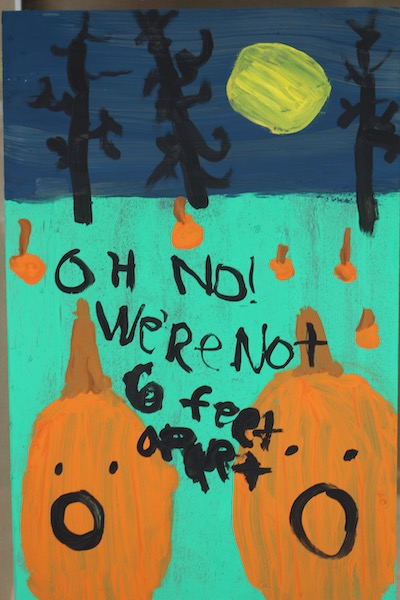 The tone of the October 19 meeting of the Board of Education was a big departure from the tenor of the October 5, 2020.
At the October 5 meeting, parents were sharply critical of the district’s hybrid schedule and asked how and when students could return to more in person learning. At this week’s meeting, students and parents rallied in support of teachers, the administration and the Board of Education, a few calling themselves “the silent majority.”
Perhaps in response to parent’s concerns about unstructured time and synchronous learning hours, on October 15, SHS Principal Ken Bonamo announced that teachers would begin to experiment with live-streaming classes to the students in the cohorts at home. If implemented on a permanent basis, this will allow teachers to move more quickly through the material as they would not have to repeat lessons on consecutive days to cohort a and cohort b.
However, this announcement raised new alarms and brought many students to the Board of Education meeting to express concerns about excessive hours of screen time, Zoom fatigue, vision problems and mental health issues. The students were concerned that if they had more time online, they would not have enough time to complete the asynchronous assignments.
The public comments session opened with a statement from the President of the Scarsdale Teacher’s Association David Wixted who noted that STA officers do not typically make statements but cited “extraordinary times” with “tremendous stress to us all.” He assured parents, the Board and the administration that “the educators of this district are doing everything possible to provide excellent educational experiences to students in this time of pandemic.”
About COVID he said, “Any reading of the news makes clear we will again confront a surge of the virus’s spread. Indeed, the events of the past weekend demonstrate how close the threat of the virus remains. Rightly, this district has asserted as a priority the health and safety of all working within its schools, students and educators alike.”
Discussing the agreement made this summer on the current hybrid plan he said, “with an eye on the coming school year, and through ongoing deliberation among the professional educators collaborating with stakeholder groups, over the summer the district devised a series of plans for school restart. These discussions unfolded while we awaited directives from Albany. These deliberations were challenging and contentious because priorities were often in conflict. Over the summer, the STA, concerned with the well-being of students and faculty, argued for a commitment to remote learning.”
“This district’s faculty has been and remains committed to answering the question of how to make instruction come alive in the minds of students. Let there be no doubt about this. The educators of this school district have dedicated themselves to planning meaningful and coherent learning experiences within unfamiliar modalities.
However, Wixted said, “Since the start of the pandemic in March, the teachers of the school district have tuned into the broadcasts of Board meetings. They know in these exceptional times, listening to the tenor of the community’s conversations with the Board is important. In recent weeks, teachers, especially at the secondary level, have heard increasing criticisms for what is being provided along with calls for the ‘live streaming’ of classes. They have heard speakers defining the education offered by Scarsdale teachers as being ‘less than’ that found at other school districts-- that teacher efforts can be defined through classroom hour counts and opportunities for students to live stream.”
He continued, “I mostly worry that the practice will place additional strain upon teachers now required to engage three audiences at once-- the students in the room, the students learning remotely, and the off cohort students. I worry that the practice of live streaming will diminish the educational experience everyone receives.”
He concluded, “When I came to Scarsdale thirty years ago, I remember being struck by the degree to which the professional educators-- teachers and administrators-- were trusted to make the decisions about what is in the educational interest of students. There was faith that the instruction provided to students was grounded on sound pedagogical principles, and that we could be relied upon to provide the learning opportunities students needed. Over the years, at the heart of this extraordinary district has been this spirit of trust.”
(Read his full statement here.)
Before public comments could begin, the Board passed a resolution to limit public comments to 3 minutes as they have been having difficulty completing their work due to the length of the public comments.
When Board President Pam Fuehrer announced public comments, speaker ran to the stage to line-up. She asked them to maintain social distance and to allow the students to speak first. Many students spoke about the change to allow cross-streaming to the at home cohort from high school classes.
The students expressed concern about the increased number of hours they would be on Zoom, the strain on their eyes and the risk to their mental health. The co-editors of the high school publication Maroon, Leah Breakstone and Ariel Weinsaft, reviewed the 550 responses they received to a student survey.
They reported that 64.1% already spend 6 hours on screen each day under the current model and 87% do not feel that live-streaming will improve their education. 86.5% believe it will have detrimental effects on their health and well-being and 94% are not in favor of the new learning model.
The only reason they heard in favor of it was, “We have the least live instruction in the county and we could possibly get through more of the curriculum.” However they received 330 responses against it. They said learning quality will diminish significantly, it will be unproductive for the class and teacher as the teacher’s attention will be divided and that the plan does not have their well-being in mind.
Many students followed suit with pleas not to live stream. They had many comments about live streaming and agreed they did not want cross cohort streamed classes. They said it was difficult to see and hear the teachers, that more screen time could cause eye strain, blurred vision and myopia and that they needed their free mornings to complete their schoolwork. They were worried about their mental health and also questioned how the decision was made.
Many parents also attended the meeting with a mixed range of comments.
Jonathan Coevary, father of a high school freshman and senior gave a blistering criticism of the administration and the Board of Education saying there were in a state of “paralysis.” He questioned the need for focus groups, saying “Our kids are being shafted…. Since when do you have the authority to delegate your authority to the outcome of a focus group? The super majority wants in person learning which is a fundamental right and not subject to the whims of focus groups and irrational panic… Do you think everyone is here because they enjoy being involved with the school board? No, they are here because you are in over your head. You don’t know what you are doing and this has immediate consequences for our children. Enough already. To be blunt – you are not picked for this moment and you are ill suited for this moment and I am here frankly to call for your resignations.”
Sheryl Felton was “grateful for the education you have provided under unprecedented circumstances… the small classes have been wonderful – a true educational gift. My daughter is learning to use time management skills and on Wednesdays she enjoys meeting with teachers through tutorials. I have spoken to many who feel the same way. I feel we are the majority and have not been heard.”
Lisa Copeland said, “I haven’t come before the Board before because I am satisfied. The plan makes sense and of course it needs tweaks.” About the teachers, she said, “it breaks my heart to hear how hard it has been for them. Many people feel the way I do. Call us the silent majority.”
Theresa Maldonado, a physician expressed concern about children’s mental health and warned about “depression from screen time, reduced physical activity and interrupted sleep patterns.” She said, “Attending school via zoom all day is isolating and lonely. … why are we so focused on the quantity covered when we are living through a pandemic?
Diane Gurden highlighted the need for more in person instruction. She said, “We have only 20% in person learning… everything that is remote is 80%. That’s our challenge.
Kim Liebowitz, also a doctor, asked the Board to assign a medical advisory board that includes an epidemiologist. She said the district needs this board to set a testing protocol and volunteered the many doctors in the community to participate. She said, “I like the live streaming for my kids…. They need more structure.”
Roger Neustadt commended the few students who stayed to listen to what everyone had to say. He warned the students who had used social media to gather signatures against live streaming that they had included people from outside the community.
He said, “I wonder if you know what you are opposing…. It’s not a choice between livestreaming and in person. If live-streaming increases, asynchronous work should decrease. How will juniors taking pre-calculous be ready for calculous next year?
Livestreaming is being done across the country… Let teachers make independent decisions to try what may work for their students. Trust the teachers. Let them try new things in an untested time.”
Rachel Arenstein said “I was disturbed by the tone and vehement demands at previous meetings. It is not a perfect time. Teachers are creative and have adapted to childrens’ schedules. I would like to see us give the teachers time to adapt.”
Allison Kahner said, “I hear a reaction to a change – and it’s fear. If live-streaming had been rolled out from the beginning this reaction would not be occurring. Asynchronous work can be adjusted. If the asynchronous work decreases there will be time for livestreaming. It seems to be an effective compromise.”
Sarah Hopkins said, “staying at home comes at a cost. … fewer kids are going to be identified for needing services, fewer kids are going to read and write… the mental health risks are huge. Elementary school children need more in person learning. We need COVID testing in the schools. Why has it not been entertained here? We’ve done lice checks, scoliosis, flu shots – we can consider COVID testing. Also the board should hold their meetings via zoom so elementary school parents can speak as well.”
Lori Weiser who is an orthopedic surgeon said, “This is a horrible disease. I want to thank the teachers and the administrators. I am sure you are all doing your best under these trying circumstances. I am here to make sure that a vocal minority does not steamroll over everyone. Back seat drivers should stay in the back with their mouths closed. I would hate it if someone told me how to do my job.”
Jessie Timberger thanked the board and cabinet members and the teachers. She said, “Communications have improved and they are appreciated. I know we are all being asked to do unsustainable things. One teacher met with my child three times in person and 14 times on zoom. Is there any plan to increase the schedule for high schoolers – such as two days at SMS or split days at the elementary school. I know how difficult this is.”
In the second public comments section Stephanie Israel said, “The rollout of livestreaming was done on an ad hoc basis. Before the announcement was made the district failed to develop a protocol for synchronous and asynchronous learning. This was done without proper enhancements to microphones. We are not setting up livestreaming for success. Please strive for better communication and structure.
I feel we are only addressing our most senior learners. We need more livestreaming for the littlest learners. The student’s expectation that the plan rolled out in September would be static is not realistic. A one size fits all solution will not work for our community.”
Focus Groups and Surveys
In his opening statement, Superintendent Hagerman explained that the Tristate Consortium is conducting independent focus groups to illicit feedback on communications, curriculum, instruction and assessment. Building level committees are developing surveys for faculty, students, teachers and administrators to get feedback from each stakeholder group. Through these surveys the district will be able to assess the hybrid learning program by level. He hopes for a high response rate so that the district can consider the full communities experience with the hybrid model to date. The data will give the district information on where they should further focus their efforts for future improvements.
Restart Notes
Eric Rauschenbach provided a recap of the one-day school closing at Quaker Ridge, and the positive COVID case following the PSAT exam at Scarsdale High School. About the quarantine after the PSAT test, Dr. Hagerman said that the students who took the test were all Scarsdale students and they were separated by cohort.
In response to audience questions about COVID testing, Rauschenbach said that public schools cannot force students to take COVID tests. He said voluntary testing was cost prohibitive. Board member Ron Schulhof said if cost was the reason the district is not testing, he would like there to be further discussion. Rauschenbach said he would get more information.
Discussing the quarantine, Rauschenbach explained, “Sometimes the Department of Health changes course if they find out they had the wrong information. But if there is a positive case or travel to affected states, 14 days are required -- a full 14 days of quarantine. This is not something that the district determines.”
Board member Amber Yusuf asked what was planned for the elementary schools; if it was taking 1.5 hours to clean the schools between cohorts and if some of the larger spaces could be used to accommodate more students. Stuart Mattey said the one and half hours was required for cleaning. Rauschenbach said these items were under review and Dr. Hagerman said that enrichment blocks on Wednesdays were also being discussed for elementary school students. On November 16, students who had chosen all virtual learning will have the choice of whether or not to return to in person school and that will affect the class sizes.
Assistant Superintendent Andrew Patrick said that the district has a matrix of factors and conditions, that if met, would allow more students to return to school. These include spacing, furniture, ventilation, lunch facilities and more. They are working through these questions.
Patrick reassured the group that livestreaming was in a “period of exploration of synchronous home cohort engagement.” He said, “During the next two weeks middle and high school teachers will try at least one from a range of strategies of engaging their home cohort students simultaneously to in person learning.”
Patrick continued, “There are legitimate concerns along with some fear about how this will disrupt what is in place. We are approaching this with authenticity and an inquiry orientation and there will be both formal and informal feedback channels to gage these experiences. The faculty and administration will establish norms for how best to engage the at home cohort that takes the feedback into account.” (Read more about cross streaming here.)
Board member Carl Finger asked the cabinet to think about how to better explain their decision-making process to the community. He feels that many cannot see the discussion and process behind decisions like the one to experiment with livestreaming. Rauschenbach agreed, saying “Sometimes it’s hard to figure out the right information to share without sending out something that looks like a doctoral dissertation. Patrick added, “We all have so much more to do than we did before COVID, that it’s sometimes hard to think about communications.”
Athletics
Athletic Director Ray Pappalardi reported that this week the coaches brought the two cohorts together to form teams. The Junior Varsity teams finalized their rosters and the competitive season has begun. He said, “We are pre-registering families who attend games so we have their information for contact tracing.”
Video About Hybrid Experience
In order to give the board and community a look into how hybrid learning is going, the district produced a video about the hybrid model, which you can watch here. It includes interviews with a group of teachers talking about their experiences the first few weeks of school. Here are a few comments from the film:
Fourth grade teacher Shoshana Cooper discussed how she modified the curriculum to emphasize the fundamentals, major concepts and big ideas and worked on home assignments to give kids opportunities to practice what we did in the classroom.
First grade teacher Lisa Pomerantz said, “Kids adapt to change. They find it fun and exciting.”
Middle School Science Teacher Benjamin Drexel showed how he divided the work into two-week sections. He said, “Students work on their own and come to class to discuss what they have learned.”
A kindergarten teacher shared, “Kids came in ready to learn.” A virtual second grade teacher said, “We hold onto what we are passionate about teaching. We are doing this through Zoom. In my class, we have students from three different schools. It’s a different way to plan. I have to think broadly.”
Middle School Science teacher Talya Holtzer said, “As a science teacher, the biggest challenge is to figure out how students can do labs at home. We are using materials students can find at home to do experiments at home.”
Tenth grade special education teacher Meghan Mead said, “We have to send home engaging and authentic work and train the students to get in touch if they need help…. Students are forced to grow and teachers are forced to look at different ways to teach.”
Shoshanna Cooper added, “This has allowed teachers across the district to collaborate. It has pushed us to be better teachers. It has forced the students to be more independent.
Board member Karen Ceske thanked the teachers for the video and Ron Schulhof said, “I though the video humanizes the way the work goes on.” Carl Finger said, “Several of the teachers said we know what the students need to be ready for the next grade. We are planning to be sure that they are ready.”
Financial Report
Stuart Mattey provided a report on district finances. It was interesting to note that as of June 30, 2020, the fund balance was $4.4 million higher than June 30, 2019. Expenditures for the 2019/20 school year were $5.2mm less than the budget. As a result, the district finished the year with $6.95mm in the unassigned fund balance, which is about $400,000 more than the 4% maximum permitted by state law. Mattey said these excess funds were used for COVID related expenses to open the schools in September.
Title IX Regulations
The Board reviewed proposed changes to the district’s Title IX regulations based upon regulations issued by the US Department of Education. These changes “reflect input of a group of actively engaged students from Scarsdale High School.
Here is a summary of the changes, The entire document can be reviewed here:
Standard of evidence:
Preponderance of the Evidence (rather than clear and convincing evidence—under the new regulations it needs to be the same for both student and employee respondents)
Determination of Responsibility:
Question and Answer method (rather than a live hearing with cross examination—as a reminder the complainant and the respondent are permitted to have advisors who could be attorneys for each phase of the Title IX grievance process)
Key Players:
Title IX Coordinator(s) who is/are appointed by the Board and empowered to organize a team of administrators to carry out the District’s responsibilities under Title IX including: Investigator(s), Decision Maker(s), Facilitator(s) for Informal Resolution when a formal complaint is filed, and Appeals Decision Maker(s).
Impacted Policies:
Policy 0100 (Equal Opportunity) and Policy 5020 (Equal Educational Opportunities) do not require any changes.
Policy 5300 (Code of Conduct) it is recommend that the following is added to “Regulation 2 –Procedures for Addressing Harassment and Discrimination”:
In the ‘Administrators will’ section add the following:
2. Incidents that may violate Title IX will be addressed by the Complaint Officer and the Title IX team in accordance with the law.
3. Incidents that do not rise to the level of a Title IX investigation for whatever reason may still be addressed by other parts of the Code of Conduct and the District’s sexual harassment policy.”
Environmental Testing
Stuart Mattey also provided an environmental testing update:
Indoor Air Quality testing was done in August by WSP and the district took care of all the issues that were identified at the time However, the district does not have the reports yet because the company’s servers went down. These reports established baseline numbers. The company will recreate the reports.
Water testing was done this summer and will be done from now on in August of every year. This year the water testing showed the presence of legionella. The district shut down water fountains and replaced all water fountains with UV filtered watering stations. All the buildings were treated for legionella. The ultraviolet light also takes care of lead. The district will test for lead at the end of the school year.
- Environmental Testing Update from the Scarsdale Schools: Legionella Treatment Completed, Building Air Quality Meets Standards
- Parents Demand Changes to Hybrid Learning Plan in Scarsdale
- Concerned Scarsdale Parents Ask BOE for More Structured Learning, Increased Transparency and Improved Communications
- Parents Ask for More Synchronous Learning at First In-Person School Board Meeting