







School Board Opts For a Bond Proposal to Fund SHS Auditorium and to Keep School Budget Below the Tax Cap
- Details
- Written by: Deborah Skolnik
- Hits: 3065
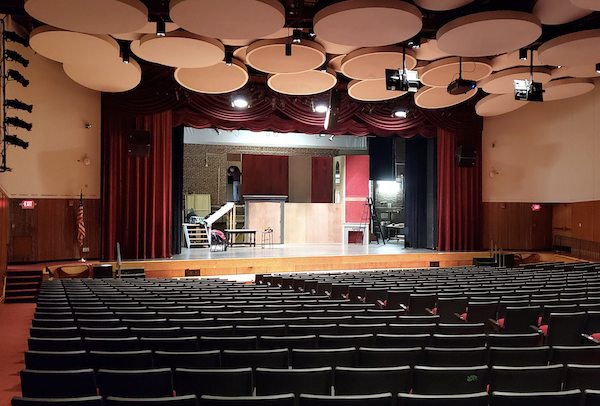 During a Board of Education meeting that stretched more than four hours, a proposed renovation of the Scarsdale High School auditorium took center stage. On Monday, March 6, 2023—the second of three budget study sessions—options for financing the multimillion-dollar improvement project were carefully considered.
Assistant Superintendent Stuart Mattey first led a review of the plan originally put forth: to fund the undertaking via a $4.735 million Transfer to Capital in the 2023-2024 budget. Of this sum, $3.534 million in offsetting funds would be provided by the Debt Service Reserve, sourced primarily from unexpended 2018 bond project balances. The remainder of the money—roughly $1.2 million—would be raised through a tax levy, increasing the 2023-24 budget alone by approximately 0.75%.
A balanced view of this strategy was presented to the Board and attendees, outlining both the advantages and disadvantages. Among the former, improvements to the auditorium would be funded immediately, and there would be no need for a separate proposition or vote. But one main drawback would be that the tax levy would be above the tax cap, which could spark dissatisfaction among votes with the annual budget. Another would be the way in which the Reserve for Debt Service would be used, as a lump sum rather than gradually.
Mindful of these considerations and several others Mattey had outlined, the Board then mulled over an updated recommendation. In the new plan, the auditorium project would be excluded from the 2023-24 general fund budget altogether. Instead, it would be presented as a separate voter bond proposition in May, seeking approval of a $4,735,581 million high school auditorium renovation and the authorization to issue bonds for that amount.
Mattey then went over the plan’s numerous advantages. First, he pointed out, approval of 2023-24 budget would be a separate matter from approval of the auditorium renovation. In addition, since there would be no one-time $1.2 million budget impact, a corresponding tax levy increase would be unnecessary. The project’s costs would instead be spread over multiple years, more in keeping with its useful life. Overall, the impact to the tax levy would be less immediate and severe than in the previously proposed plan. Mattey presented the risks of this approach as well, namely that voters might reject the renovation project, and that the total cost of the project would increase due to the expenses of bonding, as well as rising interest rates.
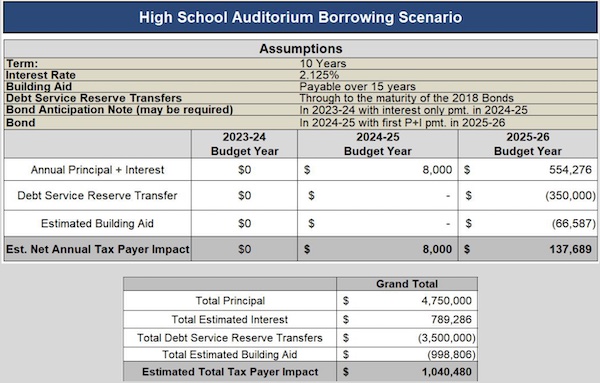 The slide above was presented to summarize the borrowing scenario. The next annual taxpayer impact initially would be zero, and then rise to $8,000 and $137,689 in the 2024-25 and 2025-26 budget years, respectively. Factoring in the principal, total estimated interest, total debt service reserve transfers, and total estimated building aid, the estimated total taxpayer impact would be $1,040,480.
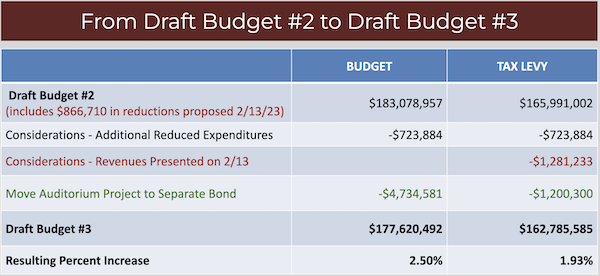
The Board and school administrators next turned their attention to the 2023-24 budget at large. At the previous study session, the Board had requested school administrators to devise an updated school budget to stay below the mandated tax cap of 2.89%. In response, the administration had created another draft, which it detailed for the Board and meeting attendees. The new approach would postpone a number of items and planned efforts to the next cycle, spanning the gamut from technological to building improvements. Along with reductions in curriculum and leadership consultants, plus minor trims to music and phys ed staff and textbook purchases, the cuts would be in the hundreds of thousands of dollars. Together with $866,710 of reductions proposed during the Board’s meeting on February 13th , the new budget would entail a tax levy increase of 1.93%. After much discussion, the Board resolved to follow this plan, which would also involve making the auditorium project a separate bond proposition presented to voters.
Following a brief cabinet update, public comment was invited. Alissa Baum, President of the League of Women Voters of Scarsdale, introduced herself. “I just have a few questions,” she said. “On revenue considerations, you spoke about the higher-than-normal increase in the health insurance reserves. Are there any risks to adjusting revenue using the TRS and health insurance reserves? Do you anticipate needing to use these reserves to just provide revenue for the 24-25 budget? [Regarding] CPSE staffing, what if any costs are associated with a deferral of the CPSE staffing reorganization, especially in terms of potentially higher costs associated with delayed or reduced services for students? [Regarding] consultant reductions, more specifically, how will the reduction in DEI consultant expenses specifically change the current DEI work plan over the next couple of years? Both with respect to [DEI expert and consultant] Doctor [Derrick] Gay's work and work in the classrooms, how will it affect teacher training in this area? And lastly, the auditorium project. Will be auditorium project be on the same timeline, whether it's included in the budget or a bond? Will the one-million-dollar taxpayer impact be distributed over fifteen years?”
Longtime Scarsdale resident Bob Harrison, who had previously interrupted the Board’s budget discussions in an attempt to interject his own thoughts, stood first. “I'm very disappointed that you did not ask for public comment on your budget discussions,” he said. “Why should we sit out here and not have a chance to comment? It doesn’t make sense. At the Village Board meetings, the mayor opens up the meeting to the public that are in attendance. Do you want to hear from us or not?” He then asked what the school is doing with its funds relative to interest income. Among his other demands was for a more granular breakdown of the budget’s impact. “I want to know what's the projected increase for our taxpayers individually,” he said. (Tangent to the subject, the Board later approved a previously discussed tax exemption for seniors.)
High school senior Juliette Schneider spoke next, urging the Board to support a student-led initiative, Westchester Green County. “We have the goal of making all schools in Westchester County carbon neutral, and eventually net zero,” she explained. After briefly explaining the program’s basics, she invited future discussion.” I lot more to say about this work,” she promised.
The school’s energy use was the subject of the next commentary, led by two representatives of a company called Cynergistics. It hopes to partner with the district in reducing energy consumption and expenditures among the schools, resulting in significant savings. The presentation was well received by the Board and administrators, who promised to consider the idea further. Commented Board of Education member Ron Schulhof, “We want to teach our children to take care of the world.”
Fox Meadow School Disconnects to Reconnect
- Details
- Written by: Joanne Wallenstein
- Hits: 2579
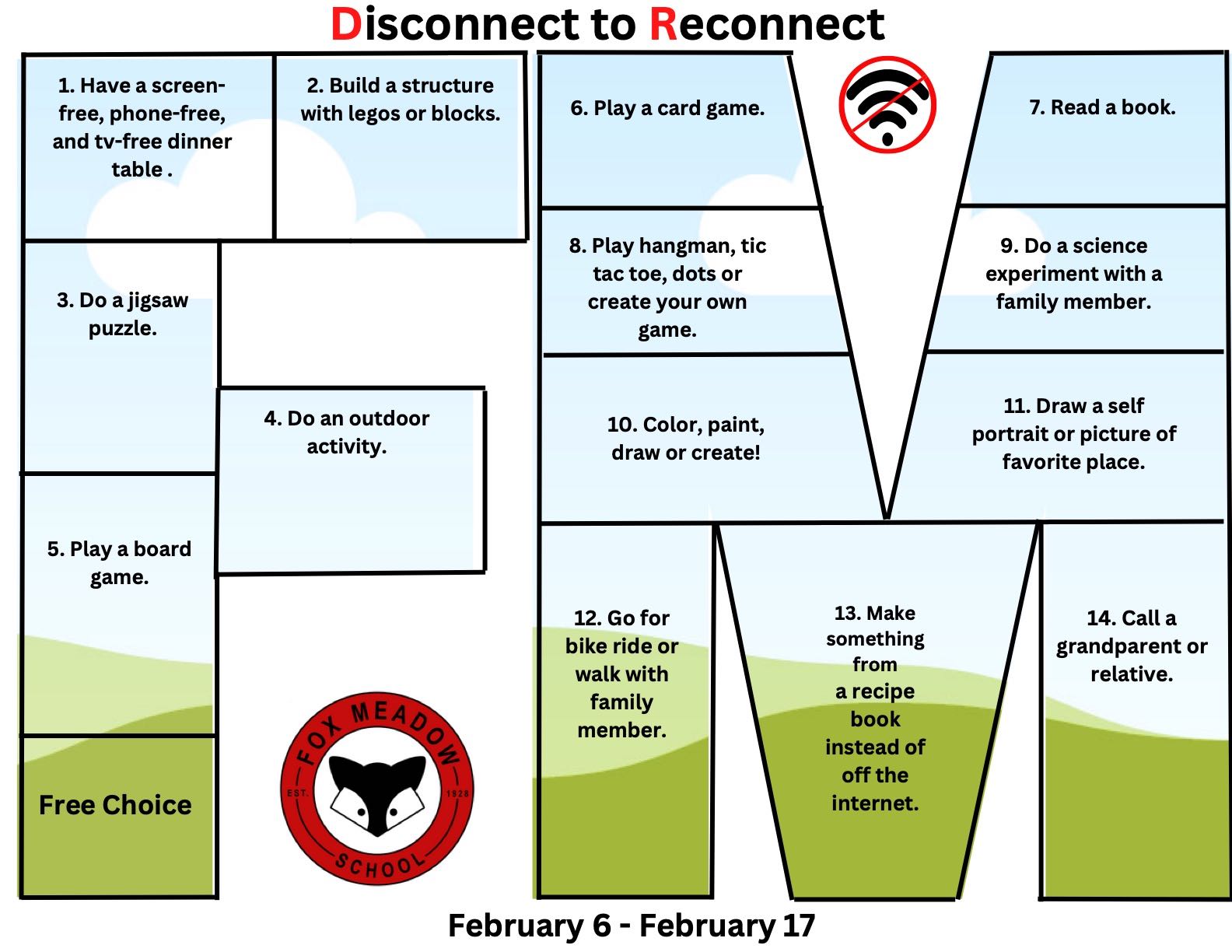 Fox Meadow Elementary School just concluded its pilot Disconnect to Reconnect program. Led by the Fox Meadow PTA’s Wellness committee, over a two week period, Fox Meadow students and their families were challenged to disconnect from their iPads, cell phones and screens while at home. Instead, students were encouraged to find screen-free entertainment. Students played board games, baked cookies, read books and even rode bikes in the unseasonably warm February weather. Fox Meadow Wellness Chair, Samara Chesler, stated “the program encourages all of us to be mindful of how and when we are using screens and put a priority on device-free activities.”
The children marked the conclusion of Disconnect to Reconnect with a school wide spirit day on Friday, February 17, and received a small gift from the PTA to mark their achievement. Ms. Lynch’s 3rd grade class was particularly enthusiastic and recounted screen-free dinners (even by their parents!), bike rides and card games they played during the two weeks. Fox Meadow PTA Co-presidents, Berit Berger and Michelle Schwartz, were so excited to bring this initiative to Fox Meadow. This initiative follows in the footsteps of the SHS’s successful Off and Away for the Day program but in a way that is age appropriate for elementary students.
Overall, Disconnect to Reconnect was a huge success at Fox Meadow. Congrats to the Fox Meadow students!
Board Wrestles with 2023-24 School Budget
- Details
- Written by: Ann Klein
- Hits: 2697
 Just minutes after celebrating his appointment as Superintendent of the Scarsdale Schools on February 13, 2023, Dr. Patrick and the board got started on the difficult job of producing a 2023-24 school budget. The challenge this year is that the Board has committed to a $5 million renovation of the high school auditorium that makes it difficult to propose a budget that comes in under the tax cap.
Staffing
The administration is proposing staffing changes including a half time position for student support, a full time custodian for the high school and $200,000 in fees for consultants. The budget allows for three faculty contingency positions depending on school enrollment including one middle school special education teacher, one special education teacher for the high school and another floating assignment as needed.
Benefits
Employee benefits account for an increase of 6.78%. The self-funded medical insurance budget is expected to increase 11.25% based on the current year claim experience and adjustments for large non-recurring claims. The NYS Teachers Retirement System contribution rate is decreasing, while other Insurances are increasing primarily due to an increase in Medicare Part B expenses associated with an increased number of retirees.
Transportation
There is a proposed 7.74% increase in the transportation budget. In 2022-23 the budget funded the purchase of 1 large bus, 3 mini-buses and 1 automobile/van for $297,500.
The 2023-24 transportation budget includes:
The planned purchase of 1 large bus and 3 mini-buses
A contractual salary increases of $188,000 thousand for the drivers
$24,000 thousand for a transportation efficiency study
$70,000 increase in capital equipment purchases related to the lease maintenance facility a $40,000 increase for busing related to athletics.
Lease with the Village of Scarsdale for $4126,305.
A state law passed in Spring 2022 requires that all new school bus purchases be zero-emission by 2027 and that all school buses in service be zero emission by 2035. Transportation costs are 3% of the draft budget.
Budget Increases
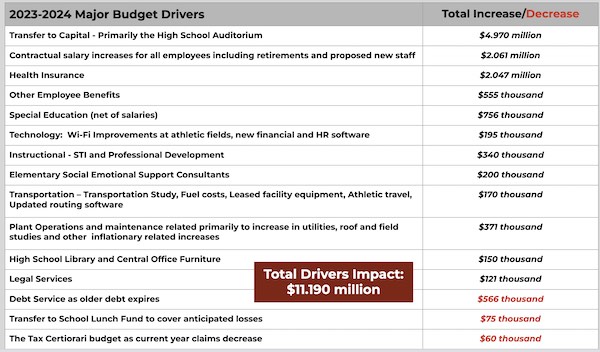
The main drivers of the budget increases are the $5mm auditorium renovation, contractual salary increases ($2mm), health insurance ($2 mm), employee benefits ($555k) and special education salary increases (($756k) plus other increases for a total of $11.190 million.
Budget Proposals
At this first budget study session of 2023, the administration gave the school board four possible budget proposals for the 2023-24 school year. The first proposal, (Draft 1) which includes the renovation of the Scarsdale High School auditorium, would increase the budget by over 6%, with a projected increase in the tax levy of 4.55%.
Anticipating that the Board would ask for alternatives, new Superintendent of Schools Dr. Drew Patrick led off by noting that the administration was holding off on creating the full budget book until they had examined several scenarios.
Budget draft 1a does not include the high school auditorium. In this version of the budget, the increase is 3.48% from last year, with a projected increase in tax levy of 3.80%.
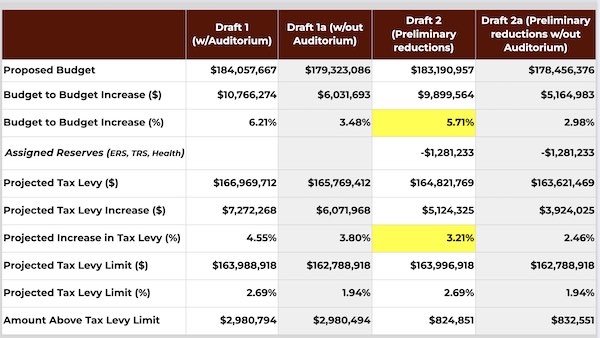
Budgets 2 and 2a both include considerations for reductions to the first drafts, with #2 including the high school auditorium renovation and #2a excluding it.
The proposed savings, totaling $866,710 would come from omitting the following from the budget and using $1,281,233 from the ERS, TRS and Health Insurance Reserves.
Hiring an additional custodian: $65,000
Special Education: $150,000
Food costs for Board meetings: $25,000
Financial software for business office: $16,000
Student activities fund at SHS : $10,000
Fund Balance
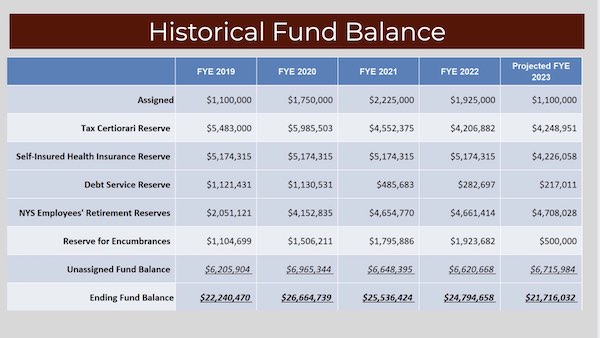
If the Board does opt to assign $1,281,233 of the fund balance for the 2023-24 budget, the fund balance would fall from $24.7mm as of June 2022 to $21,7 mm as of June 23 and would stand at only 3.65% of the total budget. State law says that the maximum that can be held in reserves is 4% of the budget. The fund balance would be at the lowest level it has been in the past five years.
After the slide presentation, board members had many questions for the administration.
Board Member Bob Klein, who is an architect, suggested reducing the budget of the auditorium by asking the architects “If we reduced our budget by $500,000 can we keep the scope of the project?” He said the renovation budget was generous and asked if any value engineering had been done. Dr. Patrick said that since the renovation is excluded from the tax cap it wouldn’t necessarily close the budget gap. The simplest answer, both Dr. Patrick and Stuart Mattey noted, would be through value engineering and materials.
Board member Jim Dugan, shouting into his microphone due to difficulties being heard, said “I feel strongly that the auditorium project should be included in the budget. The upgrades have been needed for so long and people have been very patient waiting so long. “I feel strongly we owe it to the students and the community that have been promised for a number of years. …I do think we owe it to the community to narrow the gap above the tax cap, making the cuts that we can. As long as we have been judicious, I would support those cost saving mechanisms.”
Board member Suzie Hahn Pascutti asked about funding the auditorium if it is excluded from the budget. Assistant Superintendent Mattey gave a number of options, including as a stand-alone bond or making it a part of a future bond project.
Colleen Brown supported moving ahead with the auditorium project and utilizing the proposed cuts.
Susie Hahn Pascutti supported the auditorium. However, she said she was “leery about cutting too much into our reserves. She said there are proposals to raise the limit on reserves to even 10%.” Healthy reserves are important.
Jessica Resnick-Ault said she was “torn between the obligation to include the auditorium but also to do it in the smartest way possible….Perhaps that does mean changing parts of the project scope.”
Patrick asked the Board to give the administration a read on where they want to go.
Bob Klein also asked about the implications of proposing a budget that exceeds the tax levy limit. Dr. Patrick answered, “A proposed budget that exceeds the allowable tax levy requires a supermajority vote of the public, 60% yes, to pass the budget. A levy that’s at or under the limit only requires a vote of 50% plus 1.”
Klein wondered about the potential effects of proposing a budget that exceeds the tax limit and putting the decision about potential cuts to the community?
Dugan said if the vote fails they can propose a second budget. Mattey clarified, “If the second vote fails, then your levy must stay the same as the current year.”
Board President Amber Yusuf wanted to understand tradeoffs and potential cuts before making the decision on whether or not to exceed the tax cap.
Vice President Ron Schulhof supported the auditorium project, saying that he was flexible about how it could be funded. He also said he thought the Board should be cognizant of the tax cap, saying “While it is this Board’s decision on what we propose to the community, ultimately it is the taxpayers’ decision whether to pass that budget or not. Mr. Schulhof also made the point,” If the district uses reserves this year, and next year is a tough year, what does that mean for next year? … I don’t want to box us into a place where we can’t be flexible and deliver new programs.”
Amber Yusuf supported including the auditorium in the budget or in a bond.
At the conclusion of the meeting, Dr. Patrick said they would come back with a list of proposed reductions to bring the budget in closer to the tax cap and will also give more consideration to the use of reserves.
See the full presentation here.
PTC Hosts Breakfast with Local Leaders
- Details
- Written by: Joanne Wallenstein
- Hits: 2367
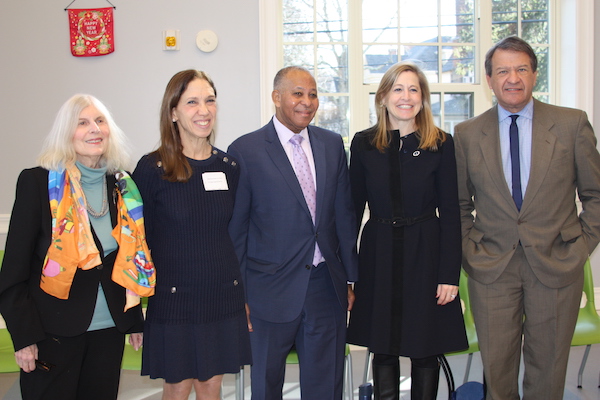 Frances Wills, Amy Paulin, Ben Boykin, Jane Veron and George LatimerCommunity leaders from the Village Board, the School Board, the School District, the state, the county and more gathered in the new multipurpose room at the Greenacres School for the annual legislative advocacy breakfast hosted by the Scarsdale PT Council on Friday morning February 3, 2023. The annual event returned after a lapse of several years due to COVID.
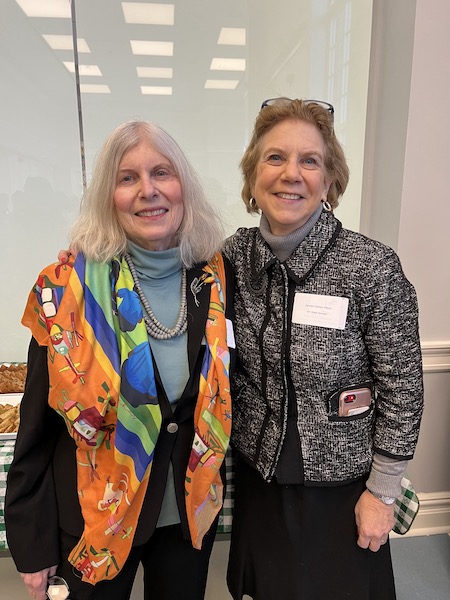 Frances Wills and Shelley MayerParents, teachers and administrators had the chance to hear what was top of mind in the area of education from Scarsdale’s representatives in the NYS Senate and Assembly, the Board of Regents, Westchester County and the Village.
The event was introduced by PTC President Lauren Grossberg and hosted by PTC Legislative Advocacy Committee Chairs Lauren Fields and Rachna Singh.
Opening the session, was Scarsdale’s State Senator Shelley Mayer who recently added Scarsdale to her district. She credited Governor Kathy Hochul with a $2.7 billion increase for education in the proposed budget and said funding for building aid and the transportation reimbursement remain, and overall, “even Scarsdale is getting a 3% increase.” She said two of her goals were to do more to fund mental health initiatives and to improve the formula for funding special education for districts like Scarsdale.
Assemblywoman Amy Paulin said, “We just got the state budget and we are analyzing it. What 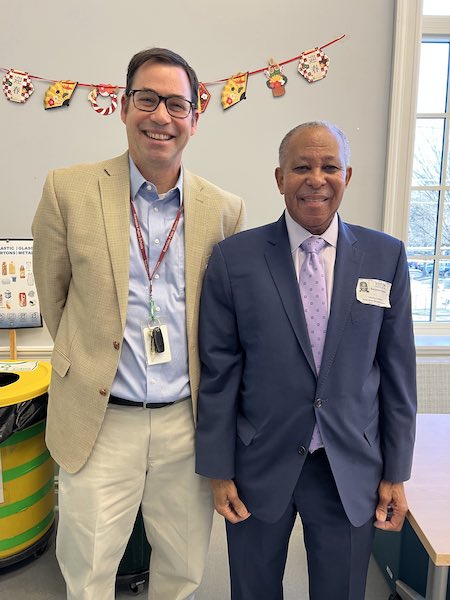 Drew Patrick and Ben Boykindoes it mean for Scarsdale?” She expressed concern about a proposal in the budget to build multi-family housing within a half mile of train stations, bypassing local zoning code. She said, “Each acre within a half mile of the train station would be zoned for 50 units … I will make sure this does not go too far.”
County Executive George Latimer said, “Most of the education issues that affect us directly are state issues. However The role of the county in schools was important during the COVID pandemic.”
Ben Boykin, Former Chair of the County Board of Legislators reviewed some of the recent legislation that was passed by the board including a reproductive health clinic access law that is currently being challenged in the courts, and a food safety law that requires restaurants with more than four employees to have one person trained in treating people with food allergies. The Board passed a hate crime bill and a salary transparency law that requires job postings to show the salary range for the opening and permits applicants not to reveal their current salary. He added, “County taxes have been cut for the fourth year in a row.”
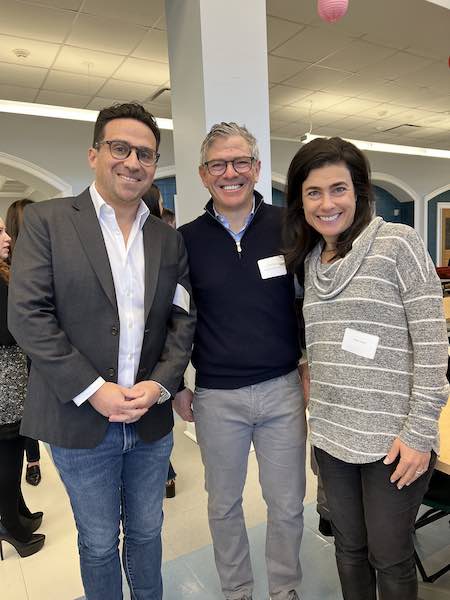 Justin Arest, Jeremy Gans and Stacey GreeneNY State Regent Frances Wills discussed a few priorities for the Board of Regents including:
-A quest for universal meals in our schools – we understand the struggles faced by families.
-New graduation measures – are there other measures that state regents tests of being a qualified graduate? The regents tests are a narrow measure. We want a system that has multiple pathways to graduation.
-Career technological education.
-Advancing the arts. She said, “It helps mental health – for those involved with visual arts, performance arts and music. The regents are very conscious of the role of the arts in mental health.
-Equity, excellence and inclusion.
-Upgrading computer system for student evaluation and for teacher certification. Also The Regents need for a way for people to get a response when they contact them.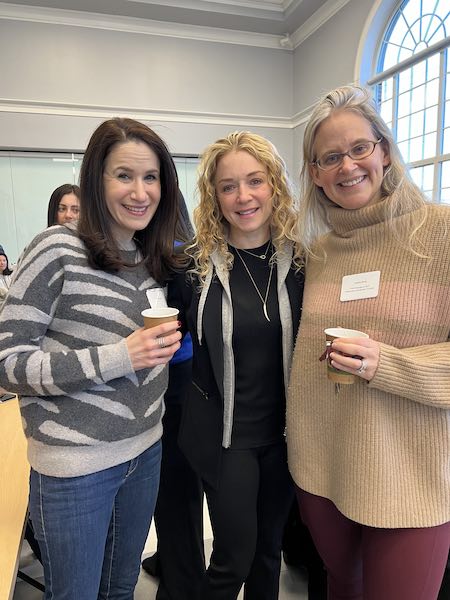 Erica Papir, Dara Gruenberg and Debbie Bhatt
-Increasing opportunities for students to take advance placement courses and college courses.
Mayor Jane Veron was thankful for the Village’s partnership with community organizations and the support of the county and the state. She said, “the collaboration between the Village and the school makes us stronger. We don’t want silos. We are better when we get to work together.”
She reviewed some items on her agenda:
About safety and security she said, “Our police and fire departments are committed to school safety. We have live feeds from the schools whenever there is a security issue. Closing the telecom gap is a matter of public safety. Our service is not what it needs to be. I spoke to the carriers and underscored the need to close these gaps. We have got to make this happen.”
“We have lowered the speed limit to 25 mph – reducing speed 5 mph has a safety impact. Watch out for the signs.”
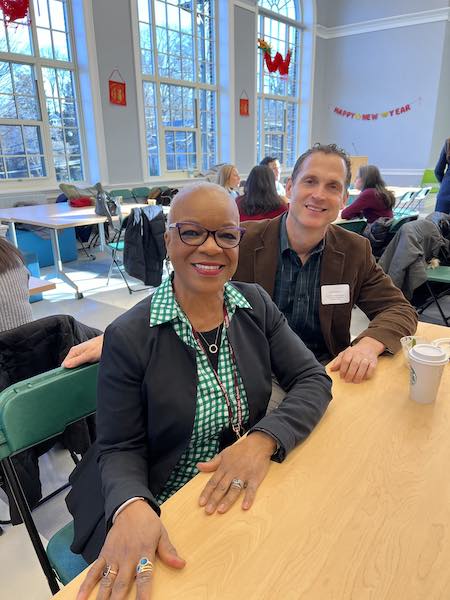 Sharon Hill and Edgar McIntoshShe continued, “People move here for our proximity to the city, our schools and our quality of life. We support our assets – including our new public library. It is bursting at the seams. Our pool has outlived its useful life. Now it’s our turn to re-imagine our future. We are going to schematic designs. I know we will transform the pool. And there are eight pickleball courts coming to Crossway this summer! We are considering a field study funded by the Village and school district. The Dine the Dale tent will return and we will have more activation of spaces including a Farmer’s Market on Sundays starting on June.”
School Board Nominating Committee Seeks Candidates
The School Board Nominating Committee (SBNC) is seeking potential candidates to serve on the Scarsdale Board of Education. The SBNC invites all Scarsdale School District residents to propose names of qualified individuals to serve on the Scarsdale Board of Education by email to [email protected]. A candidate must be at least 18 years old, a U.S. citizen, a qualified voter, and a resident of the Scarsdale School District for at least one year prior to the May 16th school board election.
Candidates should complete a biographical information form and submit it via email to [email protected] as soon as possible, but no later than 7:00pm on Thursday, February 16, 2023. The application form is available on the SBNC website www.scarsdalesbnc.com. Please see the “Join the School Board” tab or contact the SBNC Chair for further information.
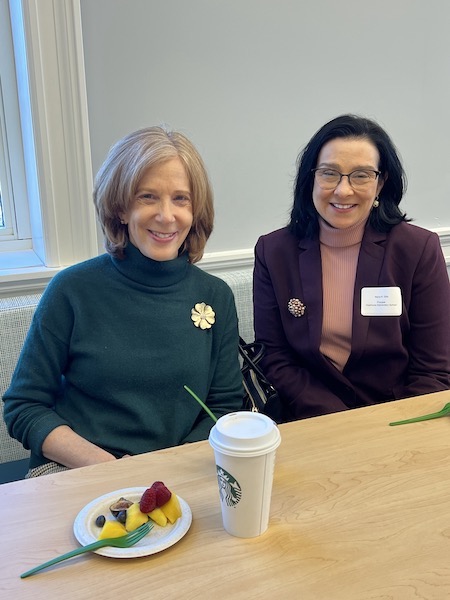 Kathy de la Garza and Maria Stile
Off And Away From Screens For The Day
- Details
- Written by: Wendy MacMillan
- Hits: 3416
 It is no secret that too much screen time (and especially social media) can harm the physical and mental health of children and adolescents. Countless amounts of research including a recent study published by JAMA, have highlighted the detrimental effects of social media and too much screen time on the developing brain. On 1/29, US Surgeon General, Vivek Murthy declared on CNN Newsroom, that he believes “13 is too young for children to be on social media platforms.” In early January a Seattle public school district filed a lawsuit against several big tech companies for their role in the current child and adolescent mental health crisis. Right here in Scarsdale, teachers have reported struggling to teach their students.
English teacher Rachel Stark describes how some students in her classes are less focused, more easily distracted, and less able to work with sustained attention. She also notes that her student’s brains are already so overstimulated by everything they see on their phones (from texts to images on social media), that by the time they are sitting in her class, many students are already mentally fatigued. Both Stark and another English teacher report that students today aren’t able to handle the same amount of reading and writing assignments as  Games to engage in rather than a phone.students were able to just a decade ago. Ms. Stark points out that this isn’t the fault of her students and instead sees unfettered access to smart devices as one of the main contributing factors to the decline of these academic skills. While the issue is thorny and difficult to broach, Ms. Stark remains hopeful that the Scarsdale High School community can still affect change.
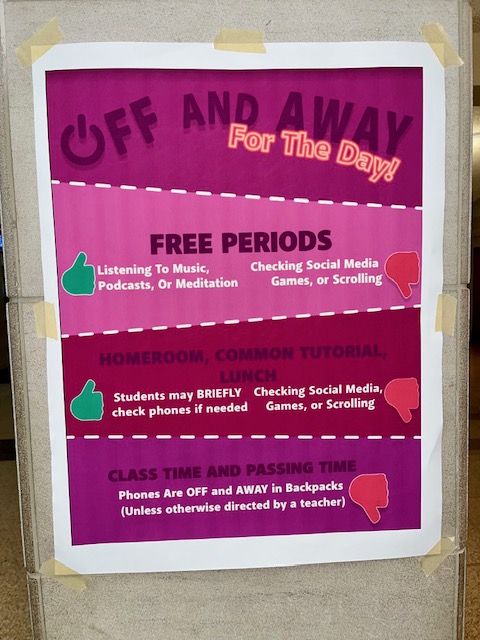 In response to what they have witnessed in their own classrooms, and to help their students avoid some of the pitfalls of screen use, the Wellness Committee at SHS led by English teacher Jennifer Rosenzweig and Director of Counseling Oren Iosepovici , created an initiative to help educate and empower their students to make healthy choices about screen use. After years of research and advocacy, the initiative finally got underway at the start of the 2022/23 school year. The initiative as described by Rosenzweig, doesn’t aim to ban all technology but rather to teach children how to use it mindfully, to give them guidelines to use technology in a beneficial way, and to encourage students and faculty to create a culture at school that promotes focus, attention, creativity, and connection.
To maintain momentum from the beginning of the school year and to remind students of the importance of stowing away devices for the day, the SHS Wellness Committee (with support of the faculty and administration) hosted its first “Off And Away For The Day” event. On Monday, January 30th, students began the third quarter with all the bells and whistles of a festive celebration. Posters lined the hallways reminding students to use their devices mindfully. Games like chess, Connect Four, Scrabble, and even ping pong were played in the common areas. Students (and faculty alike) stopped to try their hand at Rubik’s Cubes that were placed throughout the school, and people lined up to take instant photos at an old time photo booth with fun and silly props. To foster a sense of celebration, music played overhead during passing periods while a swath of parent volunteers handed out treats to passing students.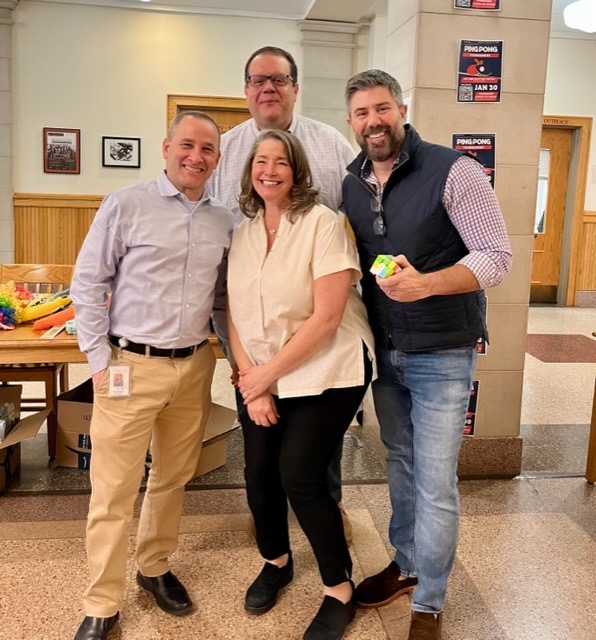 Principal Ken Bonamo, Director of Counseling Oren iosepovici, English Teacher Jennifer Roesenzweig, Psychologist Peter Faustino
Ms. Stark hoped that the “Off and Away for the Day” event “not only served as a reminder of the harmful effects of too much screen time, but also created a culture of joy and positivity and reminded students how wonderful it feels to be in the present moment, to connect with peers and community, and to just give their brains time to rest.” To that end, the event was a huge success, the halls were buzzing with a happy energy, students were laughing while taking silly Polaroid pics, they crowded around lively games of ping pong, and volunteers were met with huge smiles from grateful students for all of the yummy treats.
When asked about the event, senior Jedd Frydman reported, “I love it! It is refreshing to see so many kids not on their phones worrying about social media, and instead being in the moment and having fun with their friends. It is also really nice to be in a class where teachers care and understand the importance of trying to use technology more mindfully.” Another senior, Henry Nova, added, “ It is a really nice day and gesture, but I wish it was the whole year…that it was somehow built into the structure of our high school.”
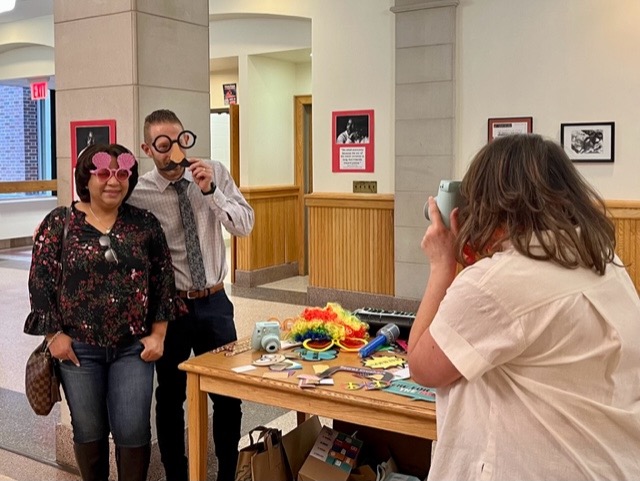 Fun at the photo station.While Rosenzweig is thrilled the event was well-received by students, parents, and faculty alike, she also hopes that it will serve as a call to action and inspire our community (from parents to administrators) to take more steps to ensure that children are taught how to use their devices safely and supported with appropriate guidelines and boundaries. For comparison, Rosenzweig relates, “We wouldn’t let a three year old walk outside and expect them to know how to cross the street and safely navigate traffic all by themselves. It is the same with the use of smart devices, children need our support and guidance…they need us to provide clear boundaries so they can learn how to use technology in a safe and healthy way.”
While some parents might feel overwhelmed by the prominence of screens and social media in their children’s lives, and feel like there is nothing they can do to stop it, others remain hopeful. Parent and volunteer for the event, Jennifer Kahan shared, “I feel really proud of our Scarsdale High School teachers and students for breathing life into the District's "Off and Away for the Day" Initiative today. Thank you to the District for realizing the role our faculty and our parent body play in modeling this behavior for our teens. As the "adults in the room," it is our job to give our kids "permission" to do the right thing: put down the phone at school. It's that thing they deep down know is right but it's also that thing that is so very, very hard to do, especially when you feel alone in the crowd. This is a gift we can start to give to our students now. The more we communicate this message and the more we practice it, the more our kids can start to live a more focused, present, less screen-addled academic and social life.”
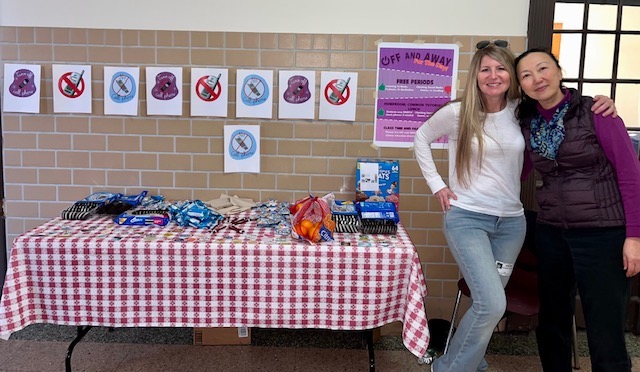 Volunteers Alice Gorelick and Julie Zhu at a snack table.
In an ideal world, both Stark and Rosenzweig would love to provide their students with a school day free from the distraction of their phones and social media. They would prefer if students always kept their smart phones off and away during the school hours to give them the opportunity to fully engage with their classes and peers during this short time. While discussions about how best to support students in the age of social media continues, Ms. Stark suggests parents take some of these small steps to start making big changes:
-Adults can model mindful use of their own devices. Try to be present during conversations and choose screen free activities to do on your own and as a family.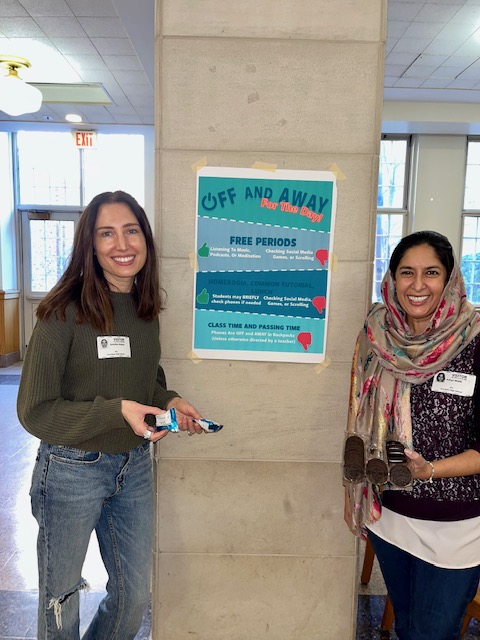 Volunteers Jennfier Kahan and Attiya Malik
-Try making mealtimes screen free…even better, try having a “phone-free” day once a weekend.
-Try to avoid having “everything” on your phone. Use a paper calendar or read a physical book.
-Keep phones out of the bedroom at bedtime.
-Reassure your children that they are safe at school and will still be able to communicate with parents in an emergency even if they leave their phone at home.
-Try to avoid texting or calling your child during the school day and encourage them to wait to call or text you.
-Small groups of parents across the US have started to band together to challenge “big tech.” If compelled, try gathering a group of like-minded parents to do the same.
Rosenzweig also suggests parents start having conversations with each other, their children and with school administration to talk about what other steps we can take to ensure healthy guidelines and boundaries. Rosenzweig believes that like the Seattle school district, Scarsdale can and should be a leader in this area.
Wendy MacMillan, the author of this article, is a volunteer at SHS and helped to organize the “Off And Away For The Day” Event.
- A World of Summer Possibilities on Display in the SHS Cafeteria
- Administration Proposes the Addition of Contract Social Workers and Administrators to Support Social Emotional Learning Needs in 2023-24
- Online Kindergarten Registration Starts January 17, 2023
- PTC Supports the Addition of Diwali, Eid and the Lunar New Year to School Calendar