








How is eLearning Going at your House and District Wide?
- Details
- Written by: Joanne Wallenstein
- Hits: 3267
 How is eLearning going at your house? Are your kids too stressed– or do they have too little to do? Do they miss the interaction with the teachers and friends? Are you having trouble keeping your children’s ZOOM schedules organized and tracking homework assignments?
These were some of the issues tracked in a recent survey conducted by the district and reviewed at the online BOE meeting on Monday April 20.
Here are some highlights of the district’s findings, but we recommend that you watch the presentation here to see how this experiment is going in the weeks since schools closed.
As Dr. Hagerman said, “We’re trying to fly the plane while we’re building it,” referring to the difficulty of moving the entire educational experience online without time for development and assessment. In just a matter of weeks, teachers have been challenged to figure out how to communicate with their classes, use online tools to teach, find ways to continue to give personal feedback and provide extra help to those who are unable to work online or fail to participate.
Though school is traditionally in session for roughly six hours a day, the National Board of Professional Teaching Standards Research recommends that kids spend far less time online. For elementary school students, 1-2 hours a day is optimal, for middle schoolers 2-3 hours a day and for high school students 3-4 hours per day. They also encourage one hour a day of social recreation for all age levels.
Last week, schools conducted a district-wide wellness week with programming and activities for students in all grade levels. Over 125 teachers provided 57 live sessions and 23 asynchronous activities and the response was overwhelmingly positive. Kids enjoyed scavenger hunts, art projects, read alouds and baking along with mindfulness/meditation and yoga.
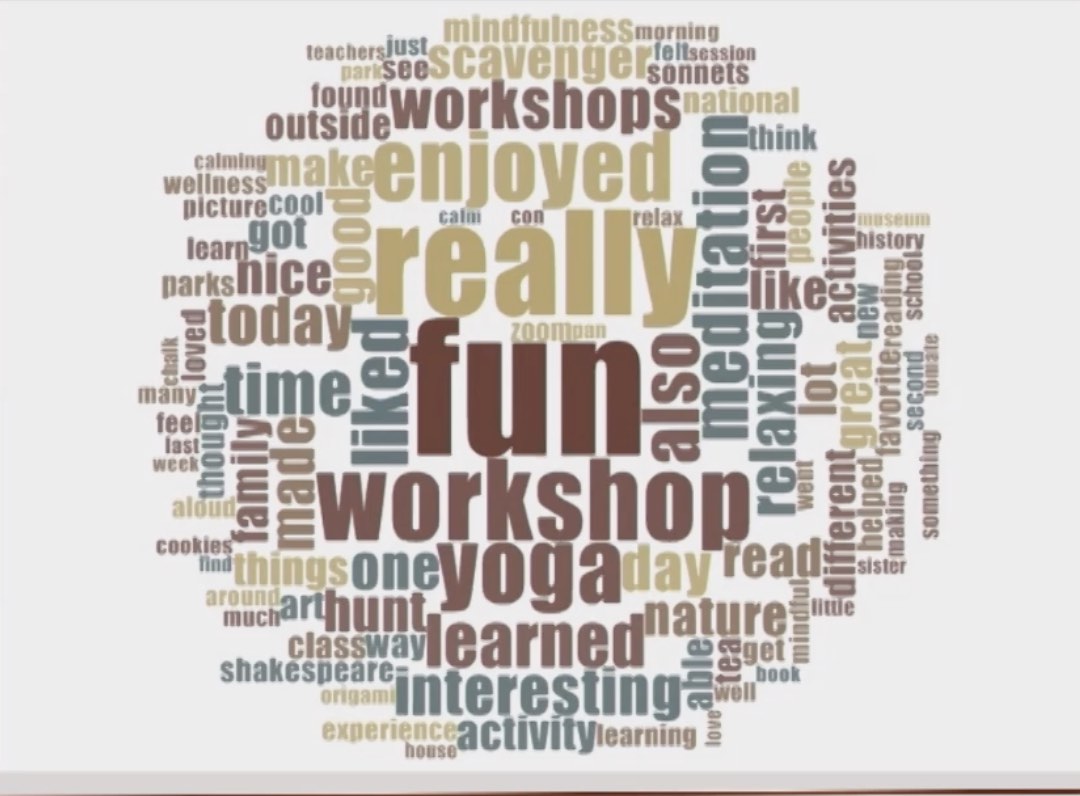
Ray Pappalardi, Director of Physical Education, Health and Athletics reported that kids described these activities using words like fun, enjoy, interesting, relaxing, good and great. The program was so successful that it will be written up in a national education publication.
Administrators conveyed the results of an eLearning survey to parents of children of all ages that received about 1,100 responses (with some duplication from parents with kids in multiple schools.)
The survey identified the successes and challenges of eLearning, and the district has sought to address some of the issues in the intervening weeks.
Among the successes are the teachers’ efforts and commitment, the consistency and quality of the work, the ZOOM sessions, feedback for students and organization of learning materials. However some of these “successes” are also challenges or struggles. Some parents report problems managing student workflow, and trouble with technology, passwords and log-ins. Kids miss interacting with classmates, student stamina and motivation are issues and staying organized can also be a problem.
The district has addressed some of these issues at each level. Elementary School principals now post a weekly calendar of ZOOM sessions by day and hour so that parents can help their kids maintain a schedule. At the middle school, parents are receiving a weekly email with each child’s schedule. Each class meets twice a week for an interactive session. Wednesdays are set aside for student support and extra help. At the high school, where students miss peer interaction and feedback from teachers, focus groups have been set up to discuss the issues.
The district’s technology team continues to work with teachers, providing a checklist to insure successful online sessions and providing them with tech support and training. They expanded email addresses for grades 3,4 and 5 to allow them to communicate with their peers. At the high school students are putting together a virtual science research symposium to replace the one that usually takes place in the spring.
From the presentation, it is evident that the administration and teachers are doing everything possible to turn lemons into lemon aid, but clearly it’s a challenge to conduct the business of learning outside the physical plant of the schools.
Dr. Hagerman summarized some key learnings from this experience and sadly they highlight the limitations of online learning and the lack of human interaction. His conclusions show that though the teachers, administrators, librarians and technology team are doing everything possible to enhance the educational experience for the students, there are severe limitations to education outside the classroom.
Here are a few of the lessons learned:
Our district schools are not remote learning institutions and it is not developmentally appropriate or feasible for very young children.
We can pivot quickly to create alternatives, but we cannot create true substitutions for Scarsdale classrooms.
The social aspects of schooling are as important as academic ones for many students, teachers and families.
Regular communication, collective patience and realistic expectation are critical in times of crisis.
eLearning during a pandemic is not like e-Learning outside a pandemic. Dr. Hagerman said, “families are struggling with a range of issues... that may impact the psyche of students trying to learn.”
It is difficult to embark on a transformative initiative when people are already separated and do not have the time to plan and collaborate in a physical space, like we would for any other initiative.
Despite the challenges kids are engaged in learning and working within the restraints posed by the pandemic. It’s clear that everyone is learning as they go in this brave new experiment with online education.
Watch the entire presentation here: https://vimeo.com/channels/boe
Note from the SHS PTA Scholarship Fund Committee
Apply Now! Scarsdale High School PTA Scholarship Fund for College
SHS seniors may apply for a one-year grant from the SHS PTA Scholarship Fund
To learn more about the Scholarship Fund, who is eligible, and how to apply, please refer to our Fund Facts link here.
Applications can be downloaded from the Scholarship Fund Webpage.
For additional information regarding the Scholarship Fund, please contact Seema Jaggi at [email protected].
Reflections from a Sidelined College Senior: The Class of 2020 Will Never Get Back to Normal
- Details
- Written by: Joanne Wallenstein
- Hits: 3617
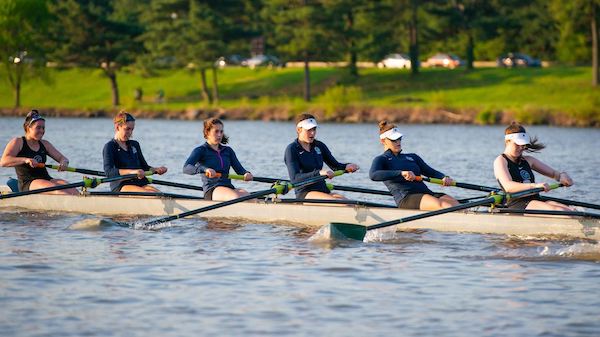 This was written by Carly Glickenhaus, a 2016 graduate of Scarsdale High School and a member of the Georgetown University Senior Class:
The novelty of teleworking is wearing off for many. For adults, the benefits of working home, perhaps the salvation from a Metro North commute or the silent glory of wearing pajama pants in a Zoom conference, no longer feel like a treat but a routine. Students too are itching for this extended snow day to end and trade distant for social. As Zoom University stole all the beautiful parts of our educational institutions while retaining the solo homework, I hear the daily musings of jittery younger students, across social media and quoted in newspapers. I feel for them. Admittedly, I envy them. They have every right to complain, but they also have more time. Like the working world, they will get to go back to normal. There is one population that does not get to go back to “normal,” and that is the Class of 2020.
Bombarded with unsolicited poetry exchanges, sermons from the Wall Street Journal reminding me how to be productive at home, “quarantine recipes,” and livestream yoga packages whenever I open my laptop, I can only conclude that people are desperately craving any digital vector of motivation in this dearth of normalcy. I keep coming back to this idea of motivation, and I want to reflect on what it means for the Class of 2020, particularly senior student-athletes.
When I started Georgetown four years ago, I was not recruited to play on a team. But after only two days on campus I realized I missed athletics and tried out for the only team to accept inexperienced walk-ons: rowing. Since that day, I have trained 364 days a year for a 7-minute race, which should sound irrational to a sane reader. Those countable seconds of racing demanded constant physical and mental commitment that did not end when practice was over, but applied to every minute of the day. Division I Lightweight Rowing assigned meaning to everything: every bite I put into my body, every minute of sleep I logged inched me towards the splits I chased for years. There was no isolating rowing from the rest of my life, so my life became dedicated to that speed. Going fast when it counted most required that I slow down enough to recover and reflect when alone on land, just as social distancing asks us to do now.
Throughout my career, asthma, herniated discs, nerve pain, mono, high blood pressure, searing hand blisters, and EKGs gave me every reason to stop rowing. But I refused to let pain and fatigue stop me. Being an athlete was everything I hoped to learn from college: It set the bar higher and skewed the standards of comfort and normalcy so that I could do the absurd. Now, as COVID robs more of me than I thought I had left to give, I can’t help asking the same question many senior athletes feel: was it all worth it?
Perhaps fittingly, my life of speed ended in a flash. A few miles outside civilization in rural North Carolina, my team inadvertently self-isolated in early March on our annual spring training trip. As rumors swirled about classes transitioning to what Georgetown calls “instructional continuity” (the term usually reserved for snow day “darties”), we spent 7 hours a day doing the only thing directly in our control: keeping our heads in the boat and taking stroke after stroke. Behind the scenes, we had little idea that our coaches were spending every minute on land fighting for our careers. Soon, there was no way for them, my parental figures at school, to hide the fact that the kids were soon to be sent to their rooms and not come out, feeling punished for something they did not commit. When the Ivy league was the first to cancel Athletics, we sobbed for our rivals, girls we did not know but respected so much. Those girls gave us a reason to get out of bed every day, determined beat them with integrity but scrappy grit. While we were out on the water for our third practice of the day, I had an unshakable feeling that any strokes could be my last. Sure enough, dry land brought news from the Athletics Department. In the van ride back to D.C., another black and white email from a distant office informed us that the rest of our senior year would be “virtual,” collapsing all of the complexities and emotions of navigating college into a two-dimensional simulation. I felt paralyzed as my reality became history. Around me, my best friends started booking flights to return home, indefinitely. We were supposed to be coming back to campus our strongest versions of ourselves, ready to dive into our first race week of the spring. Eight hours later, we pulled up to a silent campus and unloaded our rowing machines. I was the weakest I’d ever felt, not just crippled by dense trash bags of my filthy laundry, but having lost my vision, my mission, my purpose of four years.
Every few hours, a new wave of loss hit me as I realized each of the little things I could never get back. I would never walk to the river with all my best friends again. I would never sit down in a Georgetown classroom, look out the window at the Washington Monument, confess my dreams to a professor. As I weighed the pros and cons of deleting my Gmail account in self-defense, I was notified that graduation would be postponed until further notice. Humans construct milestones and ceremonies because it is easier for us to cope with helpless aging if we come together to acknowledge the passage of time in a sort of consensus. The Class of 2020 was robbed of that restorative closure. But losing the bits and pieces that glued together the last four years of my life hurt more. What I would give for another few minutes in the weight or erg room, where I found peace in the eye of the swirling hurricane of 5,000 intersecting schedules, to stand in the places that built me, and just say thank you.
We college students do love having someone to be angry at; it is no coincidence that the college campus is the birthplace of so many protest movements. But seniors like me have no one to be mad at, and that is a challenge like none other. Having no one to be angry at forces us to cope together even though we are more apart than ever. Lacking a target forces us to resort to kindness over hatred. Being a college rower, I assumed that the hardest part of my life was behind me, that any job would be easier than what I did every morning for four years. Before it was even over, the world reminded me that it’s only just beginning, and I am so grateful for that. Now, students are asked to love learning without the pressure of external accountability. Years of holding myself accountable to the team’s values have armed me with an internal sense of duty, the voice that coaches me to keep going when no one is watching.
My Jesuit education taught me to question the world around me incessantly, demanding magis, or “more,” of myself, of others, and of institutions that degrade notions of truth today. Commencement was supposed to solidify that commitment, but isolated introspection reminds me that my campus was always, ironically, preparing me to leave.
So, I ask myself again, what was it all for? All of those marginal fractions of splits producing raw power for my teammates forced me to break up my life down to the second, stroke by stroke. I, and senior student-athletes across the country, lost those seconds and chances, but the sacrifices we made stay. We equipped younger athletes to fight for what we love, and we can feel at peace leaving our programs poised to lead others with the very sense of purpose that was taken from us too soon.
SBNC Announces Two School Board Candidates: Budget Vote Delayed
- Details
- Written by: Joanne Wallenstein
- Hits: 3876
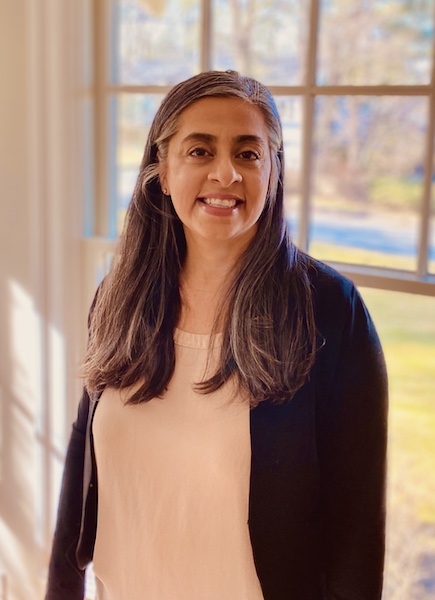 Amber Yusuf(This information was sent to us by the Scarsdale School Board Nominating Committee) As the 2020 School Board Nominating Committee (SBNC) has completed its nomination of Amber Yusuf and Robert Klein for election to the Scarsdale Board of Education, I thank the members of the SBNC for their dedication, thoughtfulness, and diligence in performing this important civic responsibility. I also thank all of the applicants. Scarsdale benefits when so many talented citizens are willing to present themselves to the SBNC each year, as well as from the efforts of an engaged SBNC.
Our community created the SBNC to nominate school board candidates who will work to maintain and enhance the quality of education provided by the Scarsdale schools. This year the SBNC was composed of 30 voting members (elected from each of the five elementary school areas) and one non-voting member. Pursuant to its governing resolution, the SBNC judges and selects candidates “solely on their qualifications to serve the community.”
If elected to the school board Amber and Bob will assume their roles on the School Board for three-year terms effective July 1 (barring additional Executive order). The SBNC is grateful to the talented and engaged citizens who were willing to put themselves forward to serve on the Board of Education. All current voting members of SBNC will sign the nominating petitions once the election directives have to given to the district.
The Candidates
The SBNC strongly endorses Amber and Bob for election to the School Board. These two qualified candidates will bring different backgrounds and experiences to serve the community, and share a deep commitment to maintaining the excellence of the Scarsdale schools and serving different constituents.
Amber Yusuf
Amber has been a resident of Scarsdale for over 11 years, making many contributions to civic life here. She and her husband, Inder, have 2 children who attend Scarsdale Middle School. She’s currently a board member on The League of Women Voters, a member of the Scarsdale Bowl Committee, a volunteer consultant at TAP (The Accelerated Project,) co-chair of PTA-sponsored STEAM Day, and a previous member of the Citizens Nominating Committee. Amber has served as PTCouncil President, PTA President at Heathcote School, chair of After School Club and many more roles.
In her most recent professional experience as Director of Operations for G2 FT, she advises small financial companies how to best utilize their tax strategy software. She possesses a great capability in seeing the big picture, and is able to sift through loads of information and extract the important and fine details. She makes the most complex issues digestible to everyone making her a unique and ideal candidate for our school board.
Through Amber’s various civic roles, she is extremely knowledgeable about our community. She is well-respected by those who have worked with her. She has a keen awareness of both local and global issues, and is incredibly open-minded, intelligent and genuine in all she does. Amber Yusef is vested in Scarsdale – particularly in our school district and is willing to devote the time and energy to be a conscientious and effective member of the School Board.
Robert Klein Bob KleinBob Klein
Bob has been a resident of Scarsdale for 34 years. He and his wife raised two children who graduated from Scarsdale High School and are now raising families of their own. Bob’s career as an architect occupied his earlier life but he was an engaged parent, serving for 4 years as a local Boy Scout den leader. He also served two (non-consecutive) three-year terms as president of his religious congregation. Bob’s career in architecture is particularly interesting as it relates to his candidacy on the Board of Education. A significant portion of his professional experience was in the “pre-planning” end of the business. Bob’s job was to interview clients, listening carefully and critically to their needs and hopes, and to establish the parameters for successful efforts. Basically, Bob helped ensure that large scale and complex projects would meet the client’s needs – perhaps even in ways that they didn’t anticipate. In addition, Bob has shared these skills with architecture students and other professionals teaching at Harvard, Cornell, Columbia and other institutions. This sort of “first principles” / “blank-slate” approach, attention to detail and experience in creative and collaborative problem solving is the sort of mind-set and skill-set that will be valuable as part of the School Board Team.
Bob, now retired from firm practice, has devoted time to several interesting hobbies and philanthropic pursuits. He is a founding member of Neighbors for Refugees, an organization committed to welcoming, protecting and advocating for refugees in our community and abroad. And after taking pottery classes, Bob was asked to join the board of the Clay Arts Center in Rye, where he has now served with distinction. Bob Klein, an ‘empty nester’ and a lifelong learner, remains devoted to student success and education and will serve the community with his valuable skills and perspective.
The School Board Nomination Process
The SBNC nomination process involves several stages.
First, the SBNC initially heard current school board members’ views on the role and structure of the school board, the school board’s relationship to various stakeholders, the roles and responsibilities of board members, and the anticipated challenges and opportunities for the school board during the next three years.
Second, SBNC members then sought potential board candidates through public appeals and by recruiting committed community members. All qualified candidates are encouraged to apply. Each interested applicant submitted a biographical form and presented orally to the SBNC in the late winter.
Third, pursuant to rules of procedure, committee members conducted due diligence by confidentially contacting dozens of people outside of SBNC for their input about the candidates’ qualifications to serve the community. In order to get a complete view of the applicant, SBNC members contacted references provided by the applicant. Committee members then reported relevant factual information to the other committee members, who were instructed to keep open minds and listen to one another carefully.
Finally, the committee discussed the qualifications of all proposed candidates fully and candidly before taking a vote, and voted by secret ballot to fill each vacancy in turn. This year’s SBNC members were devoted to the process despite the challenges presented by the current pandemic restrictions.
As per a vote of the committee, meetings and deliberations were conducted by Zoom (digital conference platform) and voting was conducted using Google polling. Using this available technology, the process was serious and focused, with respect for differing opinions.
Discussions and deliberations regarding candidates are confidential in order to encourage people to apply, protect the privacy of candidates and references, allow for candid discussion among SBNC members, and select nominees based solely upon their qualifications.
For more information about the SBNC and its procedures, visit the “About Us” and “Join the School Board”.
Please Participate
Scarsdale is fortunate to maintain a nonpartisan election process for the Board of Education that selects candidates based solely on their qualifications to serve, not on their campaigning abilities or positions on specific issues. Informed and engaged residents willing to serve on the SBNC and the School Board, along with voter participation, help to ensure the highest quality school board leadership. Please consider serving or suggesting other school district residents to fill future vacancies. You can do so at any time by emailing [email protected]
In addition, please consider a donation to the SBNC. The SBNC elections and process are financed by your contributions alone. Donations are solely used for running the SBNC elections and not towards any candidate. Any amount would be appreciated. Please visit here to donate:
Finally, please remember to vote on the school budget and in the school board election on a date yet to be determined by New York State due to the current Coronavirus crisis. When scheduled the election (per Executive order not before June 1, 2020) will likely be at the Scarsdale Middle School between 7am and 9pm.
Track and Playgrounds Closed for Now
- Details
- Written by: Joanne Wallenstein
- Hits: 4743
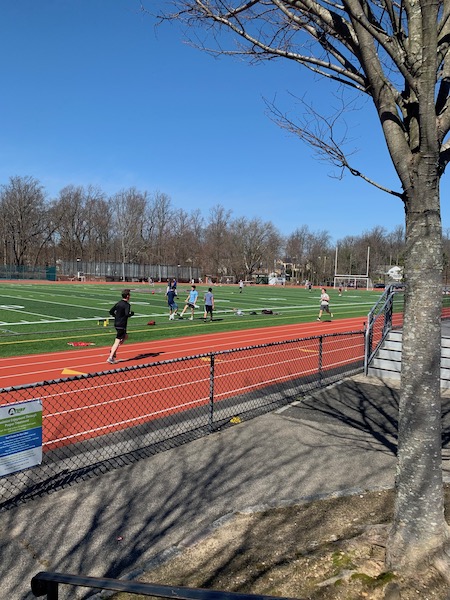 With so little to do and almost nowhere to go, the Scarsdale High School track and field became popular destinations during the Corona crisis. When temperatures climbed and spring was in the air, kids were out playing ball and walkers and runners were enjoying the new track. Sadly on Friday March 20 the school district announced that these outdoor facilities would also be closed.
In a March 20 email from Dr. Hagerman he explains, “Over the past few days, we have been receiving reports about the use of our outdoor facilities relative to social distancing guidelines. Though we were hopeful to keep these open-air spaces available for our community, the District has decided to close the Butler Track & Field at Scarsdale High School. In light of new guidance on social distancing and our understanding of the current use, we can no longer keep these spaces open. Effective immediately, all District outdoor facilities including playgrounds, fields, and the track are closed indefinitely. We will communicate when we decide to reopen these spaces.”
Last week’s police blotter reports several complaints from some who saw people using the playgrounds and fields on Boulevard, at Greenacres and at the high school. We wondered if the police were enforcing the ban and here is what we learned:
According to Scarsdale Police Captain Edward Murphy, “Our officers are checking parks/fields frequently and we have received calls about groups congregating. Our officers have responded to disperse and educate about social distancing. We advise all to follow Federal and State recommendations on social distancing.”
But we asked, “Is it okay to use the track and keep your distance?” According to Police Chief Andy Matturro, the short answer is no. He said, “As for the track, as they closed it, it is not ok to use it.”
Letter to the Editor: Streets Around Greenacres School Are Not Safe for Pedestrians
- Details
- Written by: Joanne Wallenstein
- Hits: 2899
 This letter was sent to Scarsdale10583 by Greenacres resident Gabriel Streche:
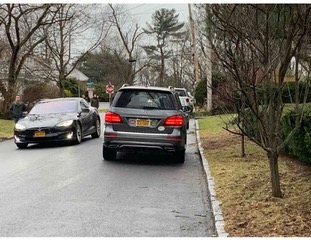
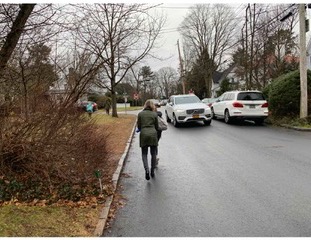
Since January I had the great opportunity to drop off my kids to Greenacres school and I was SO surprised about how bad the situation is. There are so many cars parked everywhere, in addition to all they cars trying to go through Sage Terrace and Putnam Road.
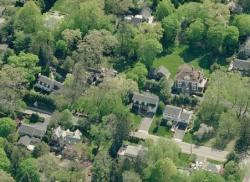
We live on Brewster Road, less than 2 blocks from the school and may times I drive because Sage Terrace and Putnam are not safe for pedestrians. The streets are so narrow, cars are parked on both sides of two-way streets and families with kids are attempting to walk. I can’t even think how anyone is able to navigate this if you have to push a stroller. When we walk I have my kids cross over peoples’ lawns as the street is too dangerous.
Many days there is a Scarsdale Police car stationed at the east corner of Sage and Brewster and one of the neighbors spoke to them. The Police Department is very aware and concerned about the situation as well and also asked my neighbor to raise the issue with the village.
There are a lot of parents that live close to school and are very concerned. Sidewalks on Sage Terrace Putnam Road and Brewster Road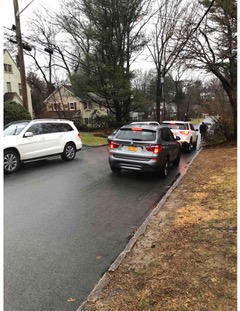 (at least from corner with Sage to Fenimore) are pretty much a must. The streets are simply too narrow to handle all the people and cars that need to do drop off and pick up.
The sidewalks on Sage and Putnam end where the school ends and need to be extended to the end of the street. People and kids have to walk on the grass to be able to reach those sidewalks currently.
Gabriele Streche
Brewster Road