







LWVS Supports Changes to Board of Election Voting Procedures
- Details
- Written by: Joanne Wallenstein
- Hits: 4573
Should school election law be changed in Scarsdale so that candidates for the Board of Education run for seats at large – rather than for specific seats? Restated, this means that candidates for Scarsdale School Board would run at large, and those with the most votes would win – rather than the current system where candidates run for specific seats.
As background, in May 2018 one candidate ran unopposed while another candidate chose to target a specific seat and challenged the candidate running for that seat. To make matters even more confusing, the challenger was a current member of the school board who was running for a second term. But rather than run for her designated seat, she chose to challenge the candidate running for the other seat – making for a very confusing ballot showing her name in both columns.
See below:

This proposed change in the school election law would need to be approved by Scarsdale voters at the time of the May election for Board of Education and the school budget.
The Scarsdale Board of Education is proposing this change on the ballot and has asked for community feedback. To that end, the League of Women Voters of Scarsdale studied the issue by conferring with former members of the Board of Education, speaking with the President of the Westchester/Putnam School Board Association and surveying other districts in our area to learn what they do.
They learned that only 10% of neighboring districts have elections for specific seats –and the remaining 90% elect board members at large.
The school board election law allows districts to either elect members for specific seats or vote for members at large.
Thinking about the advantages of electing members at large, the League committee determined the following:
-Voting at large would simplify the ballot and the procedure
-Voting at large is consistent with other towns in the county
-Voting at large eliminates gamesmanship whereby an independent candidate can target the perceived weaker candidate
-Voting at large is consistent with village elections
The only argument they came up with against the proposed change is that the current procedure is consistent with the way we have always done it here in Scarsdale.
Summarizing the discussion, LWVS co-President Linda Doucette-Ashman said, “There is no right or wrong – it’s up to the community to decide.”
Another proposed change that will be on the ballot concerns voter registration for voting in the school budget vote. Under current rules, if you are registered to vote in a US election, you can vote in the school election. However, if you are not, you need to register with the school district clerk on two designated days of the year. Under this proposed change a resident could register with the school clerk at any time – not just on two designated days and the Board of Education would no longer need to designate specific registration days.
Here is the League’s consensus statement on the proposed revisions that was read at the February 11 meeting of the Scarsdale School Board.
Statement on Propositions Amending The Board of Education Policies on Candidates and Electioneering (2120.1) and Voting Procedures - Voter Registration (2120.2)
On behalf of the League of Women Voters Scarsdale, thank you for providing the opportunity for community feedback on the proposed changes to Board Policies 2120.1 and 2120.2.
The following statement reflects the consensus of members of the League of Women Voters Scarsdale at a League consensus meeting held on February 11, 2019. This statement comments on the proposed changes to Policies 2120.1 and 2120.2 of the Scarsdale School District Board of Education.
The League of Women Voters Scarsdale (the “League”) supports including the Proposition amending Policy 2120.1, entitled “Candidates and Electioneering,” on the ballot in May. The portion of this policy affected by the Proposition is whether candidates running for the Board of Education (the “Board”) run for a specific seat or whether candidates run at large. The League recommends that the community vote in support of a Proposition that changes our current system to an at-large system.
The League notes, most importantly, that in practice, Board members currently do serve at large and are elected to represent the interests of the entire community. The League also notes that the change to an at-large system may simplify the ballot in the event of a contested election and reduce the likelihood of voter confusion. Prior to the vote in May, the League encourages the Board to convey and publicize information to the community regarding this Proposition.
After outreach to all of the school districts in Westchester County, gathering information from a majority of those districts, and in correspondence with the executive director of the Westchester-Putnam School Boards Association, the League learned that approximately 90% of public school districts in Westchester and Putnam Counties currently have an at-large system for nomination and election to the Board of Education. As part of the League’s study, in addition to the aforementioned outreach and correspondence, we also reviewed New York State Education Law and policies of the New York School Boards Association, spoke with former Scarsdale School Board members, and spoke with the Deputy Council for the New York State Board of Elections.
The League also supports including the Proposition to Policy 2120.2, entitled “Voting Procedures,” on the ballot in May. The League recommends that the community vote in support of this Proposition to expand voter registration times.
The League recommends that in the Proposition, the Board clarify that the District Clerk referenced is located at the School District Offices, in order to differentiate from the Village Clerk. The League recommends that the Board publicly clarify which elections are covered by registration for school elections, as well as clarify to all community members that one does not need to register to vote in the school election if one is already registered to vote in the general election through the New York State Board of Elections. The League further recommends that, in the Proposition, the Board clarify the exact days and times of voter registration throughout the year including whether or not there is a cut-off date for registration for the school elections.
Thank you for your time and consideration.
Sincerely,
Leah Dembitzer, School Budget Study Portfolio Chair, LWVS
Linda Doucette-Ashman, Co-President, LWVS
Janice Starr, Co-President LWVS
Footnotes
1. The League notes that the Proposition language is still in draft form as discussed at the Board of Education meeting on February 4, 2019.
2. New York Education Law § 2018[b]. The League notes that School Board elections were run with a specific seat nomination system per New York Education Law. However, the next section of the law allows communities to change to an “at large” ballot if the voters so choose.
3. In correspondence with Lisa Davis, Executive Director of WPSBA, the League learned that approximately 10% of districts in Westchester-Putnam have a specific seat nomination process.
Robo Raiders on the Rise
- Details
- Written by: Laura Halligan
- Hits: 6243
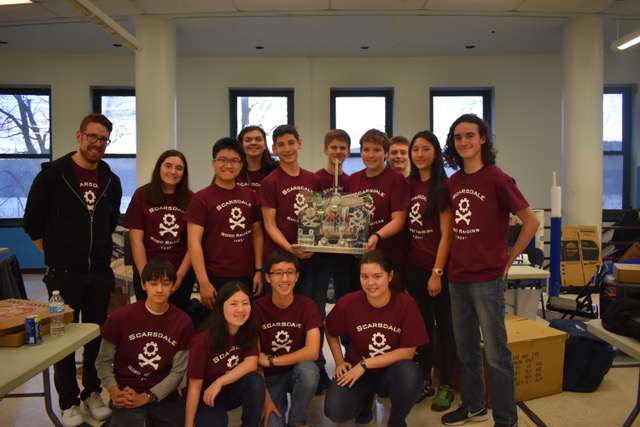 The Robo Raiders at the first Tech Challenge.There’s a new winning Raiders team in town. Scarsdale High School’s robotics team, the Robo Raiders, just had its best-ever showing in the qualifying round of the FIRST Tech Challenge, an international competition that tests teams to design, build, program, and operate robots to compete head-to-head.
Just three years after the group was formed, it’s headed to FIRST’s regional championship for the second year in a row, after its great showing in the “Rover Ruckus” held two weeks ago. The regionals will be held at Pace University this from the Hudson Valley competing. The winners will advance to the FIRST Championship in Houston this April.
The team has designed, built, and programmed their robot to compete in an alliance format against other teams. Members have used a specialized robot kit, powered by Android technology and programmed using Java, and need to develop strategy and build robots based on sound engineering principles.
Brian McDonald, who teaches STEAM classes at SHS with Lisa Yokana, serves as the Robo Raiders’ coach. He 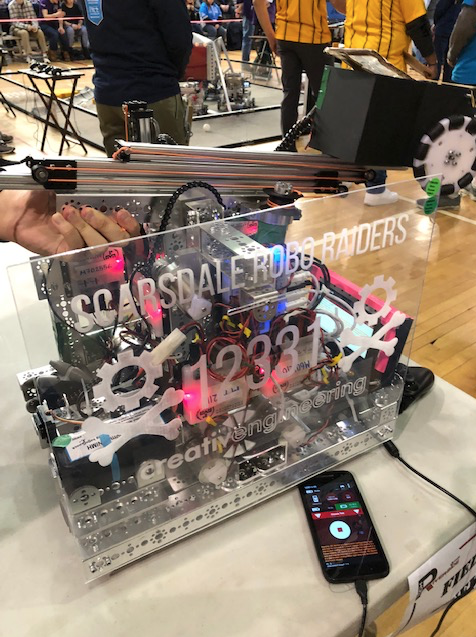 The robotics teams robot.explained that hard work and a little luck have led the team this far. “The first competition this year was in Peekskill. We signed up late and… didn’t have a running robot until the day before the competition.” Team captain, Teckhua Chiang, added, “There were many mechanical issues that we didn’t have the chance to solve and we were working up until the last minute.”
Needless to say the team had a less than stellar performance and were unable to advance after Peekskill. Fortunately, however, the group was able to enter another qualifying round in Yonkers when another team relinquished its spot. And, the Robot Raiders made the most of the opportunity.
“After their failed attempt… at the Peekskill competition, the team knew the improvements they needed to make and did what they needed to do within two weeks to make it happen,” said McDonald. He added that one student was working on programming issues through the night on the Friday before the competition.
Given a second shot, not only did the Robo Raiders qualify; they dominated in a field of 23 teams. Last year, the team walked away with one award in the qualifying round before being eliminated in regionals. This time, it won three awards and placed second in another category, and shows no sign of stopping.
The group earned the “Rockwell Collins Innovate Award” for its ability to “not only think outside the box, but have the ingenuity and inventiveness to make its designs come to life;” and was named a “Final Alliance Team, ” placing second overall in the day’s events.
They also earned a second place showing for the “Inspire Award,” the highest award a team can receive, given to the group that embodies the FIRST program and serves as a role model for others. Last, the team was a runner-up for the “Control” award, which recognizes the team that best uses sensors and software to enhance its robot’s functionality.
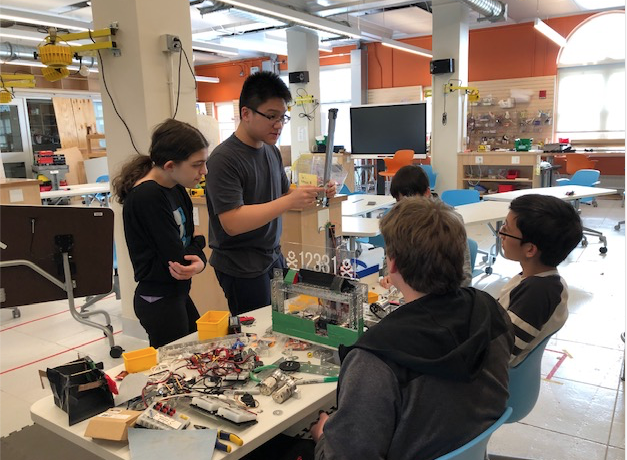 At works in the Design Lab.A unique feature of the FIRST Tech Challenge is that teams earn rewards not only for their performances in competition, but also for “community outreach efforts, design and other real-world accomplishments.” According to FIRST, “The competitions are the result of focused brainstorming, dedicated mentoring, project timelines and teamwork.”
The Robo Raiders now are working hard to maintain momentum. Mc Donald reports that, since the beginning of the year, team members have been spending hours each day troubleshooting and refining systems. “(After the qualifier) I was ready to tell them that we have to up our game (going into regionals), but I quickly realized they were ahead of me. They already were on top of the things that we need to improve… they had a full plan and were ready to go.”
He continued, “Other teams rely heavily on the mentors who they are working with. They need feedback and opinions of teachers, and sponsors, and engineering partners to help them build their robots. What’s impressive here is that I have not needed to play that role. I can’t take a lot of the credit because they go and seek those answers themselves. My main role has been … when things start to slow down, (to keep them on track).”
Chiang added, “We learned a lot from participating in our first regionals. It’s a completely different competition from the qualifier and we have to be ready this Sunday.”
Humble Beginnings
The Robo Raiders trace their roots to a group of half a dozen students who just wanted to build robots. However, three years ago, those students had either graduated or moved on to other activities. Chiang said, “I was really interested in starting a robotics team, so a group of my friends and I came together in our sophomore year to re-start the club… I was interested in building things, and working with my hands, as well as computer science and programming. Robotics is a great way to combine the two… and create a team as well, which is what I was looking forward to.”
Now, the team has “a steady 18 members,” according to McDonald., with other students pitching in from time to time. “Science Olympiad takes away a lot of students who would typically be a part of this sort of activity. However, a smaller group works better for us because it allows us to be more productive.”
While the team focuses on Sunday’s test, it also looks to continue expand its activities, complete new projects and participate in more competitions. Sponsors will play a crucial role in assuring the Robo Raiders ongoing growth; it costs hundreds of dollars to register for each competition alone – and funds are not provided by the school district.
According to the team’s outreach director, Courtney Guastafeste, “We are trying to get sponsors to help support us; it’s expensive to compete. We also need to buy build kits, and other things like shirts, and posters to reach out at school and in the local community to let them know this is a thing now… Our team members contribute some money themselves, but we still need a lot of assistance. “ Currently, Creative Engineering and the Digital Arts Experience help support the team’s efforts, but the Robo Raiders are seeking additional sponsorships and partnerships from both organizations and individuals throughout Westchester.
Why It Matters
We all know the benefits of participating in team sports. But, traditional sports aren’t for every student. The Robo Raiders, and teams like it, provide the same opportunities to learn teamwork, forge friendships, reinforce a sense of responsibility, collaborate in solving problems, experience the thrill of winning, and learn to deal with defeat. They also mold tomorrow’s problem solvers through hands-on experience.
And, speaking as a sports fan, I honestly can say that the Robo Raiders’ last competition had all the elements of a good ballgame or track meet – anticipation, excitement, uncertainty, and elation. The team is just as committed to success as any group of good athletes and deserves some boosters of its own.
For more information about the Robo Raiders or how you can help support the team, visit the Scarsdale Robotics webpage or contact Brian McDonald at [email protected].
Scarsdale High School Experiments With Two Class Schedules
- Details
- Written by: Alexandra Wilson
- Hits: 5460
 Never underestimate the difference a few minutes can make. In September 2017 the Scarsdale High School administration implemented a controversial class schedule that lengthened the school day and limited homeroom to two days a week. Students were disappointed not only because they lost their daily mid-morning break, but also because they were disoriented by the varying class schedule each day. Parents and students alike, including the Compact Committee , also feared the impact of the lengthened school day on the school’s wellness initiative.
When the school year began, school days ended at 2:55 on Mondays and Wednesdays, 3:05 on Tuesdays and Thursdays, and 1:59 on Fridays. Class periods extended from 49 to 51 minutes long, which added 75 minutes of class time to each week.
After backlash about the timing, there was much reflection on how to make the schedule more appealing to the students while also maximizing class time. After gathering students’ opinions in a survey in November 2018, the administration decided to pilot two different class schedules over the course of the next two months. “The SHS Schedule Committee has been working to devise a schedule for September 2019 that will provide consistent start and end times to the school day and to the periods in the schedule, as that was the strongest indication from feedback we solicited from students, parents, and teachers last year and that we confirmed in surveys this year,” said Principal Ken Bonamo in a letter. One pilot is in effect from January 28th until February 15th, and the other will be tested after February break, from March 11th until the 28th. Below are the schedule pilots:

One primary difference between these two schedules and the previous schedule is the end time of each day; these schedules end the school day at 3:00 on Monday through Thursday and at 2:05 on Fridays, which is more consistent than the previous schedule. In addition, periods are 50 minutes long in each pilot, as opposed to the former 51 minutes.
Another key difference is that these pilots delegate time to a brief mid-morning break in classes each day, whether that is homeroom or common tutorial. “The common tutorial period is designed to provide a time when all students and teachers are unassigned and thus available to work on classwork or extracurricular activities,” wrote Bonamo.
Once this experimentation with the pilots is complete, there will be follow-up surveys, and the administration will regroup and devise a schedule for the 2019-20 school year.
Cannon to Leave School Board, District Announces Retirement of Administrator and Teachers
- Details
- Written by: Joanne Wallenstein
- Hits: 7491
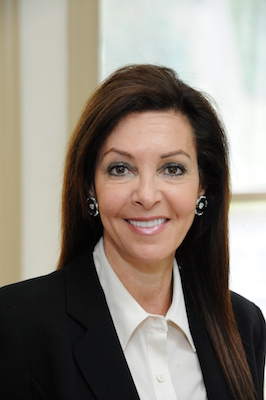 Nina CannonBoth her board colleagues and the administration appeared to be surprised by school board member Nina Cannon’s announcement at the BOE meeting on Monday night that she has decided not to run for a second term on the school board. Well-liked and respected, it was assumed that Cannon would continue to serve and move into a leadership position on the board during her second two-year term.
However, citing the responsibilities of her full-time job at Hunter College, Cannon said she was finding it difficult to manage her professional responsibilities and the time commitments she has as a board member, including attendance at board meetings and liaison assignments. She said, “I value the work we do at the table,” but felt that she could not commit to another three years. She assured the board that her “term does not end until June,” and vowed to “carry out her commitment.”
Cannon has joined a growing list of recent board members who opted to retire after one term on the board. In recent years Joel Gurin, Jonathan Lewis, Sunil Subakrishna and Art Rublin have all decided not to serve a second three year term which left voids for experienced members to assume the roles of board vice president and president.
In June, in addition to Cannon, both Leila Maude and William Natbony will complete their six years of service on the School Board. The newly elected School Board Nominating Committee will now need to nominate three candidates to serve.
In other personnel changes, Assistant Superintendent Drew Patrick announced the following retirements as of July 1, 2019:
Larry Chatzinoff – Assistant Principal at the Scarsdale Middle School
Cheryl Higgins – Teacher at Heathcote Elementary School
Kate Krahl - Social Studies Teacher Scarsdale High School
Deb Krisanda – Teacher at Greenacres Elementary School
Lisa Onofri – Teachers at Heathcote Elementary School
Elizabeth Ungar – Math Teacher at Scarsdale High School
Here is an announcement from the School Board Nominating Committee about their candidate recruitment:
SBNC seeks candidates to nominate for three seats on the Scarsdale School Board: Nina Ledis Cannon not seeking second term on Board of Education.
The School Board Nominating Committee (SBNC) is seeking to identify potential candidates to serve on the Scarsdale Board of Education. The SBNC held its first meeting of 2019 on January 13th and is now engaged in active outreach to build a robust candidate pool.
Over the next several weeks, SBNC members will recruit and review candidates in order to nominate three candidates for the nonpartisan slate in the next school board election. The school board election and budget vote are slated for Tuesday, May 21, 2019. Bill Natbony and Leila Maude are completing their tenures on the board and Nina Ledis Cannon has chosen not to seek renomination.
The SBNC invites all Scarsdale School District residents to propose names of qualified individuals to serve on the Scarsdale Board of Education by email to [email protected]. A candidate must be at least 18 years old, a U.S. citizen, a qualified voter, and a resident of the Scarsdale School District for at least one year prior to the May 21st school board election date. Jordan Copeland, SBNC Chair, stated: “The non-partisan SBNC process is critical to the excellence of our Board of Education and our schools. This year we will be proposing three new candidates for the Board, so this is a rare opportunity for service-minded Scarsdalians to help shape the educational policies that profoundly affect the children of our community.”
Interested candidates should complete a biographical information form and submit it via email to the SBNC Chair, Jordan Copeland, at [email protected] as soon as possible, but no later than 5:00 PM on Tuesday, February 26, 2019. Forms are available on the SBNC website at www.scarsdalesbnc.com. Please see the “Join the School Board” tab or contact the SBNC Chair for further information.
Contacts:
Jordan Copeland, Chair
Tanya Singer, Vice Chair
Looking Back at a Semester Abroad in Copenhagen
- Details
- Written by: Carly Glickenhaus
- Hits: 6403
 The American students leaving for their semester abroad, in a mass migration every year, are looking for very different things. My experience as a vegan D1 athlete studying counterterrorism in Denmark was probably not typical. As a student at the Danish Institute of Study Abroad, I travelled to Western Denmark, Dublin, and Belfast with a program called Terrorism and Counterterrorism from a European Perspective.
Though I was confident that I was smart, curious, and responsible enough to live in Denmark, it ended up taking more effort than just the skills I already had. Anyone can go abroad, but to enjoy almost every moment of the semester and get the most out of my investment took a tenacious and proactive effort on my part.
People say college is the first time you truly live on your own, but I’d say it is study abroad. College is like the game little kids play when they pretend to be adults, serving each other plastic food from the plastic kitchen in the basement while parents cook real food upstairs. College lets you feel a bit like an adult while still acting like a child.
Without the resources and cushioning of my university campus, my semester abroad was the first time I truly lived on my own. Sure, I could call my parents in an emergency, but only if that emergency happened after 2:00PM my time. Living on my own in a foreign country meant no student health center with my medical records and insurance card on file. Spraining my ankle turned in to an unintended field trip to the hospital to experience socialized medicine for myself. When I got food poisoning, I could not walk into my mom’s room to tell her I threw up. I cleaned the communal bathroom sink while the toilet stared me down and mocked me for missing.
Taking care of myself meant being hyper-aware for my own safety but also for my education. My terrorism class travelled to  Street Sign in BelfastNorthern Ireland to study the history of sectarian conflict and the I.R.A. Our days were spent walking the alleyways of the city where we read propaganda from both sides of the conflict between the Catholics and Protestants. I watched the victim of a violent assault, head wounds freshly wrapped, order a pizza in Belfast, under the glow of lights from the police vans. I travelled with classmates who were as eager as I was to understand how violence can become a cultural norm -- a more powerful experience than all my lectures on the Prisoner’s dilemma.
Keeping up with my normal routine of rowing before or between classes, I realized how much I’d relied on my dining hall for my chosen lifestyle. I couldn’t swipe in to the dining hall for a quick and easy meal paid for by invisible currency on my student card. Grocery shopping in the U.S. was more an errand than an activity itself. But in Denmark, I needed to allocate enough time to forage for nutrients, especially since I’m not the typical omnivore. The same products I knew at home stood before me, but masked by the hieroglyphics of the Danish language, so walking through each aisle was a sensory overload. A few times, employees spotted the bewildered eyes of an outsider and asked me in English if I was looking for something in particular. Most of the time, my squinted eyes were hunting for the obscure health-food specialties. “Almond flour?” I asked the eager teen making twice my state’s minimum wage. I was usually offered almonds and flour, and figured it wasn’t worth asking for organic crunchy unsalted almond butter.
My zealot veganism ironically started in Denmark, a country whose primary export to the US is bacon. Inspired by a contagious biking culture, I was excited to be part of the Scandinavian sustainability model. Denmark is aiming to run on 100% renewable energies by 2050, and I was captured by the passionate commitment to rethink energy sources, starting with my own carbon footprint. I did not expect to enter such a niche subculture, a cult united by soy chorizo, and leave with a poster that says “If it’s not your mom, it’s not your milk,” which will ward off unwanted carnivores on my college dorm door this semester.
 Biking in CopenhagenInstead of going to the bike shops where all the Americans were renting their bikes, I tried to live like the locals and rent a bike off the Danish equivalent of CraigsList. A man named Claus sold me a “bike” to be delivered by a man named Gizmo, who I waited on the street to meet along with my roommate for added security. Gizmo had apparently come earlier than our arranged time, which I discovered when I found a bike with backward handlebars and no brakes on the sidewalk. This bike matched the picture I’d seen online about as much as a Tinder profile using The Rock’s body. It would have saved me time, angst and a Paypal account to rent a bike from a reputable dealer. But I did get to practice lawyer skills and advocate for myself as if I was an adult. Gizmo will never know that I’m just a 20-year old girl trying to save 200 kronor for cinnamon rolls. I politely demanded my money back using a few new Danish words, and realized that when I was sure enough of myself, adults would actually listen to me and respect my demands.
Selecting Copenhagen for my semester abroad turned out to be one of the best decisions I ever made. I evaluated cities like I would people, seeking out the spectacularly unpretentious ones that don’t go out of their way to impress anyone, unlike Paris and New York. I wanted to find a place that was unapologetically itself, with the unsubtle and bold character that marks Danish humor. As a student in the U.S. capital, Copenhagen called to me because it is not at the forefront of American minds as a  Superkilen Park in Copenhagentourist destination or a pertinent European epicenter in news and U.S. politics. That meant I knew nothing about Danish culture and had no preconceived understanding of Danish politics or national identity. Copenhagen is full of surprises and contradictions, making it difficult to label.
I had looked for a city that fit my personality, so I didn’t end up travelling every weekend like many of my classmates. Like loving a person, I didn’t want to love my new home only for its shiniest moments, like the most perfect cloudless days swimming in the Baltic sea. The frigid Danish storms threatened to sweep my 5’3” frame off my pink bike on the windiest of days, and I surrendered to the Scandinavian winters to learn to enjoy the great indoors.
It was a fine balance to seek out things that scared my parents and me but weren’t dangerous … like travelling by myself. That set me up for Thanksgiving dinner at a B-rated Chinese restaurant in the Red Light District of Amsterdam.
Avoiding travelling in a pack like many of the American students abroad, I braved a hostel where I was the only girl in a dark room of 20 beds. My miserable experiences with surprise visitors in a smoky apartment rented through the bankrupt European version of Airbnb “Yes Student” were well worth the pain. I sought to avoid hanging out with the same familiar people, eating the foods that were most comfortable, taking the classes that looked easy and shying away from speaking the language. Despite this independence, abroad accelerates friendships faster than a kindergarten recess. In fact, there’s no stronger bond than three girls getting locked out of their Airbnb leaving us to adapt and problem-solve until the sun rose over Berlin.
 Hike in Bergen Studying abroad in Denmark granted me the time and opportunity to reflect on my own sense of national identity. I would like to incorporate the European pace and work-life balance into my own lifestyle. Nonetheless, hearing many Europeans label Americans with blanket assumptions created by today’s news, I realized that as much as I fit in to to the culture I experienced in Scandinavia, I have a strong affiliation with an American generation that seeks to reshape our national image and our face to the rest of the world.
Carly Glickenhaus is a junior at Georgetown University on the Lightweight Rowing team, where she is studying Economics and Security. She studied abroad at DIS: Study Abroad in Scandinavia in a European Counterterrorism program.