







Graduates Bid Farewell to SHS And Look to Change the Future
- Details
- Written by: Laura Halligan
- Hits: 7785
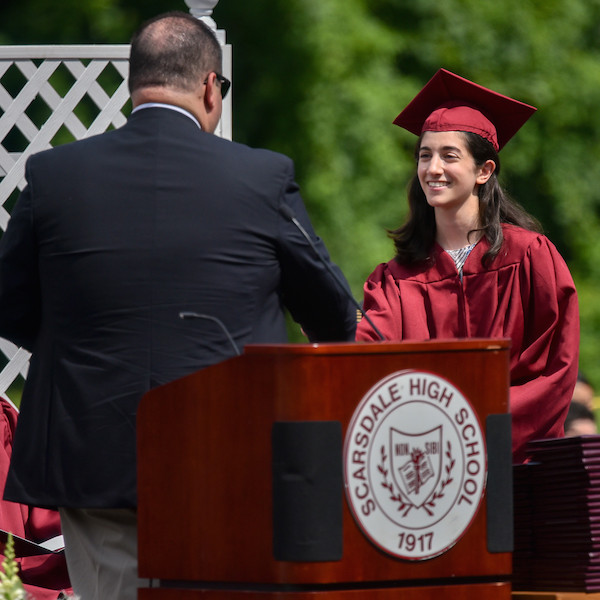
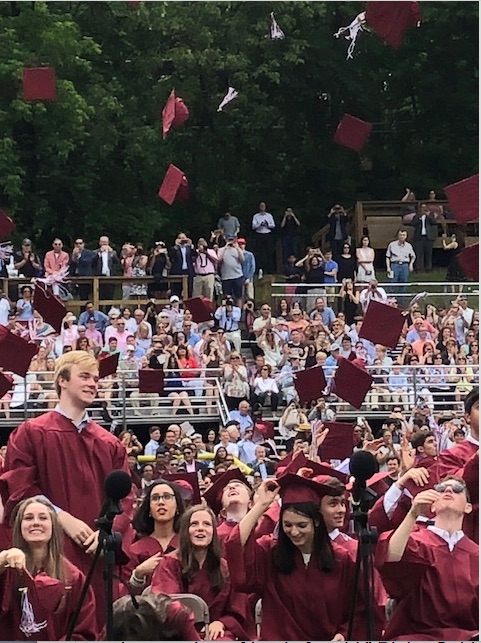
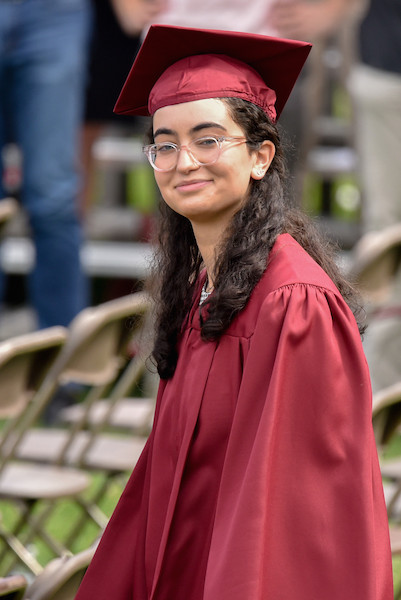
 Photo by Jon ThalerThis year, the weather cooperated nicely as Scarsdale High School graduated its 101st senior class this past Friday, June 22. Almost 400 students received their diplomas at Dean Field, surrounded by family, friends and SHS faculty, and were urged to “endeavor to make the world a better place.” As he congratulated his seniors, Scarsdale High School Principal Ken Bonamo said, “The key to your success…will be to infuse love into your work, your relationships and your self-regard.”
Scarsdale School Board President Bill Natbony welcomed the crowd and reflected on how the graduates had come: “Your heads must be so filled with dates, formulas, historical facts, vocabulary words, grammar rules, foreign language words and artistic concepts. Some of this knowledge you will actually use in your careers; some of it you will happily forget or have already purposely forgotten. However, there are certain key lessons and rules you should never forget.”
He quoted Robert Fulghum’s book, All I Really Need to Know I Learned in Kindergarten: 1) Share everything; 2) Play fair; 3) Don’t hit people; 4) Put things back where you found them; 5) Clean up your own mess; 6) Don’t take things that aren’t yours; 7) Say you’re sorry when you hurt somebody; 8) Wash your hands before you eat; 9) Flush; and 10) Warm cookies and cold milk are good for you; 11) Live a balanced life – learn some, drink some, draw some, paint some, and sing and dance and play and work everyday some; 12) Watch out for traffic, hold hands and stick together; and, last but not least, 13) Be aware of wonder…. “Each of these has significant meaning in your life and future… 13 years later,” he concluded.

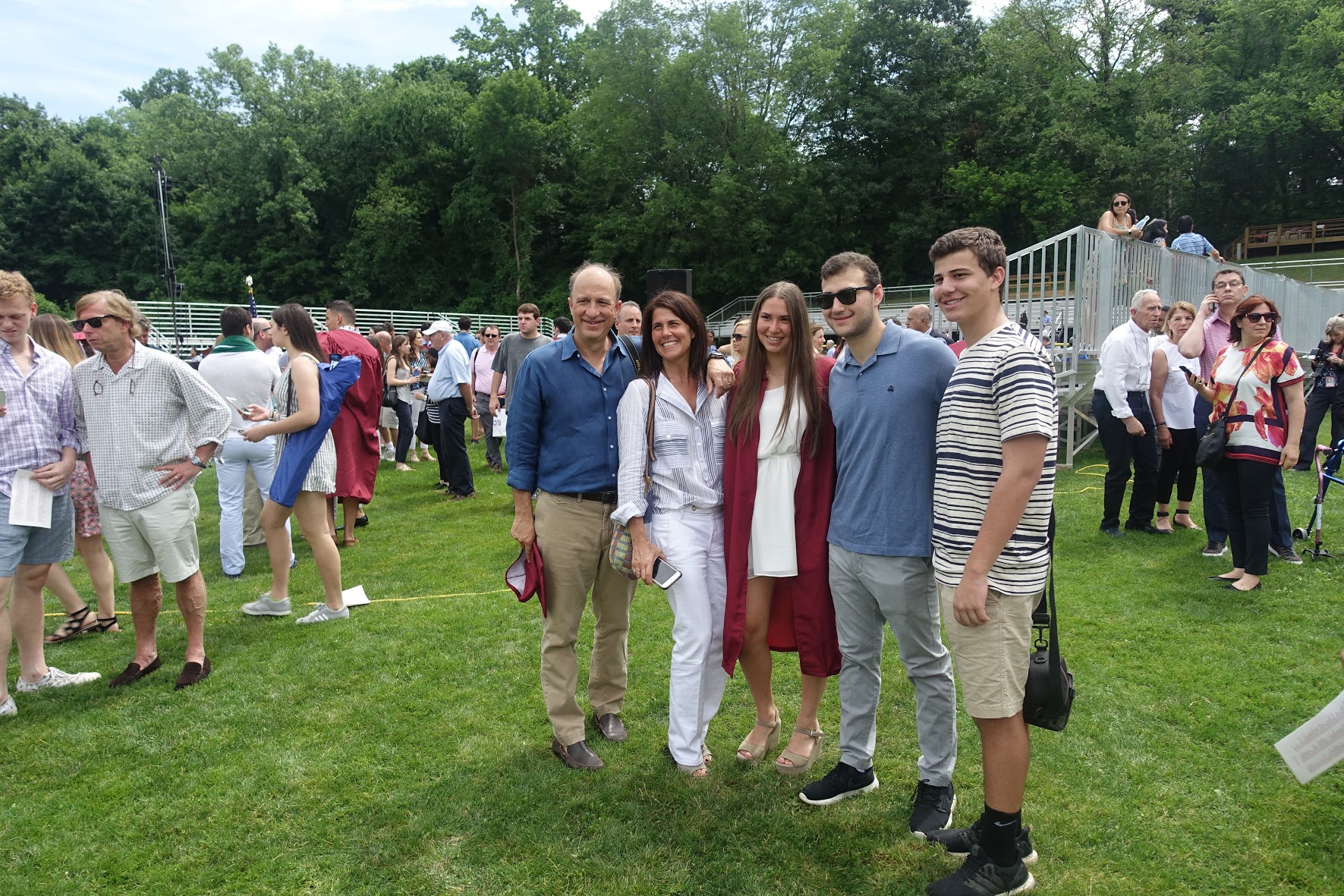
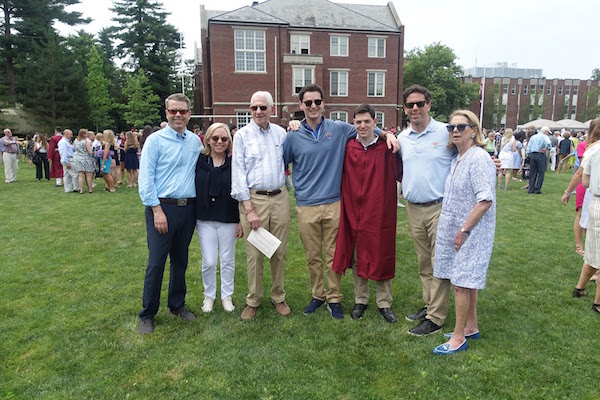

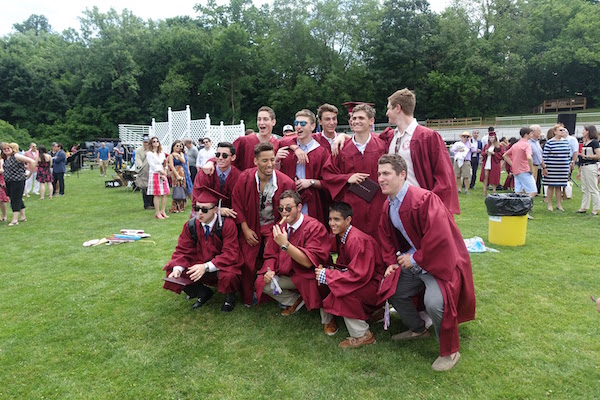

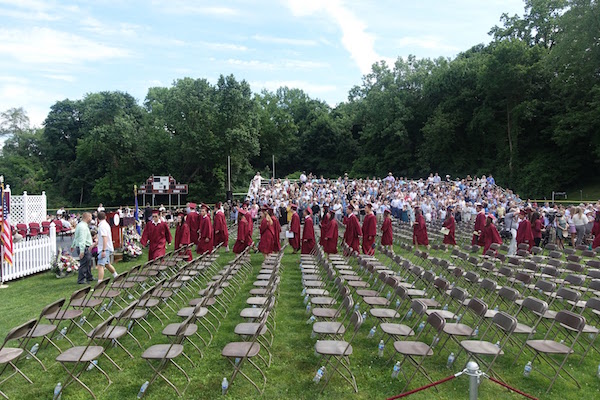





Photos above by Jessica Solodar
Mason Marsh and Jake Miller, co-treasurers of the graduating class, followed Natbony to introduce class advisors, Sandra Chan and Elise D’Ammora. “We have the pleasure of introducing our Class of 2018 government advisors…(who’ve) worked tirelessly over the past four years to provide our class with fun and meaningful events… Their hours upon hours of dedication and hard work should not go unnoticed.” Chan and D’Ammora then addressed the graduates. D’Ammora said, “Leave here with at least one good memory and let the bad ones go… Stand up for what you believe in, even if others disagree with you… Ask questions, stay informed, and play an active role in whatever you do… Find the courage to find something new.”
Chan said, “Accept that you will make mistakes… Hopefully, your experiences here in Scarsdale have taught you that mistakes can be a pathway for growth, if you choose to learn from them… Finally, appreciate your friends and be a good friend… A true friend celebrates even the smallest successes with you, listens without judgment and forgives unconditionally. Hold on tight to those friends… and embrace every opportunity to make new ones in the future.”
Class of 2018 Co-Secretaries Rhea Kothari and Perri Thaler then extended thanks to SHS faculty and staff for their work and support throughout the last four years. “For all that you’ve given us, we cannot thank you enough. Thank you to everyone who has made our high school experience memorable.”




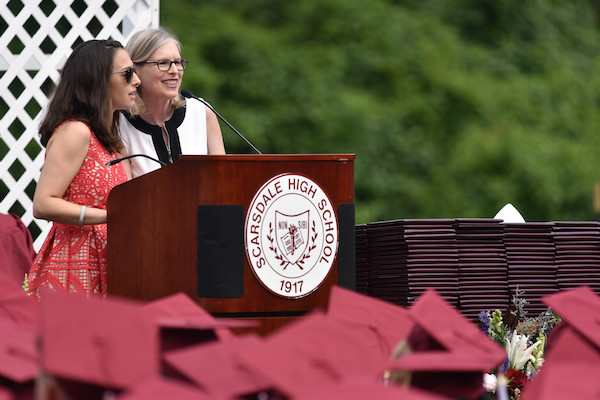

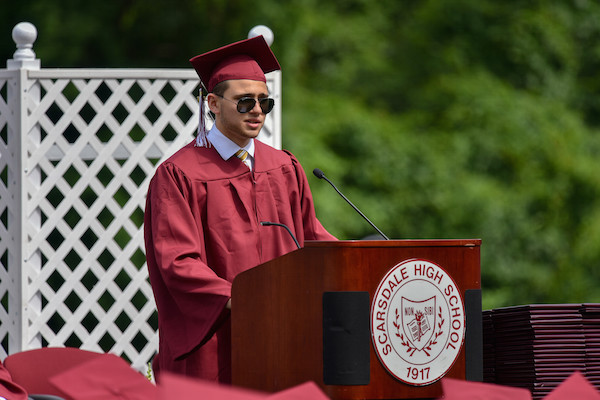
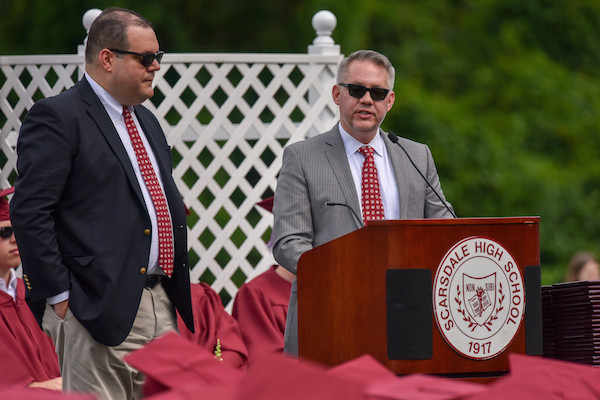

Photos above by Jon Thaler
Matthew Greenberg, senior class vice president, followed and said, “We were lost in this strange place called Scarsdale High School. But, somehow, by some miracle, we all made it here today… We learned compassion, through endless community service. We learned the importance of hard work and perseverance… And we learned, that when our own efforts were not enough, we could always turn to our teachers and our friends for aid.” Blake Goldstein, senior class president, then addressed his fellow graduates, citing their many volunteer efforts and willingness to speak up for what they felt was right. “Together we are strong of will and full of passion… As we step out into college and into the real world… we cannot forget the impact we’ve made here and will continue to make.”
Just before presenting diplomas to his graduates, Bonamo stated, “Your engagement and initiative in advocating for change reminded mePhoto by Laura Halligan of the inspirational language of Robert F. Kennedy, who said, ‘Few men are willing to brave the disapproval of their peers, the censure of their colleagues, the wrath of their society. Moral courage is a rare commodity, rarer than bravery in battle or great intelligence… To make real change and bring about progress, you will need to add personal courage to the skills and knowledge you gain in school and college.” He continued, “Given the magnitude of (today’s) social and global problems, we will need your fresh voices and new ideas…. Write your untold stories for yourselves and those around you.”
Scarsdale Schools Superintendent Thomas Hagerman then certified the seniors as graduates of Scarsdale High School and bid them to go forth, grow in wisdom and serve the common good. Each each student was awarded with his or her diploma. You may watch the ceremony online, via the Scarsdale School District website.
What John Waters Learned at Scarsdale High School
- Details
- Written by: Derek Moritz
- Hits: 6871
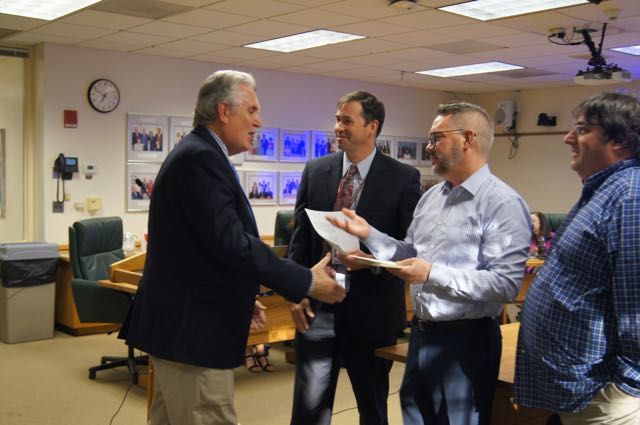 John Waters shakes hands with Dr. HagermanAfter 40 years of teaching, John Waters has decided to put down the smart board pen one last time. A graduate of Manhattan College, Waters began teaching at Brooklyn Tech in 1978, and taught there for 20 years. He left his position at Brooklyn Tech to become Math Department Chair at Bronx Science, and taught there for three years. Mr. Waters, however, always had an interest in teaching in a suburban school, and in 2003, Scarsdale had an opening. He’s been teaching at Scarsdale ever since.
Waters believes that day to day teaching is the most rewarding experience a teacher can have at SHS. Scarsdale is full of motivated students who want to both do well and learn, which makes his job more meaningful and enjoyable.
Mr. Waters believes that as the years have gone on, his philosophy and style of teaching have changed. Waters recognizes that each and every student who walks through his classroom has a different style of learning: some students are visual learners while others are auditory learners. As a result, Mr. Waters tries to cater his lessons towards all learners through the use of technology. The only downside to this technology, according to Waters, is that it requires more prep work on his part, however, he finds it’s worth it if it yields a more enhanced learning experience.
Mr. Waters has also learned a lot from his students. Waters noted that it’s especially important to listen to students in math, as they may have a different approach to a problem that still yields a correct answer. It’s important for a teacher to recognize this and learn from it, so in the future, the teacher can show students this new method for solving a problem to add more insight. Waters put it best: “Don’t limit yourself to your own knowledge.”
Waters is going to miss the students the most. He’s described the students of SHS as a “group of motivated young people who want to learn”, and has developed a sense of appreciation for their passion.
Upon retirement, Waters will still work part time at a local college, but will also have more time to pursue his unique passions. Waters is an extreme cyclist who bikes roughly 2,000 miles a year, and is also a big sports fan (specifically, Yankees, Giants, Rangers, and Knicks — in that order). Waters also loves to travel.
Perhaps the biggest mystery surrounding Waters is the origin of the iconic Superman poster sitting in his classroom adjacent to the side wall. Waters has finally spilled the beans. A former SHS computer teacher worked with the now-retiring Ms. Bell to make a calendar for the French club. Each year, the calendar had different themes, including classic TV shows. Mr. Waters was asked to be Superman, so his face was photo-shopped onto George Reeve’s body by the computer teacher, and was used as the picture for one month of the calendar. These calendars were sold to students, and received an extremely positive reception, but the calendars were unfortunately discontinued when the computer teacher left SHS.
Waters offered the following advice to anyone planning on entering education or becoming a teacher: He believes a successful teaching career is rooted in having a passion for both the subject matter and the students. New teachers also have to be willing to learn and be open to change.
Committee Recommends Using EPDM Infill for Replacement of Synthetic Turf at Butler Field
- Details
- Written by: Joanne Wallenstein
- Hits: 6459
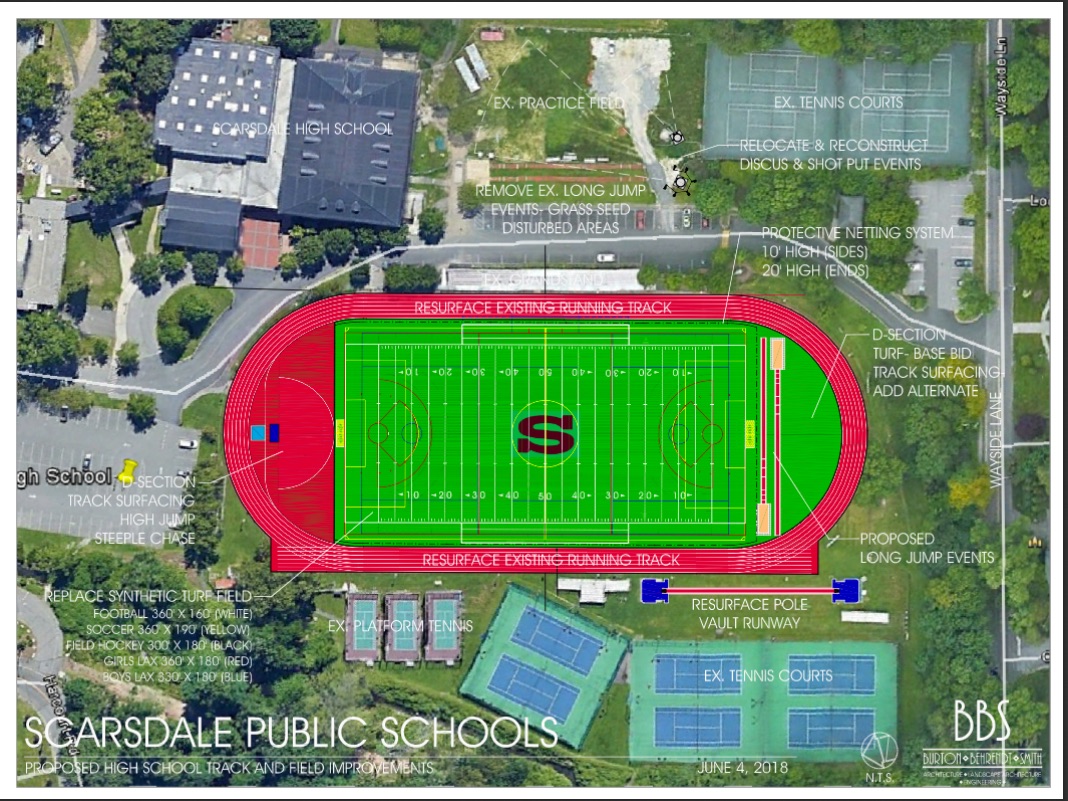 The Butler Field Committee comprised of administrators, coaches, parents and students was convened to analyze options for replacement of the 13 year-old turf field at SHS and to make a recommendation to the Board. At the June 11 meeting of the Scarsdale BOE, Athletic Director Ray Pappalardi reviewed the committee’s report and explained why they had decided on a synthetic turf with Ethylene Propylene Diene Monomer (EPDM) black rubber infill as well as renovations to the track and relocation of some of the track and field events to another area.
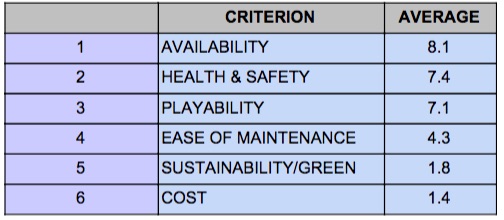
The committee based their decision on the following criteria:
Availability
How early is the field available in the Spring?
Can you get on the field during the hottest days typically in August?
Is the field available after a medium or heavy rain?
Are there days lost due to maintenance?
Health and Safety
What are the current or known health risks?
What are the future or unknown health risks?
What are the concussion impact or injury risks?
Playability
Infill splash-bounce displacement
Ball speed and running speed
Similarity to grass for softness
Ease of Maintenance
Additional man-hours required on a regular basis?
Equipment or storage requirements?
Frequency of replacing lost infill
Sustainability
Made from recycled or renewable material?
Organic?
Disposal method at end of useful life?
Source country of materials?
Cost
Annual operational costs
Upfront cost
Expense of replacing lost infill
The committee visited numerous sites to learn more about different varieties of infill and spoke to parents, coaches and administrators in other districts about their experience with different surfaces.
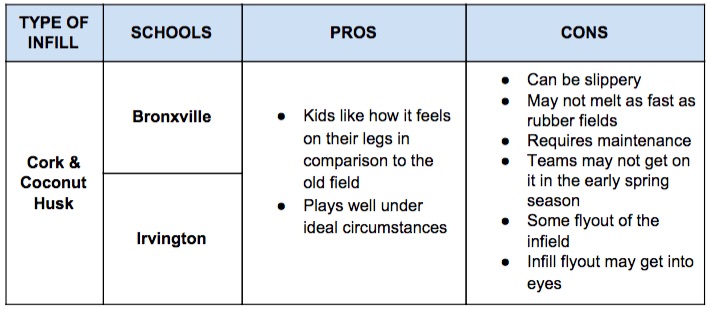
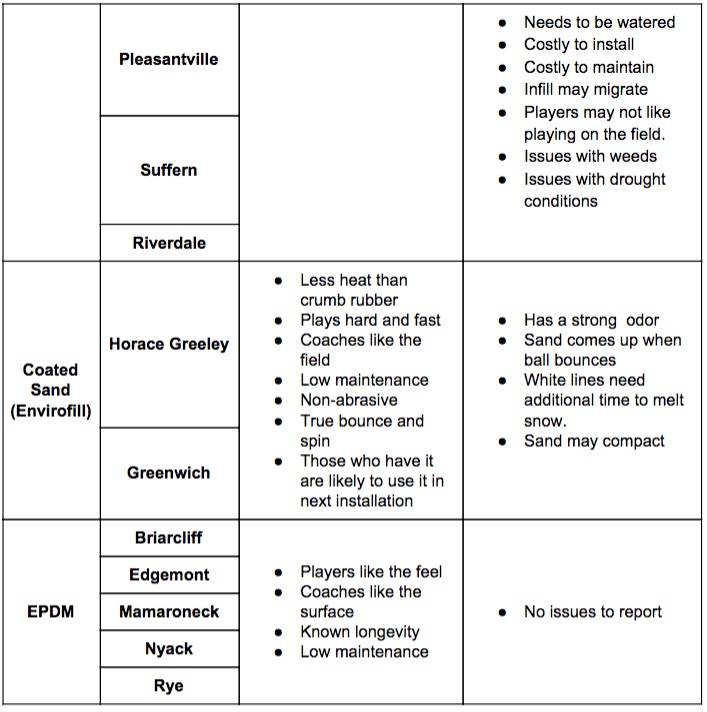
Based on their research, they came up with the following:
At their May 24 meeting, they weighed the criteria to determine their ranking of priorities and came up with this analysis:
They concluded that fields with rubber infill are more readily available than those with organic infill such as cork or coconut husks. Fields with coated sand infill also have good availability and drain well.
For health and safety, they found that fields with EPDM and coated sand infill allow for the use of turf shoes rather than cleats, which increase traction and are a contributing factor to injuries of the lower extremeties. They learned that the fields with organic infill are slippery when wet and may be less safe.
In terms of playability, under ideal conditions, the organic infill feels good to the players. However when it’s dry, the flyout gets into players eyes and mouths. Coated sand feels hard and plays fast. The committee found that EPDM plays well and provides a consistent surface for play in most weather.
Organic fields require more maintenance as they require grooming after rain as well as weeding. However, organic infills are the most sustainable option as they are compostable whereas EPDM and coated sand must be taken to a landfill.
The committee estimated that the annual operating costs for the organic field would be $36,000 as compared to $5,000 for the EPDM.
Based on their work, they recommended that the district install EPDM black rubber infill with a shock pad between the base layer and the synthetic turf, for both safety and playability.
They recommended that the six-lane track as well as the high jump, long jump and pole vault be replaced.
They also recommended that the aging goal posts be replaced and that field safety netting be installed around the field to prevent lacrosse and soccer balls from flying on the track.
The plan calls for turf work to begin in November 2018 and track work to begin in June 2019.
The budget for this work, including drainage improvements would be $1.712 mm. If the district decides to go with green EPDM rather than black, it would cost an additional $256,800and bring the cost to $19.5mm.
The committee also recommended additional work to the track, totaling another $250,000. The Board will need to decide whether or not to do this work at the same time as the turf replacement project.
In the discussion, Board Member Nina Cannon questioned the use of black vs. green infill and was told that the black is less expensive because it is more readily available, though the green might be cooler on hot days.
Art Rublin asked about sustainability, and Andrew Patrick replied, saying that the committee acknowledged that playability, not sustainability, was the objective of the project. Rublin also asked if there were any health studies available about the safety of EPDM and Stuart Mattey responded that the committee was not aware of any studies.
Lee Maude questioned whether or not the additional $250,000 should be spent on the track and field improvements. Chris Morin said, “We should decide if these are worthwhile and if so, use the most efficient way to make these improvements.”
The Board of Education will vote on the field replacement at their next meeting on Tuesday June 10, 2018.
Also discussed at the meeting were gifts to the district, a new social media policy and a revision to the Code of Ethics of District Officers and Employees.
Annual Gift Review
The Board conducted an annual gift review of all gifts given to the seven district schools. They have received a total of $128,345.86 in gifts over the 2017-18 school year from various organizations, including the seven school’s PTA organizations. One of the more recent gifts was $15,000 from the Fox Meadow PTA for new smart furniture, which includes standing desks, kinesthetic seating, and communal tables to create a more innovative and modular learning environment for Fox Meadow students. Board Member Leia Maude questioned the role the district would play in “owning up” to the purchase of the furniture, to which Dr. Hagerman responded that there is an expectation that once the school accepts the gift, the district will need to decide to either maintain it or eventually get rid of it. Hagerman also noted that Edgewood has also experimented with this kind of furniture and other schools will likely install more smart furniture in the future.
This discussion also led board member Art Rublin to discuss the issue of disparity, and maintaining equality among the elementary schools. Dr. Hagerman noted that the five schools should have a general shared experience, but are each unique. He thought it was best to look at the issue of equality by not necessarily looking at the amount of gifts a school receives in one year, but rather over multiple years. The Greenacres PTA, for example, has been holding out on spending a significant amount of money on gifts due to upcoming construction. Board President William Natbony agreed that it is key to ensure that these disparities do not exist in the long term and that all elementary students receive a high quality but unique experience.
Social Media Policy
Also discussed was the first reading of a new Social Media Policy presented by Director of District Technology Jerry Crisci. The new policy can be reviewed here:
The policy includes guidelines and education for students and staff on the use of social media. Board President William Natbony, questioned some of the phraseology used in the policy which states, “Under no circumstance should inappropriate comments be made about any member of the school community. Any user who receives threatening or unwelcome communications or material should report them to a teacher, a school administrator or the Director of Technology” but it did not define the terms “inappropriate” and “unwelcome.” Natbony asked, “If a student made a constructive comment online that criticized their teacher, for example, would that be worthy of punishment? Natbony believes the words “disrespectful” and “offensive” might be better suited. Additionally, the policy states that “Engaging in social-networking non-academic friendships with current Scarsdale students is discouraged”, but board members expressed some concern as students often seek help from teachers on personal issues, and this line could potentially alienate those students. Board Member Art Rublin suggested gathering community input on this policy before implementation.
Code of Ethics
The Board also reviewed revisions to the Code of Ethics for school district officers and employees. They discussed the section regarding school gifts that now says, “A Board member, officer or employee shall not directly or indirectly solicit any gift or accept or receive any gift having a value of $15 or more ,… under circumstances in which it could reasonably be inferred that the gift was intended to influence him or her in the performance of his or her official duties or was intended as a reward for any official action on his or her part”. Assistant Superintendent Drew Patrick recommended that the $15 limit be scrapped, as no gifts of any monetary amount should be able to influence the intentions of any staff or board member of the Scarsdale Schools.
Board Member Nina Cannon brought up the future employment provision, which states that "A Board member, officer or employee shall not, after the termination of service or employment with the district, appear before the Board/District in relation to any action, proceeding, or application in which he or she personally participated during the period of his or her service or employment or that was under his or her active consideration while he/she was with the District.” For example, this clause would prohibit retiring Board Member Art Rublin from speaking at a future meeting on an issue covered at a meeting in which he was a board member.
Assistant Superintendent Lynne Shain Looks Back on a Decade of Improvements to the Scarsdale Curriculum
- Details
- Written by: Joanne Wallenstein
- Hits: 5812
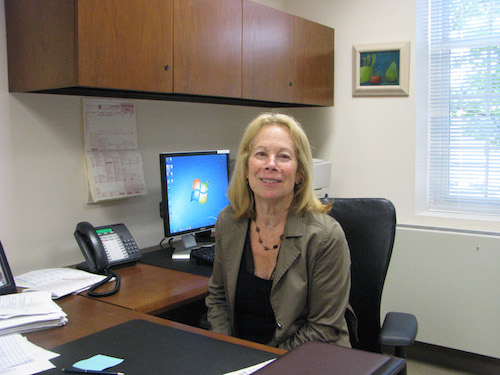 When you consider Lynne Shain’s 27 years in the classroom and 24 years as an administrator, it’s impossible to calculate the number of students she has influenced over her lengthy career as an educator.
But it is clear is that she has had an enormous impact on the education of almost all the children who have attended the Scarsdale Schools in the last decade. She will retire at the end of this school year and agreed to an interview before she leaves town.
Shain came to Scarsdale in 2008 as the Assistant Superintendent for Curriculum after serving in a similar role in the Westport Schools for 14 years. A resident of Weston, CT, Shain has been commuting to Scarsdale daily, often staying late into the night for Board of Education meetings. During her tenure here, she made far-reaching changes to elementary education and impacted the curriculum in all of Scarsdale’s Schools.
Under her leadership, the Scarsdale Schools were one of the early adopters of the Singapore Math program that has now become a model for other districts in this country and abroad. Shain explained that Singapore Math is distinctly different from the district’s former program, Trailblazers, in that it uses concrete tools to visualize abstract math concepts. In its simplest form, children utilize manipulatives, i.e. small objects such as pennies to make groups that represent numbers, and then learn to translate these visual groups into numbers or numeracy. The program has been highly successful at giving young children number sense and the framework for understanding mathematics.
The district has also implemented the Metamorphosis Program for professional development in mathematics. Currently 18 elementary teachers have completed the program, designating them as math leaders who can share their expertise with other faculty members.
Similarly, under her leadership the district adopted the Teacher’s College Reading and Writing Project which provides professional development for teachers using a workshop approach. The workshops prepare teachers to teach reading and writing through conferring, iterating, editing, and building upon student feedback. The program uses materials at instructional levels rated A to Z as well as performance assessments to allow for individualized instruction based on each student’s ability.
Shain was also successful at getting funding for a reading support teacher at each of the five elementary schools to diagnose reading issues and assist struggling readers.
The district is now working on gathering and using individual student achievement data to strengthen instruction. Shain explained, “We are creating data dashboards for teachers, giving them access to individual student learning data.” This data can be used to assess student’s strengths and weaknesses and inform instruction.”
Asked about how the new learning commons at SHS would be used, Shain explained that many of the existing courses in the high school were already designed for collaborative learning spaces, saying, “form follows function.” She said that the district is promoting collaborative learning from one classroom to the next along with project based learning at the elementary and middle school levels. These programs will integrate the efforts of the librarian, computer and classroom teachers. Shain said that much of the program improvement funds that are used by teachers to do research and development during the summer will be used for curriculum integration.
The district’s decision to move from the standardized AP curriculum to a deeper AT curriculum was made shortly before Shain came to Scarsdale. Asked whether that had been a success, Shain quoted former SHS Assistant Principal Kelly Hamm, who reported on students’ performance after the change, saying, “Not only have we done no damage, but key metrics, such as SAT scores, AP scores, and percent of students admitted to “most selective” colleges and universities, have edged up.”
About the New York State tests, Shain said at the elementary and middle school levels, Scarsdale’s math and ELA programs are now aligned with state standards. She said, “Our scores are always up there compared to our peer districts. Since the State changes the tests every year, longitudinal comparisons are not possible. We’ve tried not to let the state test scores get in our way.” She quoted former Scarsdale Superintendent Michael McGill who said, “Teach a deep rich Scarsdale curriculum and let the scores take care of themselves.”
What advice would she give to her successor? Shain said, “Personal relationships are most important. Nothing gets done unless people want to work with you. I would tell him to find the time to meet with faculty and hear what they have to say.”
Scarsdale will surely miss knowing what Shain would have to say. After helping to transition the new assistant superintend Edgar McIntosh into his role, she is hoping to spend more time with her three grandchildren, one who lives in Virginia and the other two in London. Is more work in education on the horizon? She says she can’t rule that out.
BOE Talks Security, Sustainability
- Details
- Written by: Laura Halligan
- Hits: 5345
 Soon after yet another school shooting tragedy, the Scarsdale Board of Education opened this week’s meeting with an all too familiar expression of condolence to members of the Santa Fe High School community in Texas.
Scarsdale School Superintendent Thomas Hagerman stated, “There are no words that I can say that will allay the grave concerns that parents and children feel around their vulnerability to violence in today’s world. That does not mean that we accept it as an inevitability, however.” He continued, “We have, and continue to, encourage our students, staff and parents to have their voices heard on this issue to ensure that our schools, of all places, are, indeed, safe spaces for all... Here at home, we’ve redoubled our efforts and maintained a strong focus on health and safety.”
Fittingly, the meeting, which provided a detailed update on the district’s transition plan, also included a good deal of discussion about school safety and security. While parents can appreciate the administration’s reports on finance and budget, communications, facilities, curriculum, staffing and related matters, many are distracted by the rash of violent incidents in our nation’s schools.
Shortly after his update on 2014 bond project status and planning for 2018 bond projects, Scarsdale Assistant Superintendent for Business and Facilities Stuart Mattey addressed the district’s efforts to enhance safety in and around its buildings. He began by saying, “Security vestibules (were) a big part of the security planning that was part of the bond, along with a more robust security camera system, and really tying in with some of the different opportunities for improvement that were identified by our security consultants when they came on board.” He continued, “Security vestibules are a best practice… for many school districts, so we’re instituting that, but also (entry) procedures will change as well… putting those in place (provides) another layer of making sure that the people who are coming into the building(s) are the people you want to come in.”
Mattey also mentioned the district’s recent security panel discussion that included district and law enforcement representatives. The event, which was very well attended, provided Mattey’s team with ideas about safety and security from a variety of viewpoints, particularly parents’ ideas, and set the table for future collaboration. “Those conversations have always been there, and when tragedies occur, they become more robust and focused. I do feel good, however, about the processes we’ve put in place.“
He then went on to discuss improvements in the district’s approach to security, stating, “Having Altaris on board, working with our building teams, having them go through training, and making them, perhaps, more aware of best practices and things they should be putting in place, has been a really big boost to all of our buildings, and we’ve been hearing really positive feedback.”
Mattey also reiterated the importance of hiring a security liaison or head of security, made possible for next year through a late budget allocation. “With a 100 percent focus on security, (the liaison) will make sure all our buildings and district level teams are working together… and keep us focused on security instead of getting diverted by (issues such as) construction and budget. This person will be the key go-to person on a day-to-day basis if (our staff) needs assistance.” Hagerman followed by saying, “This is somebody we want out and about, and interacting and visible.” In addition,
Mattey also mentioned the role of the Scarsdale District-Level Emergency Response Team (DERT) as a forum to review district level crisis-response and how to address security issues going forward. Going forward, DERT will be critical component in ensuring a thoughtful, collaborative process in longer-term security planning and decision making. “This is new… items have arisen and been handled as they made sense, without thoughtful planning and review.”
In the meeting’s public comment sessions, attendees made statements for and against the more significant step of placing armed security officers at our schools. Mayra Kirkendall-Rodriguez (Fox Meadow Road) said, “Many of us would like to put armed guards all around our prized loved ones, our children… Do we want to fill them with fear when they are at an age where we want them to find their passions and talents… Armed guards did not save 10 people in Sante Fe…” She continued, “We cannot protect our children 100 percent from all exposure to adversity. We should first tackle those first risks that have a high probability of manifesting themselves. I thank the Scarsdale administration and board of education for lending us your ear. My fellow Scarsdale friends and neighbors, I urge all of us not to succumb to fear… I have faith that we are so incredibly lucky in Scarsdale to have the intellectual and financial resources to devise efficient and economically prudent ways to improve safety in and around our schools. I have faith that we, as a community, will not come to the conclusion that we need to imprison our children. And, I have faith that we will continue to pressure legislators for sensible gun control laws and additional resources for mental health problems. “
Steve Pass (Shawnee Road) later asked school administrators for related cost estimates, and pros and cons of hiring and training armed security guards at each of the district’s buildings. “Armed school resource officers (SROs) will obviously not solve all our safety issues. But they could be just one component of many, including a improved counseling program, an improved social curriculum and building enhancements that should be considered. While there does not appear to be any research showing the effectiveness or ineffectiveness SROs have in preventing crime or more serious incidents, intuitively, I think having an armed, specially trained officer on the premises if something were to happen is better than not having one.“ He went on, “Would it, definitively, be the most efficient use of funds? We could never know… School resource officers are not (just) armed guards standing at school entrances. These men and women receive training in counseling and other skills that help them be effective in a school setting. Part of the SRO’s job is to build relationships with students and faculty… I realize this is a very controversial topic, but the community needs more information to have the discussion.”
In responding to the idea of making armed guards part of the district’s security plan, Scarsdale School Board President Bill Natbony said, “That issue is part of our ongoing discussion, among many other options, with regard to security.”
Significant Strides in Sustainability
The meeting also featured a presentation on another topic of significant interest, the district’s sustainability planning and programs, and achievements to date. Fox Meadow Elementary School Principal Duncan Wilson began the presentation by discussing the history of Scarsdale’s sustainability program, which began 10 years ago, when the Environment Protection Agency provided grants to organizations focused on energy conservation and reduced emissions.
In referencing the district’s official sustainability resolution from June 2007, Wilson explained the initial focus on reducing greenhouse gas emissions by 10 percent below the district’s 1990-91 emissions level by the year 2020. “The truth is it’s a much harder target to understand… people were trying to peg targets based on emissions numbers.” He went on, “One reason that it’s complicated is the (district) isn’t a car… it’s more complex to measure. The more important part is… the ongoing metrics of energy use, our fuel consumption and other items so we have a much better sense of what our environmental footprint is.”
Today, as Wilson explained, the district’s sustainability efforts are interdisciplinary, involving facilities, curriculum and professional development, and community behavior. “It’s not just that global warming is taught in the classroom. It’s the behaviors in the lunch room, it’s also in facilities (management). We’re doing our best work when everything surrounding a student’s life at school is having them think in a certain way.”
Scarsdale Assistant Superintendent for Human Resources and Leadership Development Drew Patrick then discussed efforts to define sustainability objectives and set priorities, notably through the district’s sustainability committee. In all its work, the committee is guided by the question of what a Scarsdale student needs to know, understand, be able to do, and value at the elementary, middle and high school levels, in order to create a sustainable future. “That became the center point of our conversion and generated a set of expectations, hopes and dreams for each of these areas… it has become a living, guiding (statement) for how we think about this,” said Patrick.
Specifically, the committee has developed a three-part model to illustrate its view of sustainability, which involves students being connected to guiding principles that shape short-term goals in key areas. According to Patrick, “Sustainability is just a bunch of key ideas, deep ideas, that cut across all sorts of different facets of learning, of life, of organizations and of communities. “ From this, the sustainability committee is focusing on four major areas -- student engagement projects, curriculum/professional development, facilities and community involvement.
Wilson chose to discuss the community component first, outlining efforts to promote zero waste throughout the district and in Scarsdale as a whole. “In the sustainability world, the three Rs are not reading, ‘riting, ‘rithmatic; they are reduce, reuse, recycle. Zero-waste is a more ambitious version of that. It… strives to reduce the amount of waste entering the waste stream that could otherwise be directed toward recycling, composting or reuse,” he said. To this end, the committee is working with school PTAs and the district office on a variety of efforts, such as expanding cafeteria recycling and composting, and considering how all school events can eventually become zero-waste events. Although different schools are at different points in their sustainability programs, the concept has impacted events district-wide.
Moving forward, the plan is to make all schools zero-waste and enlist students to assist in these efforts by getting involved in projects like reducing bottled water use, and promoting battery recycling. “My generation got our parents to wear seatbelts and stop smoking; this generation is going to be taking on these zero-waste challenges,” promised Wilson.
With regard to facilities, the committee is working to ensure that sustainability is an important part of the facility and operations planning and decision making processes. Patrick stated that the district should consider that “all aspects of internal operations and school environments should maximize energy and resource efficiency; reduce, reuse and recycle materials; foster clean air and excellent water quality; minimize the impact of land use changes; and prevent pollution.”
He continued, “This doesn’t always mean that we always act with sustainability as the number one consideration, that just not going to be realistic, but that it’s embedded in the process, to have, at least, thought about it and reported on it.”
Patrick noted that sustainability efforts must be considered in the context of what is best from educational, environmental and economic points of view. Is the project consistent with sustainability goals? Does it assist students in sustainability activities? Does it promote decreases in energy consumption? Does it improve air, water and/or soil quality? Are we assessing not only financial return over time, but the environmental and human health impacts of an investment? Are we weighing financial considerations along with educational and environmental goals?
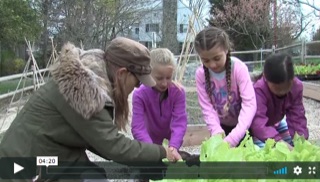
In concluding their presentation, Wilson and Patrick screened a short film that illustrated varying approaches to sustainability programming in Scarsdale’s elementary, middle and high schools. It provided a brief snapshot of hands-on student activities, based on level of understanding and course of study. The video may be viewed via the district website here.