








Architects Examine Options for Greenacres School
- Details
- Written by: Joanne Wallenstein
- Hits: 12917
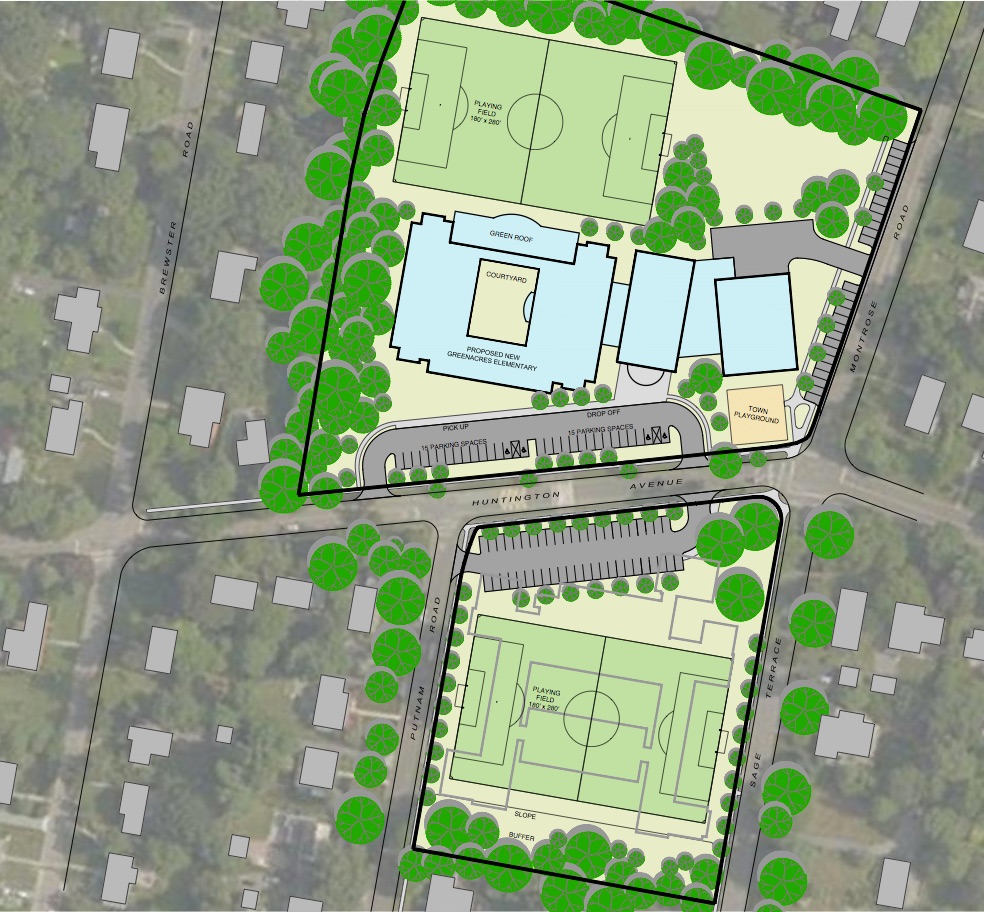
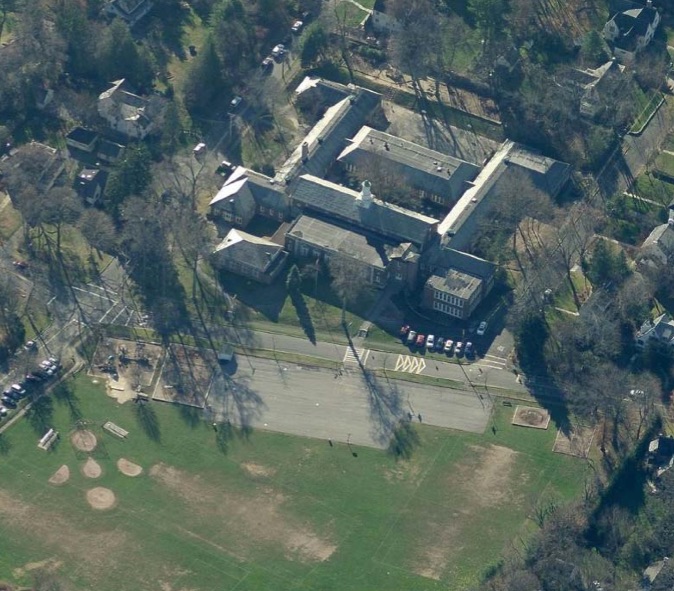 What will happen to the Greenacres Elementary School? Undersized and plagued with structural issues, the 100 year-old elementary school is poised for improvement or possibly demolition. The district has retained architects KG&D, who are working on a large renovation and improvement of district facilities, with doing a feasibility study to determine whether the school should be repaired, expanded or even razed.
Residents got an update from the architects at a study session before the April 20th Scarsdale Board of Education Meeting and learned how the architects are approaching the study.
Here is what they shared:
The school is currently covering the maximum allowable footprint on the property and variances would be needed to expand it further. It now houses 400 students in grades K-5 as well as special needs students.
A Building Committee that includes administrators, teachers, parents, community members, a board representative and the Village Planner has been formed.
The architects surveyed the condition of the building and found the following:
The building has inadequate ventilation and the amount of fresh air in the classrooms is below current standards. They believe new heating and air conditioning systems are needed.
The roof needs to be replaced
The building is located on land with a high water table and water sometimes leaks in.
Plumbing and pipes are old and should be replaced.
Greenacres has 78 square feet of net usable space per student or 26% less overall space per student than the average of the other four remaining elementary schools at 105 square feet per student. The existing square footage per student falls below the space standards from New York State and national recommendations.
Architects then presented the four options that they are currently exploring:
1) Repair the building's mechanical issues and leave it as is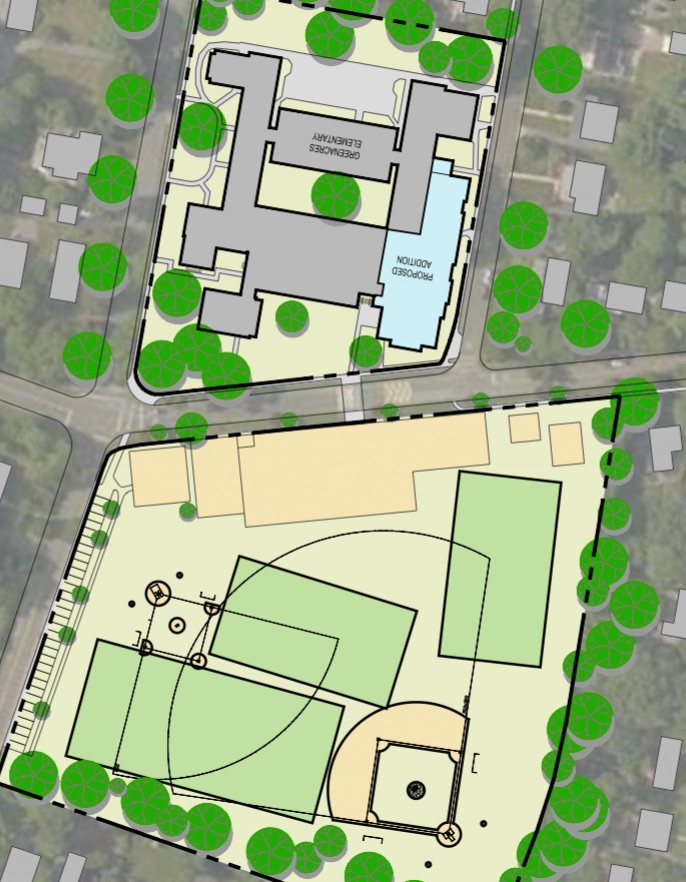
2) Option A – Do extensive renovations without adding any square footage to the building. The school would accommodate 335 students. Since the architects estimate that the population of the school will be around 415 students in the future, Option A requires redistricting.
3) Option B – renovate the current building and do an addition on the Putnam Road side
4) Option C – build a new Greenacres School on the playground and field across the street and convert the site of the existing building to playing fields.
In Options A and B, current classroom walls would be removed to create larger classrooms that meet the current square footage requirements. In Option A, as there would be fewer classrooms, approximately 80 students would have to attend another school.
Option B includes a 21,000 square foot addition on the Putnam Road side of the school. The state would need to grant the district variances to expand the size of the school.
Option C calls for a new two-story school across the street from the existing site. The new school would have a full-size gym, a two-story classroom wing and 120 square feet per student. Students could attend the old school while the new one is under construction.
Also discussed at the meeting was the possibility of closing Huntington Road to give students access to the fields without crossing the street.
Next steps would be as follows:
- Architects will examine the costs of each option
- The Board will investigate how the project could be financed.
- An extensive public outreach process will be designed to get input from residents, parents and all community stakeholders.
Though time was tight, residents asked a few questions.
 Barbara Wenglin of Brewster Road asked if the special needs students at the school were causing additional stress for space. The superintendent replied that special education students were evenly distributed across the district. Wenglin said that though we "all want the best for the children," Greenacres has very little open space. George Field has become a retention basin and the playing fields are Greenacres only open area. She urged the board to "Keep Greenacres Green."
It is interesting to note that since the project will take years to complete it is doubtful whether children who now attend Greenacres will be there when the work is complete. However, there is concern among those whose homes border the school and the playing fields. Those homeowners fear the impact of the construction of a large new building in the midst of a residential neighborhood.
Take a look at the entire presentation from the architects here:
Community Organizations Voice Support for the Proposed 2015-16 Scarsdale School Budget
- Details
- Written by: Melissa Hellman
- Hits: 5776
 The Board of Education met on the evening of April 13 to hear from community organizations on the proposed budget. The meeting turned out to be brief with three statements of support for the budget from The League of Women Voters (LWVS), The PT Council and the Scarsdale Forum. All three organizations supported the emphasis on literacy with increased instruction time in the early grades. This issue was the subject of debate early in the budget process as the increased instruction time requires the delay of the introduction of Spanish until second grade, but the Board of Education appears to have satisfied community concerns on the issue. There was much praise for the openness with which the Board conducted the budget process this year. The fact that all budget meetings were televised and detailed responses to all questions were available on the schools' website helped to foster a feeling of transparency in the budget development which was greatly appreciated by the commenting organizations.
The LWVS presented a detailed statement that can be read in its entirety here. Highlights include support for the Board's use of this year's opportunity to develop a structurally balanced budget due to an unexpectedly large drop in state-mandated pension contribution costs, along with significantly larger than anticipated savings from teacher retirements. LWVS also expressed strong support for the Board's stated policy of not budgeting to a state-calculated tax cap. They requested to be kept up to date on the results of the Board's study of a number of issues such as the addition of Mandarin to the Middle School curriculum, the role of our school librarians in the delivery of library services; the five-year Building Condition Survey; and the development of a long-term capital plan and the strategic plan that had been put on hold last year. Also, LWVS appreciates the Board's past and current advocacy efforts in connection with maintaining local control over school decision-making and would like to see even greater advocacy from the Board on this issue.
The statement of support from the PT Council and the complete report from Scarsdale Forum appear below. The Board will respond to these organizations at its next meeting on April 20 and also plans to adopt the budget at that time in advance of the May 19 community vote.
PT Council Comments on the Proposed Budget: Presented by Claudine Gecel and Pamela Fuehrer
This year has been a thoughtful and productive one for Scarsdale's PTAs, as we participate in the annual school budget process. With only a slight time lag, all the publicly asked questions were posted on the district website, and answers to the majority of questions were well researched and documented. For both parents and teachers, it was helpful to have answers to questions readily available on the website, as well as any relevant, time-sensitive documents, so that facts could be checked - and thought over. In most cases, both parents and teachers were able to take postings at face value. In other cases – seeing issues discussed in writing helped pinpoint ideas which still need further development by the district, either during the school year, or during subsequent budget meetings. Not only is it very important for PTA members to be able to focus on the discussion (without worrying about taking notes), but speaking directly for parents in the district, our evenings are understandably focused on the activities of our school-aged children. Having access to Wi Fi and Texting Services in the BOE Room also enables some parents to attend meetings, while maintaining contact with their older children. Lastly, maintaining the VOD meetings on the internet naturally allows parents with younger children to watch - whenever they can find the time!
During the actual budget process itself, there seemed to be three main categories of interest, as expressed by parents: 1.) Teachers' Professional Development, 2.) Academic and Social Development of All Students, and 3.) The Financial Condition of the District - as interpreted by Moody's.
In the area of Teachers' Professional Development, we all recognize the importance of teachers having ongoing opportunities to develop and grow. While it's wonderful for teachers in the district to learn from each other, it's also crucial for them to continually see what is going on in the larger world - and bring fresh ideas into their classrooms. STEAM-Oriented curriculums are presently developing all across the country, at all levels of education, and it will be exciting to see what our own teachers come up with over the next few years. It's positive that we have budgeted for future professional enhancements, as we've had some challenging years in the recent past where that wasn't done to the extent many would have liked.
In the area of the Academic and Social Development of All Students, parents were all in agreement about emphasizing literacy, and language development in the early years, uniformly, across all elementary schools. The reinstatement of the English Language Arts Helping Teacher and the additional 2.5 Reading Specialist positions should help to move the district in that direction. Middle School parents are thankful that a Special Education Teacher has been added to assist students with IEP's. High School parents are pleased that this year's budget has enhanced student athletics, student clubs and other extra-curricular activities. Parents feel that these important programs help extend the students' education beyond the classrooms.
In the area of the District's Financial Condition, parents seem to feel positively about the fact that this year's budget focuses on shoring up the District's various reserve accounts. While various state lawmakers may disagree as to what financial actions they perceive to be prudent, experienced financial executives will all agree that risk taking needs to be balanced out with reserves, especially in a non-profit, municipal environment. If Moody's removes the 'Negative Outlook' from the District's credit rating, then our upcoming bond offering can be executed at lower interest rates. Everyone in the district should agree, no matter how old their children are, or how many they have, that a lower borrowing cost is a good thing for us all!
Going forward, many parents might still want to look at the issue of reinstating the Middle School Librarian, some parents think we need to review busing rules for high school students, and all parents want to make sure the schools are staffed correctly based on their respective, changing, population sizes. In addition, other concerns may surface, before the budget is printed, that we haven't yet addressed. Despite these issues, the PTA's and the PTC feels that next year's budget continues to be carefully and thoughtfully crafted. As PTA members, we also want to continually encourage all parents of school aged children to voice their concerns, in any way that makes sense - no matter how large or small the issue seems to be.
I hope you won't mind if I end by quoting Herbert Spencer (1820-1903), a distinguished British Philosopher and Sociologist: "The great aim of education is not knowledge - but action". We're all parents, and we're all participating in this annual process, so that our children's future is bright!
Thanks for your time and attention. We know it's very valuable.
Scarsdale Forum Report on the Proposed Budget: Presented by Dan Hochvert
RESOLVED, that the Report of the Education Committee on the Proposed School Budget for 2015-16 be Approved.
SUMMARY STATEMENT
The Education Committee (the "Committee") has reviewed the proposed 2015-16 budget. The Committee supports the adoption of the proposed budget. It supports the Board's and Administration's efforts to maintain the highest quality education for our children and recognizes the effort made to achieve a balance between enhancing our fine school system while being sensitive to the burden on taxpayers. The Committee offers a few thoughts regarding New York State's recommended maintenance target percent and its cap on undesignated reserves.
The proposed budget, $148,139,127, is slightly lower, for the first time in memory, than the previous budget. The correlated increase in the tax levy is also $395,000 lower than the allowable increase under the tax cap. The most significant driver of the proposed budget is a reduction in the mandated contribution to the teacher and employee retirement plan of $2,919,685. The Administration stressed during the budget work sessions that the practice of building surpluses into a budget would no longer be done. Instead conservative estimates of expenses in situations of uncertainty would be taken. According to Linda Purvis "This budget provides us with a very unusual opportunity to realign the financing of the District's educational program." The proposed budget does this in three ways:
1) Uses a significant amount of the 2014-15 budget surplus to reestablish the reserve accounts
2) Eliminates planned surplus that had been included in the Retirement System line for many years. In the current year budget it was $1.85M; and
3) Drastically reduces the amount of prior year surplus that had been allocated to offset tax levy growth. These funds were down from $3.762M in 2014-15 to $500K in the proposed budget.
This rectifies a long-standing structural issue with the District's budget. The repeated use of prior year surplus to fund current program is a risky financial plan, as the District can never be certain that a planned surplus will materialize. If it doesn't, the District would be required to either seek additional property tax revenue (which is controversial in the "tax cap" environment) or reduce spending. By eliminating both the planned surplus in the proposed budget and the use of prior year surplus as revenue in the proposed budget, the budget is better based on a rational assessment of anticipated expenses for the coming year.
The proposed budget is based on the demographer's forecast of 4,775 pupils, a decrease of 47. The proposed budget takes advantage of the declining enrollment to add 1 helping teacher and 2.5 reading teachers. These increases are offset by a reduction of 2 classroom teachers resulting from the decrease in enrollment and the elimination of 1 elementary school Spanish teacher as a result of changing the starting grade of the Foreign Language at the Elementary Schools (FLES) program from first to second grade. The net proposed addition to teaching staff is .55 positions in the proposed budget. The Committee supports the extra help in the language/reading area. Strengthening language skills at the elementary level will be a benefit throughout the school years for pupils who need the help.
The Committee also supports the funding for Staff development. Several important categories are: Program Improvement, Arts and Aesthetic Education, Interdependence Institute, Scarsdale Teachers Institute, Center for Innovation, Sustainability Initiative and Curriculum Research/Assessment. Helping teachers to stay current with our ever-changing world means our children get the kind of education we believe is needed.
MAINTENANCE AND UNDESIGNATED RESERVES
The National School Boards Association has recommended that 2% of a district's expense budget be used for maintenance of its buildings. Scarsdale has not reached this level for several years. The recommended target may not be appropriate for all districts in all years. For example, as the Superintendent noted during a work session, considerable work, which otherwise might need to be included in the annual expense budget, will be funded from the recently approved bond issue. Further, in light of the pending decision regarding the Greenacres School, there is likely to be another bond issue proposed in the next year or so. As has been explained in the past, it may not be prudent to issue bonds for relatively small projects since there is a cost related to the issuance, but when a bond issue is required, including appropriate work with a long expected life, is prudent. In some years it is possible that more than 2% will need to be budgeted to cover the cost of several smaller maintenance projects. As the Board recognizes, the 2% is just a guiding target number and the needs of a district and other factors should be considered.
The State has specified a cap of 4% cap on undesignated reserves. Some residents appear to have misinterpreted the cap as a target. Rather, it should be recognized that "one size doesn't fit all". In smaller districts the cap might permit the reserve to be less than one million dollars of unanticipated expenses, whereas in Scarsdale it is almost six million dollars. With the many years of Administration experience, several designated reserves, stop loss in healthcare expenses and the conservative approach taken in developing the 2015-16 budget plus a long history of never requiring a 4% undesignated reserve, it is appropriate to remember that the 4% is a cap, not a target.
The hallmark of the proposed budget is the restructuring of the reserves. In part, the restructuring is in response to Moody's Rating Service stern warning to Scarsdale that its reserves might not be adequate. Sufficient reserves are prudent, especially in light of the elimination of built-in surplus.
APPROVAL RECOMMENDATION
The Committee recognizes the effort made in the proposed budget to achieve a balance between educational enhancement and the burden on taxpayers. It applauds the move to more sound financial practice by eliminating the District's reliance on previous year's surplus to reduce a proposed budget's tax levy. It also recognizes the need for adequate reserves to ensure that the District maintains the quality of education in face of future issues such as pension cost and tax cap ramifications. However, the Committee asks the Board of Education to consider shifting some of the 2014-15 surplus proposed for use in the 2015-16 budget for reserves to reduce the increase in the tax rate to achieve a better balance between the educational goals and the tax burden.
Note: THIS REPORT HAS BEEN PREPARED UNDER EXPEDITIOUS TREATMENT PROCEDURE OF THE SCARSDALE FORUM INC. BY THE COMMITTEE WHOSE MEMBERS NAMES APPEAR BELOW. IT HAS BEEN APPROVED BY THE EXECUTIVE COMMITTEE OF THE FORUM AND AUTHORIZED FOR RELEASE TO THE PUBLIC, BUT IT HAS NOT YET BEEN SUBMITTED TO THE FORUM MEMBERS FOR THEIR APPROVAL.
NYS Teacher Rating System is TBD
- Details
- Written by: Joanne Wallenstein
- Hits: 5383
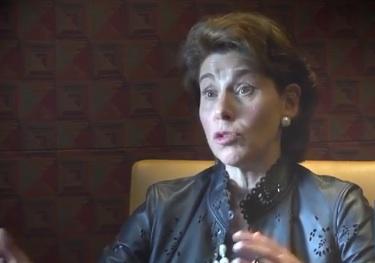 Though legislators in Albany approved a new teacher evaluation policy that was packaged with the state budget, it's not clear what the new system will be. The new law gives state education officials the power to implement the policy but even Merryl Tisch, Chancellor of the Board of Regents, does not know what rating system will be designed by state education officials. After the budget passed, Tisch said, "We are going to look at the language very carefully and figure out what it all means. The Governor says it's administrative. The Legislature says it's a vast level of authority. Somewhere between the two of those, I'm sure, lies reality."
Under the new law, the State Education Commissioner is charged with creating a system to consider 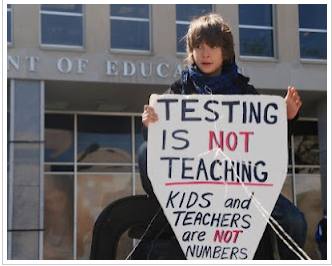 student performance on standardized tests and observations of teachers in the classroom to rate teachers as "ineffective," "developing", "effective and "highly effective" based on these results. According to the NY Times, school principals can still observe and evaluate teachers but the district must also use outside evaluators to rate teacher performance in the classroom. The state has not offered funding to pay these outside evaluators. New teachers will have to wait four years to get tenure and must be rated effective or highly effective for three years to be tenured. Tenured teachers who are rated ineffective for two years in a row can be fired.
NYS Teacher's Union President Karen Magee is calling for a boycott of the state tests, saying "they're not valid indicators of student progress" and an unreliable measure of teacher quality. If enough students opt out of testing, the results would not be valid for rating their teachers.
A March 26th letter from the Scarsdale Board of Education to Governor Cuomo calls for the evaluation system to be reviewed and redesigned. The letter says the system has led to "redundancies and the over- testing of our students." The Board also objects to the Governor's weighting of classroom observations of teachers, which require that 35% of the observation points to be determined by an independent observer who would make one un announced visit to a classroom.
Scarsdale High School Math Teams Place Top in County
- Details
- Written by: Joanne Wallenstein
- Hits: 9236
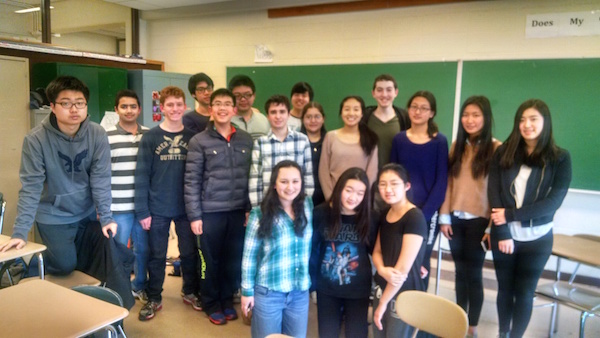 The Scarsdale High School Math Team A won first place in the Westchester County Interscholastic Math League, and the Scarsdale High School Math Team B won second place. This league consists of teams from 22 school districts in Westchester county. The teams meet monthly to solve challenging and intriguing math problems. Individuals and teams earn points based on the number of problems they solve correctly.
Five of the top six students in the individual rankings are from Scarsdale. Richard Xu won first place, Dexin Li won second place and third place was a four-way tie. The three Scarsdale students who won third place are Harry Chalfin, Garrett Tanzer and David Wang. The teams are led by Scarsdale High School Math teacher Laura Estersohn.
The final meet was held Monday, March 16 in White Plains High School. Seventeen Scarsdale students attended the final meet. They prepare at Scarsdale High School where they meet, on average, one or two times every week to play in various leagues. The students work through problems and explain their solutions to each other. By so doing, they become stronger mathematically. In addition, they enjoy each other's company and have a good time.
Seventy-seven teams from 22 school districts in Westchester entered the contest. The questions reward clever thinking as much as straight-ahead math knowledge.The questions do not require a knowledge of calculus. In fact, most of the questions can be solved using high school algebra and geometry so that students from all grade levels can participate.
The Scarsdale rankings were based on results from 5 meets throughout the year. The top students throughout the county will go on to a state level meet on April 25 in Syosset, NY. Here are the twelve students who will represent Scarsdale:
Rebecca Agustin, grade 12
Michael Bogaty, grade 12
Harry Chalfin, grade 11
Alan Chung, grade 9
Connie Lam, grade 12
Dexin Li, grade 10
Cailey Martin, grade 12
Garrett Tanzer, grade 11
David Wang, grade 11
Cherie Xu, grade 11
Richard Xu, grade 9
Tom Zhang, grade 10
Governor Cuomo Proposes Tightening State Control over Local Schools
- Details
- Written by: Joanne Wallenstein
- Hits: 8449
 In 2001 Scarsdale drew national attention when 8th grade parents organized a boycott against a wave of new high-stakes State tests, imposed now on even high-performing districts that used to get waivers before federal enactment of No Child Left Behind.
Since 2010 Albany has now riled many in Scarsdale again by meddling in traditionally local school personnel decisions and by raising the test stakes even higher. The Annual Professional Performance Review (APPR) law, rushed through by the State Legislature in order to win New York $700M in federal Race to the Top dollars, requires that all teacher and principal "effectiveness" ratings be tied to student test scores.
The Scarsdale School Board, faculty, Parent-Teacher Council, and the Scarsdale Forum, a longstanding civic organization, have all objected to the State's costly testing and teacher evaluation policies in the name of local control and evidence-based policy. (See the Board's Statement on Education, Resolution on High-Stakes Testing, and The Scarsdale Declaration of Intellectual Independence, also endorsed by the Scarsdale faculty; PT Council's Statement on State-Mandated Teacher Evaluations and Student Testing; and the Forum's Report on the New State-Mandated Teacher Evaluation System.)
But it looks like their efforts were in vain. Rather than backing off, Governor Cuomo launched his 2015-16 State budget talks by tying more State Aid for schools to compliance with his plan to further tighten State control over local teacher evaluations. He wants to increase the weight of student performance on teacher assessments and mandate that schools bring in independent evaluators from outside the district to judge teachers' effectiveness. Faced with lawmaker resistance, Cuomo now seeks to create a six-member commission to decide the future of New York's teacher evaluation policy.
We asked Scarsdale's Assistant Superintendent for Curriculum Lynne Shain to explain the current evaluation system and how Cuomo's proposed new plan would work. Here is what she shared:
"The current Scarsdale teacher evaluation plan has three components as required by NY State: 20% for state test scores, 20% for local assessments, which could be replaced by doubling the state test scores, and 60 % for "Other" which refers to classroom observations. All non-tenured teachers have four observations each year; tenured teachers have two each year. Scarsdale uses the Charlotte Danielson rubric for assessing teacher's proficiency in the classroom in four domains: Planning and Preparation, Classroom Management, Instruction, and Professional Responsibilities. Scarsdale administrators and supervisors conduct the class visitations and provide timely feedback to teachers that reflect individual, building and district goals
Governor Cuomo's Opportunity Agenda 2015 calls for state test results to count for 50% of a teacher's evaluation. Class visitations would count for a total of 50%, with 35 of the 50 points determined by outside evaluators, who do not know our district or school goals, our curriculum, or our culture. In addition, it is unclear who foots the bill for the outside evaluators, which could result in another unfunded mandate.
Further, to base 50 % of a teacher's evaluation on state tests that have yet to be deemed valid measures for such a purpose, is most problematic and troublesome."
The State's method for using growth on student test scores to rate teacher "effectiveness" is apparently more complicated -- and controversial -- than Governor Cuomo lets on. The State uses a sophisticated "value added" statistical model to attempt to isolate and statistically adjust for other variables that might influence student test scores in order to identify the remaining numerical value from which a causal inference is then made about a teacher or principal's relative effectiveness at improving student test performance.
But the nation's foremost experts on testing and assessment do not agree with the politicians when it comes to using "value added" models to make high-stakes decisions about teachers. As noted on the Scarsdale PT Council's website:
• In 2009 National Research Council experts on testing warned the U.S. Department of Education that Race to the Top put "excessive emphasis on value-added approaches" to tie student test scores to individual teachers and was prematurely promoting them to states for high-stakes decisions about teachers when too little is known about their validity;
• In 2010, ten of the nation's leading experts on testing presented evidence on the instability and errors associated with "value added" models and urged New York's Board of Regents not to risk "distorting the entire instructional program" of districts "by imposing a flawed system of standardized quantification of teacher quality."
• A 2010 report for the U.S. Department of Education found error rates in teacher value-added ratings based on student test scores of 35% with one year of data and 26% with three years of data. Wide margins of error were also found in recent Los Angeles and New York City teachers' VA ratings that were nonetheless publicized by the local media; and
• Leading U.S. mathematician John Ewing calls the use of student test scores to evaluate teachers a "modern, mathematical version of the Emperor's New Clothes."
Under New York's current system, many area districts are rating teachers effective or highly effective by skewing the locally controlled portion of the assessment high in order to decrease the effect of the State's "value added" calculation of their ratings based on growth in student test scores. An October 2014 Journal News article reported on the results of an independent study showing a flaw in the State's rating system. If districts gave lower scores in the 60% observation portion, many teachers would get unfair overall ratings due to the State's skewed scoring system. In a related article, the Journal News reported that Scarsdale was the only district in the Lower Hudson Valley that did not inflate its teachers' classroom observation scores.
A recent article in the New York Times also reported on the discrepancy between districts' teacher ratings based solely on the growth in student test scores, which were low, and districts' overall teacher ratings, which were high; however, the article did not discuss the related discrepancies in the State's scoring system. Nor did it mention the expert consensus on the lack of reliability and validity of the State's methods.
Parents and teachers in high-performing school districts like Scarsdale question why they need to measure students with state tests, when local assessments have proven to be good measures of student achievement. Furthermore, with high-achieving students who year after year are accepted at top colleges and universities, parents and administrators question why Cuomo is trying to force a one-size fits all solution to address problems that don't exist in the high-performing districts.
The issue is one of State vs. local control. But it is also a matter of politics vs. evidence-based education policy, with the fate of not only of Scarsdale, but also of over 2.5 million New York school children at stake.
- Pam Fuehrer and Art Rublin Nominated for School Board by SBNC
- School Board Approves Dean Field Renovation, Fox Meadow Office Renovation and More at March 11th Meeting
- Quaker Ridge Principal to Retire, Mathcounts Team to the States and SMS Teacher Connon Wins Award
- Scarsdale Students Enjoy a Bon Voyage