







School to Begin Before Labor Day Weekend in 2015
- Details
- Written by: Joanne Wallenstein
- Hits: 12435
 A change in the usual timing of the opening of school for the 2015-16 school year will cut some family summer vacations short in August.
At the February 4, 2015 meeting, the Scarsdale Board of Education the board passed on the new school calendar which shows ninth grade orientation on Monday August 31 and Tuesday September 1 with the first day of school on Wednesday September 2. The hitch is that Labor Day is the following weekend – so there is a half-day planned for Friday September 4 and a full day off on September 7. Customarily, school starts immediately after Labor Day weekend – but since it's late this year, school needs to begin earlier so that it's open for the required number of weeks.
There's another interesting change in the calendar.
While Scarsdale Schools customarily have a week off in February during the week of Washington's Birthday and another in March or April for Easter and Passover, in the spring of 2016, the calendar includes an extra four-day weekend. Easter falls on Sunday March 27 and schools will be closed from Friday March 26 through Monday March 29 for a mini break. Then in April, Passover starts on April 23 and there is a full week of vacation from Monday April 25 – Friday April 29.
So even though families will need to cut short their summer vacations, they can enjoy three breaks in the spring.
What do you think? Like it or hate it? Share your thoughts below.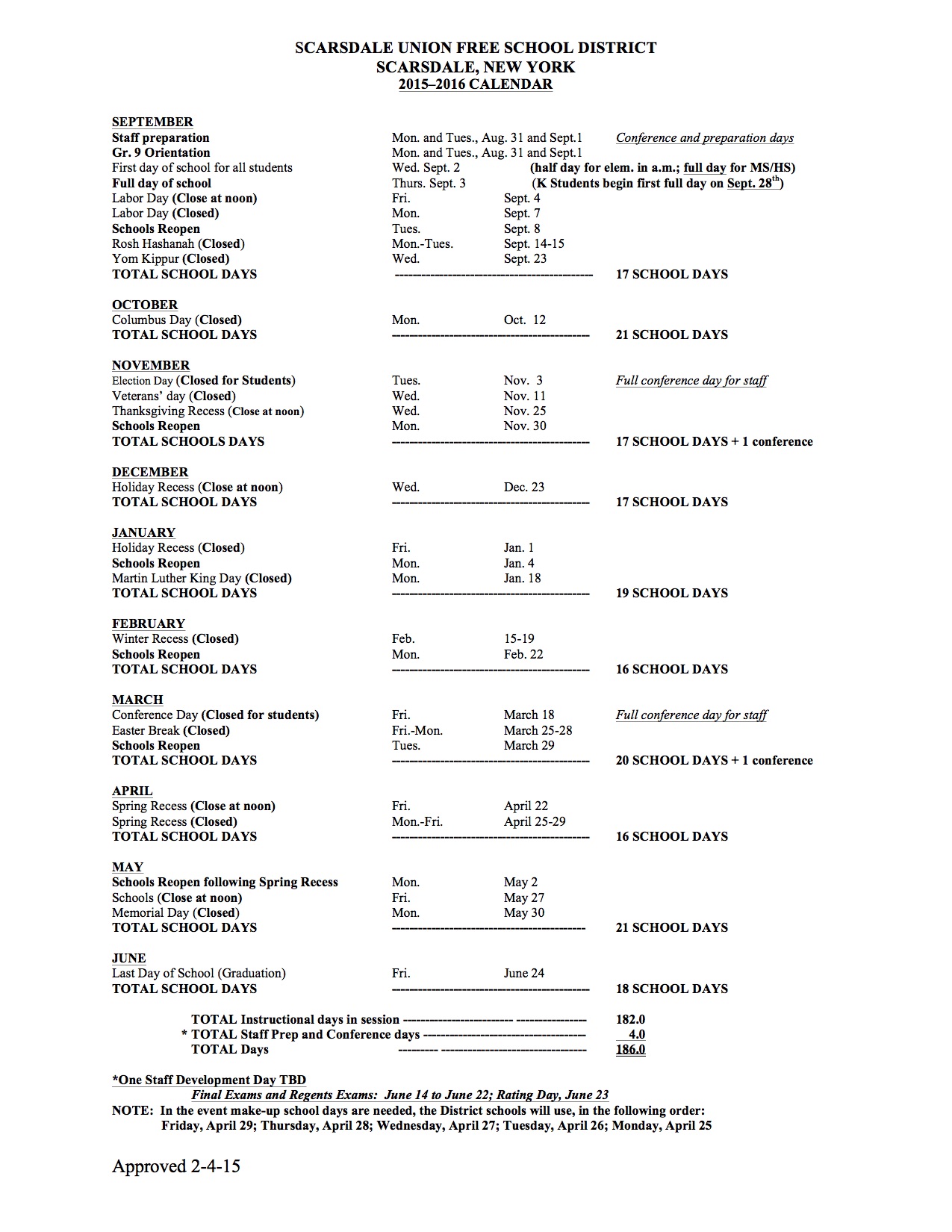
Meet Intel Semifinalist David Frank
- Details
- Written by: Joanne Wallenstein
- Hits: 9562
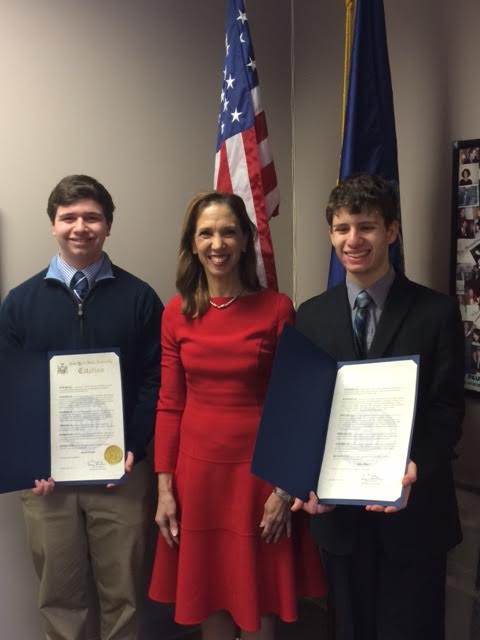 Scarsdale High School Senior David Frank has been named a semi-finalist in the Intel Talent Search for his work on Alzheimer's Disease. He is a student in the science research program at SHS, headed up by science teacher Beth Schoenbrun and spent countless hours working in a lab at the Burke Medical Research Institute under the direction of Dr. Gary Gibson. Among other honors, Frank was invited to State Assemblywoman Amy Paulin's office to receive a certificate of achievement. He is pictured here on the left with Paulin and Max Pine of Pelham who was named an Intel finalist.
We asked Frank to answer a few questions about his work and the experience and here is what he shared:
Tell us about your research:
In Alzheimer's Disease it has been noted that there is a decrease in an enzyme involved in the production of ATP (celluar energy) called the α-ketoglutarate dyhydrogenase complex (KGDHC). What this means is that these neurons with low levels of KGDHC are selectively vulnerable or are more prone to cellular and metabolic stress. What I was looking at was what changes in cell signaling were causing the cells to be more vulnerable to stress. I looked at a different mitochondrial enzyme complex called the pyruvate dehydrogenase complex (PDHC). I observed this enzyme complex because it had been shown to translocate from the mitochondria to the nucleus. The importance of mitochondrial nuclear signaling is that it is a stress response that can alter the genome and therefore cellular function. This study mimicked the metabolic changes seen in Alzheimer's Disease to see what is happening in the cells when KGDHC is diminished. I saw that as KGDHC was inhibited, PDHC translocated from the mitochondria to the nucleus which indicated a type of cell signaling. What was also important is that there was no cell death which shows that this movement of PDHC was causing other changes in the cell. When PDHC is in the nucleus it can turn on and off certain genes and because of this, we are attributing the selective vulnerability of neurons to the translocation of PDHC from the mitochondria to the nucleus.
In whose lab did you work -– for how long?
I worked in Dr. Gary Gibson's Lab at the Burke Medical Research Institute in White Plains. I've worked there since June 2013. During the summers I worked from 9 - 4:30, 5 days a week and during the school year I work around 4 hours each week. The specific project I did was done over 8 weeks this past summer.
How did you meet your mentor?
I emailed many scientists in the area and eventually got a response from Dr. Marc Tessier-Lavigne, who unbeknownst to me was the President of Rockefeller University. He put me in contact with Dr. Raj Ratan the head of Burke and from there I was referred to Dr. Gibson who became my mentor.
How did you become interested in the subject area?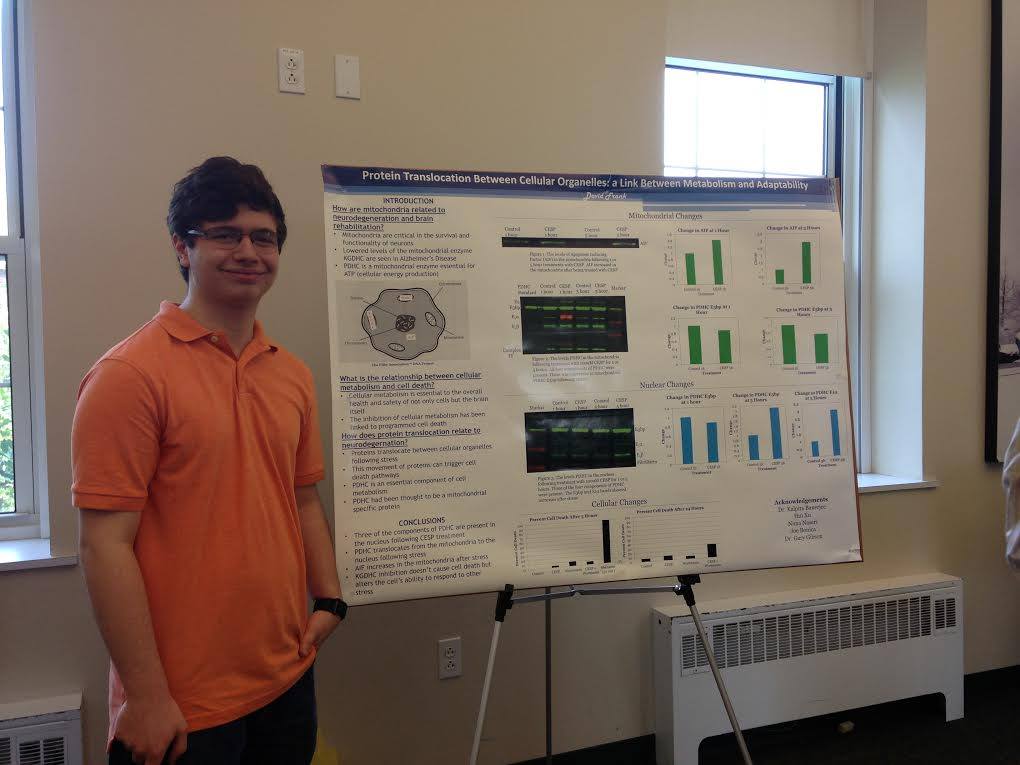
I was originally intrigued by traumatic brain injuries and concussions in football. I did some research on the topic and looked at the available research opportunities that I could be involved in. After thinking about what I wanted to research in more detail I concluded that rather than look at brains and the damage caused by neurodegeneration and trauma, I would look at what is causing neurodegeneration at the cellular level. My mentor Dr. Gibson looks at the mitochondria and how it relates to neurodegeneration. I took on that research goal as well. Even though my research is more on the cellular pathways and Alzheimer's disease, my desire to do brain research came from my love of sports and my interest in head injury.
What is involved in applying for the Intel award?
There is a research paper you write about the work you have completed in your lab. In addition to the paper, you fill out an entire application, complete with questions, supplemental essays, teacher recommendations, and transcripts. It was like doing another college application.
Do you plan to pursue science research in college?
I am planning on doing engineering in college, but I am still interested in doing research. I have loved working at a lab and have cherished every moment of it. I am currently not sure what I want to study but I do want to continue doing some form of research. Not only have I learned a lot about science, I have also had the pleasure of meeting and interacting with some incredible people. I also learned what its like to be in a real work environment, which is something you do not learn at school.
What has it been like for you since the announcement was made? Have you been busy doing interviews? Making appearances?
It has been a little hectic. I've been busy at school and then you add in people congratulating me and talking to me about my research. It has been fun and it is really amazing to have people interested in the work I've done.
What do you win and what do you plan to do with the proceeds?
I won $1000. I haven't decided what I want to do with my money yet, but I'll probably spend it on something like sports tickets, which are never that cheap here in New York.
The Country Club: On Stage at SHS this Weekend
- Details
- Written by: Lena Proctor
- Hits: 6433
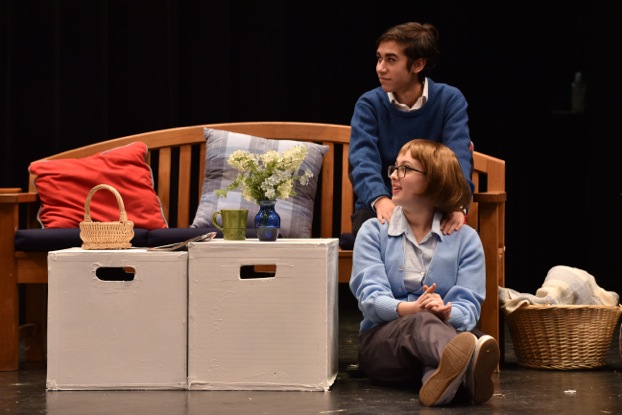 The SHS Drama Club will put on their student directed play, The Country Club on Friday January 30 and Saturday January 31. Under the direction of high school seniors Katie Kearns and Kimmy Rothberg, the cast and crew have worked long hours for almost two months to stage the show.
The directors and acting teacher and club advisor Sarah Robbins have worked closely with the small cast of only seven actors, three boys and four girls, along with the production staff. Commenting on working with a small cast, Assistant Director Kimmy Rothberg noted that "having a smaller cast show definitely helped. I feel like everybody has evolved during the show, and thus far have seen so much growth in everybody's talent...." Sydney Prince, who plays Froggy in the show, explained, "The small cast makes the whole experience very intimate. We've all gotten super close and it really makes for an amazing experience."
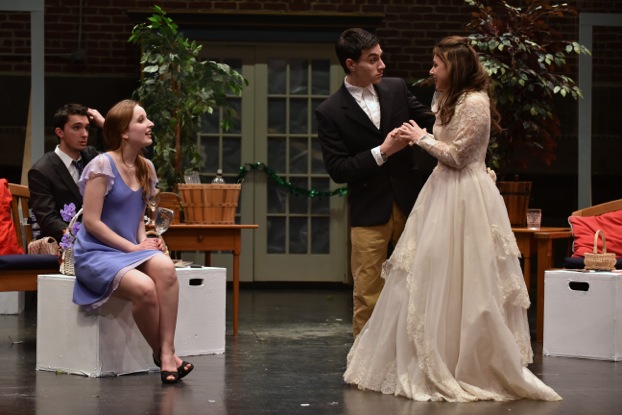
Rothberg says, "The process has gone pretty smoothly. There have been a few rocks in the road so far, but Katie and I are doing a good job managing the production. Student directing was a new and big responsibility for me, but I am so happy that I have done it." Co-Director Katie Kearns says, "The Country Club has never been done in Scarsdale before; it's a unique show which makes it even more special."
The storyline focuses on Soos; a young, witty, and charmingly neurotic woman who retreats from a failed marriage to her conservative, upper-class hometown of Wyomissing, PA. According to Soos, her hometown is "The type of WASP domain with houses " that made Martha Stewart forget she was Polish", She attends party after party and the initial getaway weekend gives way to a year, and ultimately to the rest of her life. Brittle conversation is bandied about, and Soos is reunited with her onetime boyfriend, the ever-charming Zip. She also returns to her old circles of friends: including a high-strung party planner Froggy; a wry and sarcastic friend named Pooker; and a drunken good ol' boy called Hutch. But cracks soon begin to show in the veneer. Zip falls in and out of an easy relationship with Soos; He starts an affair with Hutch's wife. Lives are casually destroyed, lives go on and through it all, tragedies occur without being mentioned. As Pooker observes between cocktail sips, "We all have our little stories and nobody brings them up. That's what's known as community spirit.''
Although most of the characters in the show are older, the humor of the production will be enjoyed by high school students, parents and grandparents.
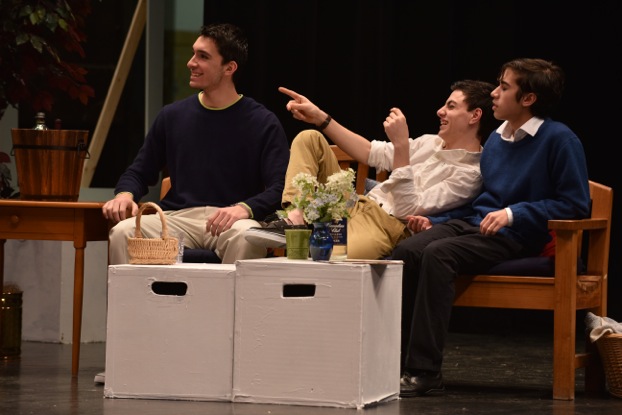
Cast:
Soos: Genna Shuster
Zip: Orion Rendon
Hutch: Dillon Orlando
Froggy: Sydney Prince
Pooker: Morgan Cochrane
Chloe: Alison Maybaum
Bri: David D'silva
Tickets are $10 for students and seniors and $20 for adults.
Showtimes are Friday January 30th and Saturday January 31, both at 7:30 pm.
Buy tickets in advance here or purchase them at the door.
Photo credit Jon Thaler - see more and buy yours at JonThaler.com.
Board Examines Factors That Drive the School Budget
- Details
- Written by: Joanne Wallenstein
- Hits: 5293
 Is it possible to build a model to project Scarsdale School budget for the next three, five or even ten years? Though some in the community have urged the administration to find a way to provide accurate forecasts of long-term budget growth, (similar to corporations) according to Assistant Schools Superintendent Linda Purvis, formulating this number can only be done to a certain extent. Though some factors can be modeled, many of the components of the budget do not follow the Consumer Price Index (CPI) and rely on factors that vary from year and cannot be accurately predicted. To that end she provided a framework of the factors that go into formulating the budget to help the Board and the community understand what numbers drive the budget discussions each year.
What are these factors?
As Purvis patiently explains every year at this time, almost 80% of budget costs are people-related –including salaries, benefits, pension and retirement costs and health insurance.
Though salaries are negotiated on a multi-year basis, the district never knows exactly how many teachers they will require until enrollment estimates are released, usually in the spring of the budget year. And even those numbers are put to the test each summer when families move into town without warning and expect to find a place for their child in the schools.
The district also cannot predict how many staffers will choose to retire on a yearly basis. And when a seasoned teacher retires and is replaced with a new recruit, there is often a big salary savings that effects the bottom line.
Claims against the district's self-insured health plan can also be volatile. It is difficult to predict what these will be year over year –and that's why the district formerly maintained a health care reserve fund to buffer against large claims that would otherwise need to be funded via the operating budget. Though the district was pressured to dissolve the health care reserve fund last year, new legislation was passed to permit funding of a healthcare reserve and Purvis recommended that the Board fund a healthcare reserve in the 2015-16 budget.
Pension costs grew precipitously after the downturn in the market in 2008 and are now "trending downward." The pension contribution is determined by the state each year and now compromises 10% of the total school budget.
Utility costs are driven by the weather, the economy and oil and gas prices. These are also unpredictable.
Each year the district is required to pay back taxes to property owners who file grievances and are awarded settlements. Tax certiorari settlements can be sizable and again impossible to forecast.
Special education costs are also unpredictable, particularly if litigation is involved.
Purvis concluded this portion of the discussion by noting that new educational programs or enhancements also require funding. Multiyear budget planning could preclude the board from having the flexibility to adopt new programs.
Purvis then took a look at the "revenue" side of the budget which includes property taxes, state aid and the use of budget surpluses. Purvis told the Board that decisions about the use of surplus funds is their responsibility and can have a big impact on taxes. This year the administration estimates that there will be a budget surplus of $2 million from the 2014-15 operating budget in addition to $2.2 million in planned surplus. In the past few years the Board has drawn down budget reserves to fund annual budgets but has made an effort to reduce their dependence on using reserves to keep tax growth down. Last year the Board allocated $3.5 million in surplus funds to the 2014-15 budget.
The tax cap is determined by the state each year. This is another factor that affects budgeting decisions each year and cannot be projected.
Purvis then posed a list of questions to the Board that will affect budgeting.
Here are the questions:
-Will the Board consider requests for new program or other enhancements to the educational program if such enhancements require an increase in budget/tax dollars?
-Is the tax cap going to be a defining consideration in determining what the proposed budget will include?
-How much of this year's anticipated surplus will be used to reduce the tax rate? To replenish health insurance reserves?
-The list of plant improvement projects for 2015-16 is approximately as the same dollar value as 2014-15. Understanding that each project will need to be individually justified, is the Board comfortable with a capital/plant improvement allocation at roughly the same level as last year?
In the discussion that followed, Bill Natbony asked Purvis if she would be more comfortable with lower planned surpluses if the Board funded reserve accounts and she replied yes and said, "I think you should have less planned surplus but you have to be willing to raise taxes to backfill or cut costs."
Responding to the questions, Chris Morin said, "We certainly should consider any new program proposals. Discussing the tax cap, he added, "Breaking the tax cap has real world implications – we have high surpluses, flat enrollment, and retirement costs are working in our favor this year."
Board Vice President Lelia Shames Maude said, "I think frameworks are great and help the process. But if the faculty and administrators have ideas for new programs I would not want this to put the brakes on this. Does it mean you have to cut something to add something? I want to be sensitive that ideas that may percolate up."
Board President Mary Beth Gose added, "We have to think differently than we have in the past. I agree that the tax cap is silly and arbitrary but we had a bad experience with the cap and the budget and we need to learn from it." Discussing new programs, she said, "We have to have strong justification for adopting any new programs -- that is the reality."
Hurricane Godzilla Hits NYC! Command Center Set Up in Scarsdale High School
- Details
- Hits: 15959
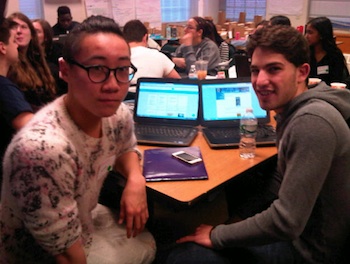
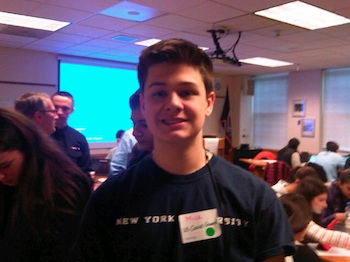
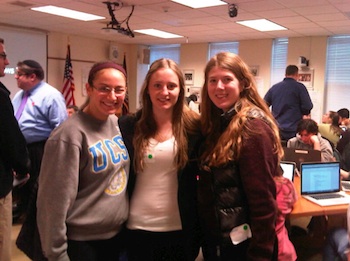
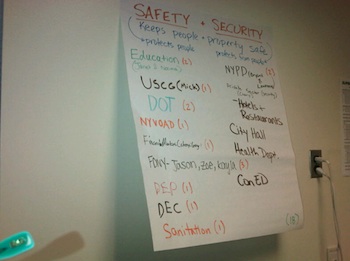
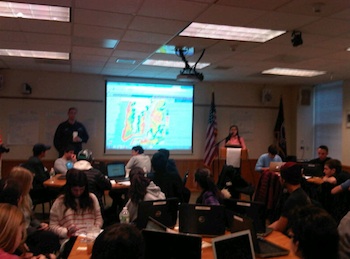
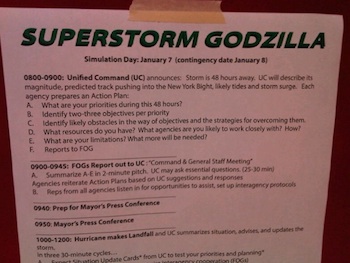
 What if the mother of all hurricanes unexpectedly hit New York City? What would we do? Not to worry, the students of Scarsdale High School's City 2.0 classes have all the answers. Rooms 170-172 were all a buzz on Wednesday, January 7th as the three sections of the newly introduced class Redesigning Urban Life in Real Time: City 2.0 collaborated on a simulation exercise to deal with the approaching hurricane Godzilla. The anticipated category 2 storm (Sandy was a category 1) required intense preparation and communication between all the relevant city agencies. Fortunately, Scarsdale students had done their homework and were ready to handle anything that was thrown their way. People are refusing to evacuate? They are on it! People for the Ethical Treatment of Animals (PETA) are protesting the Mayor's lack of a plan for household pets? They've got it covered. The MTA is refusing to send their people out in dangerous conditions? The Unified Command Center is ready to take charge!
 SHS teachers Maggie Favretti, Jennifer Maxwell, Fallon Plunkett, and Lisa Yokana were the designers of this course, completing much of their work and research through the Scarsdale Center for Innovation. As described in the course catalog, it allows students to apply a range of disciplines to an exploration of New York City. Students were introduced to the "design-thinking" concept as a collaborative, human centered, problem solving process. The course developers hoped to provide an "experiential" education for their students, and the emergency management simulation today definitely achieved that goal. Students were asked to participate as members of the NYPD, the Office of Emergency Management, the Coast Guard, the Department of Sanitation and as workers in many more areas. Even social studies department chair John Harrison played the role of the mayor of New York City!
It would be hard to overstate the level of student engagement witnessed today during this simulation. Students were focused, excited, talking and asking a lot of questions. They were working well together and with their instructors, members of the community, and public service representatives who aided in the planning and execution of the day's event. This class filled three sections in its first year and is poised to become a very popular offering for seniors. The Scarsdale Center for Innovation and the teachers who designed and delivered this experience deserve tremendous credit for a job well done!
 The Office of Emergency Management on the Unified Command Center team.