








Scarsdale School Budget Wins 86.2% Approval
- Details
- Written by: Joanne Wallenstein
- Hits: 6670
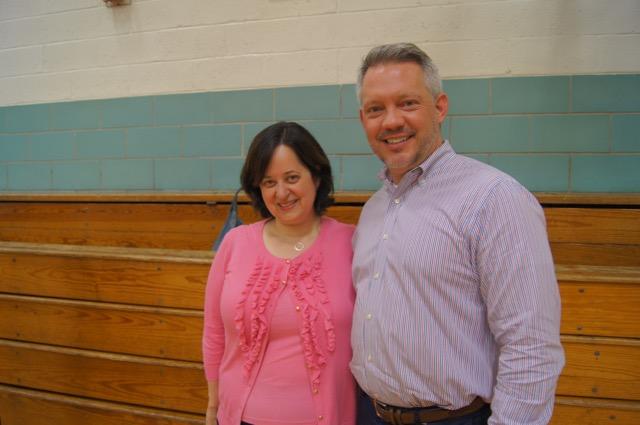 It was all smiles at the Scarsdale Middle School on Tuesday night May 19 when the Scarsdale School budget passed with 86.2% of the vote – a historic high. Though the total vote count of 714 votes was low, 616 voted yes, indicating strong support for the budget, the educational program and the Scarsdale schools. The proposed $148,048,080 2015-16 school budget was actually a tad lower than the 2014-15 budget, giving residents little cause for dissent. In addition, since both the village and school budgets came in under the state tax cap, the state recently sent rebate checks to qualifying households, which may be another reason that the budget passed easily.
Pam Feuhrer and Art Rublin, who had been nominated to serve 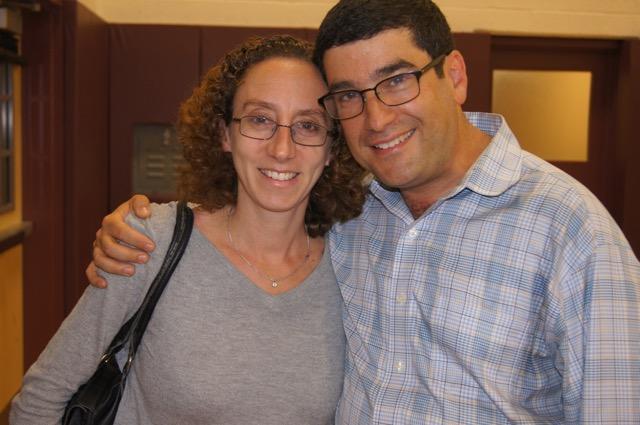 on the School Board by the School Board Nominating Committee were both elected, Feuhrer with 600 votes and Rublin with 569 votes. They will replace the current School Board President Mary Beth Gose and Board member Lew Leone, who will both complete their terms of service in June.
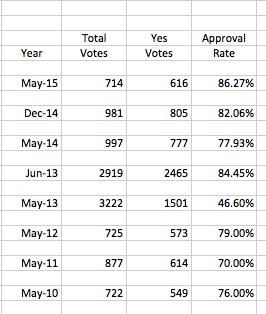
The vote count was announced by former Mayor Robert Steves, who was appointed Chair of the District Meeting for the Budget Vote and Election. The 86.2% approval rate was markedly higher than last year, when there were 997 votes and the budget passed by 77.9%.
For those watching the numbers, see below for a history of budget and bond votes in Scarsdale:
Additional factors that may have contributed to the positive vote include:
Decreases in the district's contribution to the NYS Pension and Retirement Systems and the elimination of a planned surplus will save Scarsdale $4.878 mm for 2015-16. This 30% savings over the prior year is a result of improved investment returns. This savings took pressure off the Board and gave them more flexibility to agree on a budget that came in under the tax cap.
This was Superintendent Thomas Hagerman's first budget vote and it appeared that he worked well with the board to reach consensus on sensitive issues. With the board and administration in harmony, former critics of the board and school spending found few reasons to object.
In December 2014, the community approved an $18.12 million bond for improvements to the elementary school, middle school and high schools. The debt service on the new financing replaced retiring debt and will cause no increase in the school budget. By separating the financing of capitol projects into a separate vote, the board and administration diffused criticism from those who may have questioned the need to improve the facilities. When the budget was turned down in 2013 for the first time in 43 years, many dissenters said they voted "no" due to proposed spending for a new fitness center at the high school.
All community organizations, including the Scarsdale Forum, the League of Women Voters and the PT Council supported the proposed budget and encouraged residents to vote yes.
Offering his interpretation of the vote, Board member Bill Natbony said, "I think the administration and board looked at all the cost areas and at all the areas where there was a need for a quality, enhanced program and came to a really good balance. The community recognized that."
The 86.2% approval rate augured a great beginning 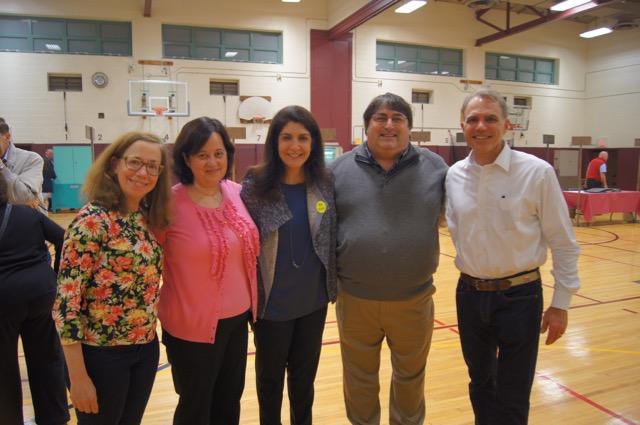 for the tenure of Dr. Hagerman and a joyful end to the career of Assistant Superintendent Linda Purvis who has managed the budget process for the past 15 years. School Board President Mary Beth Gose was clearly gratified with the response from the community as she completes six years of service on the Scarsdale School Board.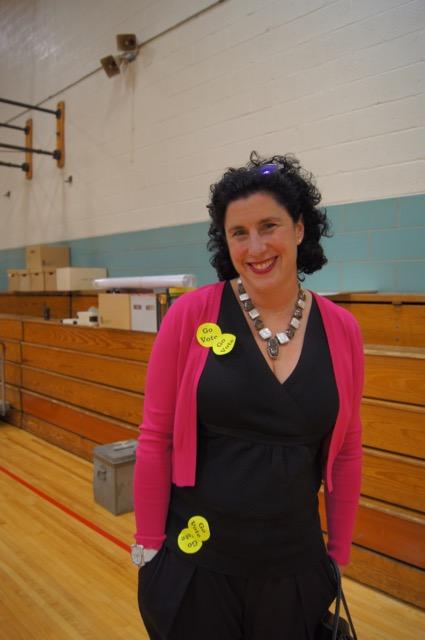
Budget Vote Today
- Details
- Written by: Joanne Wallenstein
- Hits: 4070
 The school budget vote and the election of new members of the School Board is being held today, Tuesday May 19th at the Scarsdale Middle School. The polls are open from 7 am to 9 pm and all registered voters are encouraged to participate.
The proposed budget for 2015 - 2016 the Scarsdale Schools is $148,048,080 which represents a slight decrease over the 2014-15 school budget and is under the NYS tax cap. If passed, taxes will rise by 2.54% for residents of Scarsdale and the Mamaroneck strip.
The School Board Nominating Committee has selected Pamela Fuehrer and Arthur Rublin as candidates for school board and their names will appear on the ballot as well.
Scarsdale Teachers Tuttle, Braun, Gordon, and Henry to Retire
- Details
- Hits: 10847
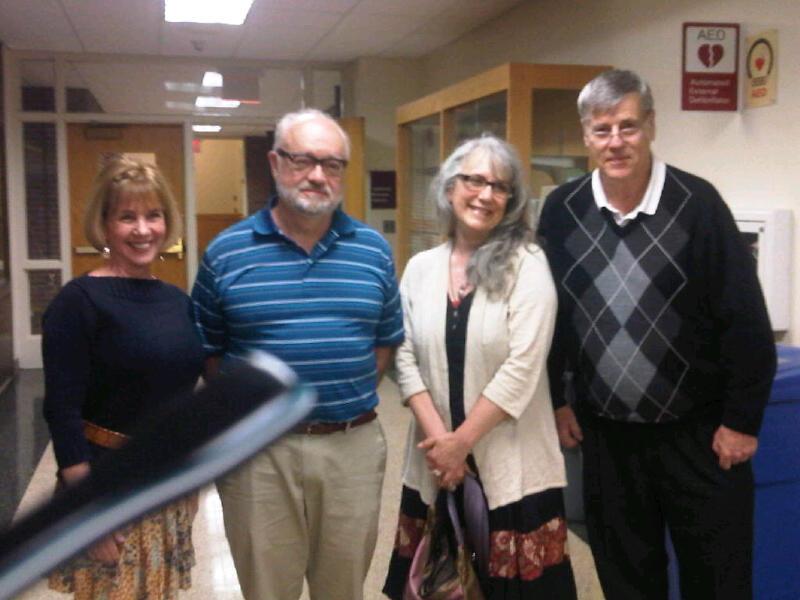 The "changing of the guard" continues in Scarsdale. At the Scarsdale Board of Education meeting on Monday, May 4 the board honored retiring teachers Jeffrey Tuttle, Ronnie Braun, Nadine Gordon and Bruce Henry, who Joan Weber said, "have served our community so well."
Dr. Jeffrey Tuttle, Technology teacher for Scarsdale Middle School who will retire at the end of this year. Dr. Tuttle was lauded as a phenomenal teacher, who helped students to understand technology, and taught life lessons that extended beyond the typical reach of a classroom. Dr. Tuttle was known for his "rye sense of humor" as Middle School Principal Michael McDermott said Tuttle had a "rye sense of humor" and was calm in a potentially dangerous classroom. He had "a placid unperturbed air of calm as students besieged him with questions" and always took fair stances with his students. Within the classroom, Dr. Tuttle was known for the way he got his students involved in technology class, and his "green light" system. The green light signified a building day, and as one of Dr. Tuttle's former students, I can personally say the green light could brighten up a bad day. Dr. Tuttle catered to his students, providing extra challenges and work for those who were ahead, and providing help for anyone who needed it. He will be remembered for his achievements, and as Middle School PTA President Tracy McCarthy said, "May [his] future be filled with green lights."
Ronnie Braun will retire from the Scarsdale High School Learning Resource Center (LRC). Scarsdale students noted Braun's for her kindness and dedication. She was known for putting her students needs first, seeing them at any time in the LRC rooms, and working with their teachers to help them succeed in class and making the school a better place for everyone. Ms. Braun looked out for her own students and for all the students in the school. Amy Cooper, the President of the SHS PTA, remembered "Ronnie's passion for ALL students, not just her own" and her "dedication and compassion." High School Principal Ken Bonamo thanked Ms. Braun for her service, noting that "she has left an indelible mark on her students, and as she has often said, her students have left a mark on her as well." Ms. Braun will be greatly missed at the High School, and though I personally did not know her, I'm sure she helped shape people I knew into the great people they are today.
Art teacher Dr. Gordon, or "Doc Gordon" as her students knew her, was credited with kindness and compassionate. Her goal in the classroom was to help her students mature as people through their artwork and to learn to be professional in everything they do. Doctor Gordon challenged her students to be both their own toughest critic, and their own best supporter. She wanted her students to work hard for themselves, and to try to bring out the best in themselves. Principal Bonamo remembered Dr. Gordon for the ways in which she encouraged students to be artists, "She helps students enter outside exhibitions, often taking the work herself to these shows.... She leaves behind colleagues who have gained so much from knowing her, and a legion of students for whom she has made the arts an important aspect of their lives."
Bruce Henry, a legendary math teacher at SHS will also retire. He is known for his extensive work at the High School, and his dedication to mathematics. Even students who were not in his use his legendary review packets, which Mr. Bonamo said are "worth their weight in gold." Mr. Henry has even been a part of the development of current Scarsdale teachers, and has positively influenced current Math teachers when they were Scarsdale students. One such student turned colleague reflected on Mr. Henry's legacy, "When I came back to SHS as a math teacher, my appreciation for him as a master teacher continued to grow. Mr. Henry will be greatly missed at SHS."
All the retirees will be celebrated during a Recognition ceremony on June 2nd.
Regent Judith Johnson Calls For Reconsideration of New Teacher Evaluation System
- Details
- Written by: Joanne Wallenstein
- Hits: 9709
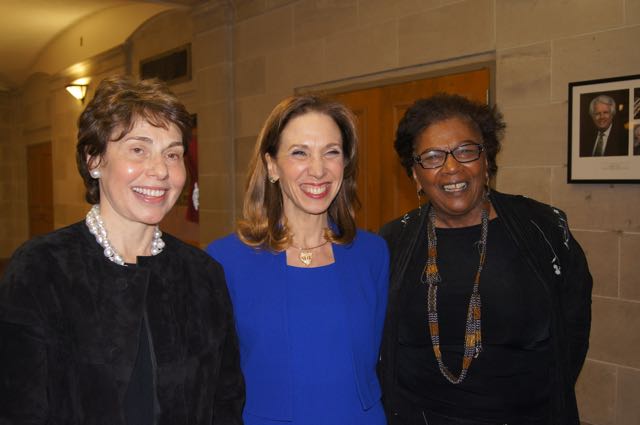 Though the crowd came to Scarsdale High School on April 30 to hear what NYS Regents Chancellor Merryl Tisch had to say about student testing and teacher evaluations, newly appointed regent Judith Johnson emerged as the local hero that night. In the week leading up to the Scarsdale Forum Panel that promised to bring together Scarsdale Schools Superintendent Thomas Hagerman, State Assemblywoman Amy Paulin and Tisch, the Chancellor cancelled her appearance and said she would be in the audience. In her place, she sent Johnson who had just been appointed as a Regent representing the lower Hudson Valley.
The panel drew an audience of educators and parents from Scarsdale, surrounding towns, northern Westchester and Rockland County who are concerned about state mandated tests and legislation that orders the Regents to design a system that closely ties teacher evaluations to their students' performance on state tests and observations from evaluators outside the school. Passed with the NYS budget, the new laws extend the probationary time before teachers can be granted tenure to four years, makes test results 50% of a teacher's evaluation score, calls for someone from outside the school to observe and measure teachers and further minimizes the influence of local administrators on teacher evaluations. Though there is a popular movement to opt students out of the lengthy state tests, there could be possible sanctions if less than 95% of students take the test.
According to State Assemblywoman Amy Paulin, these measures were implemented under pressure from Governor Cuomo who packaged them with a state budget that promised increased aid for schools to coincide with these tough new regulations.
As it stands now, the NYS Education Department and the Regents are charged with formulating the new 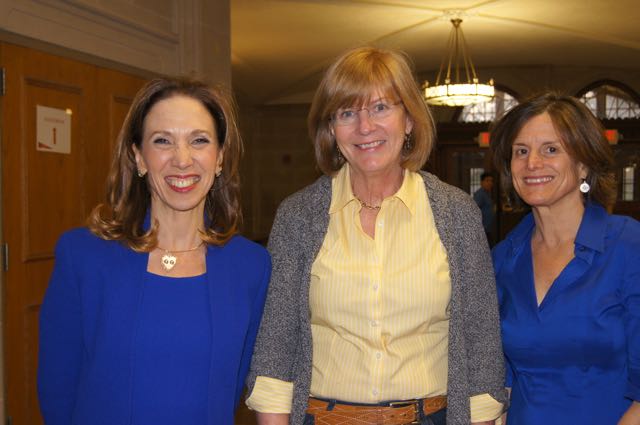 teacher evaluation system by June 30th, then school districts would need to re-open their contracts with teachers this summer and have the new system in place by November 15, 2015.
The new law has few fans. It has angered parents, teachers and school administrators and prompted a backlash against Governor Cuomo, Chancellor Tisch and the state department of education. As Johnson said on the panel, this is the "third proposed change to the teacher evaluation system in just four years," and it has caused an uproar at all levels.
Before the panel discussion began, Tisch arrived and gave an interview to local journalists. She hinted that the Regents might use their discretion to soften the impact of the law saying, "We need to find a way to give school districts a way to have a voice and tailor teacher evaluations themselves....The State Education Department has been asked to write the regulations around the law. In the end we will find a way to allow districts some leeway." She also suggested that the deadlines for implementation could be relaxed, saying, "If you (the district) can show you are bargaining in good faith you can have the evaluation system in place by September 2016." Seeking to distance herself from the Governor she said, "We did not write this law. It is being examined and we are looking for the greatest flexibility and variability to make it workable." However, it should be noted that in a December 30, 2014 letter from Tisch to Cuomo she outlined ideas for changes to the tenure process and for firing teachers that later became part of the law.
She also cautioned, "Federal law requires testing in grade 3-8 as well as reporting test results." She said, "There are 699 districts and we can't have 699 systems."
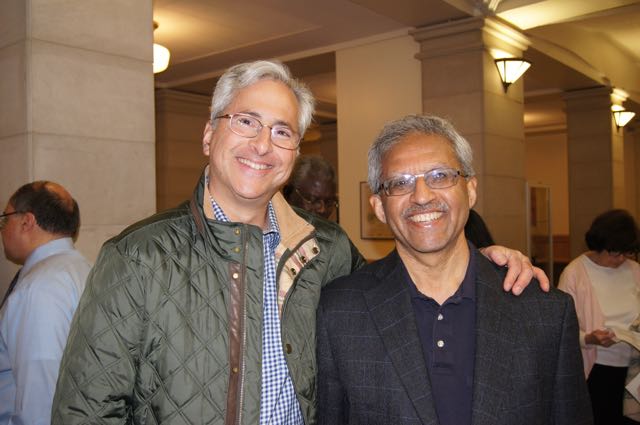 After introductory remarks from Scarsdale Forum President and recognition of retiring Scarsdale Village Manager Al Gatta, the panel discussion began. Superintendent Hagerman provided a look back on the genesis of the Common Core curriculum. He explained that the "Common Core was designed to develop benchmarks and standards ....in the beginning it focused on positive outcomes and was seen as an effective building block. The Common Core was embraced as a cure all."
However, forcing a proscribed curriculum on teachers and students proved to have shortcomings. Hagerman said, "The Common Core values analytical skills rather than personal interaction. It does not recognize how students learn...Learning requires a social context. Students want to know why something is relevant to them. Emotions and memories are intertwined. When we try to teach reading in isolation as an analytical skill we lose the passion in learning."
About the new regulations he said, "Administrators, teacher and parents are just plain angry. We are left to navigate nearly impossible waters and to find solutions where few options exist.... What we are doing currently is not working. The blame cannot be on the backs of our teachers and our children.... The work of public education must be returned to local communities and to teachers who can make the best decisions for children in their care."
Johnson took the microphone and explained that she had "only been on the Board of Regents for 30 days." She looked back on the evolution of the standards and recalled Scarsdale Schools Superintendent Tom Sobel with whom she worked in 1990 on a curriculum of project and enquiry-based learning. However they found that they were not able to successfully develop valid tests to measure the skills emphasized in the program. She is now calling for research to define intended outcomes for education. Saying we are now creating "test-ready" students, she said unless we "give students a moral code, imagination, the ability to appreciate the magic of life, our approach to the standards will have failed." About the tests she said, "Assessments must include multiple measures, must include problem solving and critical thinking."
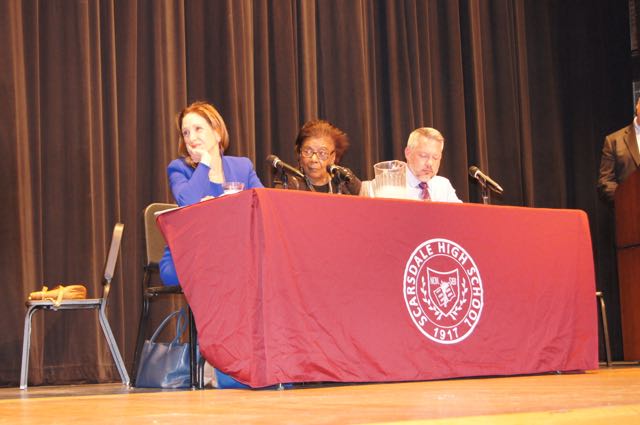 She also called for the inclusion of the arts in the curriculum and told the group that when she was in school she given the chance to learn to dance. She said, "The arts are a suite of tools for human expression that are independent of a native language. Arts are an essential component of education and we need to put the arts back on the table."
Turning to the subject of teacher evaluations, Johnson said, "Districts should be given the flexibility to attract and maintain successful teachers. There is a crisis in recruiting and retaining teachers who will be measured by a single score in a three-hour period. We need to start with a positive premise for professional growth. I think we should suspend the notion of using test scores to quantify teachers until we have a better sense of what that means. What is the point of shaming or humiliating teachers? It is not likely that anyone will be a better teacher because of his/her rating. The failure to embrace teaching as a profession is just shameful."
Taking it one step further than Chancellor Tisch, Johnson called for the Regents to delay implementation of a new system. "Given the controversy it is time for a pause. We need time to evaluate our efforts. The first step to solving a problem is to recognize we have one. What we have put in place looks like no other educational system on the planet. What is it we want our students to know and do?"
With that, the entire auditorium rose and gave Johnson a standing ovation. The applause continued for many minutes while the group acknowledged they had a champion for their cause in the newly appointed regent.
Paulin reviewed her efforts to counter state testing and state mandated teacher evaluations systems. She said that the tests are "not a valid measure of whether students will succeed in college or in a career," and that the new APPR "sets teachers, principals and districts up for failure and is a poorly designed teacher evaluation system that needs to be re-written."
Why was the new law passed? Paulin explained that the "Governor said unless this was adopted, school districts would not receive any additional state aid."
Applauding Johnson, Paulin said, "The issues are complex. That's why I am so pleased with the appointment of Judith Johnson. We got the best. Her clarity on the issues is astounding. She will be a voice for effective reform."
Paulin also called for "Flexibility on the November 15 deadline for teacher evaluations and for pushing the new system out to September 2016."
In the Q and A session, former School Board member Jonathan Lewis asked the panel if they believed we needed more oversight in place, to which Johnson replied, "The State Education Department is severely understaffed. If the Governor wants an outstanding education system, staff the education department."
Jason Copeland, a Scarsdale resident who teaches in the Bronx, explained that evaluating teachers based on test results would cause good teachers to leave districts where they are most needed. He said, "Teachers will want to work in areas with less variability. The APPR will make good teachers avoid kids in need. You will have issues every year."
Diane Greenwald asked how local parents could participate in the policy discussions and Johnson advised her to "Focus on meaningful options. Clearly state your intended outcomes. Be very clear in what you want to accomplish." She said, "We listen to the collective voices of citizens. The very fact that we are here today suggests that you are being heard."
Reacting to the evening program, one parent in the audience called Johnson "smart, knowledgeable, experienced and incredibly candid." She added, "I hope she has the stamina to deal with this issue because it's very complicated and it's going to take a long time to get this right."
Superintendent Hagerman Outlines Internal and External Challenges For Scarsdale Schools
- Details
- Written by: Joanne Wallenstein
- Hits: 6613
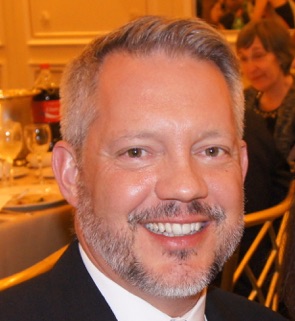 Before Scarsdale Schools Superintendent Thomas Hagerman could give his take on his first ten months on the job at an April 23rd PTA meeting, the leadership of the SHS PTA offered a humorous look at the challenges Hagerman has already faced as leader of the Scarsdale Schools.
Channeling David Letterman, they showed a list of "The Top 10 Ways You Have Been Initiated," highlighting some of the hurdles Hagerman has faced since last July when he took the helm. Though intended to be funny, many hit home. In December he was faced with a vote on an $18 million bond referendum, two of the three Assistant Superintendents and a principal announced plans to retire, a bomb scare forced the evacuation of the school and he got much flack for substituting electronic agendas rather than paper versions for board meetings.
Here were the Top 10 Initiation rites:
- Spelling "Colloquy" at the Friends of the Library Spelling Bee
- Hiring an entirely new staff
- Realizing that electronic agendas are a big deal
- Being tossed into a bond vote and getting it passed
- Participating in the ice bucket challenge
- Memorizing the athletic code of conduct quickly
- Interrupting carpools at dinner hour for a 6:30 start to Board of Education work sessions
- Handling an emergency during the coldest day of the year during lunch
- Central office open floor plan
- Surviving Superintendent hazing: to snow day or not to snow day!
Hagerman opened his talk to the sound of Taylor Swift singing "Welcome to New York" and discussed the differences between life in Chicago and New York where he "Rarely sees the four walls of (his) rental." He added, "Everything here takes a little more time, effort and work – everything is multi faceted." He continued, saying "While in Chicago a sandwich is just a sandwich, in New York "we don't just have sandwiches – we have wedges, heroes, wraps and hoagies. There are 25 questions about the ingredients with group consensus about whether it was done the right way. There's an obsession with detail." Speaking about the depth of conversation on all issues, he joked, "I supervised another meeting that should have been an email."
His agenda for year one on the job was to meet with students, staff, parents and community members and use this feedback to identify goals.
He broke these priorities down into three lists and identified Board priorities as:
- Appropriate data needed to make decisions
- Time to process and ask questions
- Building trust with the Superintendent and other staff
- Board development and succession planning,
- Short and long budget issues
- Striking the right balance between operations and instruction
- Facility concerns and district wide master plan
From the staff, he learned that the following were their top concerns:
- Communication
- Distric culture, values and beliefs
- Staff Children
- Active involvement in ongoing decision making.
Parents concerns included:
- Communication issues
- Construction and deferred maintenance: Greenacres School and the district master plan
- BOE policy development and more active engagement in the budget process.
- Curriculum consistency across schools and the quality and quantity of feedback on student progress
- Sustainability issues
- Wellness and food service
Hagerman will consider all these concerns in forming a strategic vision for the future that he plans to role that out in the next few months. The vision will layer concerns of the board with those of parents, students and staff.
In the meantime he announced some shifts in responsibilities in the central office:
- Assistant Superintendent Lynne Shain will also take on arts and aesthetic education and global initiatives.
- There will be an interim Human Resources Director for next year as the district was not able to find a person to replace Joan Weber.
- Jerry Crisci will oversee instructional technology and focus on innovation and emerging instructional models.
- Rachel Mosley will be the Director of Information Services, overseeing district data, operations and technical services which is an expansion of what she is already doing.
- Director of Special Education Eric Raushenbach will now be Director of Pupil Services and expand his role to include medical and mental health services.
- Registration for school will be handled at the district office rather than at the individual schools.
Hagerman then turned to a discussion of the new state regulations for teacher evaluations and testing, saying, "I did not anticipate that I would be playing David to Governor Cuomo's Goliath. The Governor is actively seeking out ways to discredit educators and undo the last vestiges of local control."
Cuomo's 2015 agenda requires that district teacher evaluations systems include both student test scores and evaluations, one from an independent evaluator Hagerman explained that in order to comply with this mandate, the district will need to renegotiate the teacher's contracts and have a new evaluation system in place by September 1. Furthermore, when contracts are reopened, all items can be renegotiated including salary and benefits. This, he explained, is causing us great consternation.
Tenure will now only be granted after 4 probationary years and to those who received a rating of favorable or higher.
Districts may now begin dismissal proceedings for teachers who have received two years of unfavorable ratings. But he said, "We don't have the data to do this correctly. False scores can misrepresent the professionalism of the staff." For example, students who took the first day of state tests and opted out of the second day will now receive a score of "1" for the second day, and this could affect their teacher's evaluations.
School turnaround and local assistant plans are in force and ineffective schools can be put into receivership. Normally Scarsdale would not worry about this; but schools that don't have a 95% participation rate on tests for three years could be sanctioned and go into local assistance plans.
Hagerman said that he is involved in advocacy to address these issues and credited State Assemblywoman Amy Paulin with being a champion on these issues and getting the district access to the Governors staff. Hagerman called on parents to recognize their role in this work and urged them to stay abreast of what the policy committees are doing here in Scarsdale.
Moving forward, the district will need to consider how to keep teaching and learning at the forefront for the BOE and the community while confronting operational issues, such as construction, facilities, negotiations and political reforms. The question is, "How do we prepare for future changes while preserving Scarsdale?"
He concluded by saying, "We have a future full of promise and many unknowns, but it is not going to business as usual. It will take thoughtful deliberation and planning and creative problem solving. Each one of us bears responsibility for managing change. I ask each of you to think about how individually and collectively we can manage.
Watch the entire presentation here: