







Class Notes
- Details
- Written by: Joanne Wallenstein
- Hits: 6662
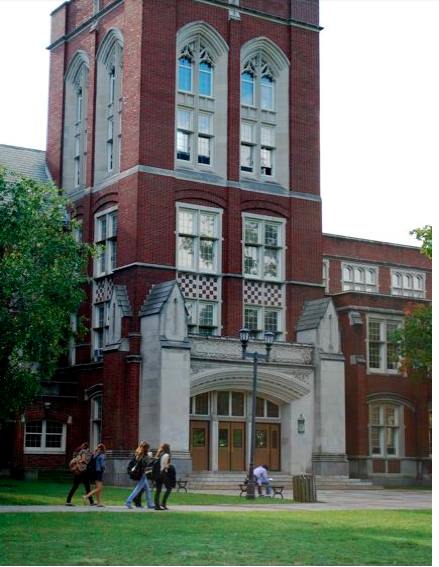 A recap of the Board of Education meeting on Monday October 20th was emailed to the community, but here are a few highlights:
Cafeteria Tours: Scarsdale High School Principal Ken Bonamo will lead tours of the High School cafeteria on Monday, October 27 and Wednesday, October 29 at noon (leaving from the Brewster Road lobby of the High School), so that community members have an opportunity to see for themselves the conditions that will be addressed by the proposed bond. Advance registration is not required, but please be prompt so that the tour can start in a timely fashion. For further information, please contact Vicki Presser:
Greenacres School: The Board of Education has formed a building committee for Greenacres School that will meet once a month for the remainder of the school year to consider the needs for Greenacres School. The feasibility study from the architects is in process.
Smart Schools Bond Act: The Smart School Bond Act of 2014 will be on the ballot on November 4. The act authorizes the state to sell up to $2 billion in bonds to provide access to classroom technology and high speed internet connectivity to equalize opportunites for children to learn and to install high tech smart security features in schools. If it passes, the Scarsdale School District will receive $445,000. If passed, these funds will be supplementary to the funds for technology in the upcoming bond proposition for the Scarsdale Schools. About the Smart Schools Bond Act, Dr. Hagerman said "There is some controversy surrounding this issue about a potential conflict of interest for those on the Governor's Advisory Group. In addition, there is concern that this act "is this an attempt to bandage the unfunded state mandate for testing and to increase testing at more grade levels."
Tenure: The following teachers and administrators are up for tenure in 2015:
-Edgewood: Julie Abbe and Allison Chiarello
-Greenacres: Erik Holvig,
-Middle School: Robert Daly, Michael Divino
-High School: Patricia Almanzar, Eileen Cager, Michael Egan, Jessica Gutta, Nicole Jakymiw, Jamie Quinn, Heather Waters,
-SHS Principal Ken Bonamo
Varsity Letter Jackets for Sale from Maroon and White:
 Maroon and White has re-established a long time Scarsdale tradition to offer varsity letter jackets for sale. Scarsdale Athletes will once again have the opportunity to wear their accomplishments and Raider Pride on their sleeves. These varsity letter jackets are for both young men and young women and range in Size from adult XS thru XXXL. This is not a fundraiser as the jackets are being sold at cost. Maroon and White has re-created these jackets so students can express their school spirit and athletic accomplishments. The order form and an FAQ section for how and where to put your varsity letters on the jacket can be found at maroonandwhite.org. Maroon and White will have sample jackets at the Fall Awards Dinner, the Winter Dessert Extravaganza and the Spring Picnic for those concerned about sizing. For delivery before the holidays send in the order form in by October 24th.
Candidates Needed for CNC and SBNC
- Details
- Written by: Joanne Wallenstein
- Hits: 5654
 Scarsdale residents are needed to serve on both the Citizens Nominating Committee and the School Board Nominating Committee. Find details about how to apply below:
Citizens Nominating Committee:
The Scarsdale Procedure Committee is still looking for candidates to run for the Citizens Nominating Committee (CNC) from all areas of Scarsdale. Candidates from Heathcote, Greenacres and Edgewood are especially urged to come forward.
The CNC is the backbone of the Scarsdale Non-Partisan system. This year the CNC will select a Mayoral Candidate as well as three Trustee Candidates. Biographical forms can be found on the Procedure Committee website under forms. Petitions are no longer required for this election cycle.
Please email your completed BIO to [email protected]. Nominations close on October 23rd. Please act quickly.
School Board Nominating Committee:
The School Board Nominating Committee is an elected group of 30 members who identify, propose and nominate qualified candidates to run for the Scarsdale Board of Education. The 30 voting members represent each of the five elementary school neighborhoods. Each year 10 new members are elected to serve a three-year term on the SBNC.
Please help to maintain our excellent Scarsdale schools and serve our community by volunteering to run for the SBNC. To become a candidate please submit a candidate petition by November 18. Forms and other information can be found at www.scarsdalesbnc.com.
The election to vote for this year's SBNC members will be on Tuesday, January 13, 2015 in the Scarsdale Middle School auditorium lobby from 7:00 am to 10:00 am and from 2:00 pm to 9:00 pm. The SBNC urges all qualified voters to vote in the election.
To become a candidate, residents complete a biographical form and submit it, with a candidate petition with signatures from 10 residents in their elementary school area, by November 18, to either of the SBNC Administrative Committee co-chairs: Bennett Josselsohn ([email protected]) or Mindy Tucker ([email protected]). These forms and additional information can be downloaded from www.scarsdalesbnc.com. The forms are also available at the Scarsdale Library and Village Hall.
Scarsdale BOE to put $18.12 Bond Referendum to a vote in December
- Details
- Written by: Joanne Wallenstein
- Hits: 8322
 In just three short months of collaboration, Scarsdale Superintendent Thomas Hagerman and the Scarsdale Board of Education led by President Mary Beth Gose came to consensus on a decision to put an $18.12 million bond referendum to a vote in December. The unanimous decision by the Board was the culmination of several years of planning that involved a wide swath of the community including Board members, administrators, teachers, parents and students. Building committees were formed to prioritize building needs and to work with KG&D architects to envision new facilities at district schools.
The board agreed on a preliminary list of projects in the spring and continued to analyze it when Dr. Hagerman arrived in July. After building tours and additional meetings with the community Dr. Hagerman recommended a project list totaling $16.7 million in early September.
However, after input from the community, Hagerman asked the board to recommend approximately $1.3 million in additional projects that could be added to the bond referendum, as favorable interest rates make this an optimal time to borrow funds.
This new bond will replace retiring debt and should be tax-neutral. An analysis by Assistant Schools Superintendent Linda Purvis showed that at interest rates of 3.0% and 3.25% the debt service on the new bonds would be less than the debt service on the existing debt and would result in tax-savings.
The Board faced a statutory deadline and had to agree on the bond offering at their October 6th meeting in order for it to be put to a vote in December. At their October 6 meeting they quickly agreed to the $16.7 million project list that includes the following:
- District-wide replacement of technology infrastructure: $1.4mm
- Quaker Ridge: Replacement of Roof: $908,000
- Edgewood School: Replace and renovate the library, relocate the office, create small group instruction space in old office area: $3,560,000
- Heathcote School: New multipurpose room and entrance canopy. Small group instruction spaces within existing courtyard: $3,387,000
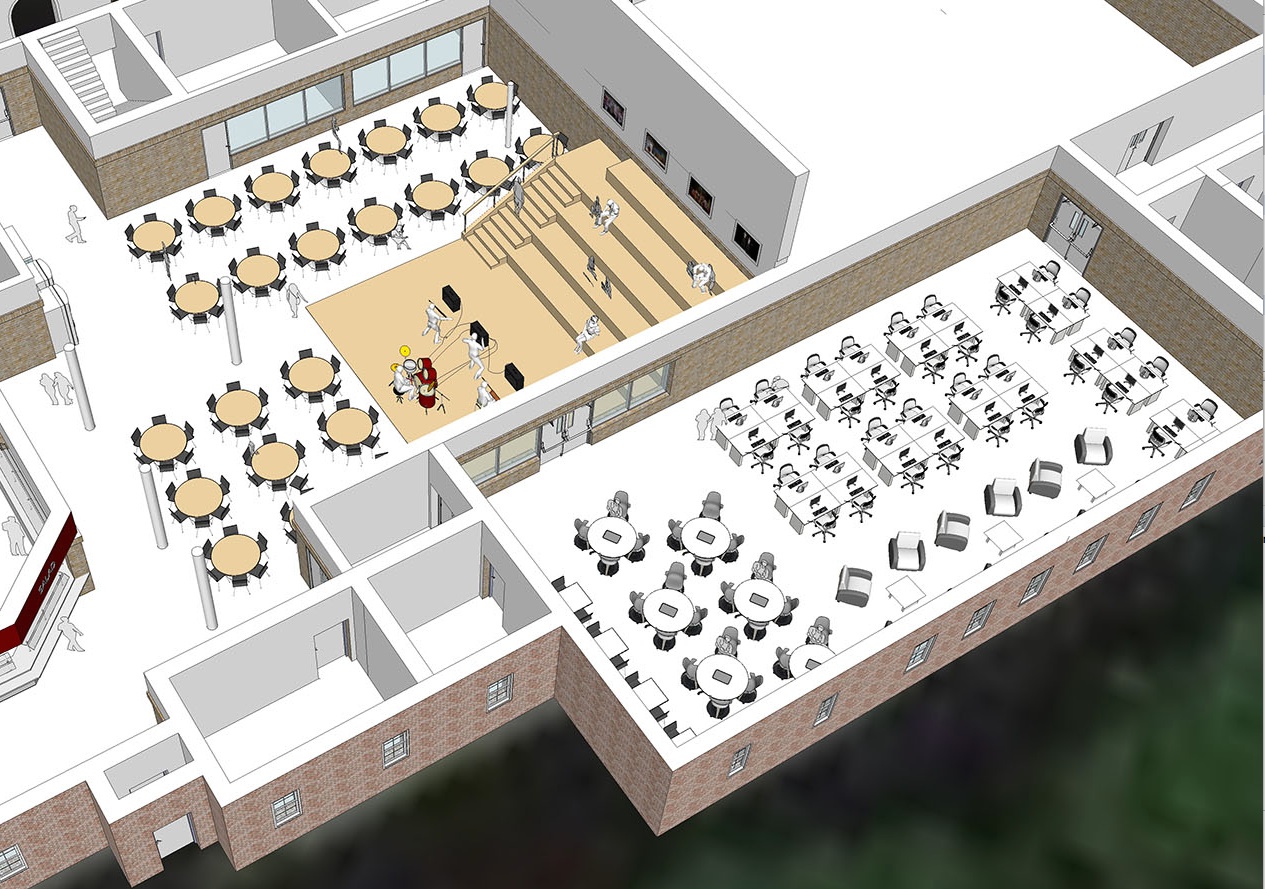
- High School: New Learning Commons with flexible seating and collaborative work spaces. I-Lab includes break-out rooms and instructional technology facilities: $4,691,000. Relocation of offices for physical education and athletics to facilitate creation of a Design Lab: $677,000
- Middle School: Addition of an orchestra rehearsal space and storage. Renovation of custodian's office to serve as new instructional music space: $2,097,000
Two additional projects at Scarsdale High School will be funded by the Scarsdale Education Foundation who will seek to raise $2.6 million of funding:
- Relocation of the fitness center to area below new gym
- Construction of new Design Lab in site of former Auto Shop
The board then turned to a discussion about additional projects for the high school that could be 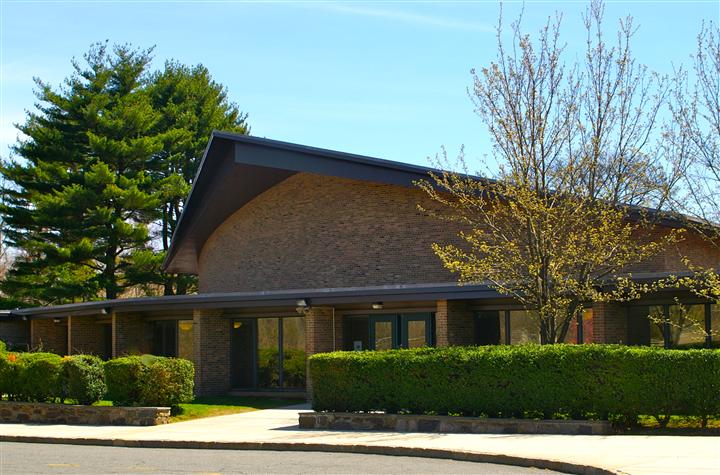 funded in this bond. On the list were repairs and upgrades to the high school that had been cut from previous annual budgets due to financial pressure. If not included in the bond, Purvis said they would have been proposed for inclusion in the 2015-16 annual school budget but she thought it made sense to borrow to fund the work at favorable interest rates.
Proposed was the following work for Scarsdale High School:
Repair of courtyard behind the auditorium to improve drainage where standing water has created problems. The work will require excavation and the installation of new drains: Project cost: $400,000
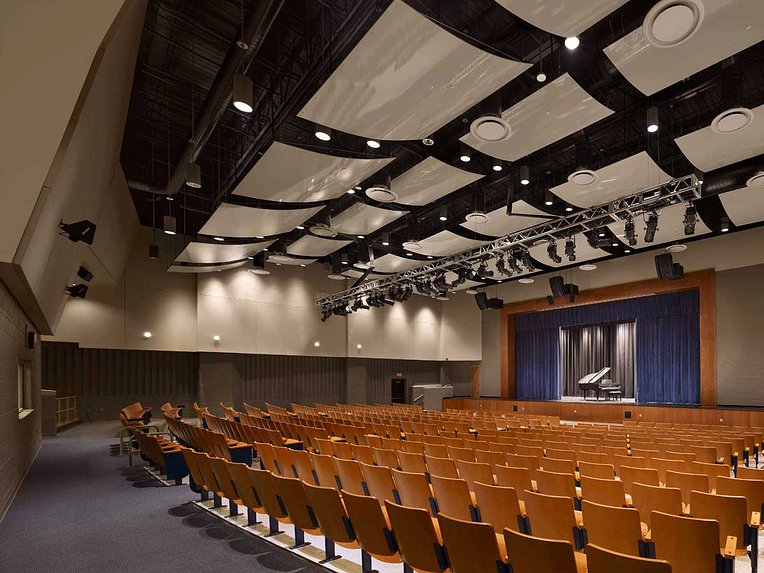 New seats are needed in the auditorium as well as replacement of the house lights with LED lighting and the installation of aisle lighting. A new sound system will also be installed: Project cost: $600,000
In Gym B ventilation and lighting are needed. The gym is often used for testing and is poorly lit and gets very hot in June when students are taking tests inside. Purvis said, "it would be good to be able to breathe.": Project cost: $400,000
Hagerman told the Board that this all added up to more than $1.3 million. However Lew Leone pointed out that $18 million was not a fixed number. He said, "We will not know what the interest rate is until we sign. We are hung up on $100,000 – that's silly. We are getting a lot of bang for our buck. I recommend that we go for the $1.4 mm in projects." After some discussion, the full Board agreed to fund all the work and add approximately $1.4 mm to the $16.7 mm – bringing the total to $18.12 million.
As part of the process the board adopted a SEQRA Resolution that affirms that the building plan will have no significant impact on the environment, approved the resolution to hold the vote for the bond proposition on December 11 and approved an understanding with the Scarsdale Schools Educational Foundation.
Among the provisions of the memorandum with the foundation are the following:
Objective: After financial contributions for both projects from the Board of Education, consistent with any legal requirements related thereto, the net of funds necessary to construct the Design Lab is $1.8 million and the Fitness Center is $800,000.
Support: The Board of Education and District leadership support the Foundation as it launches a fundraising campaign for these two projects.
Donor Recognition: The Board of Education agrees to support an appropriate means of recognizing donors to the projects, within the Board's sole discretion and with the details of that recognition to be determined through mutual discussion.
Fundraising: The Foundation will make every effort to raise the needed funds as expeditiously as possible, but cannot guarantee it will be able to raise the full amount. The Board of Education understands that the Foundation anticipates receiving multiyear pledges, and that that will mean a significant portion of the funding provided may not be available until 2016 or later.
Responsibility: The Foundation understands and agrees that the timing, scope and implementation of these projects, including the development of related curriculum, remain the sole responsibility of the Board of Education and District staff.
Commenting on the agreement, Seiden told the audience that the board and the district will not actively participate in fundraising efforts, as they not legally permitted to do so. She said, "Even though the board can't support fundraising the board can provide facts and information to support fundraising – but not ask for funds."
Board members were all enthused about the decision to put the bond to a vote, which will be held at the Scarsdale Middle School on Thursday December 11 from 7 am to 9 pm.
Commenting on the decision, Board V.P. Leila Shames Maude said, "The process was not always neat and tidy – but we got to the best possible solutions for our children." Bill Natbony said, "The Board has shown flexibility and shown that we listen. I thank the community for their comments and I can't wait to see it come to fruition." Suzanne Seiden who served as the Board President last year said, "Thank you to the community, Russ Davidson, committee members and those who came to the discussions ... without all of your participation we would not have gotten to where we are today." Scott Silberfein said he was "very excited," and President Gose thanked Seiden "for a wonderful job last year." She added, " these are wonderful enhancements and much needed repairs. This investment in our facilities will outlast all of us. I strongly believe in them and support them."
Scarsdale Forum President Bob Berg who has criticized the board for overspending in the past indicated his support for a bond referendum of $18.12 mm. He said, "I am not know for asking the board to borrow more. But in this low interest environment I think we should do the additional $1.3 million in work. Breathing in the gym would be good!"
The only unhappy person in the room was Bob Harrison who threw what I can only call a temper tantrum about the board's new policy to post the meeting agenda and supporting materials online rather than print out reams of paper for distribution. All materials are now projected onto screens during the meeting to allow the audience to see relevant documentation. However Harrison, who often appears at meetings with stacks of paper that he leafs through and piles up on the floor was unhappy that he was not given copies of the materials to examine.
In a combative tone he said, "I value open government. I think the board has taken a step backward. I see no reason why we can't have the written information. I think you should be ashamed of yourselves! What are you hiding?"
Holding up a packet of paper from the Village Board meeting he threw it to the floor and said "Look what the Village gives out." Referring to the budget he said, "We have nothing to review! The process is just no open. We are busy people – we can't be prepared for tonight. We need information so we can make good decisions. Do we have to download your materials so we can attend your meeting?"
Gose was patient with her response and said, "We appreciate your advice. I spoke to the board attorney and we are the last district that has not gone to electronic communications. I appreciate your patience and tolerance while we adjust to the use of electronics. We are working hard to be open and transparent. ...The information is available online in a more readable format than it was before."
In other business the board voted to form a "Policy Subcommittee" Chaired by Bill Natbony with members Chris Morin and Scott Silberfein. The purpose of the subcommittee will be to suggest new policies (such as the communications policy) and make recommendations to the full board for review. Gose said "this will allow these discussions to take place outside of the full board meetings," though the subcommittee's meetings would be open to all.
The decision to move forward with the bond referendum was greeted with clapping and cheers from the audience. Many were gratified that the process to gain consensus was successful and were heartened that the community had come together to rally around continued investment in the schools.
Email from Dr. Hagerman: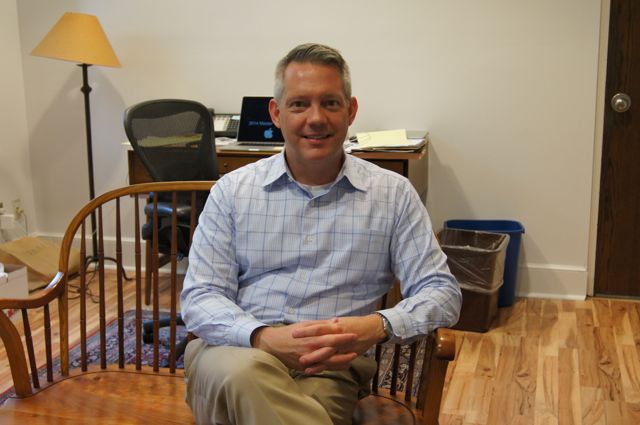
Following the Board of Education meeting on Monday night, Superintendent Thomas Hagerman sent out the following letter in an email to the community:
Dear Parents and Community Members,
Like many others, I was extremely pleased by Board of Education's bond proposal approval. Although I have only been involved in our facilities work for a short time compared to many staff, parents, community and Board members, I am deeply invested in this work. As I mentioned in a recent Insight article, teachers are clearly the single most important variable in classroom learning; however, an environment that supports learning goals, fosters collaboration, and responds to changes in student and teacher needs is also vital. Today's dynamic classrooms must necessarily be able to serve as lab spaces, gathering spots, work stations, and research hubs—and these purposes are fluid, spanning a unit, a week, or even a single class period.
In a recent article in the Harvard Education Letter, Prakash Nair, a leading futurist and architect, wrote that, "The vast majority of our schools are designed as 'cells' and 'bells': Students occupy cells called classrooms until the bell rings, then they move on to another cell." As the article continues, Mr. Nair challenges us to think about 21st century learning skills where all spaces in a school are conceived of as learning studios, and clusters of these studios can be thought of in terms of learning suites. If this paradigm is used to shape our thinking about schools, we begin to break down the isolationism of individual classrooms and begin to envision a school that is flexible and adaptive, mirroring changing education pedagogy. As a case in point, many of our schools have maker spaces that occupy real square footage, but maker spaces also exist in other iterations, both inside and outside of traditional classrooms. Likewise, I believe that the proposed Learning Commons at the High School has the ability to transform learning by providing maximally flexible space for students to congregate, study, experiment, perform, and yes—eat. This is not only a reflection of best practices in 21st century learning, but preparation for future college and career—and life.
Although this process has been protracted and messy at times, so are some of the best recipes, stories, and experiments. In my humble opinion, I believe this has been time well spent. I am confident that we reached the right balance on this proposal with respect to balancing brick and mortar needs, programmatic growth and change, and our vision for design thinking and STE{A}M curriculum. I am also pleased that we have had incredible involvement and collaboration from students, staff, parents, and broader community. I would like to thank the Board of Education for their commitment to this work and the time and energy to bring this proposal to fruition. I would also like to offer my thanks to the many staff members and volunteers who have spent countless hours in preparation to move this important bond proposal forward to the Scarsdale community for a formal vote.
I encourage everyone to have their voice heard on this issue by voting on December 11, 2014, at Scarsdale Middle School, between the hours of 7a.m. to 9 p.m.
It is truly an exciting time for Scarsdale's students, schools and community.
In Service,
Dr. Thomas Hagerman
Proposed School Bond Referendum Reviewed at LWVS Forum
- Details
- Written by: Joanne Wallenstein
- Hits: 6021
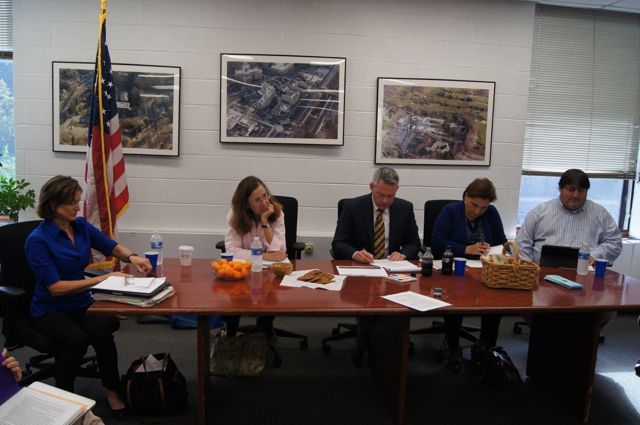 The big decision on the Scarsdale Schools Bond Referendum will be made by the Scarsdale Board of Education on October 6th. In order to examine the issues, the Scarsdale League of Women Voters held an informative meeting on Monday September 29. Superintendent Thomas Hagerman, Board of Education Vice President Leila Shames Maude, Board Member Bill Natbony and Assistant Superintendent Linda Purvis were invited to answer questions and provided information on the following and more:
- Why did the board agree to reduce the amount of the bond offering from the $18 million that was agreed upon last spring to $16.7 million?
- What is the role of the Scarsdale Schools Foundation in deciding which capital projects will be on the list?
- If the board opts for the $18 million bond, what additional projects will be added?
- How much will the new debt raise local taxes?
Superintendent Hagerman provided some background, reviewing the goals of the bond offering and how the list of capital projects was selected. Hagerman divided the project list into three categories:
-The first is to deal with health and safety issues such as the roof replacement at Quaker Ridge
-The second is to provide facilities for program enhancements and optimize learning spaces including a new music room at the Middle School.
-The third is to outfit the district for 21st century learning by implementing a district-wide replacement of technology infrastructure and building a new learning commons and design lab at the high school.
Though the building-level committees and administration identified and considered over $35mm in facilities needs the Board opted for the $16.7mm plan. What was the thinking behind this decision?
Hagerman and Purvis explained that all of the district's buildings are over 50 years old, with the high school more than 100 years old. In addition, the Greenacres School will need either extensive renovations or to be totally replaced. Therefore, the administration is considering this bond referendum to be the first step in a 15 to 20 year plan to fund plant improvements. In order to keep tax increases to a minimum, Purvis anticipated that the district would raise more funds when the debt on a $17.8 million bond offering from 1998 and a $15.8 million bond from 2000 retire in 2018 and 2019.
Maude went on to explain why the board voted unanimously to adopt Dr. Hagermans's recommendation to cut $1.3 million from the initial $18 million bond referendum at their September 8th meeting.
She repeated her comments from September 22 when she told the community that in early July Dr. Hagerman and several board members and toured the facilities. At the Scarsdale Middle School they looked at the existing space and learned that a computer room, the shop-tech room and a nurses suite would be available in the future for repurposing. Therefore there was no need for additional classroom space. This information changed their view about building a room in the existing courtyard. Instead they opted to propose building one orchestra practice room and renovate existing space for instructional music.
Then they toured the high school with the principal and facilities manager and examined the space that would become a corridor from the library to the new learning commons. They determined that a second security checkpoint would be needed at the entrance to the library. After some discussion they decided that this corridor could be submitted to builders as an alternative --and if it could be worked into the budget it would be built.
They also discussed food delivery and receiving and determined that a covered area that was in the architect's plans for this purpose was not essential.
The savings from these two changes amounted to $1.3 million and at the September 8th Board of Education meeting the superintendent recommended the board adopt the plan with these revisions.
In making this decision the Board considered communications they received from the community during the summer months. Maude said we received "a tremendous amount of positive feedback," but it was not all positive. Some said "that the new learning commons was too expensive and looked like it belonged at a college." In addition, commenters were concerned that the new learning commons would require two additional custodians. Others were concerned that the district had paid off $12 mm in debt and was replacing that with an $18 mm bond.
About the recommendation Hagerman commented, "I consulted with the board and the principals. I did not want one small project to jeopardize the entire plan. We had to move forwarding a positive way. So we scaled back on a few things to make this happen." Maude commented about the role of the Board of Education and administration saying, "In the end, the administration makes the final recommendations to the board and it is the board who votes."
The conversation turned to the role of the Scarsdale Schools Education Foundation in selecting which projects to fund and in planning and designing facilities. Bill Natbony assured the group that the projects on the current list were chosen by the Board of Education, not by the foundation. He said, "Given cost constraints it became clear that we could not fund everything on the list. We asked the SSEF to wait until we decided what we could fund and then asked the foundation to help us to complete the projects. They wanted to provide funds to move the fitness center and fund the Design Lab as a discrete project to facilitate 21st century learning. These two projects lend themselves to fundraising – fitness and learning." He continued, "Without foundation funding, the overall list would need to be scaled back or eliminated completely."
Asked if the foundation will play a role in plan, design and development, Natbony said, "The answer is no. These are not the foundation's projects. These will be designed and run by the board with input from the architects and the community. The scope of the projects will be the sole province of the district and the administration."
What projects might be funded if the board decided to bring the bond referendum back up to $18 million? Linda Purvis responded, "The first place I will go is to the list of projects that we will propose next spring for funding in the 2015-216 school budget. Some of these projects are an upgrade to the fire alarms, new seats and runway lighting in the high school auditorium and courtyard drainage issues at the high school.
In the question and answer period, Dan Hochvert asked about the impact of the new bond offering on taxpayers. Purvis was not able to give an answer at the meeting but later supplied Scarsdale10583 with the following estimate: Here is what she shared:
"Budget appropriations for debt service are scheduled to go down by $1,700,000 in the 2015-16 budget. The debt service associated with the bond issuance of $17,000,000 is estimated at about $1.425,000 annually if the Board borrows the money for 15 years at 3%. If they decide to borrow that amount over 18 years, the rate is estimated at 3.25% and payments are about $'1,260,000 annually. Obviously these are all estimates, based on the assumptions we have in place now. If interest rates bump up a bit or if the board decides to go back to the $18,000,000 total, then obviously the payments will be adjusted upward a little bit. But unless something changes drastically, the new debt service should still be a little less than what is coming out of the budget."
(Update October 2) On Wednesday night October 1 the Board met with the the Building Steering Committeeto discuss a list of capital projects that could be funded in the bond referendum if the Board decides to go from $16.7 to $18 million. These projects would likely be included in the proposed school budget for 2015-16. Among the prioritized projects are the following:
- Drainage work in the high school courtyard
- Seat cushions for the chairs in the high school auditorium
- Aisle floor lighting, stage lighting and the sound system in the high school auditorium
- Ventilation and lighting in Gym B at the high school
The Board is expected to consider these projects at their October 6th meeting.
New Classroom Design Heightens Student Engagement
- Details
- Written by: Joanne Wallenstein
- Hits: 8561
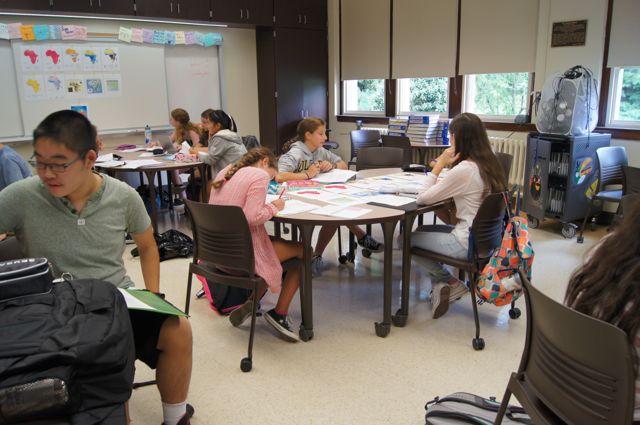
One high school teacher did not have to wait for the Scarsdale Schools Bond Referendum to pass to incorporate collaborative learning into the physical environment of her classroom. Social Studies Teacher Nicole Minchillo-Barber has already had design elements of an iLab integrated into her classroom during a summer renovation project to support a curriculum that involves critical thinking, problem solving and collaborative learning in a more flexible environment.
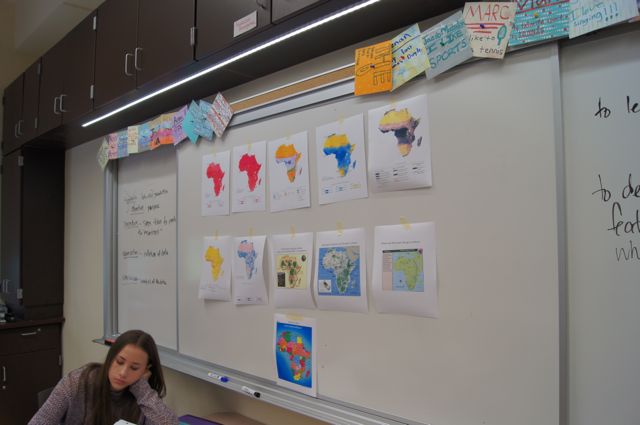
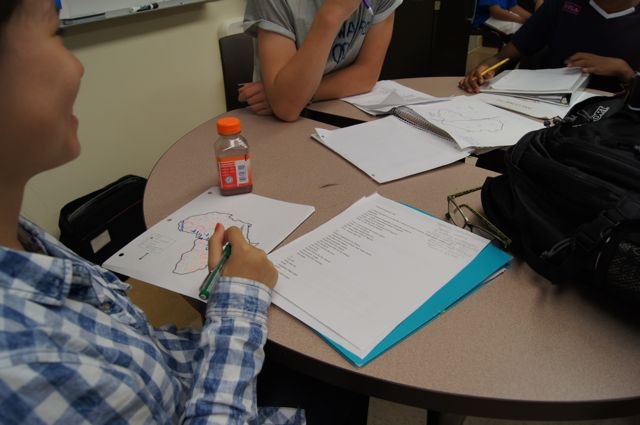
We were fortunate to visit her and see a ninth grade social studies class in action, working on a project on how the geographic features of Africa affect the population, national borders and development. We asked Ms. Minchillo-Barber to tell us more about the evolution of her classroom and here is what she shared:
Q. Can you explain why you asked to have your classroom redesigned, what features were included and how your teaching style is reflected by the new surroundings?
It was an organic process really. It just happened that room 303 was in need of some repairs. In speaking with Ken Bonamo, our principal, about these repairs, it became evident that to simply replace what needed to be fixed would not alleviate some of the "physical space" issues that existed in this small space. For example, I incorporate a considerable amount of Stanford Design School design thinking, whereby students use the physical pace of the room (wall, large tables, the internet, etc) to problem solve and ideate in groups and develop solutions to these problems. Previously only one wall in the room was effectively usable, so I was turning the windows and random sections of the room into "wall space" and filing out into the hallway to allow students the room to brainstorm, ideate and create. We agreed that this would be a good opportunity to redesign a traditional teacher-centered space into one that reflected the needs of students in a student-centered space.
Specifically, the room was gutted of its unusable and cumbersome cabinetry and corkboards, as well as the Smartboard. Working with Lisa Yokana, an art and architecture teacher here at the high school, we focused the redesign on maximizing wall space by utilizing "dead space," i.e., the four corners and high ceilings. We placed the storage space in the corners and across the top of the two sidewalls, thus opening up all three walls. We reoriented the "front" of the room so that it is not as deep and is more inclusive. We put white boards on all three walls, with sliding white boards on the two sides, so that when students ideated with post-it notes and brainstorming activities, we could return to those ideas the following class, undisrupted, while allowing me to conduct my other classes in between.
In addition, we selected configurable furniture that creates an atmosphere of communal learning and allows for a relatively easy transition of the learning space into a variety of activities. The classroom can be arranged into small groups, large conference tables, and pairings. I can arrange the room into pods with each pod having its own whiteboard on which to ideate. I can also arrange the room so that when I conduct a joint lesson or project with my 9th grade English partner, Amanda Filey, we can assure all students remain focused and engaged. The large, flat, even surfaces of the tables will also assist in large creative assessments.
Lastly, we opted to test out the next generation of classroom technology, a Sharp touch screen TV, and incorporate wireless mobile devices, specifically a class set of Chromebooks and an iPad.
Q. What kinds of problems are you asking the students to solve and how does the redesigned classroom accommodate this?
The World History 9 and 10, as well as the Philosophy elective are all critical thinking, problem solving and research based courses. As mentioned above, design thinking codifies all of these skills into one process. The classroom now provides a functional, flexible space for collective brainstorming and collaborative creating and problem solving, as well as the tools for research.
Q. Where did you get the idea to do this and what is it modeled on? Any special educational theory?
We believe that 21st century thinking skills can be more easily taught and practiced in a space that is designed to make this as natural as possible. We consulted the book, The Language of School Design: Design Patterns for 21st Century School, by Prakash Nair, Randall Fielding, and Jeffery Lackney. It reinforced our own experience-based conclusions that flexibility, adaptability, and variety are necessary to accommodate multiple intelligences and design thinking.
In talking to colleagues who visited the new iLab at Horace Greeley High School, they commented on the furniture and its multiple configurations, as well as how the different furniture had a tangible effect on student disposition to learning. Because of the positive feedback, we felt it was worth experimenting with configurable furniture.
Q. Have you noticed any changes in student engagement or attitude when comparing this year to last?
While its still early, I have noticed the rapid development of a communal and collaborative learning environment. From unsolicited and unprompted feedback from students, I have discovered that students feel more comfortable and empowered in the room. The room is less teacher-centered, simply because of the design of the room. For example, I am able to move about the room more freely to reach individual students and shift focus to different areas of the room and to different voices. With the use of the technology in the room I am able to maximize instructional time to allow for more lessons that develop skills and encourage collaboration and creativity.