







SHS Principal Ken Bonamo Looks Back and Forward
- Details
- Written by: Steven Friedman
- Hits: 6465
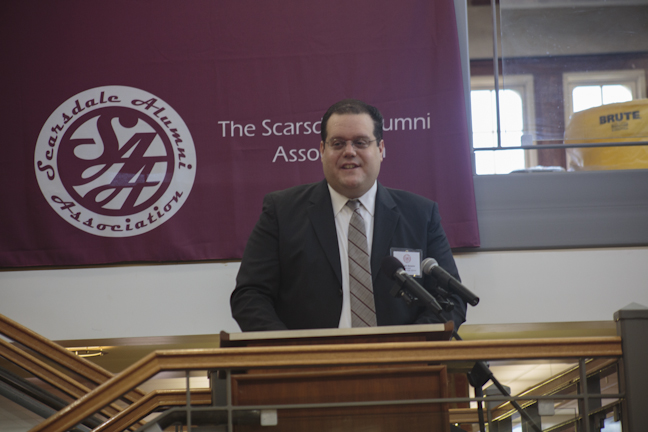 SHS Principal Kenneth Bonamo has recently completed his first year in Scarsdale. He came to the suburbs from an urban environment where he served as the Principal of Townsend Harris High School in Queens. He seems to have embraced all aspects of the job and is frequently seen at school events and school board meetings and delivered a moving address at the SHS commencement exercises in June on the power of love.
Steven Friedman, a 2013 graduate of SHS reached out to Bonamo to hear his thoughts on his first year in Scarsdale, including the impact of Sandy Hook, testing and the mission of the school. Here is what he shared:
What did you think of your first year at Scarsdale High School?
It was a year in which I learned a lot about our faculty, students, parents, and community. When taking on this leadership role, I knew my first goal was not to mess anything up. Scarsdale High School has an incredible history and functions rather well because of all that had been in place for years and the many people who work here. We certainly had a number of unexpected situations which were tremendous learning experiences. In terms of curriculum, we were able to move forward with some of the work on interdisciplinary initiatives by having teachers develop and offer new courses that really pull from two different departments. So much work had been done on interdisciplinary work and I think there was a real concern that it would wither from inattention, so I am happy with how we were able to carry that forward. Being surrounded with so many talented professionals and serving such wonderful students is really motivating on a daily basis.
How is SHS different from other schools where you've worked previously, and have those differences had any effect on your role as 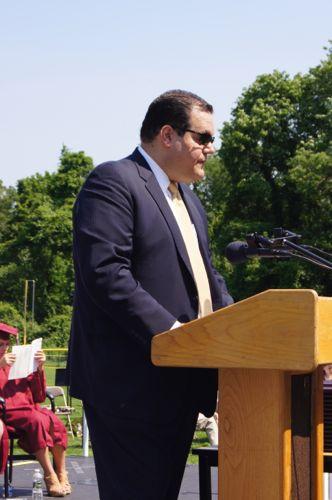 principal?
The main difference is the pace, which is breathtaking. We have extremely talented teachers working with high-achieving students in a community with high expectations. This means that not a moment is wasted in the day. Also, the support from the district office is much more evident. In New York City, the upper administration is far removed from the schools, and the frequent reorganizations prevented meaningful relationships from developing. Here, the close proximity allows for those deep conversations and thoughtful actions. The communities are obviously different, but then again similar in the desire for achievement and success--and the challenge of defining exactly what success means for different students in different contexts. The highlight for me in both settings is to work with brilliant faculty members to make students' experiences even richer, and working with students whose eager enthusiasm illuminates and energizes the school. That's what keeps me going.
What changes in school policy should we expect to see in the coming year?
I don't anticipate any changes in school policy. As situations arise, we deal with them on an individual basis, and if something warrants a full policy review, we do that. At present, there's not an area that has emerged as needing major modification.
What do you think could still use some work? What are the goals driving the administration right now?
I think there is a need to refine our vision, to figure out what students need to succeed both in college and in life in our ever-changing world, and to allow the community to appraise our work given the support provided. In a high-achieving school such as Scarsdale, there is a tendency to keep things as they are because they are working so well-- which is true. However, we know that the world around us is changing in terms of technology, in terms of the problems that need to be solved, in terms of the skills people will need to be attractive candidates for employment or successful entrepreneurs, and to lead fulfilling lives that benefit the greater good. So we may need to refine what we're doing to keep current. The real challenge will be determining what that looks like.
As a school administrator, how did you react when you found out about the tragedy at Sandy Hook?
It was of course very upsetting. To think of it on a personal and emotional level, to picture myself as the principal in such a situation, made it real for me. I think that's how some parents and teachers personalized it as well, by imagining how they would feel if their children or students or colleagues were indiscriminately murdered by a madman. After that initial reaction, we were able to really move thoughtfully through a review of our safety and security procedures. There was pressure from parents and teachers both to react immediately by putting new security in place and also to leave everything as it was. We took the time to listen to as many voices as possible and I think built the closest thing to a consensus we could achieve where we thought one was impossible.
What has SHS done or what will it continue to do in response to the attack?
Starting this September, access to the school will be limited to three designated entrances--by the nurse's office on Post Road, by the auditorium on Brewster Road, and by the gymnasium lobby. These entrances will be staffed by a monitor during school hours who will ensure that everyone who enters is a student or someone with legitimate business in the school. We will still be an open campus for students during they day; they will just have to re-enter through one of these entrances.
What's your view on the new state testing requirements? Will the school soon purchase tablets for every student?
The state tests have really moved away from the true purpose of standardized testing, which is to diagnose student learning needs. Giving tests to students without providing results that allow teachers and parents to identify areas for growth and areas of excellent performance is misguided. The frequent changing of standards further confuses the issue, and then developing educational policy around the idea of using these tests to hold teachers accountable for student performance discounts all the other facets of education, all the other ways students can demonstrate achievement, and all the other things teachers do to enrich their students' lives.
As far as computers, the district is moving towards a bring-your-own-device policy that will encourage students to bring whatever devices they have and access the school's wifi network. That seems to be the trend nationwide.
Have you been involved with programs like Civ Ed previously?
Civ Ed was my first experience with a program that so tightly coordinated English, social studies, and student development. It provides students with an outstanding experience, and I can see why it's been around so long.
Do you or the administration have any ideas about how to make the transition from middle school to high school easier for incoming freshmen?
Our two-day freshman orientation program provides students with the nuts-and-bolts right before they start high school. In 8th grade, we have a morning at the middle school for the students to meet with their high school deans, as well as an evening program for parents. During the freshman year, we have the Civ Ed and Freshman Seminar programs which help students with this transition. Add to these programs the fact that, on the whole, students have been together since kindergarten or sixth grade, and I think you have the makings for a smooth transition. There will always be times of adjustment, and our teachers and deans allow for that and help students when they need it.
Although you already spoke at our graduation ceremony, is there any final advice you want to impart to exiting seniors as they depart for college?
The best advice I can give is to find something that you are passionate about and follow it. Everything falls into place after that. A balance between careful planning and allowing life to happen (i.e. letting yourself live) also helps you to enjoy the ride.
Test Scores Under the Microscope: Beginning to Understand the NYS Test Results for Grades 3-8
- Details
- Hits: 5723
 At the beginning of vacation month for many Scarsdale families, Dr. McGill, Superintendent of Schools, sent an email to district parents regarding the recently released (to the districts, not to parents) New York State (NYS) test results for grades 3-8. We have reprinted the email, which came via the Infinite Campus Messenger system, for those parents who didn't see the original email, as well as for those who do not have children enrolled in district schools.
Dear Parents,
As you may know from recent newspaper reports, this past spring's round of state testing featured a new generation of more difficult elementary and middle school exams. As a result, the State Department of Education predicted that results would be weaker than in previous years. Officials said the decline wouldn't mean students were learning less or that they or their teachers were less effective. The standards were simply higher and harder to reach.
Locally, we began to receive score reports on Monday. We're still awaiting some information that will allow us to put the numbers in context. In a nutshell, however, and as the State predicted, the results aren't as strong as before. While the large preponderance of children continue to score in the 3-4 range, generally speaking, there are also more scores in the 2 range and some "1"s in each grade in each school. We anticipate that our overall outcomes will continue to be among the best in New York State.
A wider spread of scores is what one expects from a harder test – fewer at the top, more in the middle, some at the bottom. And in fact, that's exactly what we saw in Scarsdale before state tests displaced the more rigorous standardized exams we used in the 1990's.
Those earlier tests gave us information that helped identify individual student needs and program shortcomings. Because of security concerns, unfortunately, the State won't disclose similar information from the current tests. As a result, it'll be harder to use the results to improve instruction. For purposes of brevity, I won't explore this or other controversial aspects of the new exams here, but for those interested, will provide further information in the not-too-distant future.
The goal of the new state tests is to determine whether students are "college and career-ready." The State Education Department's method is to set annual learning targets by "scaffolding" exams, so that they build sequentially from one grade to the next. The assumption is that if students meet the targets, they'll move systematically and successfully from the elementary grades, through high school, to college or career.
In fact, most strong school districts, Scarsdale included, have long had sequential curriculums and assessments that set objectives for student growth each year. Among the difficulties with this construct: people don't learn in neat, sequential, annual increments. For example, gains often occur in spurts, in conjunction with brain development, not on a fixed schedule.
In practice, therefore, it's most realistic to evaluate children's growth in a larger context – looking at a much wider range of information than a single test score and also looking at the record over time.
Most broadly, what we know about student progress in Scarsdale is that children change and develop in many dimensions between the time they're in kindergarten and the time they're seniors. Over the full 13 years, motivated students, engaged parents and quality teaching combine to produce significant personal growth. When they leave us, 99 percent of our graduates go to college, 95 percent go to 4-year colleges and over 60 percent typically are admitted to the most selective colleges and universities in the nation.
We never want to be complacent, and we can always continue to improve. Nonetheless, the range of information we have about every Scarsdale student, as well as an established record of success, are cause for confidence. By providing our graduates a deep and powerful education all along the way, we foster able, contributing adults.
As principals and district administrators gain access to the full range of information about this year's state tests and as we have an opportunity to evaluate its significance, we may get back in touch with further thoughts. If you have questions, please share them. This being vacation season, please understand if a response is not immediate.
In the fall, and consistent with the usual practice, school principals will be in touch with elementary and middle school parents to offer more specific information about their children's performance on the spring exams. As always, there will be opportunities to discuss individual results and children's growth.
I trust that the summer months are being all you would wish and look forward to resuming our collective journey in the autumn.
Sincerely,
Michael V. McGill
Superintendent of Schools
Dr. McGill's email raises many important issues. One question that town residents are sure to ask is how test results will affect perceptions of Scarsdale schools and, possibly, property values. Will Scarsdale still retain its reputation as a town that stresses academic excellence? A visit to the New York State Department of Education (NYSED) website provides some understanding of how Scarsdale performed versus other districts across Westchester and the state. For example, Scarsdale performed significantly better in English Language Arts (ELA) than most other districts in Westchester and across New York State, even considering that the tests were redesigned and more challenging.
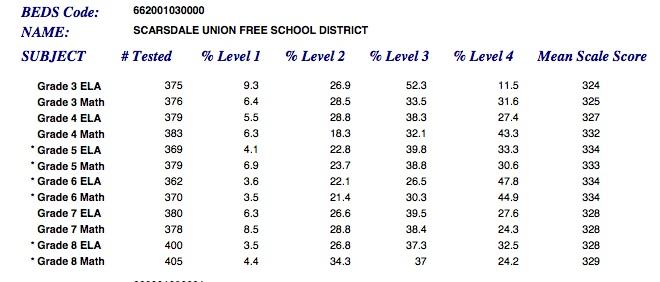
As stated by Dr. McGill, students' individual scores are not being released because of security concerns. What these concerns are remain unclear as procedures certainly could be implemented to protect the sensitivity of this information. Dr. McGill suggests that the amalgamation of scores by district, schools and grades limits their usefulness. More specifically, combining student scores in this way reveals nothing about how individual students have performed and whether a specific student is making adequate progress in reaching the standards developed by the NYSED. As such, parents and teachers are not able to use the test data to identify weaknesses in specific academic areas and intervene when appropriate. It should be noted, as Dr. McGill states in his email, that multiple sources of information are necessary to evaluate children's academic progress, not just a score on one test. However, the score on the state-mandated test could be one of pieces of information used to evaluate how well a student develops important skills over time. Failure to provide specific information about each student also does not allow parents, teachers and, perhaps most importantly, students, to appreciate significant improvements that are made academically over the years.
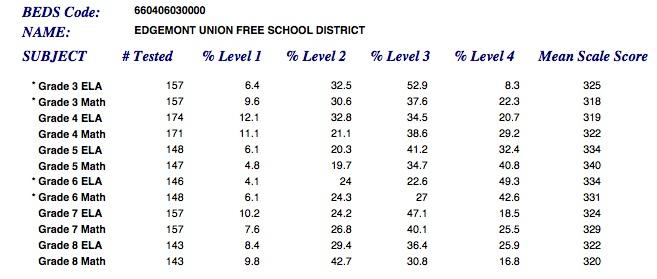
Another issue limiting the usefulness of the test scores is the apparent significant changes in the test content made to meet the "Common Core" standards. These changes reportedly increased the difficulty of the most recent tests administered over the previous ones. In support of these changes, The NYSED website states that "The new assessments are a better, more accurate tool for educators, students, and parents as they work together to address the rigorous demands of the Common Core and college and career readiness in the 21st century." However, the significant changes in the content of the test seem to severely limit its usefulness as a measurement of change from the previous state-mandated tests. As quoted on the NYSED website, Board of Regents Chancellor Merryl H. Tisch states that "These scores reflect a new baseline and a new beginning." One wonders, however, whether the content of the next series of state-mandated tests also will be modified significantly as beliefs about what constitutes the "Common Core" also change. In other words, will we face the same problem as we do now in that we may not be able to make valid comparisons between recent test scores and previous ones?
Finally, the wide-publication of state-mandated scores may result in a myopic perspective on how students in a particular district, school and grade are performing. As Dr. McGill emphasizes, there are many criteria that are necessary in evaluating the success of schools. Without a conscious awareness of other indicators of academic success, parents, teachers, students, and even prospective town residents, may not fully appreciate the high quality of education that students in towns like Scarsdale receive.
Scarsdale Teachers and Board of Education Agree on New Contract
- Details
- Written by: Joanne Wallenstein
- Hits: 19913
 The Scarsdale Board of Education and the Scarsdale Teacher's Association have come to an agreement for a new three-year contract. The announcement was made at the July 1 Board of Education meeting, concluding a tumultuous year of budget discussions and the rejection by voters of the initial proposed budget in May. The new contract freezes all salary increases for two years and eliminates Step increases during the 2013-14 and 2014-15 years. No cost of living (COLA) increase will be applied to the salary schedule.
Though salaries will not go up, the new contract provides teachers with stipends in lieu of increases. Effective September, 2015 there will be changes to the Step schedule that will increase the time it takes to move between lanes. In addition, beginning in 2014 Scarsdale teachers will contribute to their healthcare costs via payroll deductions.
Provisions of the new contract, which can be reviewed on the district website, include the following:
-Salaries will be frozen for the next two years and will increase by .05% in September, 2015 and by another .05% as of February, 2016.
-Beginning in 2014-15 all members eligible for health insurance will contribute 7% of the COBRA cost through payroll deduction.
-The Board will increase payments to the STA Benefit Trust Fund, that covers dental and life insurance, by $60 per year per employee in year 1, $60 in year 2 and $60 in year 3.
-Teachers who announce their retirement before January 15 of the year will receive a $10,000 stipend.
A joint committee will be formed to study the policy and practice regarding non-resident staff children attending District schools The Committee, will be made up of equal number of designees appointed by the President of the STA
and the Superintendent of Schools and will include a representative from the Board of Education. The committee will issue its finding and recommendations no later than October 1, 2015
Analysis:
Under the one year extension of the prior contract, which remained in force until a new agreement was signed, teachers were entitled to a 2.00% increase per year...(following a giveback from the teachers in an extension of the prior contract.) So, in the first two years of the new contract, the salary freeze will save the district an estimated $2,000,000 per year, or $4,000,000. This savings will be partially offset by the stipends, which for the 420 teachers will total $525,000 in year one and $735,000 in year two But, the $1,260,000 in total stipend payments will not increase the salary base – which will also save the district on pension and retirement contributions.
Critics of the first school budget complained that Scarsdale teachers were among the highest paid in the state, and the two year hiatus on salary growth stipulated in the new contract should work to bring Scarsdale faculty salaries in alignment with comparable districts. The new contract addresses another commonly heard criticism that teachers do not contribute to their health care costs, even though they pay very high co-pays per visit. This contract will require a 7% contribution beginning in 2014-15. To appease those who objected to staff children's attendance in Scarsdale Schools tuition-free, the contract calls for a study of this practice leading to recommendations.
Newly elected Board president Suzanne Seiden gave the following statement about the contract at the Board meeting on Monday night:
I am pleased to announce that the Board of Education and the Scarsdale Teachers Association have reached a contract Agreement that we will vote on tonight.
Negotiations were conducted in a spirit of partnership from our very first session in February 2013, and that spirit continued throughout the entire process. Both sides recognized that the uniquely excellent education offered by the Scarsdale Schools relies upon collaboration among the community, administration, Board and STA.
I am going to provide some context and then will ask Board members to explain different aspects of the Agreement. After that, the Board may have some discussion and then will vote on the Agreement.
It has been several years since we have negotiated an entire contract. The last Contract originally covered 2007-2012 and in 2008, the parties agreed to extend it through June 30th of this year. The Board began preparing for the current round of negotiations last summer, and the first bargaining session was February 14th.
The Board set goals for the negotiations. We believe we have reached those goals. The overarching goals were to slow the growth of both compensation and benefits and to bend the cost curve so that both salary and benefits would be in line with comparable districts in the region. To achieve these goals, the parties restructured the salary schedule and restructured the employee cost share for the Scarsdale Health Insurance Plan.
Both parties were mindful of recent contract settlements in the area as well as the importance of maintaining the professional standing of Scarsdale's dedicated teaching staff. Throughout the negotiations process, the Board listened carefully to all points of view at Board meetings, through letters, emails and community reports. We participated in good faith exchange with the faculty organization, recognizing the particular demands and parameters of public sector bargaining law.
Many people know when you are involved in contract negotiations, the result is a compromise. There is no winner and no loser. While I expect some community members will applaud this agreement, others may feel this fell short. Most important here is that the agreement benefits the District – all the students and the entire community.
We believe the settlement is a meaningful and pragmatic response to a challenging economic environment, the realities of managing one of America's premier school districts, and residents' financial capacity.
Board member Lew Leone provided a more detailed explanation of the terms of the new contract:
The term of the new STA contract is 3 years. The current salary schedule will remain in effect for two years and there will be no Step increments for two years.
In the 2013-14 school year returning teachers will receive a one-time non-recurring salary payment of $1250. Nurses, Ot's and PT's will receive $750. In the 2014-2015 school year returning teachers will receive a recurring salary payment of $1750 with nurses, OT's and PT's receiving $800.
In the 2015-2016 school year Step advancement will occur. On September 1, 2015 the salary schedule will increase 0.5% and on February 1, 2016 it will increase by another 0.5%.
On September 30th 2015, four new Steps will be added to the salary schedule at 2A, 6A, 11A and 14A. The amount of the new Step will be determined by adding one half of the value between the numbered Step and the next Step. For example Step 2A will be halfway between Steps 2 and 3.The other part of the contract which effects compensation is the decrease in the allowable STI credits which can be earned each year. Currently teachers can accumulate 8 credits.
In the 2014-2015 school year the number of allowable earned credits will decrease to 6. Also on the MA lanes 15 credits must be earned before a salary increase is realized. Currently a pay as you earn process is in effect where salary is increased with each earned credit.
The structural changes in this contract which slow salary growth over time include an increase in the number of Steps, an increase in the time it takes to move between Lanes and a freeze in the schedule for 2 years.
Commenting on the new agreement, Scarsdale Teacher's Association President Trudy Moses said, "The teachers and the Board of Education have, historically in negotiations, been partners in addressing each other's needs. This negotiation continues that partnership."
A collective statement from the Scarsdale Teachers Association and the Board of Education concludes as follows:
"Both sides recognize that the uniquely excellent education offered by the Scarsdale schools relies upon collaboration among the community, administration, BOE and STA. Both parties have shared responsibility for finding a structural solution that will control compensation over the long term and assure that teachers' are more closely aligned with those in comparable districts. The terms of the Agreement reflect a common understanding of recent contract settlements in the area while maintaining the professional standing of Scarsdale's dedicated teaching staff."
SHS Graduation 2013: The Power of Love
- Details
- Hits: 6902
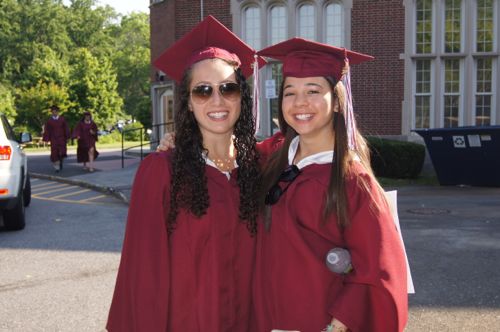
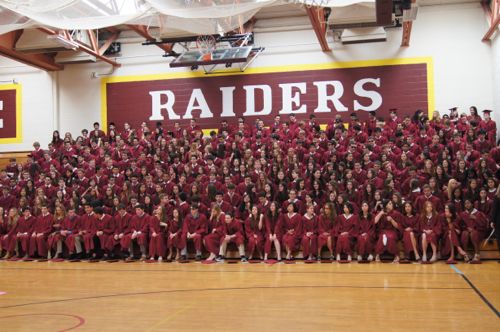
 You could feel the love at the graduation of the Scarsdale Class of 2013 on June 21, the first day of summer. The weather could not have been better – under sunny skies the class marched onto Dean Field to the sounds of Pomp and Circumstance played by the high school band. The relatively small class of only 324 students took their seats and breezed through the ceremony in the civil manner they have approached their tenure at the school.
Unlike their predecessors, this class seemed determined to do it right –- and graduated without putting the school administrators and parents through any major incidents, save a food fight. They passed on the traditional "senior cut day" and took pride in a homecoming victory against White Plains and a successful senior class production of "The Wizard of Oz."
School Board President Elizabeth Guggenheimer, an SHS grad herself, told the students that they have been taught to think, know and act in an interdependent world. As they step out into the world she advised them to "wear comfortable shoes, whether they be practical to help you move with confidence, platforms, or heels to help you rise toward your goal, flamboyant to help you express your creativity, or sturdy shoes in which you can walk run or climb as you pursue your passion."
Quoting Dr. Seuss she said, "You have feet in your shoes. You can steer yourself any direction you choose. You're on your own. And you know what you know. And YOU are the one who'll decide where to go..."
She asked them to consider two questions: "What can I do to make a positive difference now and how do I learn, work and live in a way to foster a sustainable, democratic world?" She advised them to "discover who you are and where you are going ... and to go forth and make your mark."

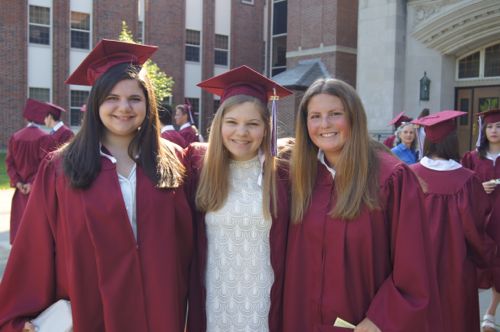

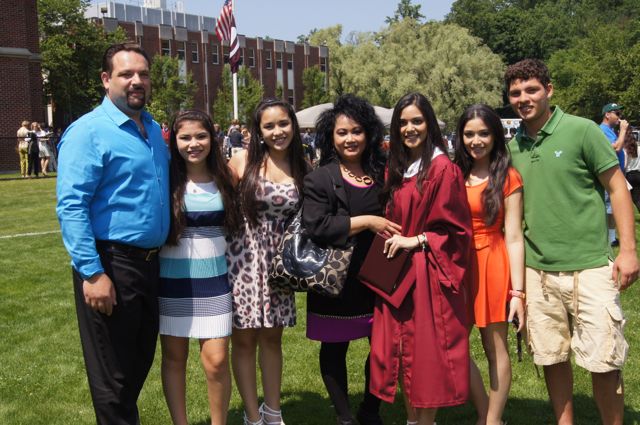
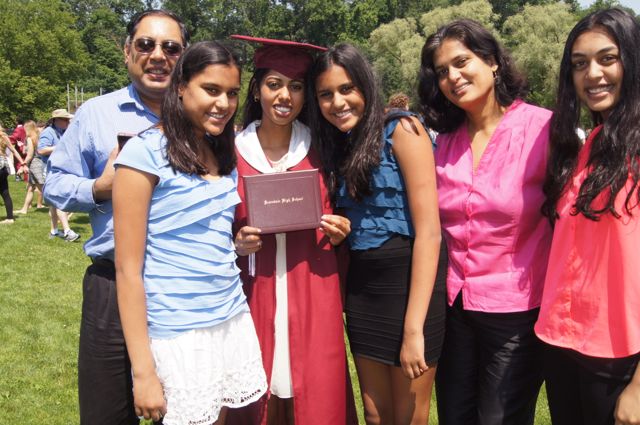


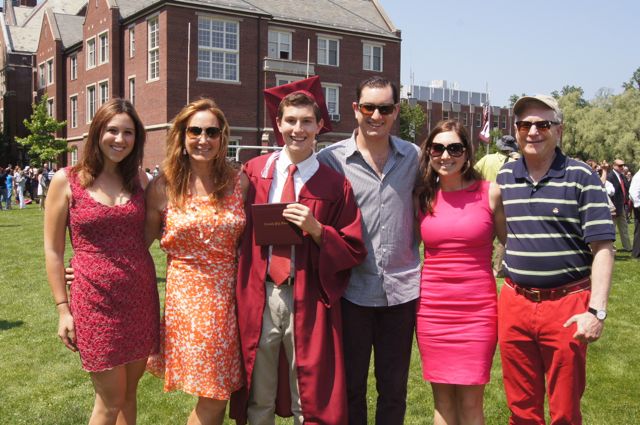
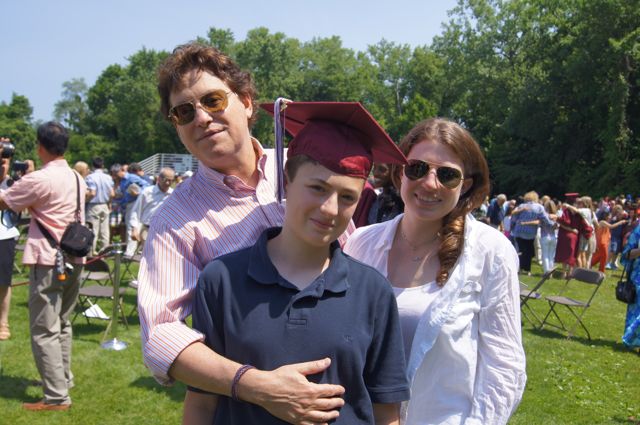
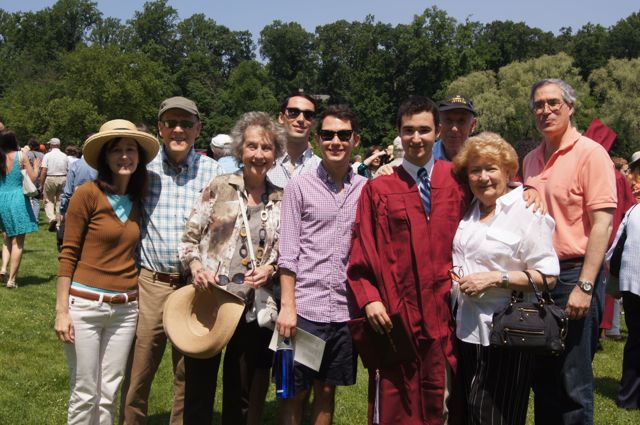
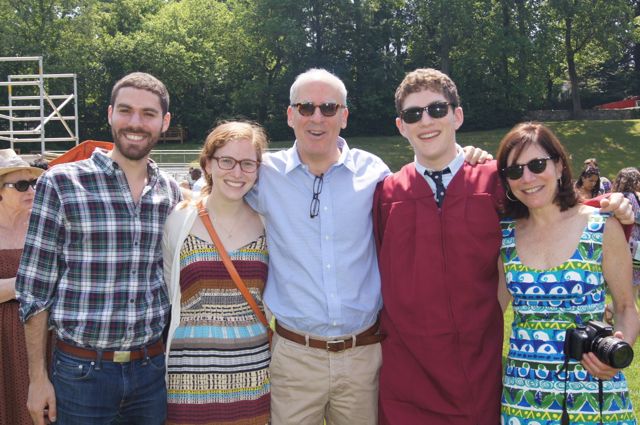

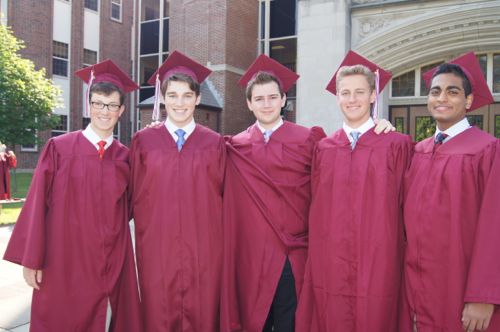
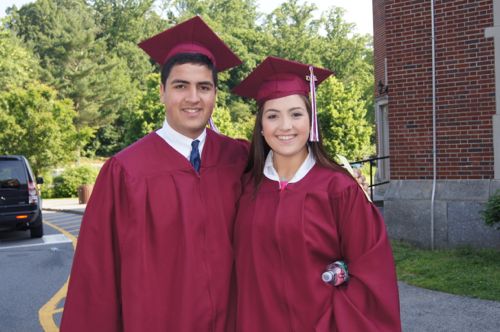


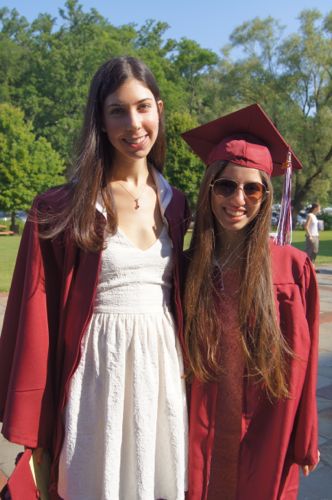

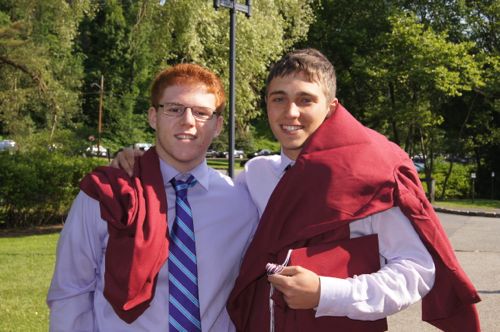
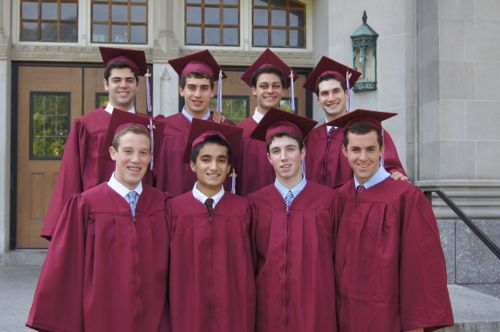
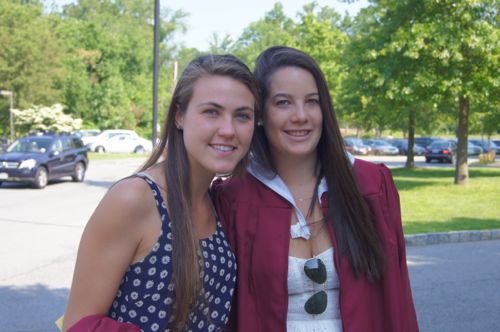
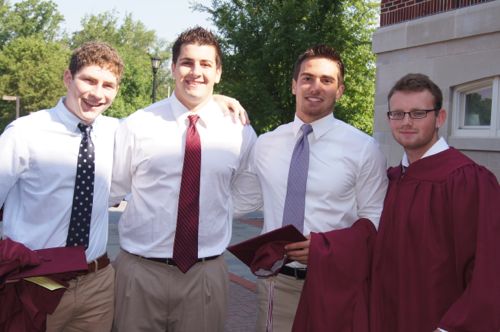
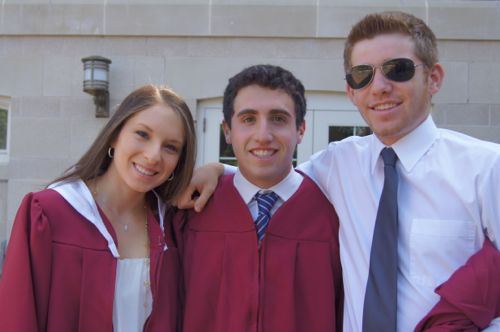
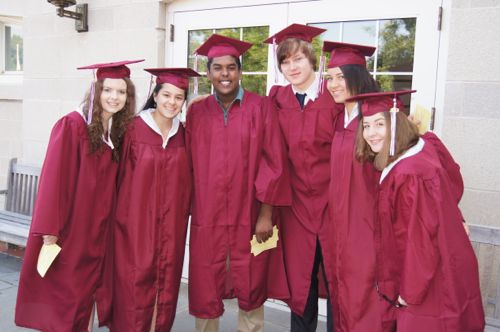
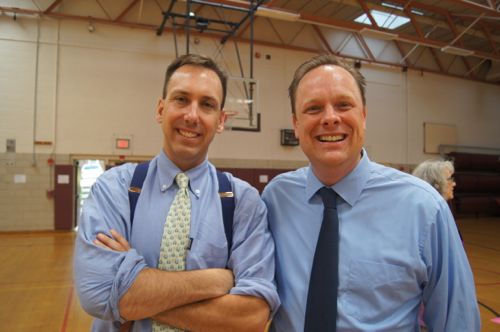


Class Treasurers Lindsay Root and Jake Gibson took the stage to introduce the class faculty advisors Lauren Barton and Jason Noble. Before he turned to the teachers, Gibson thanked Max Krohn, SHS'95 founder of Sparknotes, for allowing him to get a passing grade. He then said that he originally mistook Barton for a freshman and attempted to "brook her," that is to throw her into the brook but that she was saved by Noble. Root thanked the two for organizing and chaperoning class events, and being "the only two people to attend them!" Gibson then introduced Barton and Noble, calling them the mother and father of the class of 2013.
Before Barton and Noble could begin, they were interrupted by the ringing of an iPhone followed by the recording of the familiar voice of 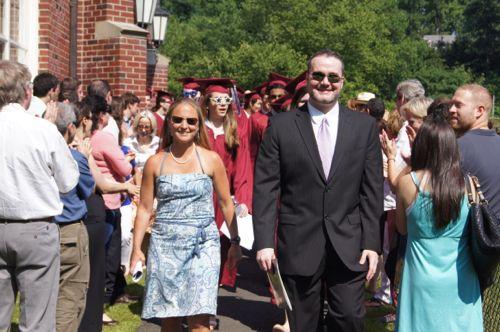 Assistant Schools Superintendent Linda Purvis making one of her famous robo calls. Purvis said, "Because of a freak June snowstorm and a locust invasion, graduation for the class of 2013 has been postponed. The entire class has been scheduled to return for a make up next year."
Barton recounted the many class events that were interrupted by the weather ... a rainy carnival for freshman year, Hurricane Sandy at the time of the Halloween breakfast, a thunderstorm during Junior Olympics and the rain on prom night. She credited the class with persevering. Noble told the class to "Go forward and pursue something you are passionate about.... I get to make beautiful music everyday." He quoted Steve Jobs who said, "Your time is limited so don't waste it living someone else's life. Don't be trapped by dogma—which is living with the results of other people's thinking. Don't let the noise of other's opinions drown out your own inner voice." Barton advised her students to "be true to yourself, be self-compassionate, and go forth and maintain your individuality but don't ever forget that you are part of a larger family."
Class V.P. Celeste DiLauro thanked the SHS staff and gave a special tribute to retiring government advisor Neil Ginsberg, or 'Gins,' "who attended every class event and had a deep interest in the well being of others." She thanked him for "offering guidance and advice in a time of change," and said" he will be greatly missed next year."
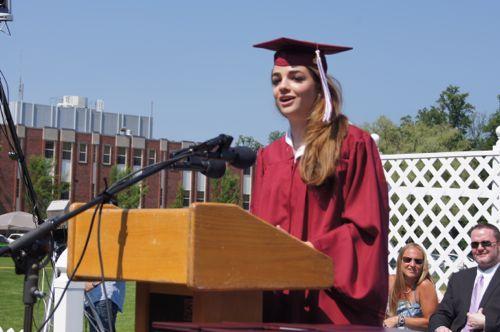 Class President Becky Goldberg opened by saying, "Have a good life ... We did it! And then made a mock departure from the podium only to launch into a longer address. She emphasized the bond between classmates and said, "You were a source of constant support during a difficult time at SHS, the losses of loved ones. You helped in a time of pain." She told her classmates to "look back at high school through the lens of honesty" and urged them to "join something, get involved, and build new relationships." In the words of Fat Amy, she said, "We crushed it."
In his first graduation address to the community SHS Principal Kenneth Bonamo gave an eloquent discourse on love. He called the graduation a "celebration of the purist form of love.... the love of parents for their children, the love of children for their parents which motivates them to fulfill their aspirations ... the love for subjects and teachers, and student and teacher relationships steeped in their shared love of learning." He told the students that "Love should continue to motivate you. Love of humanity, love of learning and the subject of your choice." He advised them to follow their hearts and study what they love, saying, "A subject chosen because you are interested will lead to work that never feels like a job and cannot be measured in dollars and cents....The key to your success will be to infuse love into your relationships and your work."
With that, School Superintendent Dr. Michael McGill "bid them go forth to grow in wisdom and to serve the common good," and the degrees were conferred on the SHS Class of 2013.
Scarsdale School Budget Gets 84.4% Approval Rate
- Details
- Hits: 7906
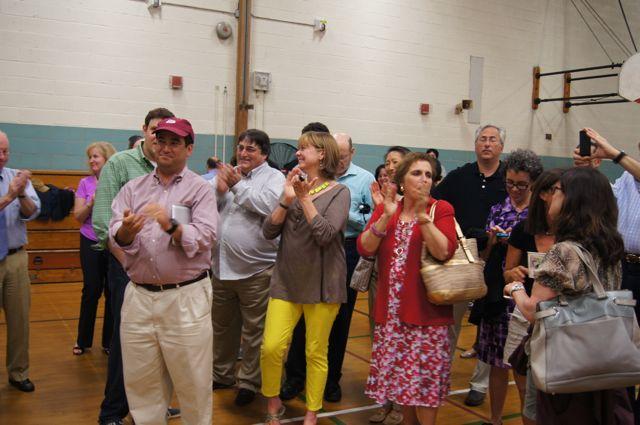
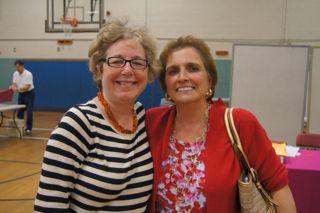 Scarsdale voters came out in droves to show their support for the Scarsdale Schools on Tuesday June 18. After the first budget was defeated for the first time in 43 years, the Board and administration responded with substantial cuts to the budget and met demands that the increase should come in under the NYS tax cap. The count was a remarkable 2,465 yes votes to 454 no votes, yielding a 84.4% approval rate.
The budget for 2013-14 is $143,899,713 and is only 1.49% above this year's school budget. The tax increase will be 2.82% for Scarsdale residents and 2.91% for homeowners in the Mamaroneck strip.
On June 18 the Scarsdale Middle School gym was packed with voters right up until the 9 pm deadline and officials were surprised at the high turnout for this second pass at school budget for the 2013-14 school year. In response to outreach by the Coalition for Scarsdale Schools, the PT Council, the PTA's, Maroon and White, the League of Women Voters and 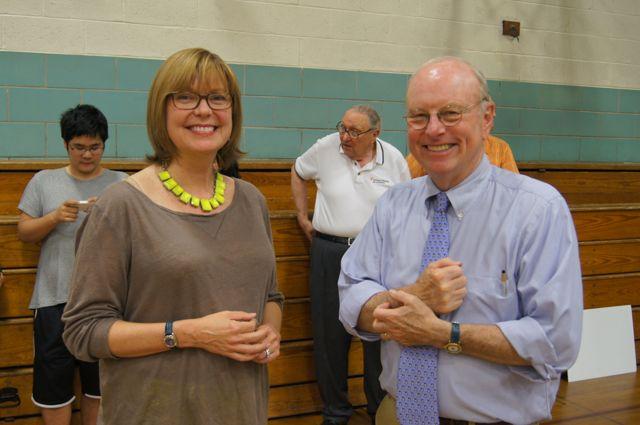 neighborhood associations far more voters were engaged than in previous years. The total vote count was 2,919 which is triple the number of votes in previous years. Last year for example, a total of 725 total votes were cast and in 2011 the vote count was 877. This year's approval rate of 84.4% exceeded approval rates of 79% in 2012 and 70% in 2011.
When Linda Chayes, Chair of the District Meeting for the Budget Vote and Election announced the results the crowd cheered and clapped in a mixture of happiness and relief. The vote ended four weeks of uncertainty, during which School Superintendent Michael McGill announced his retirement effective June, 2014.
Commenting on the outcome of the vote, School Board President Liz Guggenheimer said, "I thank the community for coming out to vote in large numbers. The June 18 vote shows incredible support of Scarsdale's public school system. With this budget, we can focus on keeping the strong Scarsdale schools strong. The Board looks forward to keeping the community informed about educational programs made possible by the budget. I hope the increased level of community engagement will continue as the District continues to move forward."
Art Rublin, who headed up the Coalition for Scarsdale Schools said, "Voters were out in force at the Middle School yesterday -- voters in Scarsdale and the Mamaroneck Strip OVERWHELMINGLY, and in historic numbers, approved a budget that, as our distinguished outgoing School Board President Liz Guggenheimer has said, will keep our strong Scarsdale schools strong. As our cherished Superintendent Dr. McGill said,"This is a statement that the voters want to support their schools and do not want to see them changed in fundamental ways."
Bob Berg, who was outspoken in his opposition to the first budget but supported the second proposal said, "I am delighted with the huge voter turnout yesterday and the landslide vote in favor of the second budget. This tremendous community support for our schools should silence the Chicken Littles who feared "the sky is falling" after the crushing defeat of the ill-considered first budget. The message is clear - "Power to the People" -- Scarsdale's taxpayers do strongly support their schools, but they now demand greater fiscal responsibility and sensitivity from the Board and the Administration to the taxpayers' pocketbook. The first budget's defeat and its aftermath have been extraordinarily beneficial for Scarsdale. The true "silent majority" have been empowered to make their voices heard. Going forward, I expect we will have a more transparent and open Board that welcomes vigorous debate with an engaged community and among themselves and an Administration that is more focused on making sure we are getting the best bang for our buck on existing programs rather than using our schools and our tax dollars as a testing ground for the latest educational fad du jour.