







Fostering Empathy at Scarsdale Middle School
- Details
- Hits: 7658
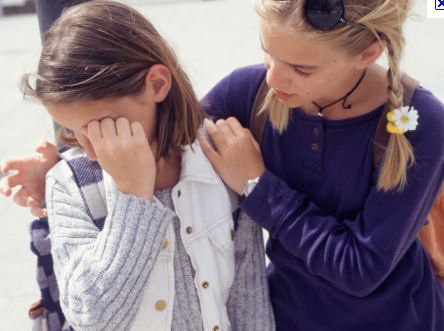 Middle School can be scary. It is a giant pool of hormones, ever-shifting cliques and preferences, mean girls, backstabbers, wimpy kids and jocks. I think I threw away every picture I had of myself from this age (acne, perm, Z.Cavaricci pants, I shudder at the thought) just to escape those memories. Scarsdale Middle School principal Michael McDermott and his staff are working hard to make the lives of the students at his school far better than many of our middle school years, with a focus on empathy.
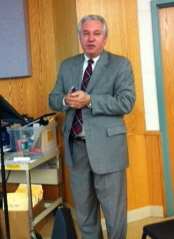
On Tuesday night, at Scarsdale Middle School’s PTA meeting, Mr. McDermott delivered his presentation: The Roots of Empathy: One School’s Story. He describes what it’s like to change the school’s mindset, create new programs and reshape the existing curriculum to create a more empathetic community.
In his dynamic presentation which had video clips, animation and music (inspired by Steve Jobs, according to McDermott), the principal explained that as humans we are wired to experience what others experience and as a society we have a drive to belong. “Developing empathy is like giving your school a heart transplant,” he says.
As adults we can all agree that the need to relate and belong is very much a part of the human condition, but seeing that translate in a middle school cafeteria is a very different thing. McDermott has observed this as an educator as well. He spoke of changing social norms -- where it was once the norm for kids to look away and comply with a bully -- now it’s the norm to treat others with respect and to speak up if someone is being intimidated. He highlighted class projects that helped the elderly and people with disabilities that allowed students to be empathetic to people who they normally wouldn’t speak to or think about. He showed videos students took where they examined themselves in the context of the world. For a 12 or 13-year-old who thinks he or she is the center of the universe, this is pretty earth shattering stuff.
Keeping it Local:
“We can’t be talking about saving Darfur one day and isolating each other in the lunchroom the next,” explains McDermott in his presentation.
The most striking part of McDermott’s presentation was a video of an interview with Dori Rosamond, the Special Class teacher at the middle school. Dori described how many of her students often felt segregated from the rest of the school and apart from the community. She spoke of how her some of her students would look down and avoid eye contact while walking the hallways. But through this focus on empathy, her class joined with high school volunteers and the kids began to open up, feel more confident and make friends outside the confines of her classroom. She also spoke of how the student volunteers also benefited from this program as several of them are siblings to autistic children. It was touching and inspiring.
What You Can Do:
As parents we can do a lot to create empathy in our children. Of course we know the basics, talking about feelings, creating a culture and a home environment that’s caring and respectful and having compassion for others. But there are things that I think many of us (ok, me and maybe you) do that perhaps can be changed or improved.
Praise publicly, correct privately: I’m pretty good about the first part, praising my child or even her friend about doing something great always feels good. That’s a no-brainer. On my best days, though, I will take my daughter aside or talk about behavior that wasn’t so great in private and talk about how situations could have been handled better. That said, I think more than enough parents have heard me say in not the quietest of voices “Are you kidding me?” to my daughter on the playground over some infraction. I have to work on that.
Yelling: If you create an atmosphere of yelling and tension or intimidation your kid is more likely to be a bully. I think most people know this. I think most people don’t want to yell at their kids. But long days, frayed nerves and bad or repeatedly bratty behavior will cause voices to rise. McDermott seems understanding of that. But if your goal is to raise a kind, empathetic child with a decent amount of self-esteem, think before you shriek.
Even in Jest: McDermott says that often when he praises a student to his parents, a parent will often joke ‘Him? Really?’ Now everyone gets humor and false modesty and gentle teasing, even kids. But he makes a good point. When your kid is getting praise, especially about good behavior, why minimize it? If there was ever a time to beam with pride and take a compliment, this would be it. You are also labeling your kid as bad. Boo. Don’t do that.
Speaking of Labels:
In an era when the phrase zero-tolerance, especially when it comes to bullying, appears to be the smart and pro-active thing to do, leave it to Scarsdale to go in the other direction. McDermott says that those types of policies really label one group of kids as ‘bad’, and one could argue another group as ‘victims’.
We know that tween and teen behavior can be unpredictable. But labels stick. A sure-fire way to get a kid to continue cause bad behavior is to label him bad. And with a zero-tolerance policy, there is no chance for redemption. If we can’t allow a 12 or 13 years old to redeem him or herself, then we may have missed the whole point of empathy.
We can’t really believe that everything is sunshine and rainbows at Scarsdale Middle School. That age is tough and I think we’d be naïve to say things are always easy for kids around here, but I think McDermott and his staff are doing their best to change minds and attitudes at the school and their work should be commended.
 This article was written by Jen Geller with input from Judy Stanley
Jen is a freelance journalist who has covered the economy and markets for over a decade at a major financial news outlet. She lives in Scarsdale with her husband and 2 children. Jen has yet to bake a successful batch of cookies.
---------------------------------------------------------------------------------------------------------------------------------------------------
Drug and Alcohol Task Force November Factoid
Real kids are curious about alcohol. 40% have tried it by the time they reach eighth grade. Talking with your children early and often can make a difference. Get the facts, the tools, and the advice you need to start talking real at http://underagedrinking.samhsa.gov/
The Scarsdale Task Force on Drugs and Alcohol encourages you to start the conversation with your kids now. Please visit our website and sign up for our email alerts at www.scarsdaleschools.org/datf
Heathcote Book Fair and the Fire Department Visits Edgewood School
- Details
- Hits: 4821
 Heathcote Elementary School hosted their annual book fair at the school this week. On Wednesday night from 6:30-8:00 pm, there were festivities going on at the school in conjunction with the book fair. Coach Steve conducted games and contests with prizes in the gym, there was Bingo in the multipurpose room, and the book fair in the Library.
Community Service was also encouraged throughout the book sale, as new PJs and new/gently used books were collected to be donated to local children in need.
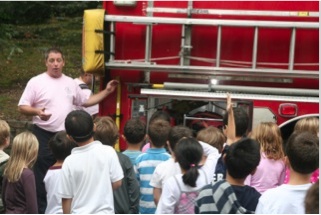 The Scarsdale Fire Department visited Edgewood's first graders on Friday October 14 to discuss fire safety. October is Fire Safety Month and firemen showed the young students how to prevent a fire and what to do in case of a fire. They demonstrated how to stop, drop and roll and to get out and stay out of a fire. Students watched a fire safety video and saw a fireman in full gear so that they would not be afraid if a fireman came to their aid. Finally, the tour of the fire truck was the event highlight for some.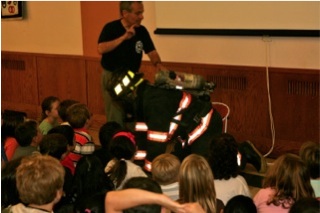
Mapping Educational Excellence
- Details
- Written by: Joanne Wallenstein
- Hits: 4648
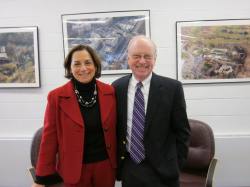 What is a world-class education and how can Scarsdale provide one to its students? That was the topic of discussion at the Board of Education meeting on Tuesday night October 11, when researchers from Columbia University presented their findings in an ongoing study of learning at some highly successful schools all over the world.
Sheridan Blau and Deborah Sawch from Columbia University Teacher’s College discussed the work they have been engaged in over the last three years in six countries to observe, evaluate and assess how critical and creative thinking are taught around the globe. The study involves collaboration with schools in Australia, Singapore, Canada and Scarsdale, where genuine, authentic learning is already taking place. The work will be expanded to Finland and Shanghai– where students are top scorers on international academic tests.
Speaking for the research team, Debra Sawch explained the progression of the team’s work. In 2009-10, researchers visited the Scarsdale schools to document initiatives in the Scarsdale Education for the Future. They observed classes and spoke with teachers and evaluated direct instruction, ethical thinking, perceptual thinking, critical thinking and creative thinking in all grades.
In the next phase of the study, researchers identified and visited successful schools in Toronto, Perth, Australia and Singapore where they observed science and English classes in grade K-12. They spoke to teachers at a mix of public and independent schools and looked at how students were taught to interpret, analyze, synthesize, apply and evaluate. They even examined how students tolerate ambiguity and take risks. During this phase the interviewed teachers to discern best practices, and observed and recorded.
What did these high performing schools have in common? Here is what researchers found these schools shared:
- Student autonomy
- Significant investment in teacher development
- Clear communication of school’s mission
- Curriculum and program aligned with mission
- Cross-grade and cross-disciplinary focus on real world problem solving
- Extracurricular activities to foster learning and global citizenship
In the next phase, Scarsdale will audit all of the critical thinking activities that are taking place within the district and decide the best way to document this information and share it with the other schools in the study. Administrators and teachers will seek to develop relationships with their international partners and look at the best way to collaborate with them on successful teaching strategies. Administrators hope that this work will become a model for other districts – similar to Scarsdale’s experience with Singapore Math, which is now under consideration by many other schools.
All the BOE members were very impressed with the research results and appeared proud to be part of a district that is setting new standards in education. It is remarkable that this groundbreaking research is being undertaken at a time when test results have superseded the learning process – and budget cuts threaten educational innovation.
Speaking for the Coalition for Scarsdale Schools, Edgewood resident Moira Crouch provided further validation for the study in her comments at the meeting. Referring to the tax cap which could cut funding for forward-thinking initiatives like these, she told the Board that the Coalition will support a budget to fund the existing program and also vowed to marshal votes for the super majority that will be necessary to override the 2% tax cap.
Students Win in the Investment Game at SMS
- Details
- Hits: 6915
 It’s never too early to learn how to invest your money – at least not in Scarsdale. At the Scarsdale Middle School, the process of learning to manage a stock portfolio can start as early as sixth grade, when students can sign up for the after school Investment Club, run by SMS Math teacher Robert Saya.
Saya, who has background in finance and accounting took over the club when Larry Chatzinoff, another math teacher became an assistant principal at the school. The club is open to students in grades 6 -8 and no one is turned away. A very popular after school activity, this year there are about 50 students enrolled who are managing their own phantom stock portfolios using a computer program from stockmarketgame.org .
Stockmarketgame.org and the New York Times provide free accounts for each student – and kids can access these accounts in school or at home. The program monitors trades, balances, assesses fees and allows students to simulate the experience of managing their own funds. Each student starts the school year with a $100,000 portfolio and at the end of April, Saya assesses who came out with the most money – or in some years, who lost the least.
With so many enrolled in the club, Saya relies on the older students to help the younger ones and sometimes asks students to attend on alternate weeks. Saya reports that kids learn valuable lessons from participating, grasping mathematical and investment concepts. Students often follow companies in the news, and theorize about how business events will affect share prices. Saya advises the students to learn what the companies in which they invest do, and to consider any ethical issues they may have with the company’s products or policies. Students use Yahoo finance to do research, track investment performance and compare competitors in the same industry. Saya also teaches the students about portfolio diversification and instructs them on how funds that are not invested accrue interest.
At the end of April all the portfolios are closed out and those who come out on top are recognized.
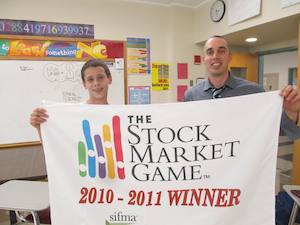
Last year’s winner was seventh grader Joseph Metviner of Fox Meadow. He finished the year with $123,000 in his portfolio and is pictured above with Mr. Saya. Joseph not only exceeded all the kids’ balances at SMS but came out tops among all 12 schools that participated in Westchester as well. He was awarded a medal and a certificate. In previous years there were also cash awards. Metviner’s strategy was to do research and to purchase stock in companies he believed in. He made few trades during the year, using a strategy of “buy and hold.” In the real market, Joseph purchased four to five stocks that have not performed as well as his SMS portfolio.
Asked to comment on the experience, Metviner said, “The contest was a lot of fun and has really turbo charged my interest in the stock market.”
We asked Mr. Saya if he has noticed any stocks that have stood out in the student’s portfolios and he told us that Chipotle Mexican Grill and stocks in the alternative energy sector have been winners. But he made it clear that he is an educator, not an investment advisor, and warned parents to do their own research. Next year, Saya says the students will learn how to evaluate companies to see if they are under or overvalued and might even get a peak at the real stock exchange via a videoconference.
The students are learning some valuable lessons that many adults only learn the hard way. So if your portfolio is suffering you may want to look to your kids for advice!
Complex Thinking and a Budget Surplus at the Scarsdale Board of Education
- Details
- Hits: 5573
 At the Scarsdale Board of Education on Monday night September 26th, tenure, class size, and critical thinking were on the agenda. The Board noted that last year was the first that the school asked for parent and student input on tenure decisions, by distributing questionnaires about teachers who were eligible for tenure. This new system was a success and the Board found that much of the feedback they got from the parents matched the schools’ evaluation. Residents can get the list of those up for tenure by calling the District office.
Dr. McGill discussed elementary school class size which was a hotly debated issue in the past school year. While class size is capped at 22 for grades Kindergarten-third and 24 in fourth and fifth, an exception will be made if there are children move into the district after August 15. According to McGill, the applicant pool of teachers late in the summer isn’t strong and he believes students are better served by being placed in an experienced teacher’s class with one extra student than by being placed in an additional section with a new teacher. (Though in this economy, one would imagine there are good teachers looking for work regardless of the date).
Among the items discussed and voted on were the approval of grant applications, money for new textbooks, new vehicles for out of district students, the student activity fund report and the health advisory council. Much of this was procedural and the Board quickly ratified the agenda.
The Board also heard from the community:
- Renee Baylor of Greenacres talked about the traffic pattern around Huntington Avenue and what could be done to mitigate potential accidents or tie-ups due to students crossing the street from the school to the field.
- The new executive director of the Teen Center Ellen Tiven-Moore was introduced as was the program director, Eugenia Valliades, a Scarsdale High School and Boston University graduate.
- Art Rublin co-director for the Coalition for Scarsdale Schools spoke about the fight against the tax-cap that was waged in Albany earlier this year, and stressed the importance of the town override.
A large portion of Monday’s meeting was dedicated to an education report. Assistant Superintendent for Instruction Lynne Shain, gave a presentation titled: “Can Scarsdale Students Solve the World’s Problems.” In it she discussed new ways for students to learn in a more dynamic fashion. The approach aligns with colleges’ expectations and also allows students to look at more complex issues and deal with high level challenges that often don’t have one answer. Shain called these type of problem, “wicked problems.” Shain illustrated this style of teaching by looking at an Earth Science problem. The first was deemed a level one type question; one that looked at land erosion and water flow. It was typical of a question that would be on a Regents exam. The second, a level two type question asked the student to draw from their knowledge of social studies as well as science and examine the flow of the Mississippi River and its tributaries and how the water flow affected regions, such a New Orleans.
The third, and most complex question looked at water flow, erosion and water rights between the US and Mexico. This involved economic, social as well as scientific and geographic knowledge. It was multidisciplinary and involved teamwork. Shain explained that this is the level of thinking and work they hope high school students achieve. She admits that this will take time as it involves new ways of thinking and breaking down walls between classes and subjects while adhering to state requirements. One can certainly see how students will be able to apply these skills and abstract thinking to real world issues. It will also require students to listen and work with others on challenges that do not have simple solutions.
Jeff Martin, District Financial Officer presented the 2011 financial report and said that at the opening of the 2011-12 school year the budget showed a $1.4 million surplus. While surpluses are always preferable to deficits, which the District faced at this time last year, Board member Lewis Leone bristled that the estimate was so far off. He suggested that taxpayers would think that the Board was padding the budget while raising taxes. Martin explained that the surplus came from many items that were unknowable when the budget was created, including lower energy costs, state aid and a large savings in health care costs. By switching health care plans, the District saved $1 million. This cost-savings could not have been estimated earlier. About half of the surplus will go back taxpayers, and the balance will be used to increase the retirement reserve and other savings and reserves.
Other items on the agenda that evening included authorizing funding for the teen center, establishing a Tax Certiorari Reserve and discussion of proposed capital projects such as repairs to Dean Field/baseball field. The Board discussed the merits of a Village plan to use excess soil from a storm water management program at George Field to raise the height of the gravel lot at the High School parking lot. Though this was not originally a priority, it may make sense to do the work in conjunction with the Village to avert flooding at the school.
On October 11, the Board will hold an open session for the school community at Edgewood School at 7:15pm, followed by a Board meeting at 8pm.