








Scarsdale Village Launches Food Drive
- Details
- Written by: Joanne Wallenstein
- Hits: 1612
 The Village of Scarsdale is pleased to launch a community-wide Food Drive for the month of July, in partnership with Feeding Westchester, a leading hunger-relief organization serving Westchester County. Summer presents unique challenges for food banks, as donations typically decline while the need remains high, particularly among families whose children rely on school meal programs during the academic year.
To help address this seasonal gap, the Village encourages residents to support neighbors in need by donating nutritious, non-perishable food items. High-priority items include brown rice, whole grain pasta, shelf-stable milk, canned meat and fish, peanut butter, whole grain cereals, oatmeal, canned vegetables, and canned or dried fruit. Glass containers will not be accepted. Donated items should be low in sodium and added sugars whenever possible.
Donations can be dropped off at any of the following locations—just look for the large white collection bins:
• Scarsdale Village Hall – 1001 Post Road
• Scarsdale Public Library – 54 Olmsted Road
• Scarsdale Department of Parks and Recreation – 244 Heathcote Road
• Scarsdale Municipal Pool Complex – 311 Mamaroneck Road
• Weinberg Nature Center – 455 Mamaroneck Road
* Scarsdale Public Safety Building - 50 Tompkins Road
• Starbucks – 51 East Parkway
• Lover’s Diamonds – 14 Garth Road
• Choice Pet Supply – 1 Palmer Avenue
• Ovder Scarsdale – 14 Palmer Avenue
Additionally, residents can shop directly from the Feeding Westchester Amazon Wishlist for convenient online giving. For more information, visit scarsdale.gov/fooddrive or FeedingWestchester.org. Donations will be accepted from July 1 to July 31, 2025.
Fox Meadow and Edgewood Elementary School Fifth Graders Move Up
- Details
- Written by: Katy Goldman and Eul Hui
- Hits: 3424
 Fox Meadow Elementary School
(Contributed by Katy Goldman and Eul Hui) On the beautiful morning of Friday, June 20, 2025, 102 fifth graders from Fox Meadow Elementary had their Moving Up ceremony. The ceremony was held in Fox Meadow's "Gymatorium." The graduates walked into the room to Pomp and Circumstance. The fifth graders were welcomed by Principal Melissa Feinberg and Assistant Principal Trish Iasiello. The class first recited the Pledge of Allegiance and then proceeded to sing "Kiss the Sky" by Roger Emerson, led by music teacher, Ms. Cynthia Gorney.
The students then heard encouraging and heartfelt words by Principal Feinberg and Assistant Principal Iasiello who both pointed out that their first year in their respective roles at Fox Meadow coincided with the graduating fifth graders' kindergarten year at Fox Meadow. They have all grown at Fox Meadow together! Principal Feinberg presented Assistant Principal Iasiello with her own Fox Meadow diploma as she is "moving up" herself to be the Principal at Greenacres school.
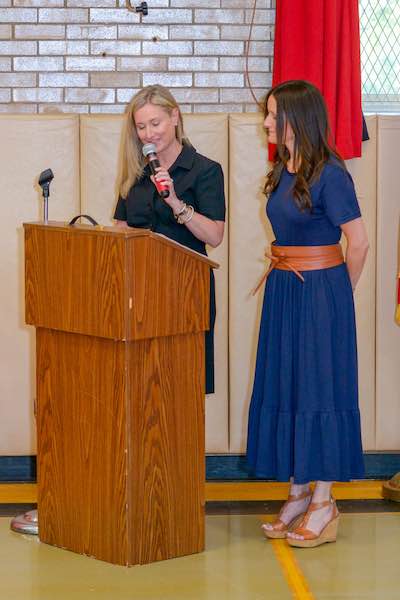








PTA Co-Presidents Katy Goldman and Eul Hui delivered some middle school advice to the graduating students and remarked that for 51 families, this was their last child to graduate from FM. The diplomas were handed out by the 5th grade teachers, Daniel Brodsky, Susan Gray, Alethea Lynch, Susan Smith (Sarah Berger) and John Speedling. At the conclusion of the ceremony, the 5th graders walked through the halls and enjoyed a final clap out from the rest of the school. It was a wonderful day at Fox Meadow!
Edgewood Elementary School
 (Contributed by Katie Garvey)
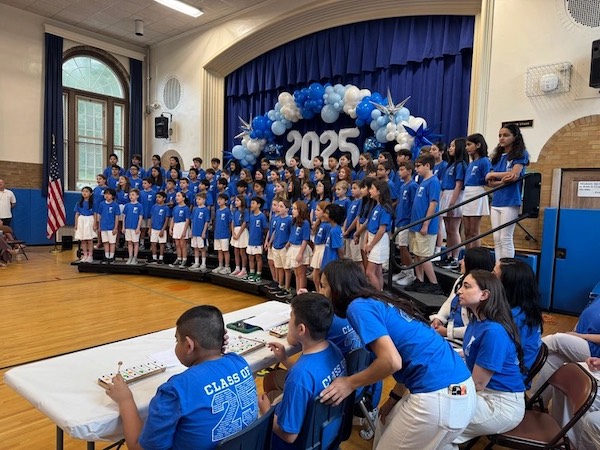
On the morning of Wednesday, June 18th, the Edgewood School gymnasium was filled with excitement and pride as the Class of 2025 gathered for their Moving Up Ceremony. With smiles on their faces and a bounce in their step, the students processed in to the familiar strains of “Pomp and Circumstance.”
The ceremony began with the Pledge of Allegiance and a spirited performance of the beloved Edgewood School Song. Principal Dr. Annette Keane offered warm welcoming remarks, and the 5th grade class followed with a touching rendition of “How Far I’ll Go” from Moana.
Each student was individually recognized by Assistant Principal Lauren Drapek and walked proudly to the front to take a commemorative photo with their classroom teacher and Dr. Keane. In her closing remarks, Dr. Keane reflected on the significance of the day, acknowledging the bittersweet emotions that come with transitions. She spoke from the heart about her inaugural class as Principal, encouraging the students to embrace the exciting adventures that lie ahead in middle school.
The celebration continued as the Class of 2025 exited the gymnasium together one final time. Families joined them for a light breakfast hosted by the PTA 5th Grade Committee, capturing memories with photos and receiving their brand-new SMS Class of 2032 sweatshirts.
Congratulations to the Edgewood School Class of 2025 — your future is bright!
Foley Has a Sterling Reputation for Hard Work, Intellectural Rigor and Giving to the Community
- Details
- Written by: Joanne Wallenstein
- Hits: 1812
 (This letter was sent by Former Mayor Jon Mark and BK Munguia in support of Tim Foley for the Westchester County Board of Legislators. Vote on Tuesday June 24, or vote early.)
To the Editor:
This week, Scarsdale voters will be selecting its candidate to run for term-limited County Legislator Ben Boykin’s seat. Two Democrats are running in the June primary to replace him, and the best candidate is the one most familiar to Scarsdale residents – our friend, Tim Foley.
If elected, Tim will follow in the footsteps of his former boss and Scarsdale resident Assemblywoman Amy Paulin, who has endorsed him. Tim served as Amy’s Communications Director and worked on the response to the 2018 nor’easter that left many in our Village without power for more than a week; the Assemblywoman’s response to Trump’s capping of the SALT deduction; and, creating sustainable funding for the Metro North Railroad.
Tim was profiled on "Scarsdale10583.com" as one of the most visible volunteers in our community, exemplifying Scarsdale’s “non sibi” values. We know him best from his years of leadership on the Scarsdale Forum, including a year as President, when, among other things, he took the initiative to create that organization’s Climate Resiliency Committee. He served for years on the Village Planning Board, where his attention to detail and reasoned analysis was put to good use. Whether as a member of the Scarsdale Bowl Committee, on the Advisory Council on Human Relations, as a Democratic District Leader, or even as a youth basketball coach, Tim has a sterling reputation for hard work, intellectual rigor, and giving his all to our community.
There can be no doubt that Tim is well prepared to enter County government. For years, he chaired the County Fiscal Affairs Committee for the Scarsdale Forum, analyzing the $2.5 billion County budget and testifying at budget hearings before the County Board of Legislators.
He has an impressive track record of bringing people together from all walks of life and with vastly different backgrounds and perspectives to make sure all voices are heard. That is exactly the quality we will need in our next County Legislator.
Because of a big Democratic enrollment advantage in the district – which includes 60% of White Plains and a corner of West Harrison in addition to Scarsdale – the winner of the primary is quite likely to win in November. If Scarsdale Democrats turn out to vote, we can make Tim Foley our next County Legislator. Primary Day is June 24th. Early voting is happening now. Please join us in casting your vote for Tim Foley.
Submitted for your consideration,
BK Munguia
Jon Mark
Remembering Brendan Marx
- Details
- Written by: Joanne Wallenstein
- Hits: 6726
 Longtime Scarsdale resident, attorney, father, friend, athlete, and philanthropist.
Brendan Marx, 67, a devoted father, accomplished attorney, and cherished member of the Scarsdale community, passed away on May 31, surrounded by his loved ones, after a courageous five-month battle with glioblastoma, an aggressive form of brain cancer.
Known for his quiet strength, kindness, and unwavering integrity, Brendan leaves behind a legacy of exemplary legal work, boundless love for his family, and a deep commitment to serving others.
Over a career spanning more than four decades, Brendan practiced law in New York with great distinction, culminating as a Principal at Offit Kurman. His clients included individuals, businesses, and organizations across a wide array of industries—from education and entertainment to manufacturing and nonprofit sectors. He was especially proud to represent charities, cooperative corporations, and condominium associations. Colleagues and clients alike described him as a brilliant litigator and one of the kindest people they’d ever met.
Brendan was born in Bronxville, NY, on December 9, 1957, to his parents, Roland and Patricia (Johnson) Marx and raised in Yorktown Heights with his three siblings. His childhood was filled with joy and adventure, shaped by parents who instilled in him the value of education, hard work, and above all, family. During middle school, Brendan’s family relocated to Paris, France - a place that awakened in him a deep connection to his heritage. Though not one for tattoos, he often joked that if he ever got one, it would say “La famille avant tout” ("Family above all"). He continued studying and practicing French throughout his life.
Service to others was central to who Brendan was. He devoted countless hours to charitable work, most notably through Hitchcock Presbyterian Church’s Midnight Run Program, where he regularly prepared and delivered food and clothing to the homeless in New York City for the past 15 years. His children have vivid memories of visiting Blythedale Children’s Hospital, delivering Thanksgiving turkeys to families in need in the Bronx, and welcoming a young girl into their home through the Fresh Air Fund.
While Brendan would be embarrassed to receive the accolade, he was a serious athlete - a marathon runner, cyclist and triathlete at the highest level. His favorite sport was skiing, although he did it less regularly. Less than 10 years ago, he became an IronMan champion. Brendan instilled in his children a love for running and biking. Weekends were filled with family bike rides, local 5k races, triathlons and impromptu backyard obstacle courses.
Above all his roles, Brendan’s greatest joy was being a father. He loved his three kids more than anything. His children describe growing up with him as “like magic,” recalling weekend adventures that ranged from hiking, white water rafting, to building life-sized igloos and sleeping under the stars in their backyard.
He is survived by his three children Kira Marx, her fiancé James Seidman, Lindsey Rappaport (Marx), son-in-law Michael Rappaport, Ryan Marx, and daughter-in-law Lauren Marx (Wiener); his beloved life partner Melissa Beverly; his former wife and mother of his three children Sandi Marx and their stepfather Keith Marshall; his father Roland Marx; his three siblings and their partners Robert Marx (Nancy Marx), Audrey Alonis (Joe Alonis), Elisabeth Marx (John Marco); his stepdaughters Colette and Celeste DiLauro; his grandchildren Jack and Jordan Rappaport; and his seven nieces and nephews Hayden Marx, William Marx, Andrew Alonis, Patrick Alonis, Amelia Alonis, Linus Marco, and Nina Marco. Brendan’s memory and impact will remain with each of them every day.
Brendan’s family is raising funds in his memory for research on Glioblastoma disease. Learn more and donate here.
Sign Up for the Arthur Manor 97th Annual Parade
- Details
- Written by: Joanne Wallenstein
- Hits: 2403
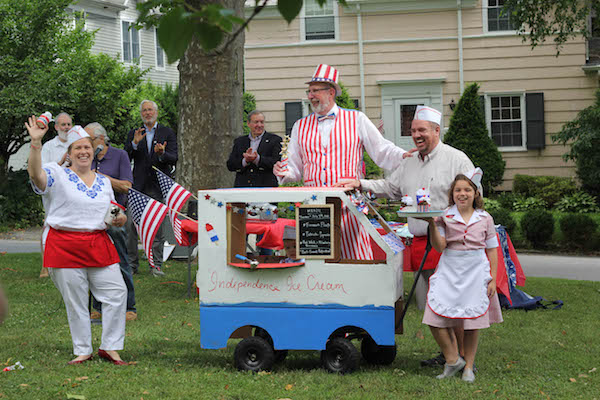 The Arthur Manor Neighborhood Association will hold its 97th Annual July 4th parade and ceremony on Friday, July 4th. The lineup for the parade will begin at 9:15 am at the corner of Bell and Sprague Roads and the parade will start promptly at 9:45 am. The parade will then march down Sprague Road, turn left at Lyons Road, and then proceed to Davis Park. Children interested in participating in the parade can dress in patriotic costume or decorate their bicycles, tricycles, wagons or strollers with patriotic decorations. Pets are also encouraged to dress in patriotic costumes.
The celebration continues at Davis Park with a ceremony, comments from Village officials, and awards for parade participants in all of the traditional parade categories. Following the ceremony, the Association will hold the annual field games – including the egg toss at the end! Hot dogs, bottled water and other food and refreshments will be available for purchase. The Association encourages everyone to come out this year and celebrate the 4th of July by showing your patriotic colors! Please contact Matt Martin at [email protected] or (917) 697-2747 if you would like to help out with this year’s festivities.